If I had one market weekend in Burgundy, this would be it.
There are markets somewhere in Burgundy almost every day of the week, but that doesn't mean they naturally fit together into one weekend. It's easy to look at a map and think Beaune, Dijon and Semur-en-Auxois are all close enough to visit in two or three days. Once you start looking at train times, market hours and how each town actually feels after lunch, the picture changes quite a bit.
One thing that surprised me about travelling around Burgundy without a car was how different the market towns are from one another! Dijon is still busy long after the stalls at Les Halles begin packing away. Beaune feels much quieter once the Saturday market finishes and the day shifts towards wine bars and cellar visits. In Semur-en-Auxois, people are already carrying baskets full of vegetables and cheese across the medieval bridges while many visitors are only just arriving from Montbard.
That's why I wouldn't try to squeeze as many markets as possible into one trip. Burgundy works better when you choose two or three places that naturally fit together and leave enough time to actually enjoy them. You might spend the morning browsing for local cheeses, fresh fruit and antiques, then find yourself sitting in the same café for an hour before wandering through streets that have become noticeably quieter now that the market has gone.
This guide isn't simply a list of Burgundy's weekly markets. It's about how to put together a weekend that works in real life if you're travelling by train, from choosing the right base and avoiding awkward Sunday connections to knowing which market towns complement each other and which combinations usually end up feeling rushed.
After a weekend like this you'll probably find yourself looking at TER maps differently. This guide makes planning the next trip much easier.
The market is only the beginning of the day
When I first started planning weekends around Burgundy's markets, I spent far too much time looking at train timetables and not nearly enough time thinking about what I'd actually do once I got there. On paper it looked easy enough to fit Dijon, Beaune and somewhere smaller into the same weekend because none of them seemed especially far apart. Then I arrived, bought far more cheese than I'd intended, wandered into a bookshop for "just five minutes", ended up sitting outside with a coffee much longer than I'd planned and realised the market had only been one part of the day…
And that's actually something I wish more guides talked about.
A market morning doesn't last all day. By lunchtime the fruit growers are packing away, the flower stalls begin disappearing one by one and the town starts becoming itself again. That's where the choice of market really starts to matter, because each place heads off in a completely different direction once the shopping is over.
In Dijon, people don't seem to go home when the market finishes. They drift through Rue des Forges, stop at the food shops around Rue Odebert, browse the shelves at Librairie Grangier, meet friends around Place François Rude or settle into a terrace on Rue Musette before eventually deciding where to eat. In Beaune, the shopping bags slowly give way to wine bottles. The terraces around Place Carnot fill up, the wine merchants along Rue Paradis and Rue Maufoux reopen after lunch, and the afternoon somehow slips away between cellar visits and long lunches. Semur-en-Auxois feels different again. Once the market starts disappearing, people cross Pont Pinard, wander along the old ramparts, sit beside the River Armançon or simply keep walking because another little street catches their attention.
It's one of the reasons I've never enjoyed trying to squeeze two markets into the same morning, even though it can look perfectly possible on a map. Burgundy is much more satisfying when you give each town enough time to settle into whatever comes next. A Saturday in Dijon followed by Sunday in Chagny feels completely different from trying to race between three stations before lunch, and spending the night in Semur-en-Auxois makes much more sense than arriving halfway through the market from Montbard and leaving again as soon as you've finished shopping.
The markets are still the reason I keep coming back, but they're no longer the only thing I plan around. They're really the beginning of the day rather than the whole day, and once I started thinking about Burgundy that way it became much easier to decide where to stay, which train to catch and, just as importantly, which places were worth slowing down for.
The place you stay usually matters more than the market
It's easy to get caught up comparing markets. I do it too.
But after a few weekends in Burgundy, I realised the market isn't really what shapes the trip. It's the place you wake up in.
The market might only last until lunchtime. After that you're wandering around the town, looking for somewhere to eat, browsing a bookshop, opening the bottle of wine you bought that morning or sitting outside a café because you've got nowhere else you need to be. Some towns are great at that. Others become surprisingly quiet once the stalls disappear.
Dijon feels like a city all weekend
Dijon is the place I'd choose if I didn't want the weekend planned down to the minute.
It's the easiest town in Burgundy to change your mind in. You might leave your hotel intending to spend an hour at Les Halles, only to notice a queue outside Fromagerie Gaugry, wander into Athenaeum looking for a wine book and somehow end up sitting outside on Place Émile Zola much later than you expected.
One thing I always notice is how little the city seems to care that the market has finished. By early afternoon, the fruit and vegetable stalls are gone, but people are still walking out of Maille carrying little yellow bags, tables outside Café Gourmand are filling up again, and Rue des Forges is often busier at three than it was at eleven. Walk a little further towards Rue de la Chouette and you'll find yourself away from most of the shopping streets within a couple of minutes, even though you're still right in the middle of the old town.
It's also much easier to fit little detours into the day. If you've bought too much at the market, you're rarely more than fifteen or twenty minutes from your hotel, so dropping everything off before lunch isn't a whole expedition. That's surprisingly useful if your shopping somehow turns into a wedge of Époisses, a jar of blackcurrant jam from the market, half a dozen gougères that smell too good to save until later and, despite promising yourself otherwise, another bottle of Burgundy you'll have to carry home.
I also wouldn't underestimate Friday evenings here. A lot of people arrive on Saturday morning because they don't want to miss the market, but arriving the night before completely changes the feel of the weekend. You can have dinner around Place François Rude, wander through the illuminated streets towards the Palais des Ducs, pick up breakfast from Boulangerie Pâtisserie Pierre Hubert the following morning and be walking into Les Halles before the biggest crowds arrive. It feels much less like you've turned up for an event and much more like you've slipped into the city's normal weekend.
Sunday is where Dijon really pulls away from the smaller towns. You won't find every independent shop open, but you can still buy fresh bread, sit outside with a coffee, browse the book tables at Librairie Grangier if it's open, or walk through Jardin Darcy without feeling as though you're simply waiting for Monday morning. If you're basing yourself in one place and making day trips by train, that's a bigger advantage than it sounds.
If you're spending a day or two in Paris before heading down to Burgundy, these markets are easy to reach by train and make a good introduction to French market mornings.
Beaune changes more than you expect once the market is over
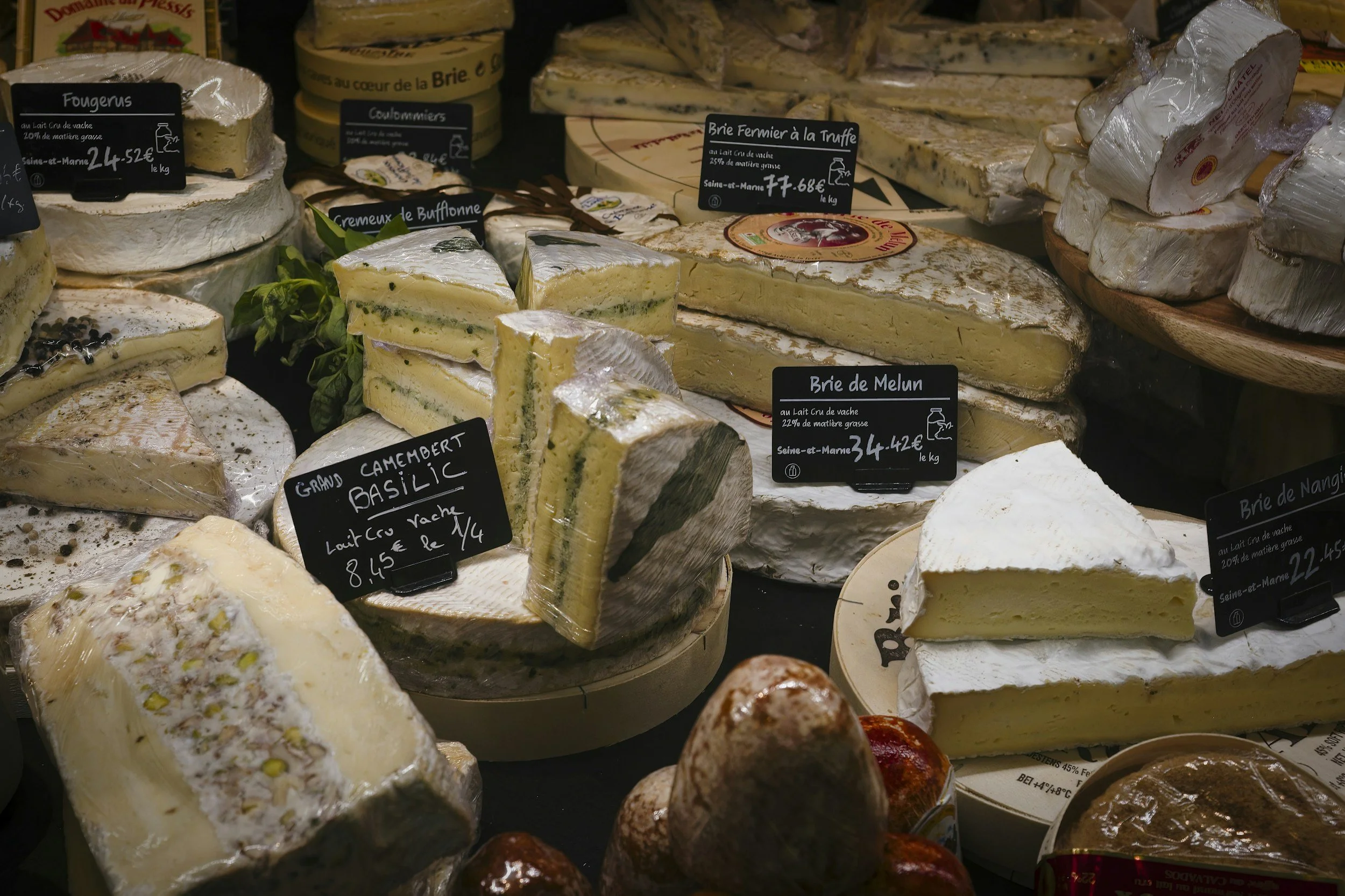
Beaune always feels busiest before lunch, not because there are huge crowds everywhere, but because so much is happening in a relatively small area. Around Place de la Halle, the market spreads out into Place Fleury, Rue Monge and Avenue de la République, and it's easy to spend the whole morning drifting from one stall to the next without ever following a particular route. One minute you're tasting Comté that has been aged for two years, the next you're looking at summer cherries from nearby orchards, homemade pain d'épices or jars of cassis jam, before noticing an antiques dealer with old enamel advertising signs leaning against a van just a few streets away. If you're hoping to buy food to take home, it's worth wandering beyond the busiest part of the market because some of the smaller producers on the outer streets often have shorter queues, even while the centre is shoulder to shoulder.
The reason I rarely rush back to the station after the market has nothing to do with shopping.
By half past twelve, most people who've come for the market have started moving on. Some head towards the Hospices de Beaune, others disappear into the cellars around Rue Paradis, and the little crowd that had been weaving between vegetable stalls all morning simply spreads out across the town. If you walk the same route through Place de la Halle twenty minutes later, you'll probably recognise the streets more than the market. Stallholders are folding away tables, someone is hosing down the stone where the fish stand had been, and the smell of roast chicken is gradually replaced by people sitting down for lunch.
I usually keep walking rather than looking for somewhere to eat straight away. Beaune is one of those towns where the nicest part of the day often comes after everyone else thinks it's over. Rue Maufoux becomes much quieter once the tasting groups have disappeared indoors, the little side streets behind the Hospices are suddenly easy to wander without constantly stepping aside for people taking photographs, and if you carry on towards Parc de la Bouzaize, it doesn't really feel connected to the busy market morning anymore. Local families are feeding the ducks, older couples are sitting on benches looking over the lake, and every now and then someone walks past carrying a baguette tucked under one arm, looking as though they've done exactly the same Saturday routine for years.
That's usually when Beaune starts feeling less like somewhere people have come to visit and more like somewhere people simply happen to live.
The walk back to the station always feels longer than the walk into town.
In the morning it's just ten minutes or so along Avenue du 8 Septembre 1944 and Avenue de la République, but later in the day you've usually collected more than you expected. Maybe you only meant to buy a jar of mustard from La Moutarderie Fallot, then a cheesemaker offered you a piece of Époisses that was impossible to leave behind, a baker talked you into taking home a bag of gougères because they were still warm, and somewhere between Place Carnot and Rue Monge you wandered into a wine shop "just to have a look" before walking out with a bottle wrapped in tissue paper. None of those purchases seem particularly awkward on their own, but they do make the uneven paving stones feel much less forgiving when you're pulling a suitcase towards the station.
That's one of the reasons I almost always stay the night in Beaune instead of catching a late afternoon train.
Once the market has packed away and the tasting groups have settled into the cellars, there's no real reason to hurry anywhere. I'll usually wander back through the quieter streets behind the Hospices de Beaune, stop somewhere for a glass of wine before dinner and leave the shopping in the hotel room rather than dragging it around for the rest of the afternoon. By seven o'clock, most of the tables around Place Carnot are beginning to fill, but you'll notice plenty of restaurants are already full if you haven't booked ahead, especially from late spring into autumn. Afterwards, it's worth taking one more walk through the old centre. The streets are much quieter than they were that morning, shop shutters are down, the stone façades are lit up and you'll mostly pass people heading home after dinner rather than arriving for the market.
You probably won't stay in Montbard, but you'll be glad it's there
Montbard probably isn't somewhere you'll spend much time, but if you're travelling around Burgundy by train, you'll almost certainly end up passing through it at some point.
The TGV from Paris stops here in well under two hours, and that's what makes the town so useful. The station is small enough that you don't spend ten minutes trying to work out where to go next, and if you're continuing to Semur-en-Auxois, the bus leaves from directly outside the station rather than another part of town. It's one of those connections that's much easier than it looks when you're planning the trip at home.
I normally don't hang around too long in Montbard. Once I'm on the bus, the journey to Semur only takes around twenty minutes, and it doesn't take long before the railway lines disappear behind you and the landscape starts looking much more like the Burgundy people imagine. Fields stretch out on both sides of the road, little villages appear every few kilometres and, not long before you arrive, the towers and stone walls of Semur-en-Auxois come into view above the River Armançon. Even if you've seen photographs before, it's a striking first glimpse because the town seems to appear all at once.
If I had the choice between staying overnight in Montbard or carrying on to Semur, I'd keep going every time. By the time you've checked into your hotel, walked through Place Notre-Dame and crossed Pont Pinard, you're already where you wanted to spend the weekend. The market is within easy walking distance the following morning, the bakeries are opening, the cafés are putting out their tables and there's no need to think about buses or train connections again until it's time to head home.
Most people stepping off the train in Montbard aren't planning to spend the afternoon there, and I'd carry on to Semur-en-Auxois as well.
The bus leaves from directly outside the station, so the connection is straightforward, and twenty minutes later you're walking through Porte Sauvigny into a town that feels completely different from the railway hub you've just left behind. The first thing I usually notice is how quickly everything becomes walkable. Within a few minutes you've passed the bakeries around Place Notre-Dame, the little food shops on Rue Buffon and the cafés beginning to fill if it's a Saturday morning.
If you've arrived on market day, it's worth slowing down rather than heading straight for the busiest part of the square. The market stretches through several streets, so it's easy to think you've reached the end before another row of stalls appears around the next corner. By late morning, the queue outside the butcher is often longer than the one at the bakery, and you'll still find people stopping to chat in the middle of the street while others walk home carrying flowers, bread and whatever looked good enough to take home for lunch.
I wouldn't rush away once the stalls start packing up either. That's usually the point when I'll cross Pont Pinard, follow the path beside the River Armançon for a while and then climb back up towards the old town instead of returning through the main square. It isn't the quickest route, but it's the one that gives you the best sense of how Semur changes over the course of the day. The delivery vans have gone, the market noise has disappeared, and most of the people you pass now seem to be residents out for a walk rather than visitors trying to see everything before the next train.
One small thing that's worth knowing before you travel is that buses between Montbard and Semur aren't running every few minutes. If you're arriving on a Friday evening or heading back on a Sunday, it's worth checking the return times before booking your train rather than assuming you can simply turn up and catch the next one. It's an easy connection, but not one with much room for improvising.
I'd leave Montbard to the trains and spend my evenings in Semur instead. Once you've had dinner around Place Notre-Dame and wandered back towards the ramparts while the stone buildings start catching the last of the evening light, it's hard to imagine why you'd want to sleep anywhere else.
If you're travelling on towards Lyon afterwards, don't rush straight past Tournus. It's one of those stops that's much more enjoyable than people expect.
No two market mornings in Burgundy feel the same
I used to think a market was a market… like a few stalls selling vegetables, local cheese, bread, flowers and maybe a couple of antique dealers if you were lucky. I expected the towns to be different, but I didn't expect the markets themselves to feel so different!
After a few weekends travelling around Burgundy, I realised I was looking forward to each market for completely different reasons.
In Dijon, people seem to fold the market into an ordinary Saturday. In Beaune, the whole town slowly shifts from shopping to wine as the morning disappears. In Semur-en-Auxois, it's just as easy to find yourself wandering down a side street or stopping on one of the old bridges as it is to stand browsing the market itself. Then there are places like Chagny, Nolay and Saulieu, where the market still feels very much like something people come to because they need vegetables for dinner rather than because it's in a guidebook.
That's probably why I stopped trying to decide which market was the best, and rather think about what sort of morning I feel like having.
Some days I simply want the buzz of a city where the cafés are just getting busy as the market starts packing away. Other times I'd much rather spend an hour chatting to a cheesemaker in a smaller town before walking home with a paper bag full of things I definitely hadn't planned to buy.
They're all markets, but they just don't feel anything alike.
If what you enjoy most is wandering between vineyards, little food shops and village cafés, Bugey feels like a very natural next trip.
Provence has a completely different market culture, and if you're curious how it compares, these towns are a great place to start.
Dijon feels like a Saturday morning that happens to include a market
Dijon is the market I'd come back to if I wanted to understand how people in Burgundy actually shop.
The first thing that stands out isn't Les Halles itself. It's everything happening around it before you even walk through the doors. Along Rue Odebert and Rue Bannelier, people are already leaving bakeries with paper bags tucked under one arm, someone is balancing a bunch of flowers on the back of a bicycle, and the little specialist food shops have their doors open while plenty of visitors are still wandering towards the market from Place Darcy or the tram stops. The market doesn't feel like a destination sitting in the middle of the city. It feels as though the whole neighbourhood has gradually turned into one.
I wouldn't rush straight inside Les Halles either. One of the nicest things to do is spend twenty minutes walking around the outside first because the atmosphere changes from one side of the building to the next. Along Rue Bannelier, you'll find people popping in and out of independent food shops almost absent-mindedly, while around Rue Odebert the café terraces begin filling with people who've already finished shopping rather than those about to start. By the time you eventually step into the market hall, you already feel part of the morning instead of arriving halfway through it.
Inside, it's surprisingly easy to forget what time it is. Someone is asking for just one slice of jambon persillé, another customer is discussing which Époisses is ready to eat today and which should wait until next weekend, and further along you'll see people buying bunches of herbs, white asparagus in late spring, tiny gariguette strawberries for only a few weeks each year, or baskets of wild mushrooms once autumn arrives. You don't get the feeling that people are trying to see everything. Most already know exactly where they're going.
Around eleven o'clock, the shopping slows down, conversations become longer, and you'll notice more people standing outside with coffee than walking around with empty baskets. Mulot & Petitjean starts attracting another wave of customers picking up pain d'épices, pastries and biscuits to take home, while the terraces between Place François Rude and Rue Musette become noticeably busier than some parts of the market itself. If you arrive then, Dijon feels less like a food market and more like an entire city settling into its weekend.
I really like that the market doesn't have a clear ending!
You leave Les Halles thinking you're finished, then find yourself stopping at a little wine merchant on Rue des Forges, wandering through Cour Bareuzai, looking at the seasonal displays outside the delicatessens, or taking a small detour through Place de la Libération simply because the streets are still full of life.
That's also why I wouldn't come to Dijon expecting antiques.
You'll usually find a few vintage stalls tucked between the fruit growers and cheesemakers, but if I'm hoping to come home with an old enamel sign, copper cookware or vineyard tools, I'll wait for one of Burgundy's brocantes instead. Dijon has always felt much stronger as a food market than an antiques market. It's the sort of place where I end up spending far more time deciding which cheese to take home than looking through old furniture, and somehow lunch always arrives before I've managed to visit every food shop around Les Halles.
If the brocantes end up being your favourite part of the weekend, this guide will save you buying something you'll probably regret later.
Beaune is the market where nobody seems to be in a hurry
The first hour in Beaune always feels much quieter than I expect.
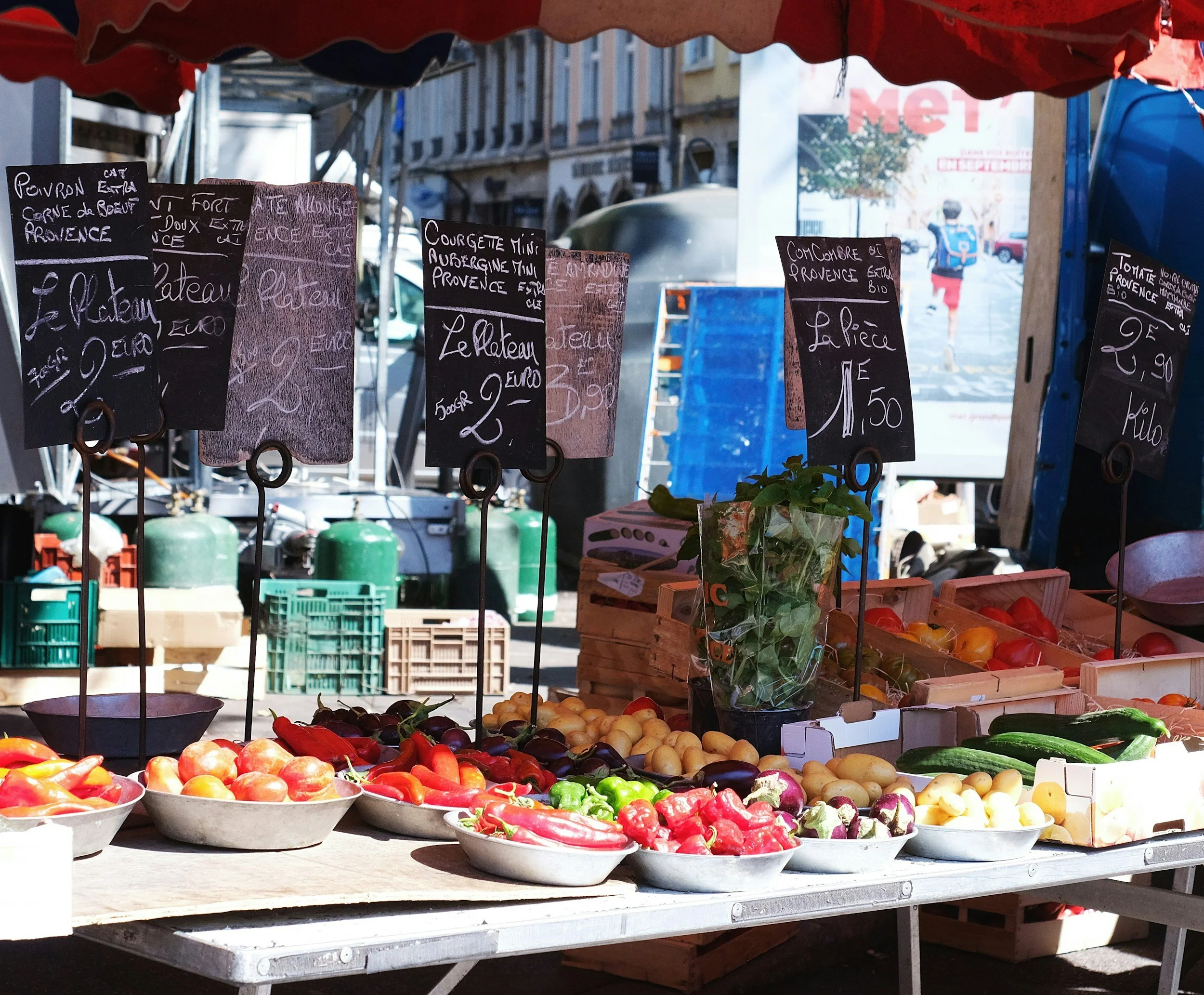
People are there, but they're not rushing from stall to stall with shopping lists the way they often do in Dijon. Around Place de la Halle, you'll see someone stopping to taste three different Comtés before deciding which one to take home, another person chatting to the producer selling fresh goat's cheese from the Hautes-Côtes, and plenty of people who seem perfectly happy standing in the middle of the square with a coffee before they've bought anything at all.
If you come home wishing you'd packed an extra wedge of cheese, these cheese caves are well worth adding to your list.
If you arrive early, don't stop at the first rows of stalls around the covered market. Keep walking. The market continues through Place Fleury, along Rue de Lorraine, parts of Avenue de la République and into several of the smaller streets where the pace immediately changes. That's often where you'll find the growers selling whatever has just come into season, whether it's white asparagus in April, gariguette strawberries for a few weeks in late spring, peaches and apricots later in the summer or baskets of girolles and cèpes once autumn arrives. Some of the smaller producers are packing up before the busiest part of the market has even started to thin out, so if fresh food is what you're here for, I'd begin at the edges rather than in the middle.
One thing I didn't really notice until my second visit was how naturally the market blends into the wine trade. Around eleven-thirty the shopping starts slowing down, but the town doesn't empty. It simply changes direction. People begin wandering towards Rue Paradis, Rue Maufoux and Place Carnot, wine merchants unlock their doors after the lunch break, and suddenly you're seeing far more people carrying one carefully wrapped bottle than bags full of vegetables. It never feels as though everyone is following the same route. Some disappear into tiny tasting rooms, others order a glass of Aligoté on a terrace and don't seem to move again for an hour.
I almost always end up taking the long way back through the old town instead of walking directly across it. The streets behind the Hospices de Beaune are usually much quieter once the market starts winding down, and it's worth wandering through Rue d'Enfer, Rue Maizières or Rue Rousseau Deslandes, where little wine shops, old stone doorways and family-run businesses replace the busiest parts of the market. If you're interested in Burgundy beyond the vineyards, Athenaeum is a lovely place to disappear into for half an hour after lunch. It isn't only shelves of wine books. There are beautifully illustrated books on regional cooking, vineyard maps, local history and enough ideas for future trips that it's surprisingly difficult to leave quickly.
I nearly always end up at Parc de la Bouzaize at some point during the afternoon, usually with whatever I couldn't resist buying at the market. A piece of Comté wrapped in paper, a fresh baguette, cherries if they're in season and maybe a bottle of Crémant if I'm not catching a train until the next day is enough for lunch.
It's only a short walk from the old town, but it feels surprisingly separate from the streets around the Hospices de Beaune. While people are still moving between wine tastings and cellar doors in the centre, the paths around the lake are mostly used by local families, dog walkers and the occasional runner. Some people stop for an hour before heading back into town, others seem perfectly happy to spend most of the afternoon there. If you've been weaving through the market all morning, it's a nice contrast without having to go anywhere particularly far.
If antiques are the reason you've come to Burgundy, I'd also keep an eye on the local calendar before choosing your dates. The weekly Saturday market isn't really where collectors spend their time. It's the seasonal brocantes and antique fairs that transform Beaune, filling the squares with old vineyard tools, copper pans, enamel advertising signs, linen, café crockery and boxes of photographs that can keep you browsing for hours. If one of those weekends happens to coincide with your trip, I'd happily rearrange the whole itinerary around it!
Semur-en-Auxois is the market that keeps pulling you down another street
The first mistake most people make in Semur-en-Auxois is thinking the market is all in one place.
You arrive in Place Notre-Dame, see the first rows of fruit, cheese and flower stalls and naturally assume that's where everything is happening. Then you notice people disappearing down Rue Buffon, somebody walks past carrying vegetables from the direction of Rue de la Liberté, and before long you've wandered through three or four streets without ever deciding where you were actually going.
That's what makes Saturday mornings here feel so different from Dijon or Beaune. You're never really walking around a market. You're walking around a medieval town that happens to be full of market stalls.
I nearly always drift away from the busiest part of the market first. Around Rue du Vieux Marché and the smaller lanes leading back towards Porte Guillier, it's often a little quieter while everyone else is still gathering around Place Notre-Dame, and it's much easier to stop for a conversation without feeling you're blocking the street. The stalls change through the year, but you're just as likely to come across bunches of asparagus and pink radishes in late spring as crates of cherries, apricots and tomatoes in early summer, followed later by walnuts, mushrooms, fresh herbs, local goat's cheese wrapped in paper and jars of honey from villages across the Auxois. Quite a few producers have been coming here for years, and regular customers often seem to know exactly which stall they're heading for before they've even reached the market.
The morning changes almost street by street. Before ten o'clock there are usually still empty tables outside the cafés around Place Notre-Dame, while the queue outside the butcher grows steadily longer and people are already walking away from the bakery with paper bags tucked under one arm. An hour later the balance has shifted. More visitors have arrived, the viewpoints beside Pont Pinard and the old ramparts attract a steady stream of photographers, yet if you turn into Rue Fevret or one of the little lanes leading back towards the river, you can suddenly find yourself walking almost alone. That's one of the things I like most about Semur. You never have to walk very far before the market noise disappears, even on the busiest Saturdays.
If you're interested in antiques, don't assume you've already seen everything after your first walk around. The produce stalls are usually ready before everyone else, but some of the brocante traders and vintage dealers take longer to unpack old wooden crates filled with enamel kitchenware, linen, postcards, brass candlesticks and bits of Burgundy's wine history that don't immediately catch your eye. I nearly always end up doing a second circuit before lunch because the market doesn't look the same an hour later as it did when it first opened.
The river is another part of the morning that most people seem to miss.
Around midday, while the viewpoints above the River Armançon are at their busiest, the path below the old bridges often feels almost empty. Instead of joining everyone taking photographs from the walls, walk down towards the water, follow the riverside for ten minutes and look back up instead. You get a completely different view of the towers, and for a little while the only sounds are the river, birds and the church bells carrying across the valley from Collégiale Notre-Dame.
One thing I like about Semur is that it's very difficult to walk through it only once.
You cross Pont Pinard thinking you're heading back towards Place Notre-Dame, notice a little passage you've somehow missed, end up on Rue de la Liberté instead, stop outside a bakery because a tray of gougères has just come out of the oven and, before long, you're standing back in the market wondering how you ended up there again. The old streets don't really follow a straight line, and that's part of the reason the market feels larger than it actually is. It spills into side streets, disappears around corners and keeps drawing you a little further than you meant to go.
The busiest part of the morning doesn't last particularly long. Around lunchtime you'll notice one producer loading empty crates into a van while another is still serving regular customers who seem in no hurry at all. The florist starts gathering up the last buckets, the queue at the butcher finally disappears and the little delivery vans that had been tucked into side streets all morning gradually pull away. Ten or fifteen minutes later you can walk along the ramparts towards the Tour de l'Orle d'Or, look back across the rooftops and find that most of the people who were filling the streets earlier have already gone home.
That's probably why I'd return to Semur more often than anywhere else in this guide.
Not because there's more to do than in Dijon or Beaune, but because I always seem to notice something I'd walked straight past the previous time. It might be a tiny courtyard behind an old doorway, a shop I'd somehow missed or a different view across the River Armançon after crossing one more bridge than I'd planned. It's one of those towns where taking the wrong street usually turns out to be the right decision.
Once you've seen the bigger markets, these are the towns I'd start adding
The smaller markets are where Burgundy starts feeling much less predictable.
Nobody arrives in Chagny, Nolay or Arnay-le-Duc expecting to spend half the day there, and somehow that's exactly what happens.
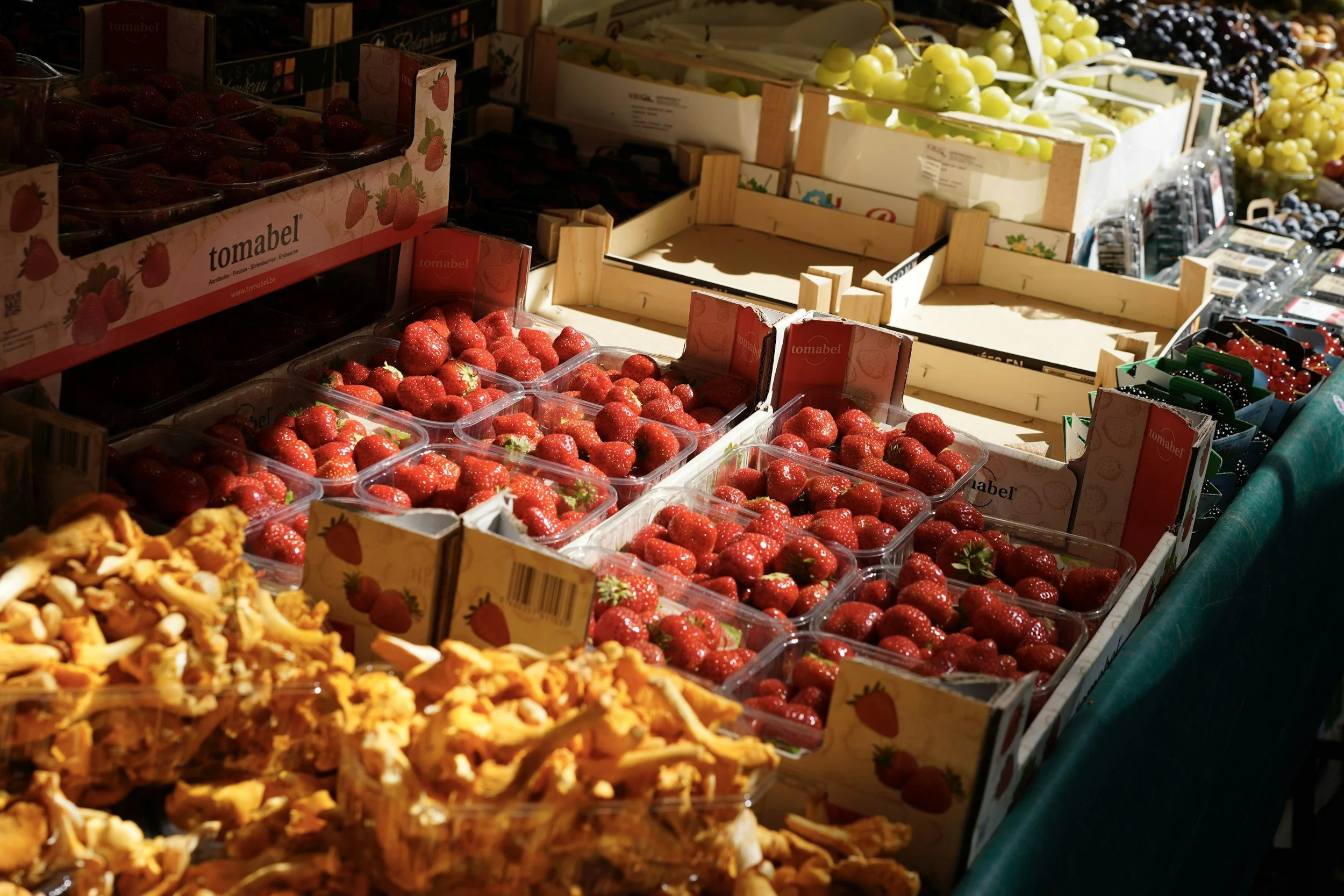
If I were planning a second market weekend in Burgundy, Chagny would probably be my first stop. Sunday mornings are busiest around Place d'Armes and Rue de la République, where the market gradually spills through the centre instead of staying in one neat square. Restaurant chefs from the surrounding villages still shop here before lunch, you'll often see people wheeling little shopping trolleys rather than carrying backpacks, and the stalls tend to focus much more on produce than souvenirs. Depending on the season, you'll find white asparagus from the Saône plain, Charolais beef, fresh poultry, goat's cheese from nearby farms, jars of local honey and bunches of herbs that disappear surprisingly early in the morning. Once you've finished shopping, don't rush back to the station! Instead, walk a few minutes towards the Canal du Centre. By late morning the towpath is full of cyclists, narrowboats drift slowly past the locks and it feels like a completely different place from the busy market streets you left ten minutes earlier.
Nolay feels different as soon as you reach the market because almost everything happens beneath the enormous medieval market hall on Place de l'Hôtel de Ville. Even on a wet morning, people simply carry on shopping under the old timber roof while the conversations continue much as they would on a sunny day, and that's probably why the market feels busy without ever becoming particularly hectic.
I usually end up walking around the hall two or three times because it's surprisingly easy to miss things the first time. One corner might be full of vegetables from nearby farms, another has local cheeses and honey, then you notice someone selling walnuts, homemade jams or bunches of herbs tucked between the larger produce stalls. While people are still queuing at the bakery or stopping at the butcher with their market baskets, others have already settled outside the cafés around the square, so the whole morning feels slightly less rushed than somewhere like Dijon.
If you've come hoping to find antiques as well as food, don't head straight back once you've finished at the market. A few brocante dealers and antique shops around the streets behind the market hall often open later than the food stalls, and I've found it's much quieter browsing there once most people have moved on to lunch. It's the sort of place where old enamel kitchenware, copper moulds, wooden wine crates and boxes of postcards are stacked wherever there's space rather than carefully laid out for visitors, which makes looking around half the fun.
Arnay-le-Duc feels even more rooted in everyday life. Around Place Bonaventure des Périers, the market feels as though it's still there for the people who live nearby rather than the people who've travelled to see it. You'll find flowers beside fruit and vegetables, charcuterie next to someone selling old hand tools, and a table of vintage kitchenware only a few metres from the cheesemaker. It never feels carefully arranged. Things simply end up wherever there's space, which is part of what I like about it.
I wouldn't leave as soon as you've finished walking around the square either. Most people do, especially those arriving by car from nearby towns, and that's exactly when the antique shops and little brocantes become much easier to browse. I've spent far longer than intended looking through shelves of old enamel coffee pots, hand-painted Burgundy wine bottles, copper jam pans, vintage preserving jars and faded café signs, usually with the owner happy to tell you where they came from if you show even the slightest interest. It's not the sort of place where everything is neatly labelled or laid out for photographs. Sometimes you have to open a drawer, look behind a stack of wooden crates or ask whether there's anything else out the back, and that's usually when the interesting pieces appear.
It's probably the market I'd choose if I wanted to come home with something that didn't fit in a shopping basket. Not because there are more antique dealers than anywhere else, but because there's a good chance you'll stumble across something you weren't looking for in the first place.
Saulieu is one of the few places where I almost stop thinking about the market because I keep disappearing into the shops around it.
You'll buy bread at one bakery, then notice a cheesemonger a few doors away, cross over to the butcher for a slice of jambon persillé, wander into a delicatessen because something in the window catches your eye and somehow find yourself back in Place Monge without having planned any of it. Around Rue d'Argentine, the market doesn't really end where the stalls finish. It carries on through the food shops, bakeries and little specialist stores that have been part of Saturday mornings here for years.
If you're travelling through the Morvan, it's one of the easiest towns to put together a picnic without thinking too much about it. Within a couple of streets you've usually collected everything you need: fresh bread, local cheese, charcuterie, something sweet from the pâtisserie and whatever fruit happens to be in season that week. Quite a few people seem to shop in exactly the same way. They'll leave the market with one or two things, disappear into a shop, come back carrying another paper bag and then head off again. It never feels as though the market and the town are separate parts of the morning.
One thing I'd leave time for is simply wandering another lap after you've finished shopping. It's surprisingly easy to walk straight past a little épicerie, a chocolatier or a producer selling regional products because you were looking at the market stalls instead. The second circuit is often the one where I end up finding whatever I hadn't realised I was looking for.
The markets change far more than most people expect through the year
It's easy to think a Saturday market in Burgundy is the same market every week, just with slightly different fruit on the stalls.
After travelling through the region in different seasons, I don't think that's true at all. The streets are the same, Les Halles still fills with shoppers every Saturday morning and you'll probably recognise plenty of the producers if you come back a few months later, but what people are buying, what ends up on restaurant menus afterwards and even how long people linger over coffee changes surprisingly noticeably.
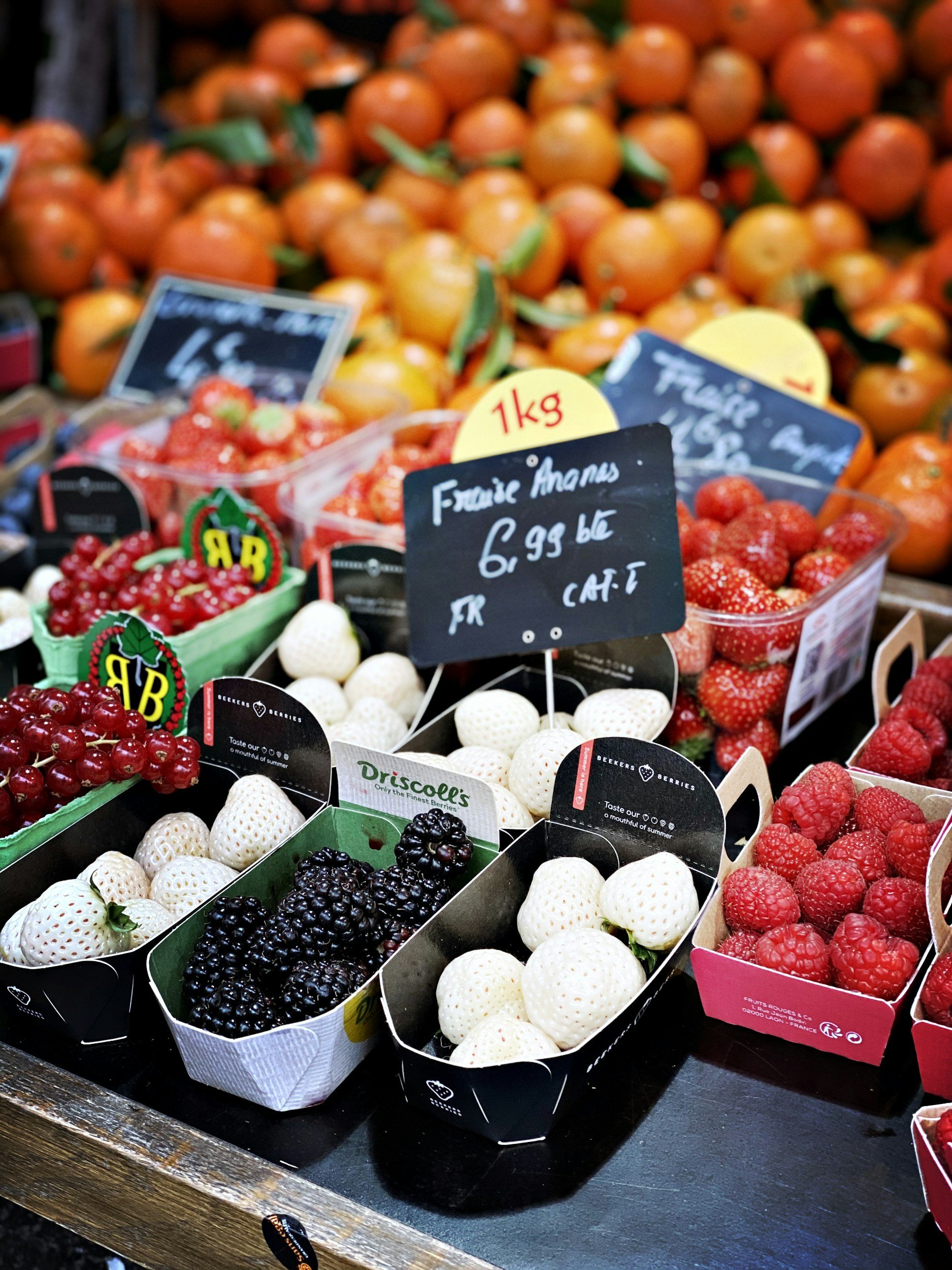
In April and May, the markets feel as though they're waking up after winter. You'll start seeing bunches of white asparagus standing upright in wooden crates, the first gariguette strawberries appearing on the fruit stalls, fresh goat's cheese from nearby farms, armfuls of peonies and buckets of lilac outside the florists. It's also one of my favourite times to wander around Dijon because the café terraces around Rue Musette and Place François Rude are busy enough to feel lively without the crowds that arrive later in summer, and it's much easier to find a table after you've finished at Les Halles.
By June, the markets become noticeably more colourful. Cherries from orchards around the Côte-d'Or sit beside apricots and peaches, basil starts appearing in generous bunches, and you'll notice more people buying picnic food than hearty meals to take home. The days are long enough that there's never much rush to leave. It's quite normal to spend the morning at a market in Beaune, wander through the old streets afterwards and still have several hours of daylight left for a walk around Parc de la Bouzaize, another wine tasting or dinner outside once the evening cools down.
September and October are probably the months I'd choose if food is the main reason you're coming.
The grape harvest is underway across much of Burgundy, tractors appear on the roads around the vineyards, and the markets begin filling with cèpes, girolles, walnuts, figs, squash and the first game dishes appearing on restaurant blackboards. You can almost smell autumn walking through some of the smaller towns. In places like Chagny and Nolay, producers seem to linger a little longer over conversations because the busiest weeks of summer have passed, while wine merchants in Beaune are preparing for one of the most exciting times of the year.
Autumn market mornings in the Dordogne feel completely different again. This guide is a good place to start if you're already thinking about your next trip.
Winter is quieter than many people expect, but I wouldn't dismiss it. The markets are usually smaller, with fewer seasonal fruit stalls, yet they feel much more local. Instead of visitors browsing with cameras, you'll mostly see people shopping for the weekend, picking up regional cheeses, charcuterie, fresh bread and ingredients for long Sunday lunches at home. Around Christmas, pain d'épices, foie gras, handmade chocolates and bottles of Crémant start appearing everywhere, and even though you'll spend less time sitting outside cafés, it's one of the nicest seasons for slipping into little food shops and warming up over coffee before wandering back through the market.
That's one of the reasons I never tell people there's a single "best" time to visit Burgundy's markets.
If you visit in late spring, you'll probably head home with asparagus, strawberries, fresh goat's cheese and a bunch of flowers balanced on top of everything else in your bag. Come back in September or October and you'll find yourself choosing between mushrooms, walnuts, figs, bottles from the new harvest and whatever caught your eye at the cheesemonger's stall. Walk through the same market a few months apart and you'll recognise the streets and many of the producers, but the shopping bags people are carrying, the conversations they're having and even what's written on the restaurant blackboards after lunch will be completely different. That's one of the reasons I never feel as though I've already "done" a Burgundy market. The season changes the day more than most people expect.
If you're deciding when to visit Provence, don't just pick a month at random. This guide shows how much the markets change through the year.
The little things I wish I'd known before my first Burgundy market weekend
It took me a couple of weekends before I stopped trying to treat Burgundy's markets like ordinary Saturday shopping. The first time, I bought a beautiful Époisses almost as soon as I walked into Les Halles in Dijon because I was worried it might sell out, then spent the next four hours wandering around with it while I browsed bookshops, stopped for coffee, caught a train to Beaune and wondered whether I should have left it where it was until I was ready to go home. Since then I've become much better at making one slow lap around a market first, working out what I actually want to buy, and only going back for the cheese, butter or anything else that really doesn't want to spend half a day in a warm tote bag.
The same thing seems to happen with bread, although for a completely different reason. By the time you've wandered through the market, stopped to taste honey from one producer, chatted to someone selling walnuts from a nearby village and convinced yourself you definitely don't need another loaf, the bakery shelves can look very different from when you first walked past them. It isn't unusual to find that the gougères have disappeared, the smaller country loaves have gone and what's left is whatever people weren't queuing for two hours earlier. If I'm planning a picnic now, I'll often buy the bread first, leave it at the hotel if I'm staying nearby, and come back for everything else afterwards.
Lunch doesn't always line up with the market as neatly as you might expect. Around midday the fruit and vegetable stalls are still busy, some cafés are only just swapping breakfast menus for lunch service, and quite a few independent wine merchants have closed for their midday break. It's easy to think you'll pick up a bottle after finishing your shopping, only to find a handwritten "Fermé de 12h à 14h" sign in the window.
I've started doing the opposite. If there's a wine shop or delicatessen I know I want to visit, I'll stop there before settling down for lunch, even if it feels a little early. It saves carrying market bags back through town twice, and it usually means I can spend the rest of the afternoon without checking opening hours or wondering whether somewhere will reopen before my train leaves.
It's a small detail, but one that's easy to miss when you're planning the weekend from home. Saturday in Burgundy still follows a local routine, and that doesn't always line up with the timetable visitors have in mind.
If you're catching a mid-afternoon train, buy your wine before lunch rather than afterwards. Several independent merchants close for a couple of hours, and they don't all reopen at exactly the same time.
The trains are much the same. Looking at a railway map, it feels as though you can move around Burgundy almost effortlessly, and between Dijon, Beaune and Chalon-sur-Saône that's often true, but once you start adding places like Semur-en-Auxois, Nolay or Arnay-le-Duc into the weekend, you realise the first train of the day doesn't always arrive in time for the beginning of the market, buses don't necessarily wait for delayed connections and suddenly staying the Friday night instead of arriving early on Saturday makes far more sense than it seemed when you were booking everything at home.
I always leave a bit of space in my bag before heading to Burgundy now, although I've stopped pretending I know what will end up filling it.
Sometimes it's practical. A jar of blackcurrant jam from Chagny, a wedge of Époisses wrapped so carefully by the cheesemonger that it survives the journey home without any drama, or a bottle of Crémant that somehow seemed much lighter when I bought it than it does walking back to the station. Other times it's something I hadn't expected at all. I've walked into Athenaeum in Beaune thinking I'd have a quick look at the travel shelves and come out half an hour later carrying a cookbook instead, and I've lost track of the number of times an old copper mould or enamel kitchen sign at a brocante has found its way into my backpack because I decided I'd probably never see another one quite like it.
It's one of the reasons I wouldn't plan every hour of the weekend too carefully. Some of the nicest stops aren't on the itinerary at all. They're the little food shops you only notice because you took a different street back from the market, the antique dealer who opens just after lunch or the bookshop you wandered into while waiting for the next train.
Once you've done Burgundy, you'll probably start looking for somewhere similar. These market towns are the ones I'd look at next.
How I'd pair Burgundy's market towns
When I'm planning a weekend in Burgundy now, I don't really start by choosing the markets. I start by thinking about which towns I'd like to spend a day in.
Some combinations fall into place almost effortlessly because the train connections are straightforward and each town offers something different once the market has packed away. Others look tempting on a map but end up feeling rushed, with half the day disappearing between platforms and connections. These are the pairings I'd choose if I were planning the trip today.
If you want one busy market and one wine town
I'd combine Dijon and Beaune every time.
Saturday morning in Dijon feels woven into everyday city life. People are already carrying shopping bags through Rue Odebert before you've even reached Les Halles, the queue outside Mulot & Petitjean keeps growing as the morning goes on, and by the time you've wandered through Rue Bannelier and across Place François Rude, you'll notice plenty of locals are already sitting down for coffee while others are only just arriving at the market.
Beaune has a completely different feel. I'd catch one of the mid-morning TER trains rather than rushing for the first departure because by the time you arrive, the market is properly underway and the cafés around Place de la Halle have found their rhythm. Spend the afternoon wandering between Rue Paradis, Rue Maufoux and the little wine merchants tucked into the old streets, then head back to Dijon before dinner. I nearly always prefer eating around Place Émile Zola or one of the quieter restaurants just off Rue Musette, partly because you'll have far more choice than in Beaune on a busy Saturday evening and partly because Dijon still feels lively long after many visitors have left Beaune for the day.
Semur-en-Auxois and Montbard if you're arriving from Paris
This is one of those journeys that sounds much more complicated than it actually is.
The TGV reaches Montbard in well under two hours, and one of the nicest things about arriving there is that you don't need to spend twenty minutes working out where to go next. The bus to Semur-en-Auxois leaves from just outside the station, so you're usually on your way again within a short time, watching the landscape change from railway tracks and open fields to the old stone towers that appear above the River Armançon as you approach the town.
I'd book accommodation in Semur rather than Montbard every time. That way you're already walking through Place Notre-Dame while stallholders are still arranging flowers, the butcher's queue is beginning to grow and the first café tables are only just filling up, instead of trying to time a bus to arrive before the busiest part of the morning. On Sunday, it's easy to reverse the journey back to Montbard for the TGV without feeling as though you've spent half the weekend travelling.
Coming down from Paris? I'd seriously consider breaking the journey with one of these towns instead of heading straight to Dijon.
And I wouldn't be surprised if Semur-en-Auxois is the place you end up wanting more time in. This guide picks up where the market morning finishes.
If food is the reason you're coming
Beaune and Chagny work brilliantly together.
Beaune naturally drifts towards wine once lunchtime arrives, whereas Chagny stays firmly centred around food. Around Place d'Armes you'll find growers selling seasonal vegetables, Charolais beef, Bresse poultry, local cheeses and bunches of herbs alongside people who are clearly doing their weekly shopping rather than ticking another market off a list. Walk a few minutes towards the Canal du Centre afterwards and you'll see cyclists stopping for coffee, boats moving through the locks and families spreading out picnics with things they've just bought at the market.
If I had to choose, I'd spend Saturday in Beaune and leave Sunday morning for Chagny. The atmosphere feels more local, the market is less crowded and it's one of those places where buying lunch from three different stalls somehow feels much more satisfying than booking a table.
If Beaune ends up being your base, it's worth spending two minutes on where to stay before you book anything. It can completely change how easy the weekend feels without a car.
If you've got Friday to Sunday and don't mind a longer day
Dijon and Chablis make much more sense than they first appear, but they're not somewhere I'd try to connect on a whim.
Getting to Chablis is easy, but it isn't quite as effortless as the map suggests. There isn't a railway station in the town itself, so the final part of the journey is by bus from Tonnerre or, on some routes, Auxerre, and those connections don't always line up neatly with the trains. Missing one can easily add another hour to the journey, particularly on Sundays.
That's why I prefer treating Chablis as the destination for a whole day rather than somewhere to drop into between markets. Stay in Dijon on Friday and Saturday, enjoy Les Halles, the food shops around Rue Odebert and a long evening in the city, then leave early for Chablis on Sunday when you don't need to keep looking at your watch. Once you're there, the town is compact enough that everything from the wine cellars to Rue Auxerroise, Rue de l'Église and the riverside around the Serein is easily explored on foot, and the slower journey there somehow suits the day much better than trying to rush it.
Chablis always looks close enough to squeeze into the same trip until you start looking at the buses. If you're wondering whether it's better as a weekend on its own, I'd read this first.
Before you start booking trains
One thing Burgundy has taught me is that it nearly always looks easier on the map than it does once you start matching market days with train timetables. The distances between towns aren't particularly long, but the rhythm of the region isn't built around rushing from one place to the next, and weekends don't always follow the same timetable as weekdays.
Sunday is where people are most often caught out. The main TER routes still run, but usually less frequently, and once buses become part of the journey, whether that's between Montbard and Semur-en-Auxois or the final connection into Chablis, you suddenly don't have the same flexibility you had on Saturday. It's worth checking the return journey before booking accommodation rather than assuming you'll be able to work it out on the day.
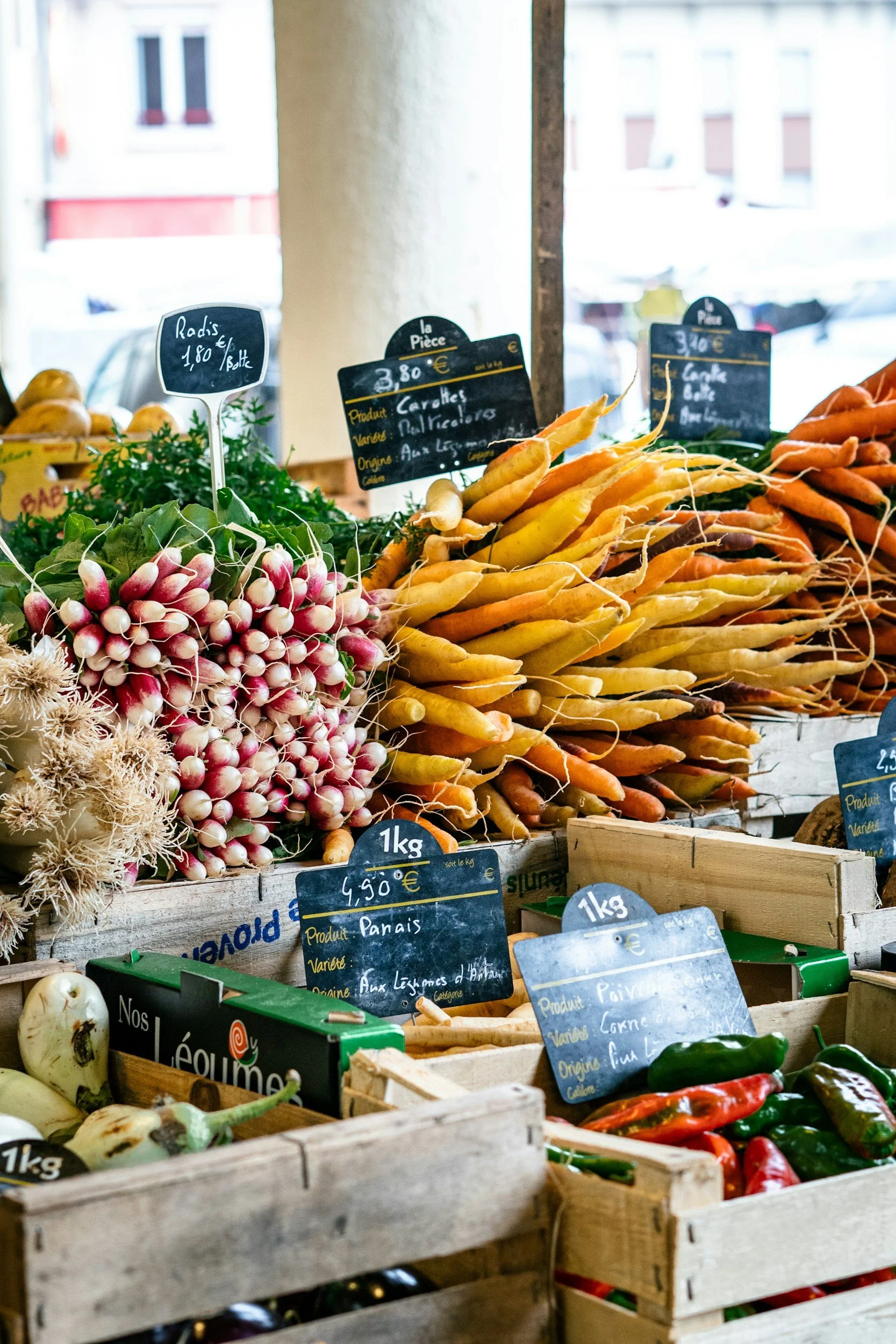
I'd also think about where your hotel is rather than just which town you want to stay in. A room inside the medieval centre might sound more appealing when you're booking, but if you're arriving by train with a small suitcase and leaving on Sunday morning carrying a couple of bottles of Burgundy, mustard from Edmond Fallot, a loaf from the bakery and whatever else found its way into your bag at the market, those extra ten or fifteen minutes over uneven cobbles feel much longer than they did on Google Maps. Somewhere within an easy walk of the station often turns out to be the more relaxing choice, even if it means another five minutes to the market.
If the markets are the main reason for your trip, I'd arrive on Friday if you can. There's a big difference between waking up a few streets away from the market and trying to make the first train of the morning. You have time for breakfast, you can watch the stallholders setting up around the square, and if you spot a bakery with a queue outside, you can simply join it instead of wondering whether you'll miss the market if you stop.
I've also become much less ambitious when planning weekends in Burgundy. On a map it looks perfectly possible to fit Dijon, Beaune, Semur-en-Auxois, Chagny and even Chablis into a couple of days, but the train journeys are only one part of the day. Markets take longer than you expect, lunch rarely happens at exactly the time you planned, and it's surprisingly easy to lose an hour in a food shop, a bookshop or a brocante without noticing.
One practical tip I would give anyone is to travel with a little less than you think you'll need. It leaves room for the things you hadn't planned to bring home, whether that's a bottle of Crémant wrapped in paper, a wedge of Époisses, a cookbook from Athenaeum in Beaune or an old enamel sign you spotted just before heading back to the station.
If I had to sum up Burgundy in one sentence, it would probably be this: plan the trains, book somewhere to stay, then leave the rest of Saturday with fewer plans than you think you need.
FAQs about visiting Burgundy's markets without a car
Which Burgundy market town is best if I'm travelling without a car?
If it's your first trip, I'd choose Dijon. The station is an easy walk from the historic centre, the TER network makes day trips straightforward and the city still feels lively after the market has finished. If you've already been to Dijon, I'd look at Beaune for a wine-focused weekend or Semur-en-Auxois if you're happy making one bus connection from Montbard in return for a much quieter medieval town.
Is Dijon or Beaune the better base for a market weekend?
For most people, Dijon works better.
You can spend Saturday morning at Les Halles, take a train to Beaune for the afternoon if you want to, then return to Dijon for dinner without feeling rushed. The city has more evening restaurants, more frequent trains and a little more flexibility if your plans change during the day. Beaune is wonderful to visit, but I think it works best as somewhere you spend a day rather than somewhere you build the whole weekend around.
Which Burgundy markets are easiest to reach from Paris?
Dijon is the simplest because the TGV takes you directly into the city centre. Beaune is easy as well, usually with a quick change in Dijon, while Semur-en-Auxois is surprisingly straightforward once you know the route. Take the TGV to Montbard, then continue by bus, which stops just outside the station. The whole journey is much easier than it first appears.
Can you explore Burgundy using only trains?
Yes, although I'd include buses in that plan as well.
The TER network links the larger towns very well, but some of the smaller market towns, including Semur-en-Auxois and Chablis, need a short bus connection for the final part of the journey. Once you accept that, Burgundy becomes much easier to explore without a car than many people expect.
Is Chablis worth adding to a Burgundy market weekend?
Yes, but I'd only do it if you've got three days rather than two.
Chablis doesn't have a railway station, so you'll travel by train to Tonnerre or Auxerre before continuing by bus. It's not difficult, but it isn't somewhere I'd try to squeeze into an already busy Saturday. I think it works much better as a relaxed Sunday day trip when you've got the whole day available.
Which Burgundy market feels the most local?
For me, it's probably Chagny.
You'll see restaurant staff shopping before lunch, people arriving with shopping trolleys instead of cameras and stallholders greeting regular customers by name. Dijon feels wonderfully local too, but it's also a city. Chagny still revolves around the weekly market in a way that's becoming harder to find.
Which Burgundy markets are best if I like antiques and brocantes?
The weekly food markets aren't always the best places to hunt for antiques.
Instead, I'd keep an eye on the local brocante calendar before booking your trip. Towns such as Nolay, Arnay-le-Duc and Beaune regularly host antique fairs where you'll find everything from old vineyard tools and enamel advertising signs to copper jam pans, linen, vintage wine labels and wooden crates. Those weekends are well worth planning around if antiques are high on your list.
Are Burgundy markets worth visiting outside summer?
Definitely.
Spring brings asparagus, strawberries and the first cherries, while autumn is probably my favourite season for food markets, with mushrooms, walnuts, fresh grape harvests and richer regional dishes appearing on stalls and restaurant menus. Winter markets are smaller, but they're also much quieter, and you'll often find yourself chatting to producers for much longer because the pace is completely different.
Do I need to speak French at Burgundy's markets?
Not at all.
A few words of French are always appreciated, especially a simple bonjour before asking a question, but most buying and selling happens with smiles, pointing and a little patience. Food has a habit of making conversations easier, and many producers are happy to explain what they're selling even if you only share a handful of words.
Can I bring food home from a Burgundy market by train?
Absolutely, although it's worth thinking about the order you buy things.
I usually leave cheese, butter and anything that needs keeping cool until the end of the morning, especially if I'm travelling in warmer weather. Bread, mustard, pain d'épices, walnut oil, jars of cassis jam and other pantry staples are much easier to carry around while you're still wandering through the market. If you're planning to buy wine as well, leaving a little extra room in your bag before you travel is never a bad idea.
What's the biggest mistake people make when planning a Burgundy market weekend?
Trying to fit too much into it.
The towns look close together on a map, so it's tempting to squeeze Dijon, Beaune, Chagny and Semur-en-Auxois into the same weekend. In reality, Burgundy is much more enjoyable when you choose one base, build a couple of day trips around it and leave enough time for the unexpected things that always seem to happen, whether that's a longer conversation at a market stall, an antique shop you hadn't noticed or a lunch that quietly turns into the rest of the afternoon.