
Market day changes with the season. Here's how I'd plan Provence.
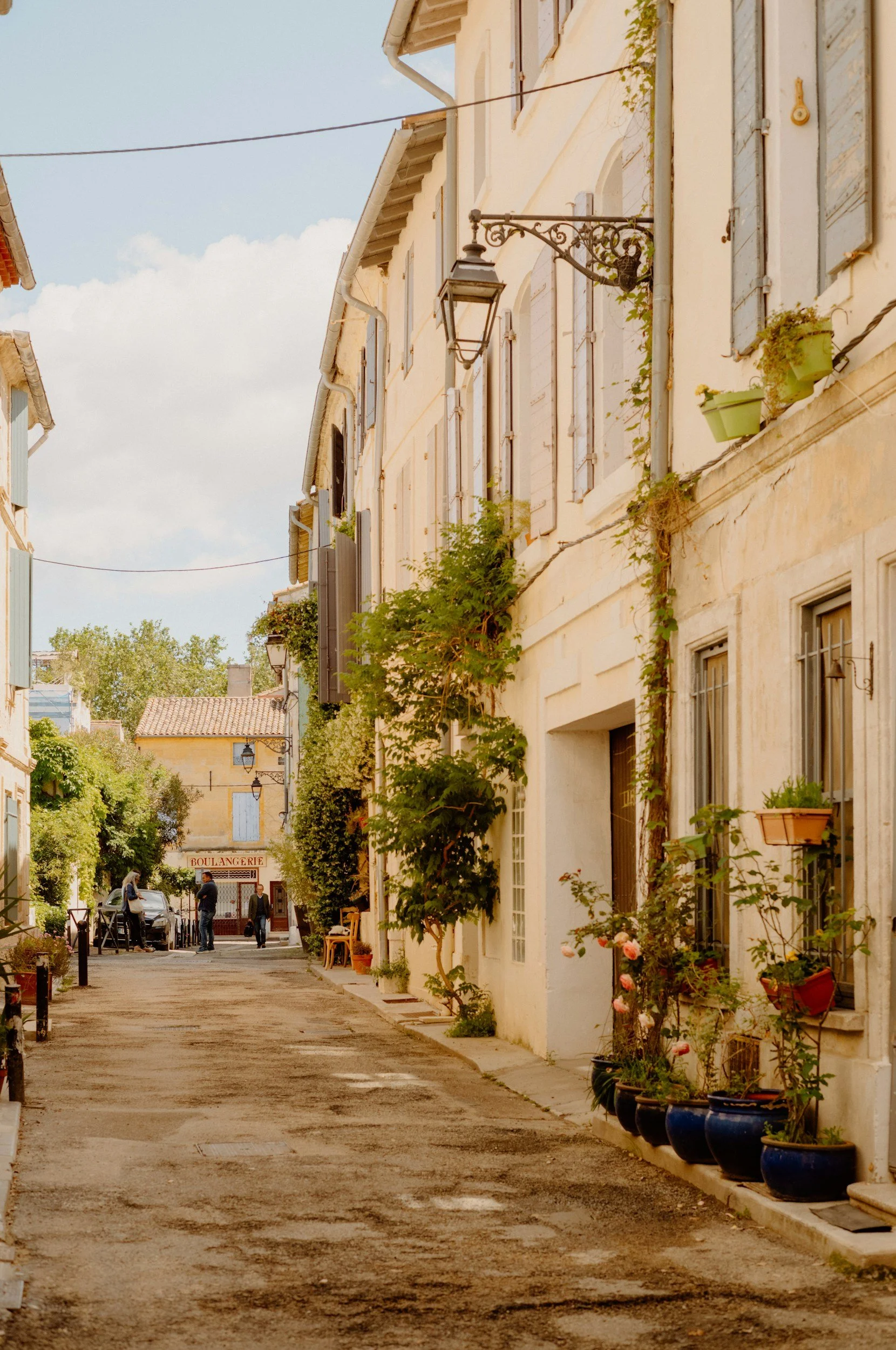
Provence markets only make sense once you start planning your days around them instead of trying to fit them in. A Saturday in Apt, a Wednesday in Uzès, a Sunday in L’Isle-sur-la-Sorgue – they all run on different schedules, and if you get the timing wrong, you end up stuck in slow-moving streets instead of actually seeing anything.
It also shifts more than people expect depending on where you are. A morning in L’Isle-sur-la-Sorgue means thinking about parking outside the center and walking in early before the antique stalls fill up. In Lourmarin, you can arrive later without it becoming stressful, and it works better combined with a long lunch. In Saint-Rémy, the central streets get tight quickly, but a few turns away it opens up again. These small differences matter more than the market itself.
Season changes everything as well. In April, you can move through most markets without adjusting your pace and actually talk to vendors. In July, the same towns require an early start if you don’t want to spend the morning navigating crowds. By September, places like Vaison-la-Romaine or Nyons feel more grounded again, and you can stay longer without planning your exit.
This is a guide to the towns where the market is worth building your day around, from spring through autumn, with the details that usually get overlooked. When to arrive, where it gets tight, how far you’ll end up walking, and what to pair it with so the day feels relaxed.
Spring in Provence often overlaps with other places that feel similar. You see it in the botanical gardens across Europe, where everything starts opening up at the same time
Late March to April – first proper market days in smaller towns, asparagus and strawberries start showing up
If you go to a market in Provence in early April, it feels like things are just starting up again rather than fully in season. In Apt on a Saturday or Uzès during the week, you’ll notice small gaps between stalls and a few regular vendors still missing. It’s not empty, just a bit uneven. Some stands are busy and fully set up, others are still arriving or keeping things simple.
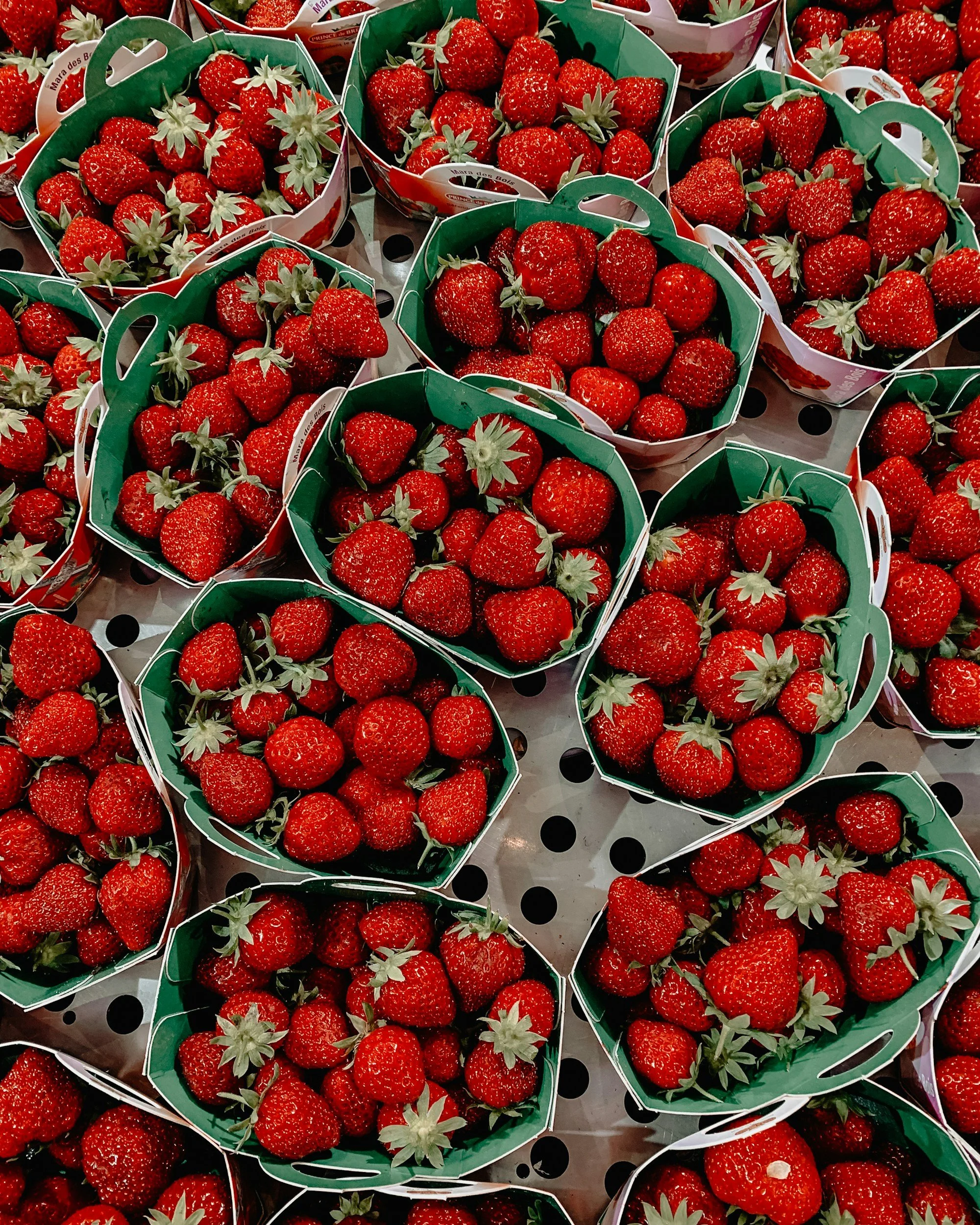
What you do see straight away is the change in produce. White asparagus shows up first, usually stacked in tight bundles with a handwritten sign, often from farms just outside town. A week or two later, green asparagus starts appearing in bigger quantities. Strawberries are already there as well, especially around the Luberon, but they’re smaller and softer than the ones later in summer. They’re often sold in shallow trays, sometimes still a bit dusty from the field.
If you get there early, around 8:00 in Uzès on Place aux Herbes or along the main market streets in Apt, the setup is still happening. Vans are parked close behind the stalls, crates are being carried out, tables are being arranged. By 9:30 everything is in place, but it’s still easy to move around. You don’t need to think about where you’re standing or constantly step aside. It’s one of the few times of year where you can take your time without it turning into a slow shuffle.
Parking is simple in spring. In Apt, you can leave the car near Avenue Victor Hugo and walk in within a few minutes without any stress. In Uzès, the parking areas around Boulevard Charles Gide usually have space in the morning, and it’s an easy walk into the center. No circling, no waiting.
A good way to structure the morning is to walk the market first, then sit down. Do one full round while it’s still quiet, buy what you actually want, and then find a café once more people start arriving. In Uzès, the cafés around the square begin filling around 10:00, but you can still get a table without waiting if you’re a bit flexible. In Apt, it’s easier if you step a street or two away from the busiest part, where things feel a bit more relaxed and you’re not surrounded by people coming and going all the time.
Early in the season, markets tend to feel quieter, especially if you combine them with slower countryside days like this side of Provence in April.
May to early June – when Provence markets feel the most normal (and easiest to plan around)
By May, everything feels more settled. If you go to Apt on a Saturday or Saint-Rémy on a Wednesday, the same vendors are back in the same spots every week. The cheese stall that was missing in April is there again, the olive stand is fully stocked, and the bakery van is parked in its usual place just behind the market square. After a couple of visits, you start recognizing who sells what and where to go first without thinking about it.
There are still visitors around, but mornings feel more local again, especially before 10:00. You’ll see people doing a full shop rather than just browsing, carrying baskets, stopping at multiple stalls, chatting with vendors they clearly know. It changes the pace of the market without making it slow.
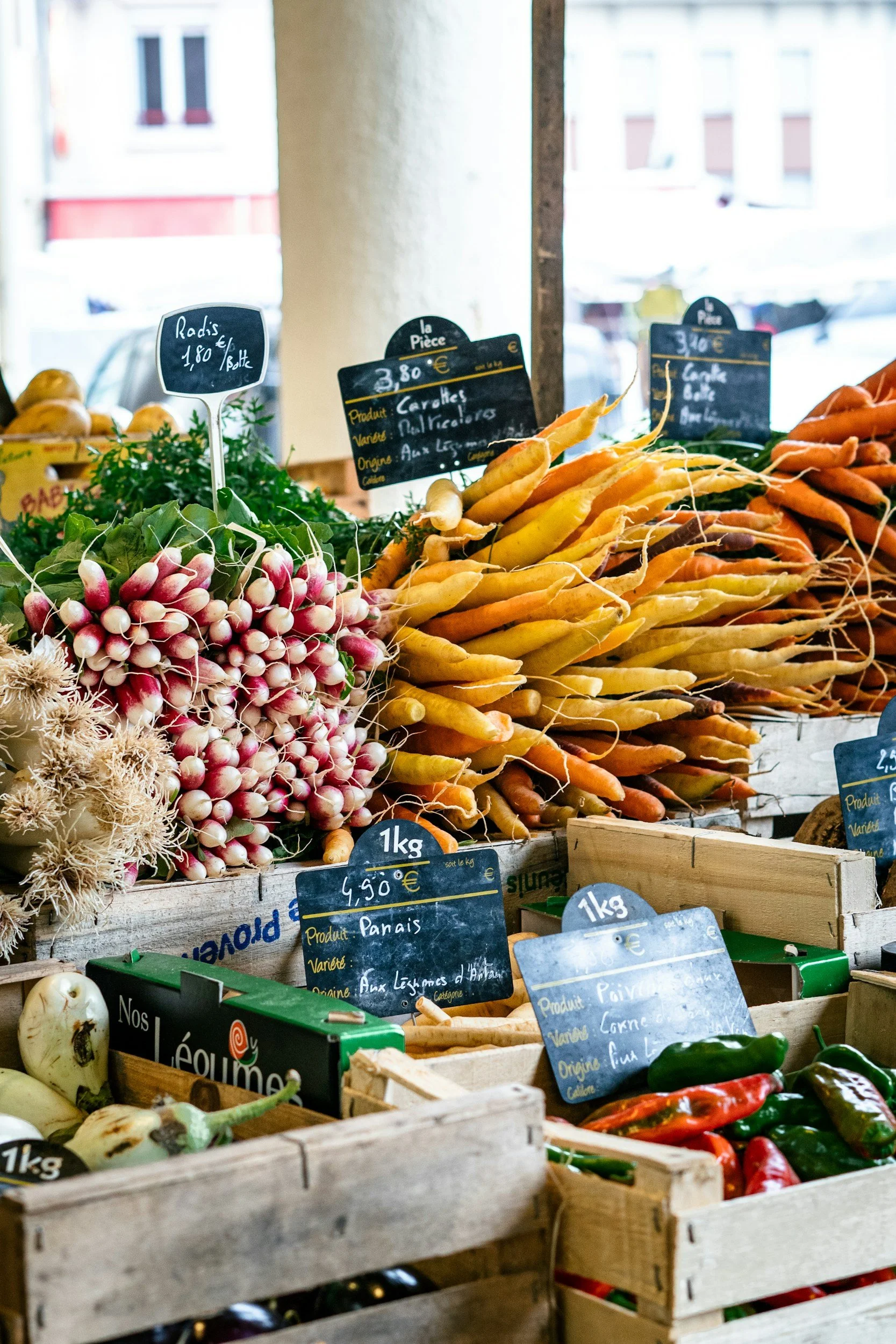
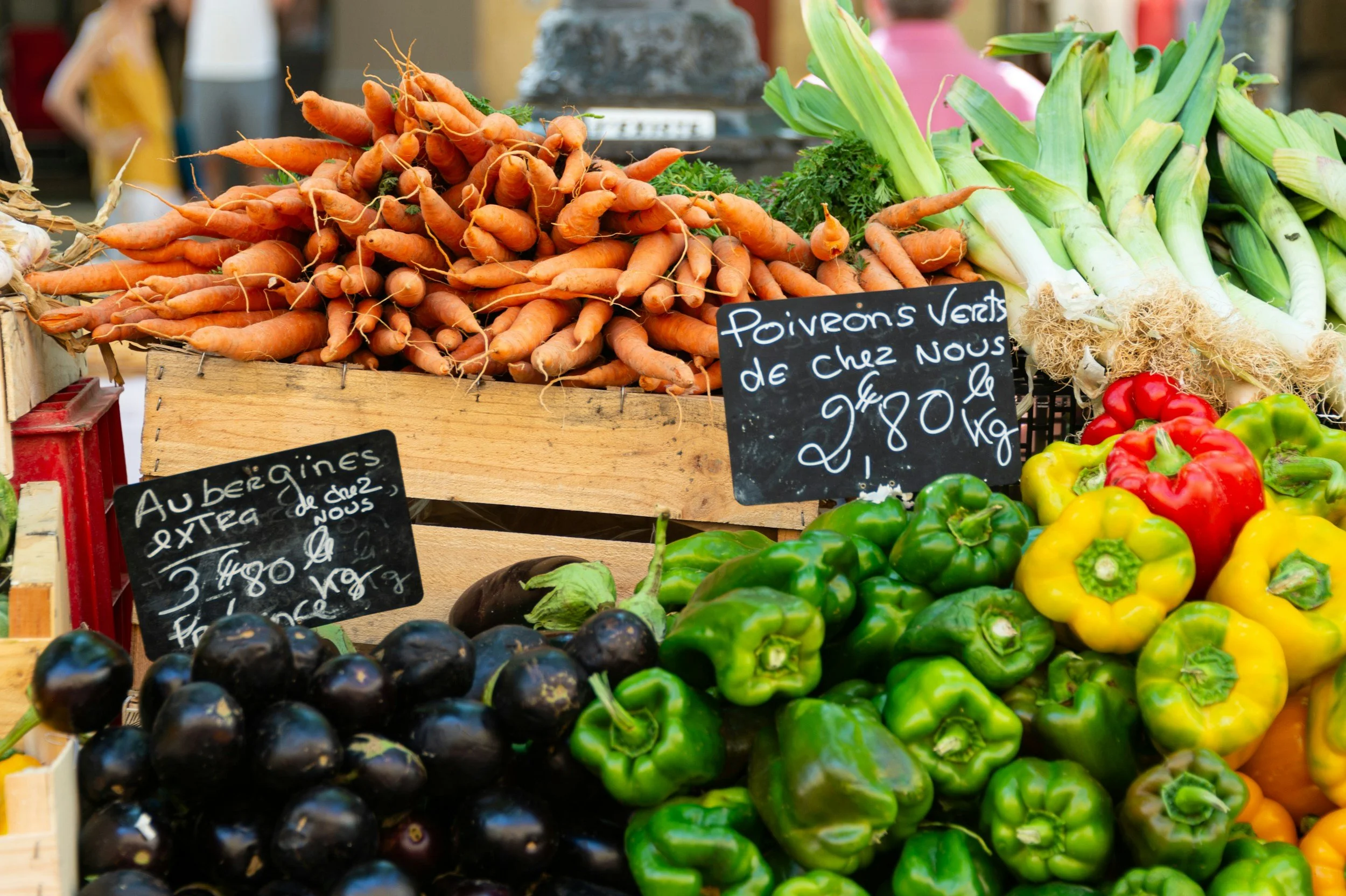
The produce is also much more varied now. Tomatoes start showing up in different varieties, not just one type, and they actually smell like something when you walk past. Courgettes are consistent across most stalls, often with the flowers still attached. Fresh herbs take up entire sections of tables, and you’ll notice more food that’s ready to eat, like roast chicken turning on spits, small containers of tapenade, or trays of prepared dishes people pick up for lunch. Cheese stalls expand as well, with more choice than earlier in spring, and bakeries bring out fougasse and small pastries alongside the usual bread.
You don’t need to rush in May. Arriving somewhere between 8:30 and 10:30 works well in most towns. In Saint-Rémy, the central streets fill up gradually but still feel manageable mid-morning. In Lourmarin, you can arrive even closer to 10:00 and still move around easily without it turning into a slow walk.
Getting between towns is simple at this time of year. Roads through the Luberon, around Gordes, or between Uzès and the smaller villages nearby are quiet enough that you don’t need to plan around traffic. It’s easy to stay in one place for a few days and drive out to different markets depending on the day, without it feeling like you’re constantly on the move.
If you’re visiting in late spring, it’s one of the easiest times to plan a route where markets line up naturally across the week, like in this Provence in May itinerary.
July to August – early starts matter more than the market itself
Summer changes things quickly, and you notice it the moment you arrive. In Saint-Rémy on a Wednesday or L’Isle-sur-la-Sorgue on a Sunday, the streets start filling before you’ve even had time to get your bearings. By 9:30, the central areas are already tight, especially around the main squares and the streets closest to the cafés. Parking becomes part of the plan as well. If you arrive late, you’ll likely end up leaving the car further out and walking in longer than expected.
If you still want to go to these markets, it really comes down to timing. Getting there around 8:00 or slightly earlier makes a big difference. You can walk through properly, stop where you want, and actually buy things without standing in the middle of a slow-moving crowd. In L’Isle-sur-la-Sorgue, this also gives you time to see part of the antique section before it fills. In Saint-Rémy, you can move through the central streets before they become difficult to navigate.
If you prefer something less intense, it’s easier to focus on inland villages. Markets in Lourmarin on a Friday or Bonnieux on a quieter day are still busy, but the scale is smaller, so it never turns into the same kind of congestion. You can arrive around 9:30 or even later and still move around without constantly adjusting your path. These are the kinds of places where it’s easier to slow down a bit, walk through once, and then sit down without feeling like you need to leave quickly.
The heat changes how long you’ll want to stay. By 11:00, especially in July, it becomes noticeably warmer, and the combination of narrow streets and more people makes it tiring to stay too long. It works better to treat the market as something you do early, then move on. Either back to where you’re staying for a break, or straight into a long lunch somewhere with shade. Trying to stretch the morning usually just makes it feel longer than it needs to be.
Later in the season, it makes more sense to combine markets with quieter lavender areas rather than the main routes. There are some local gem we have shared in this guide.
September to October – when markets calm down and you can stay longer
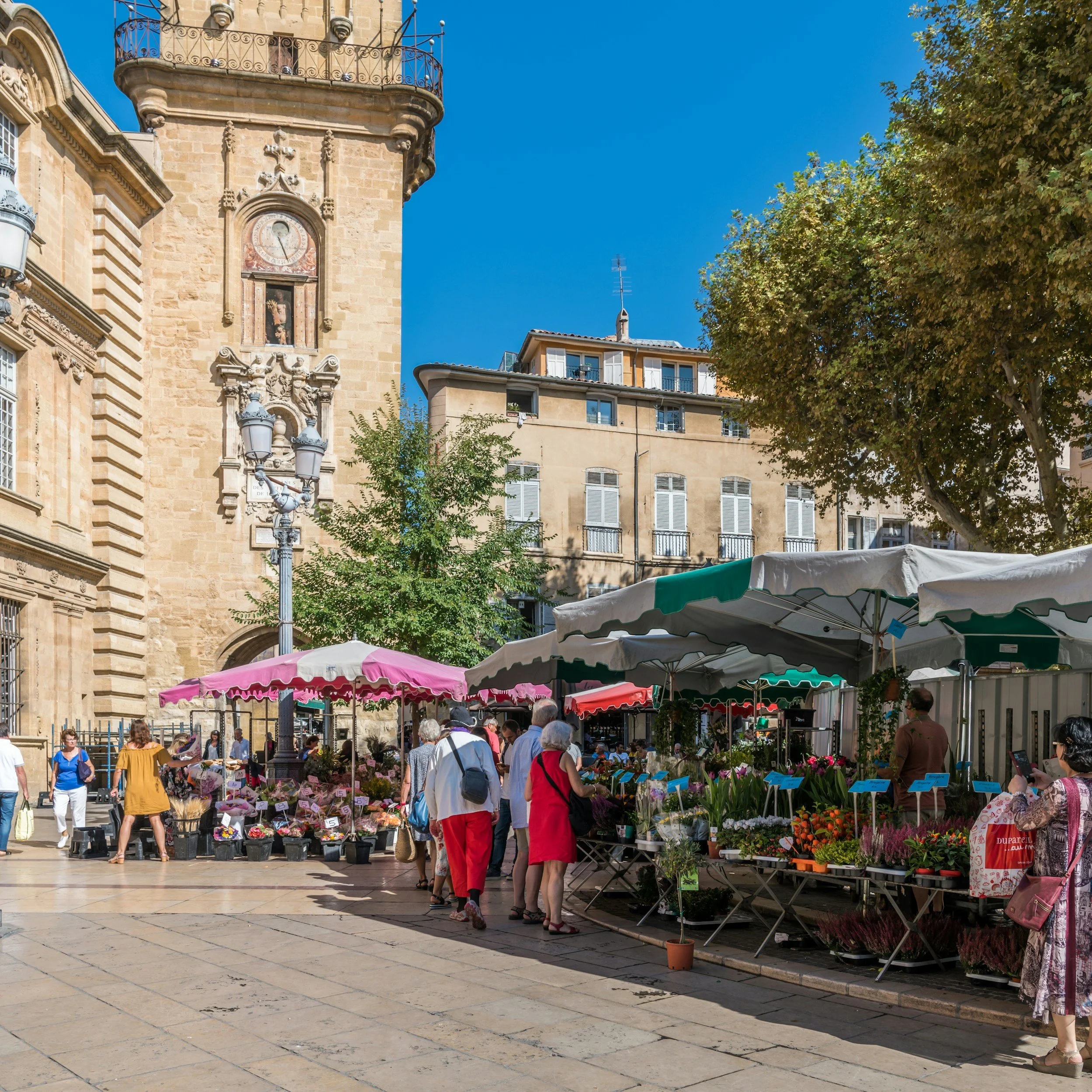
By September, it feels different straight away. In Vaison-la-Romaine on a Tuesday or Uzès during the week, you’re not stuck in a slow-moving crowd anymore. You can walk normally, stop when you want, and go back to a stall without having to squeeze through people. Even around the busier streets, there’s just more space.
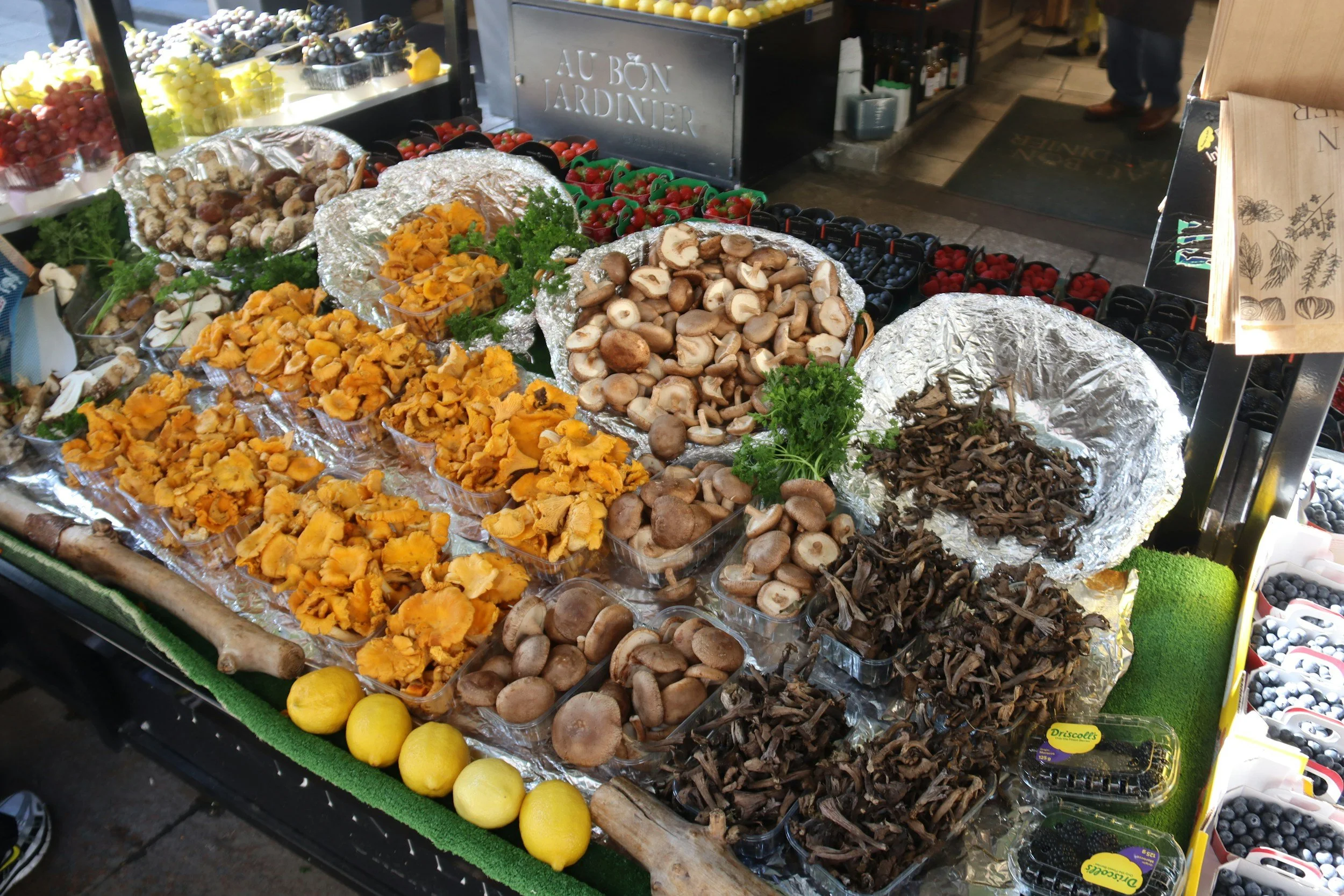
The produce changes as well, and it’s easy to notice without thinking about it too much. Grapes start taking over a lot of the tables, often in different varieties depending on the stall. Figs are everywhere early in the season, usually soft and sold in small trays rather than big piles. Later on, especially in October, you’ll see more mushrooms, pumpkins, and chestnuts, particularly in places like Nyons where the surrounding area brings in slightly different products than the Luberon.
You don’t need to plan your timing the same way as in summer. Turning up around 9:30 works in most towns, and even later can still be fine if it’s not a weekend. In Vaison-la-Romaine, the market spreads out enough that it never feels too tight. In Uzès, the square fills up, but you can still move around without having to constantly step aside.
Getting around is easier as well. Driving between villages in the Luberon, heading up towards Nyons, or across to Vaison-la-Romaine doesn’t take much thought. Roads are quieter, and you’re not dealing with the same traffic as in July and August. It makes it simple to plan a few different market days in the same trip without it turning into long drives.
Parking is the same. You can usually find a spot within a short walk of the center without circling for ages. Most of the time, it’s a five to ten minute walk in, and you don’t need to build your morning around finding somewhere to leave the car.
The same places feel different later in the year, especially in Uzès in autumn when everything slows down again.
L’Isle-sur-la-Sorgue on a Sunday (antiques, food stalls, early arrival matters)
Arriving before 9am vs after 10:30
Sunday in L’Isle-sur-la-Sorgue depends almost entirely on when you arrive. If you get there around 8:00–8:30, it still feels like a working town rather than a busy market day. Along Quai Jean Jaurès, vans are parked with back doors open, vendors are unloading crates of vegetables, folding tables are still being adjusted, and the antique dealers along the Sorgue are laying things out piece by piece instead of everything being packed together.
At that time, you can walk the full loop along the canals without stopping every few steps. Crossing the small bridges near Avenue des Quatre Otages takes seconds instead of minutes, and you can move between the food stalls and the antique sections without getting pulled into a slow-moving line of people. The stretch between Place Ferdinand Buisson and the river is still open enough that you can double back if you want to compare a few stalls.
If you arrive after 10:30, it shifts quickly. The antique areas along the water fill first, especially near the bridges, and then the narrower streets just behind them follow. You’re no longer choosing where to go, you’re just moving with the crowd. It’s still interesting to see, but you spend more time navigating than actually looking.
The easiest way to approach it is to arrive around 8:15 and start with the food side. Walk through the produce stalls around Place Ferdinand Buisson while everything is still easy to access, pick up what you want, then head towards the antiques along the river before that area fills up. By around 10:00, you’ll notice the pace changing, which is usually a good point to step away.
Getting there is quite easy, but it helps to plan it slightly. From Avignon, the drive takes around 30 minutes via D900, and from Aix-en-Provence it’s closer to 50 minutes depending on traffic. If you’re staying in the Luberon, places like Gordes or Bonnieux are about 20–30 minutes away by car. There is also a small train station, L’Isle-sur-la-Sorgue - Fontaine-de-Vaucluse Station, with connections from Avignon, but on Sundays the timing can be limiting, so it’s worth checking return options in advance.
For parking, it’s easier to avoid the center completely. Aim for areas near Avenue de la Libération or along Route de Cavaillon, where larger parking areas are easier to access. From there, it’s about a 10–12 minute walk into town along wider streets, and you avoid getting stuck trying to exit later. If you try to park closer after 9:00, you’ll likely spend longer circling than walking.
Once it starts getting busy, stepping just a few streets away changes the experience completely. If you walk away from the river towards Rue Carnot or the quieter residential streets behind it, it’s noticeably calmer. Small cafés there are easier to get into, and you can sit down without feeling like you need to leave quickly. It’s a good place to pause, have a coffee, and decide if you want to go back in or leave before the late-morning rush builds further.
Where locals actually shop at l’isle-sur-la-sorgue market (and where it turns touristy)
If you want to see the market as part of everyday life, stay around the food stalls first, especially near Place Ferdinand Buisson and the streets just behind it like Rue de la République. Early in the morning, this is where people are actually shopping. You’ll notice it straight away. People come with baskets or rolling carts, stop at the same vegetable stall, then move on to cheese, then bread. It’s not wandering, it’s a routine.
The fruit and vegetable stands here are busiest before 9:30. Some have short queues, especially for seasonal things like strawberries or asparagus, and they move quickly. Cheese stalls closer to the center, especially the smaller ones with a limited selection, tend to have regulars who know exactly what they’re buying. The bakery stands are worth paying attention to as well. Fougasse and smaller pastries go early, so if you see people lining up, that’s usually a good sign.
Once you walk towards the river, it changes quite quickly. Along Quai Jean Jaurès and across the small bridges near Avenue des Quatre Otages, people slow down a lot. You’ll see more stopping in the middle of the street, more photos, more browsing. The antique stalls stretch along both sides of the Sorgue, and this is where most visitors spend their time. It’s still worth seeing, but it’s a completely different pace and it takes much longer to move through.
If you want both sides of it without getting stuck, do the food market first while it still feels like a normal morning, then head towards the antiques once you’ve already bought what you need.
Where to park for l’isle-sur-la-sorgue sunday market (and how to walk in easily)
Parking right in the center on a Sunday usually isn’t worth the effort. The small streets near the canals fill up early, and even if you find a spot, getting out later can take longer than the visit itself.
It’s much easier to aim slightly outside from the start. Areas near Avenue de la Libération or along Route de Cavaillon are more reliable, with larger parking areas and less pressure. From there, it’s about a 10 to 12 minute walk into the center. You come in through wider streets first, then gradually reach the market, which feels a lot easier than trying to drive straight into it.
If you arrive before 9:00, you might find something closer, but it rarely saves much time. Most of the time, it just adds stress trying to get through narrow streets that are already filling up.
If you’re coming from the southern side, you can follow parts of the Sorgue on your way in. It’s an easy, flat walk and brings you in along the canals rather than through the busiest entry points.
When you leave, this makes a big difference. Instead of sitting in slow traffic through the center, you’re already close to the main roads and can get out quickly without thinking about it.
Cafés to sit down once the crowds build (which side streets stay calmer)
Once it fills up, the cafés right along the canals, especially around Quai Jean Jaurès, get busy fast. Between 10:00 and 11:30, you’ll often see people waiting for tables, and even when you sit down, it can feel a bit rushed with people standing nearby hoping you’ll leave.
It’s much easier if you step away slightly. Around Rue Carnot, a few minutes from the main flow, places like Café Fleurs are a good option if you want something calm but still central. It’s small, simple, and doesn’t get the same pressure as the spots right by the water.
If you want something a bit more settled where you can sit longer, Le Carré d’Herbes is just far enough from the busiest streets that it feels easier to breathe. It’s the kind of place where people stay for a while rather than just stopping quickly.
Closer to the antiques area but still slightly removed from the tightest spots, Café de France works well if you want to pause without leaving the center completely. It’s still busy, but not as intense as the cafés directly along the canals.
If you’re okay walking a bit further out, the streets behind the main market routes have a few quieter options where it feels more like a normal morning café stop. These don’t have the same views, but they’re much more comfortable if you’ve already spent time in the crowd and just want to sit without being surrounded by it.
Timing still matters. Sitting down before 10:00 works if you’ve already done a quick round of the market, or waiting until closer to midday when people start leaving makes it easier to find a table without waiting.
L’Isle-sur-la-Sorgue is definitely worth it if you go early and treat it as a morning rather than a full day. This guide go deeper into this charming market.
Apt market on Saturdays (one of the oldest in Provence, still very local)
If you’re staying in the Luberon, getting to Apt is easy with a car and a bit awkward without one. From Bonnieux or Roussillon, it’s about 20–25 minutes along D900. The road drops down into Apt, and you’ll usually notice a bit more traffic just before you reach the roundabout near Avenue Victor Hugo. That’s your sign you’re close.
If you get there before 9:00, parking is simple. The easiest spots are around Avenue Victor Hugo or the larger parking areas near Cours Lauze de Perret. From there, it’s a short walk, maybe 5–8 minutes, straight into the market. You avoid the narrow streets completely, which makes leaving later much easier.
Without a car, you can get there by bus, but you need to check the return times properly. On Saturdays, they don’t run often, and it’s easy to end up watching the clock instead of enjoying the market.
What Apt market actually feels like compared to smaller Luberon markets
Apt is bigger than the smaller village markets, and you notice it straight away. It doesn’t sit in one square. It spreads across several streets, especially around Cours Lauze de Perret, and it takes a bit of time to walk through properly.
There’s more choice here. Not just one stall selling tomatoes, but several, each with slightly different varieties. Same with herbs, fruit, cheese. You can compare things without trying to hunt for it.
You’ll also see stalls that don’t show up in smaller places. Clothes, fabrics, kitchen tools, everyday things. It feels more like a weekly shop than something you just pass through.
And the way people move is different. In Lourmarin, people drift. In Apt, people come with a plan. They stop at specific stalls, fill their bags, and move on. You can tell who’s been coming here for years.
Best time to go to Apt market without getting stuck in crowds
If you want it easy, aim for 8:30. You’ll have space, you can walk freely, and you don’t have to think about where you’re going.
Around 9:30, it starts filling, but it’s still fine. You’ll notice more people, but the streets are wide enough that it doesn’t feel tight.
After 10:00, it changes. More visitors arrive, and the main streets like Cours Lauze de Perret slow down. You’re not stuck, but you’re moving at someone else’s pace instead of your own.
The easiest way to do it is to go early, walk the whole market once, then leave before it gets busy instead of trying to push through it.
What to do after Apt market (walk up into the quieter streets)
Once you’re done with the market, don’t stay in the same area. It starts to feel repetitive if you do.
Walk up towards Cathédrale Sainte-Anne. It’s only a few minutes away, but it’s noticeably quieter. The streets get narrower, there are fewer people, and it feels like a different part of town.
You don’t need a plan here. Just walk. 30–40 minutes is enough to slow things down again before deciding what to do next.
If you go straight from the market back to the car, it feels a bit rushed. This small detour makes the whole morning feel more complete without adding anything complicated.
Uzès Market Days (Wednesday and Saturday mornings around Place aux Herbes)
Uzès is one of the few markets where you don’t really need a strategy. Everything sits around Place aux Herbes and spills into a few streets just around it, so you’re never far from anything. Once you’re in the square, you’ll naturally loop through everything without trying.
Place aux Herbes before 9:30 vs midday
If you get there before 9:30, it’s easy. The stalls are up, but there’s still space to walk across the square without stopping. You can cut through the middle, step into Rue Jacques d’Uzès, loop back via Rue du 4 Septembre, and not get stuck anywhere.
You’ll notice small things at that time. Vendors still adjusting their tables, adding more produce, chatting with people they clearly know. It feels like a normal morning.
By around 11:30, it fills up, especially along the edges where the cafés are and under the arcades. The tightest spots are where the smaller streets meet the square, especially near Rue Jacques d’Uzès. You’re moving slower, but you’re still moving. It never turns into a complete standstill.
If it starts to feel too busy, just walk around the edge of the square instead of straight through the middle, or step out towards Boulevard Gambetta for a few minutes.
Where to get coffee before the market (easy spots right by the square)
If you arrive early, it’s worth having coffee first before going into the market.
Right on the square, Café de l’Univers is one of the easiest places. You can sit facing Place aux Herbes, watch everything being set up, and then walk straight into the market when you’re ready.
If you want something a bit quieter, La Fille des Vignes is just a few minutes away and doesn’t have the same flow of people passing by all the time.
For bakeries, just step into Rue Jacques d’Uzès or Rue du 4 Septembre. There are a few small places where you can grab a croissant or something simple without waiting long. Everything is within a couple of minutes, so you don’t need to plan it.
Where to park or stay (what actually makes the morning easier)
If you’re driving in, don’t aim for the center. It’s easier to park around Boulevard Charles Gide or Avenue Général Vincent and walk in. It’s about 5–10 minutes, flat, and you avoid dealing with the narrow streets closer to the square.
If you’re staying overnight, it’s much easier to stay within walking distance of Place aux Herbes. Even being a few streets away makes a difference. You can go early, go back, and head out again without thinking about the car at all.
Uzès is small, so you don’t need to be right on the square. Anywhere in or just outside the center works.
What to do after the market (Where to walk once Place aux Herbes fills up)
Once you’ve walked the full loop around Place aux Herbes and the nearby streets, it helps to step away instead of circling the same square again. The difference is noticeable within a couple of minutes.
From the square, take Rue du 4 Septembre and continue out towards Rue du Docteur Blanchard. The moment you leave the edge of the market, it gets quieter. Fewer stalls, fewer people stopping in the middle of the street, and you can walk at a normal pace again. If you keep going a bit further, you’ll reach Boulevard Gambetta, which feels more like a regular town street than part of the market.
Another easy option is to walk in the opposite direction from the square towards Rue de la Grande Bourgade. It’s a narrow street with small shops and fewer people, and it gives you a short break from the busier parts without needing to think about where you’re going.
If you’re staying for lunch, it’s easier to sit just outside the square rather than directly on it. Around the streets just off Place aux Herbes, you can usually find a table without waiting, especially if you avoid the exact corners of the square. If you prefer to stay central, it’s better to wait until closer to midday when the first wave of people has started to leave.
Uzès is one of the easiest places to stay for a few days and build your mornings around the market, especially in spring.
Saint-Rémy-de-Provence Market (Wednesday mornings that fill up fast in the center)
Saint-Rémy’s market looks big on paper, but most people stay in the same central streets, which is why it feels crowded quickly. The moment you step a bit further out, it changes.
Arriving from Avignon or nearby villages (where to park without wasting time)
From Avignon, it’s about 25 minutes via D571. As you get closer, you’ll feel it slowing slightly near the roundabout by Avenue de la Libération, especially after 9:00 when more people are arriving at the same time.
If you get there before 9:00, don’t try to go into the center. It’s easier to park along Avenue de la Libération or near Boulevard Marceau and walk in. It’s about 5–10 minutes, flat, and you avoid getting stuck in the narrow streets around Place de la République.
If you drive further in, you’ll notice it straight away. The streets tighten, cars slow down, and even if you find a space, getting out later takes time.
From places like Eygalières or Maillane, it’s a short drive, often under 15 minutes, but the same thing applies. Park slightly outside and walk in.
Which Streets fill first (and how to move without getting stuck)
The busiest area is around Place de la République and Boulevard Mirabeau. That’s where most people enter, and it fills early.
If you stay there, you’ll start noticing it quickly. People stopping in the middle, queues building, and you’re moving at the same pace as everyone else.
The easiest way to handle it is to not stay there too long. Walk through it once, then move outwards. Head towards Avenue Albin Gilles or just keep going in the same direction as the market stretches out. Within a few minutes, it opens up.
You’re still in the market, but you can actually stop, look, and move without thinking about it.
Food Stalls worth waiting for (and which ones to skip)
The stalls that draw lines in Saint-Rémy are easy to spot before you even see the food. You’ll smell them first. Rotisserie chicken turning slowly on metal spits, trays of potatoes cooking underneath catching the juices, and people already standing in a loose line along Boulevard Mirabeau or just off Place de la République.
Those are usually worth it if the line is moving. If you see people getting served every minute or two, you won’t be standing there long. The same goes for stalls selling things like socca or hot prepared dishes in trays. They tend to move quickly because people know what they want before they reach the front.
Where it’s not worth waiting is when the line isn’t moving at all. Sometimes you’ll see a queue that looks reasonable but barely shifts because orders are slower or more complicated. In those cases, just keep walking. If you continue another 50–100 meters along the market, especially further out from Place de la République, you’ll almost always find another rotisserie or prepared food stall with a shorter line and the same setup.
It also helps to do one full walk through before buying anything hot. That way you see where the queues are, where they move quickly, and where it’s easier to stop without standing in the middle of the street. If you stop at the first busy stall you see, you’ll often end up waiting longer than you need to.
What to do after the market (where to walk once the center gets too full)
Once you’ve done a full loop, don’t stay around Place de la République. It starts to feel repetitive quite quickly, especially once it’s busy and you’re moving at the same pace as everyone else.
Instead, walk out in the direction of Avenue Albin Gilles. As you move away from Boulevard Mirabeau, the stalls start thinning out and within a few minutes, you’re out of the main market flow. You’ll notice the change straight away. Fewer people, wider space, and you can walk without having to adjust your steps constantly.
If you keep going a bit further, you’ll pass into quieter residential streets where there’s no market at all. Around the edges of town, near smaller side streets off Avenue Albin Gilles, it feels like a completely different place compared to the center.
Another easy option is to walk in the opposite direction from Place de la République towards Rue Carnot, then continue outwards. It’s still central, but noticeably calmer, with fewer people stopping in the middle of the street.
If you want to extend the morning slightly, this is where it works best. Walk for 20–30 minutes, then either head back towards the center once it has eased a bit or find a café just outside the busiest streets.
Vaison-la-Romaine Market on Tuesday (how to do the market, old town and ruins without rushing)
Vaison-la-Romaine is one of the easier places to plan because everything is right next to each other. The market sits in the lower town, the Roman ruins are just a short walk away, and the old hill town is directly above. Once you park, you won’t need the car again.
How to split the market and the Old Hill Town (the exact route that works best)
Start in the lower town around Place Montfort and follow the market as it stretches along Avenue Général de Gaulle and into the smaller connecting streets. It’s spread out enough that you don’t need to plan a route, just keep moving in one direction and you’ll naturally cover most of it.
If you arrive around 8:30–9:00, you can walk the whole market without getting slowed down. This is when it still feels easy to stop, step aside, and go back if you passed something. By 9:30, it’s busier but still manageable. After that, it starts to tighten, especially closer to Place Montfort.
Once you’ve done one full loop, don’t stay in the same area. Head towards Pont Romain. From Place Montfort, it’s a 3–4 minute walk, and you’ll start seeing signs for the bridge or notice the flow of people moving in that direction.
Crossing the bridge takes less than a minute, but it changes the pace straight away. As soon as you’re on the other side, the streets narrow, the noise drops, and there are fewer people. You’re in the medieval hill town without needing to think about it.
From the bridge, just follow the incline upwards. Streets like Rue de l’Évêché and the small lanes branching off it pull you further in. It’s a steady uphill walk, not steep, but enough that you won’t rush through it.
Where to Park
Parking is easier here than in most Provence towns, but it still helps to keep it simple.
The easiest option is Parking des Cordeliers or anywhere along Avenue Général de Gaulle. From there, it’s about a 5–8 minute walk into the market.
If you try to get closer to Place Montfort, you’ll notice the streets tightening and cars slowing down, especially after 9:00. It’s usually not worth the extra effort.
Parking slightly outside means you can leave quickly as well, without getting stuck when everyone heads out at the same time.
What to buy at Vaison market (what’s actually worth picking up here)
Vaison-la-Romaine is a good place to buy a bit of everything without needing to think too much about it. It’s not a market you go to for one specific thing. It’s where you pick up what you need and move on.
Along Avenue Général de Gaulle, you’ll pass several fruit and vegetable stalls one after another. It’s worth slowing down here for a few minutes because the same products show up in slightly different quality. One stall might have better tomatoes, another better peaches, and the difference is usually visible without asking. Most people do a quick first walk, then come back to the stall they preferred.
Closer to Place Montfort, you’ll find the cheese and olive stands. These are easy to spot because people tend to stop longer here. If you’re buying cheese, it’s usually better to go for something simple and local rather than trying to choose between too many options. The vendors will often cut exactly what you ask for, so you don’t need to take more than you’ll eat.
The rotisserie stalls are usually set up along the main flow of the market, often with chickens turning slowly and trays of potatoes underneath. You’ll smell them before you see them. If you’re planning lunch, this is one of the easiest things to pick up. The lines look long, but they tend to move steadily.
Bread is also easy here. Several bakery stands are spread through the market, and most people just stop at whichever one they reach at the right moment. If you see fougasse or smaller loaves that look fresh, it’s worth picking them up early before they sell out.
This is not a market where you need to search for something specific or wait for the “best” stall. It works better if you keep it simple. Walk once, notice what looks good, then go back and buy a few things rather than trying to make perfect choices.
When to visit the Roman Ruins
Once you’ve done the market and it starts slowing, don’t stay around Place Montfort. That’s usually the point where it feels repetitive and a bit crowded.
From Place Montfort, walk down towards the river Ouvèze and follow the signs for the Roman sites. It’s an easy 5–10 minute walk, mostly flat, and you’ll see the entrance areas as you get closer. You’ll pass open spaces and trees, and it already starts to feel less busy before you even reach the ruins.
The main areas, like Puymin and La Villasse, are spread out, so you’re not walking through narrow streets anymore. After the market, the difference is obvious. More space, fewer people, and you’re not constantly adjusting where you’re walking.
Going at this point works well because you’ve already done the busiest part of the morning. You move from tight streets to open ground without needing to plan anything or change direction much.
You can do the ruins first, but it usually makes more sense after the market. That way you’re not doing both at the busiest time, and the whole morning flows better without feeling rushed.
Lourmarin Market on Friday (small, easy to walk, and best combined with a slow day)
Lourmarin is one of the easier markets in Provence. It’s smaller, everything is close together, and you don’t need to think too much about where to go. You can see most of it in one loop without checking a map or doubling back.
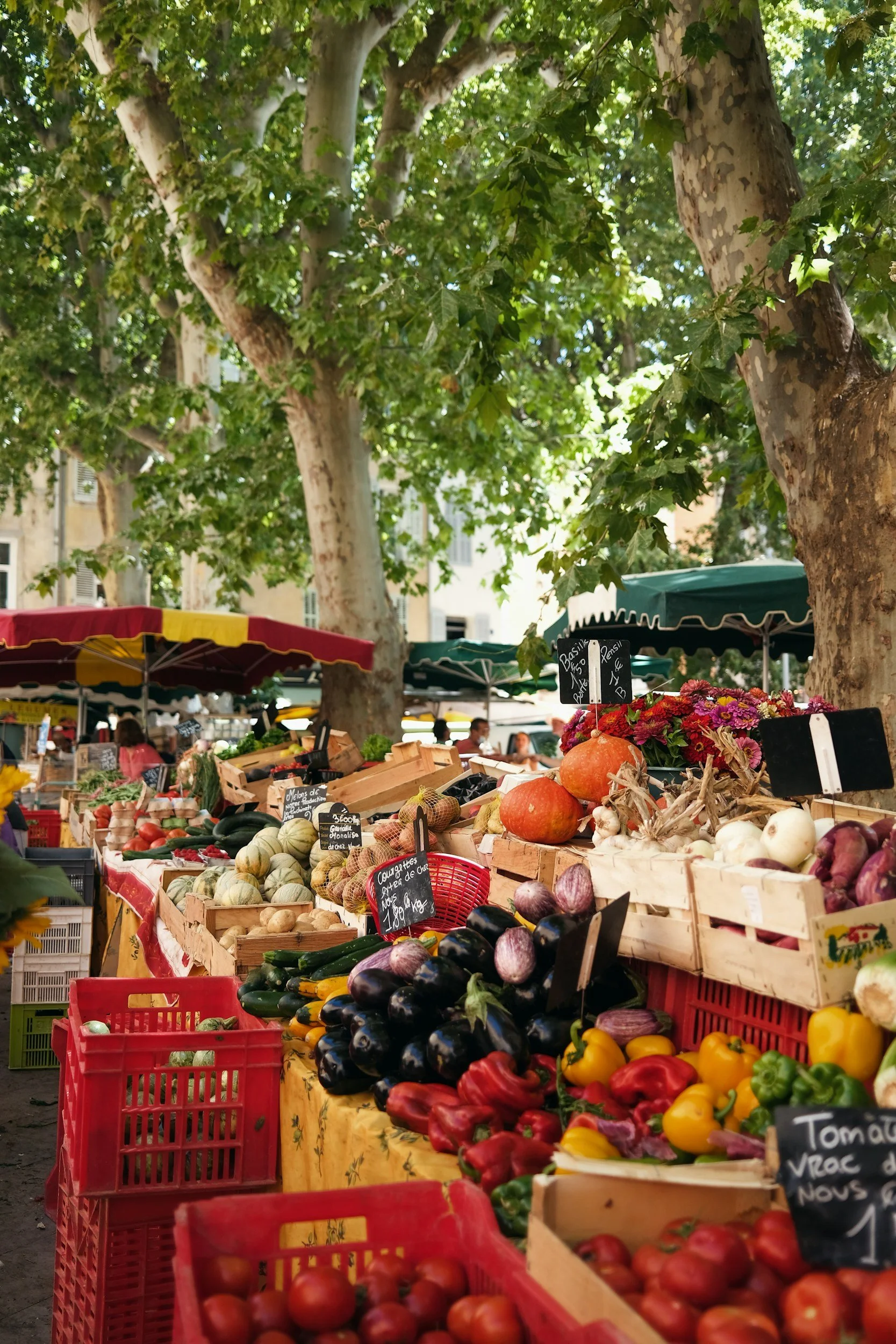
Driving to Lourmarin from Aix or Nearby Villages
From Aix-en-Provence, it’s about 35–40 minutes via D943 and then D973. The road is easy most of the way, then narrows slightly as you get closer to Lourmarin, especially the last stretch coming into the village.
You’ll arrive along Avenue Philippe de Girard, which leads straight towards the center. On Fridays, you’ll start seeing signs for parking before you reach the main square.
The easiest option is to park just outside the center along Avenue Philippe de Girard or in the larger parking areas before the road narrows. From there, it’s a 3–5 minute walk into the market. Trying to drive further in usually slows you down without saving any time.
From villages like Bonnieux, Cucuron or Lauris, it’s usually 10–20 minutes, and traffic is light compared to the more popular hill towns.
When to arrive (why this is one of the few markets you don’t need to rush)
Lourmarin is one of the few markets where showing up early doesn’t really change much.
If you arrive around 9:30–10:30, everything is already in place. Stalls are fully set up along Avenue Philippe de Girard, and the smaller streets leading towards the château, especially Rue Henri de Savornin, are already active. You can walk straight in from the main road, pass the first line of produce stalls, and just keep moving without stopping or waiting for anything to open.
The market is compact, so you’ll naturally loop through it. Most people start near the main street, drift towards the château end, then circle back through one of the side streets. It takes around 30–40 minutes without rushing, even if you stop a few times.
Closer to 11:00–11:30, it fills a bit more, especially near the entrance along Avenue Philippe de Girard where people first arrive. But once you move a little further in, towards Rue Henri de Savornin or the streets just behind it, there’s still space to walk normally. You’re not getting pushed along or stuck behind people.
The only part that gets slightly tighter is right near the main entry points where people gather or slow down, but it’s easy to move past that within a minute or two.
Combining the market with a vineyard stop
Lourmarin works well for this because you’re already in the middle of the Luberon, but it only works if you keep everything within a short drive.
Once you leave the village, you’re quickly on small roads like D973 and the routes heading towards Bonnieux or Lauris. They’re easy to drive, but narrow in places, and you’ll often end up behind a cyclist or a slower car. So even if something looks close, it rarely feels quick.
The easiest option is to leave Lourmarin just before lunchtime, around 11:30–12:00, when the market starts easing. From Avenue Philippe de Girard, you can head straight out of the village without needing to pass back through the busiest streets.
Château La Canorgue is one of the simplest stops. It’s about 10 minutes away, just outside Bonnieux, and the drive is direct. You don’t need to navigate small village streets to get there.
Domaine de Fontenille is around 15 minutes in the other direction, towards Lauris. The road is slightly more open, and you pass through a mix of vineyards and open countryside on the way.
The key is not trying to do both. If you leave Lourmarin, drive to one place, stay there for a while, and then either head back or continue your day, it feels easy. If you try to add a second or third stop, it quickly turns into more driving than time spent anywhere.
Markets and vineyards often sit close together here, which is why it works to combine them with stops like these vineyards for a relaxed picnic.
Where to sit for lunch after the market
Once you’ve finished walking the market, it’s worth staying in Lourmarin instead of heading straight back to the car. The shift from market to lunch happens naturally here, especially around late morning when people start leaving the stalls.
If you stay near Avenue Philippe de Girard, you’ll see most people settling into the cafés along that stretch. Café Gaby is right in the middle of it, facing the main flow of people. It’s an easy option if you want to sit down quickly without thinking too much. Tables turn over fairly fast, so even if it looks full, it usually moves.
If you want something a bit calmer, walk just a couple of minutes away from the main street. La Maison Café sits slightly off the busiest part and feels more settled, especially once the market starts easing.
Around the château side of the village, there are also a few smaller spots tucked into the side streets. If you turn off Avenue Philippe de Girard towards Rue Henri de Savornin and continue a bit further in, it gets noticeably quieter. Within a minute or two, you’re out of the main flow, and it’s easier to find a table without waiting.
Timing makes a difference here. Around 11:30–12:30, the first wave from the market starts sitting down, but it doesn’t hit all at once like in bigger towns. If you arrive just before or just after that, you’ll usually find something without needing to queue.
Nyons on Thursdays (olive-focused, slightly different feel from Luberon towns)
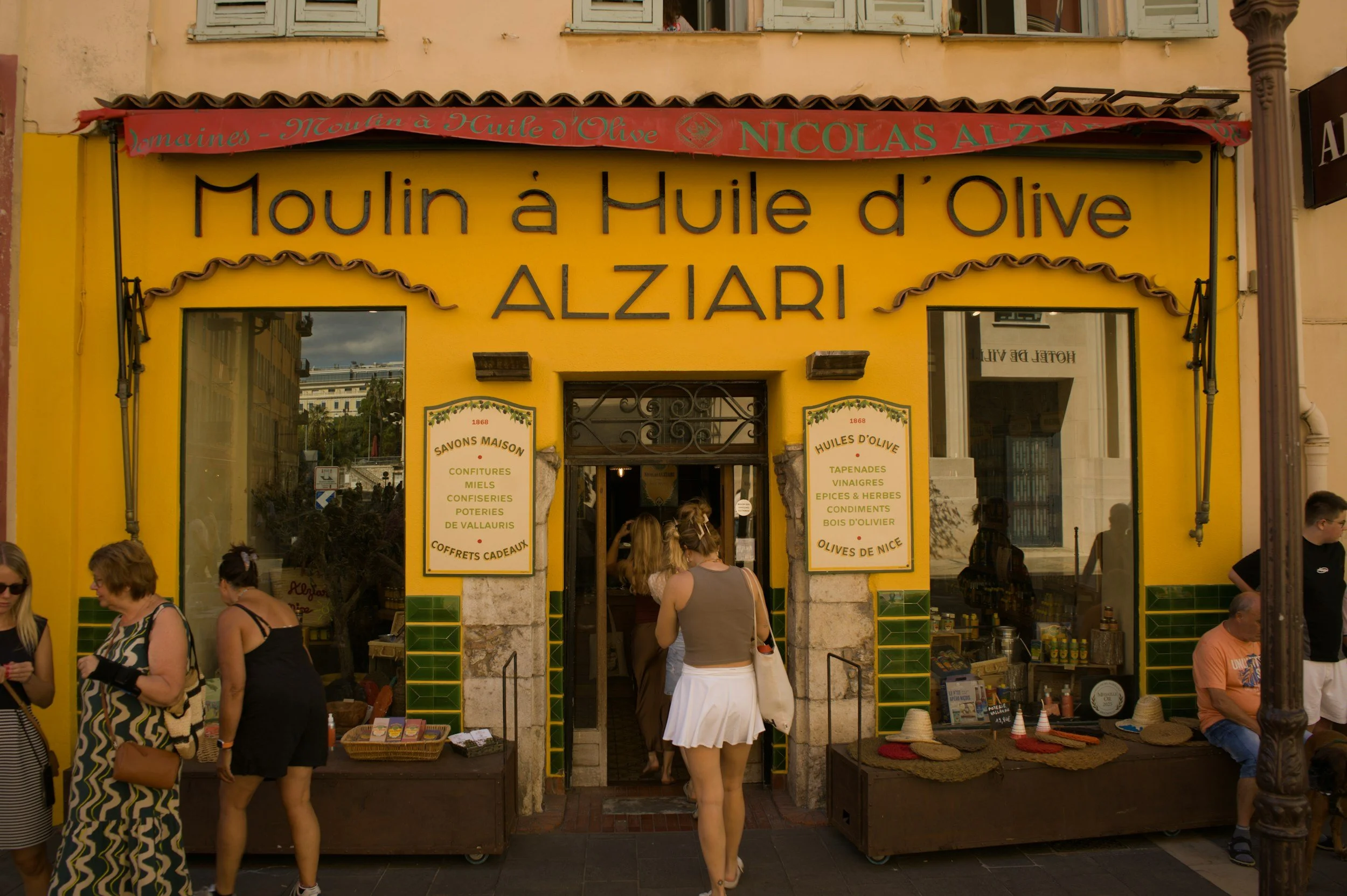
Nyons feels different as soon as you arrive. You’re slightly further north, in the Drôme Provençale, and the market reflects that. It’s less mixed, more focused, and a lot of it revolves around olives.
What makes Nyons market different
As soon as you step into Place des Arcades, it’s obvious you’re not in the Luberon anymore. Instead of one or two olive stalls, there are several grouped close together, often under the stone arcades. Big metal bowls filled with black Nyons olives, smaller ones marinated with herbs or garlic, and rows of glass bottles behind them catching the light.
Most of these stalls are run by local producers, not resellers, so the setups are simple. A table, a few handwritten signs, tasting spoons, sometimes slices of bread to try the tapenade. You’ll often see people standing there for a few minutes, tasting one oil, then another, asking where it’s from, then moving on to the next stall to compare.
The market spreads out from Place des Arcades into Rue des Déportés and the streets just behind it, but it stays quite tight. You don’t have long stretches between sections like in Apt. Everything is close, which means you see the same types of stalls repeated, but with small differences if you take the time to notice.
Compared to Lourmarin or Apt, there’s less of the mixed market feel. You won’t see as many clothing stalls or random items. It’s more focused, and people move through it differently. Less wandering, more stopping, tasting, and deciding.
If you walk it once quickly, it might feel repetitive. If you slow down, you start noticing the differences between each stall, and that’s where Nyons stands out.
Arriving from nearby villages
Getting into Nyons is usually straightforward if you’re staying nearby. From villages like Venterol or Mirabel-aux-Baronnies, it’s about 10–20 minutes, mostly along D538 or D94. These roads are easy to drive, and you don’t get the same build-up of traffic as in the Luberon, even on a market day.
As you get closer, you’ll start seeing signs for parking. It’s worth following those instead of trying to drive straight into the center. The streets narrow quite quickly near the old town, and you don’t gain anything by getting closer.
The easiest option is to park around Place de la Libération or along Avenue Henri Rochier. Both are just outside the main market area, and you won’t need to circle to find a spot, especially if you arrive before 10:00.
From there, the walk in is simple. You’ll come in along wider streets first, pass a few local shops, and then within a few minutes, you’ll reach the edge of Place des Arcades where the market starts. It’s about a 5–8 minute walk, flat the whole way.
You don’t need to think about directions much. Just follow the flow of people heading in the same direction, and you’ll end up right in the middle of it without dealing with tight corners or slow traffic.
What to buy at Nyons market
This is one of the few markets where it actually makes sense to do a full loop before buying anything.
Around Place des Arcades, especially under the shaded arches, you’ll see several olive producers set up close to each other. Large metal bowls filled with Nyons olives, some plain, some marinated with herbs, garlic, or citrus. Behind them, rows of bottles, often from the same estate, just different presses or batches.
At first, it all looks quite similar. But if you stop and taste, the differences come through quickly. Some oils are softer and rounder, others have a stronger, slightly sharper finish at the back of your throat. Vendors will usually offer a small taste on a plastic spoon or a piece of bread, and most people try two or three before deciding.
The tapenade is where it varies more than you expect. Some stalls sell a very smooth version, almost like a spread, while others are more coarse with small pieces of olive still visible. You’ll often see black olive tapenade, but also green versions or ones mixed with anchovy or herbs.
If you start at one side of Place des Arcades and move slowly through into Rue des Déportés, you’ll pass several of these stalls in a row. That’s the best way to compare without overthinking it. Do one full walk, notice which ones stand out, then go back.
Cheese, bread, and produce are there, but they sit more on the edges of the market. You’ll find bakery stands tucked between olive stalls or slightly further out, and fruit and vegetable sellers closer to the outer streets. Most people pass through those fairly quickly and then stop longer where the olive stalls are grouped.
Staying overnight vs just passing through
Nyons works better if you stay, even just one night, mainly because everything shifts once the market starts packing down.
If you come in for a few hours on Thursday, you’ll see Place des Arcades at its busiest. Stalls filling the square, people moving between Rue des Déportés and the surrounding streets, queues at the olive stands. It’s active, but you’re only seeing one version of it.
By early afternoon, around 13:00–14:00, things start changing. Vendors pack down, tables disappear, and the square opens up again. You can walk across Place des Arcades without stopping, and the cafés shift from quick coffee stops to people sitting longer.
If you stay overnight, you get both sides of it. Market in the morning, then a much quieter town later in the day.
For places to stay, it’s easiest to stay close to the center so you can walk in and out without thinking about the car. Hôtel La Bastide des Monges sits just outside the center and is an easy walk in, which works well on a market day. Hôtel Colombet is closer in and simple if you want to stay right near the old town.
If you prefer something a bit more tucked away, there are also smaller guesthouses just outside Nyons in the surrounding countryside, where you can drive in for the market in under 10 minutes and then head back out again once it quiets down.
Staying means you don’t have to think about timing. You can do the market without rushing, sit down afterwards, and then walk through the same streets later when everything has settled.
Arles market on saturday (long, busy, but easier once you know how to walk it)
Arles is bigger than the other markets, and you notice that straight away. It’s not one square you walk through. It runs along two long boulevards, and if you don’t pick a direction, it can feel a bit all over the place.
Which parts of the market feel manageable
The market runs along Boulevard des Lices and continues onto Boulevard Émile Combes. It’s long, and it keeps going further than you expect once you start walking.
The easiest way to do it is to start at one end and just keep moving. A good place to begin is the southern end of Boulevard des Lices, near Rue de la République. From there, walk straight along the stalls without turning back. If you try to jump between sections or go back and forth, it gets messy quickly.
Before 9:30, it’s easy. You can stop at a stall, step to the side, look properly, and then keep going. There’s space to move, and you don’t feel pushed along.
The first place it starts to slow is the middle of Boulevard des Lices, especially where people come in from the smaller streets like Rue Porte de Laure. You’ll notice it straight away. People stepping in, stopping, queues forming at food stalls. That’s where you start moving at the same pace as everyone else.
Boulevard Émile Combes feels tighter once it fills. Especially around the crossings between the two boulevards where people move back and forth. It’s not impossible, just slower, and you don’t have much space to stop.
If it starts feeling too busy, don’t stop there. Just keep walking. After a few minutes, it usually opens up again a bit further along.
Arriving by train vs driving
If you can, take the train. Arles Train Station is about a 10–12 minute walk from the market, and it’s one of the easiest arrivals of any Provence market.
When you leave the station, you’ll come out onto Avenue Paulin Talabot. Just walk straight ahead towards the center, pass the bus stops and small cafés near the station, and keep going in the direction of the old town. You’ll cross the Rhône via Pont de Trinquetaille, which takes a couple of minutes, and from there you’re already close. Continue straight and you’ll reach Boulevard des Lices, where the market begins. You don’t really need to check directions after you leave the station, you’ll see people heading the same way.
If you’re driving, it still works, but only if you keep it simple and don’t try to get close.
The easiest option is to park outside the center. Areas around Boulevard Clémenceau or Parking du Centre are the most practical. These are larger, easier to access, and from there it’s about a 5–10 minute walk into the market. You come in on wider streets and step straight into the edge of the market without dealing with tight turns.
If you try to drive further in, especially towards the old town entrances near Boulevard des Lices, you’ll notice traffic slowing quickly after 9:00. Cars start queueing at the entry points, and it can take longer to get in than to just park and walk.
Leaving is also easier if you park outside. Instead of waiting in slow traffic through the center, you’re already close to the main roads and can head out without delay.
Where to go after the market
Once you’ve walked a full stretch of the market along Boulevard des Lices or Boulevard Émile Combes, don’t stay there. It starts to feel the same, and you’re still moving with the same crowd.
From Boulevard des Lices, a simple way out is to turn into Rue Porte de Laure. You’ll notice the change almost immediately. The stalls stop, the street narrows, and within a minute you’re no longer in the market flow.
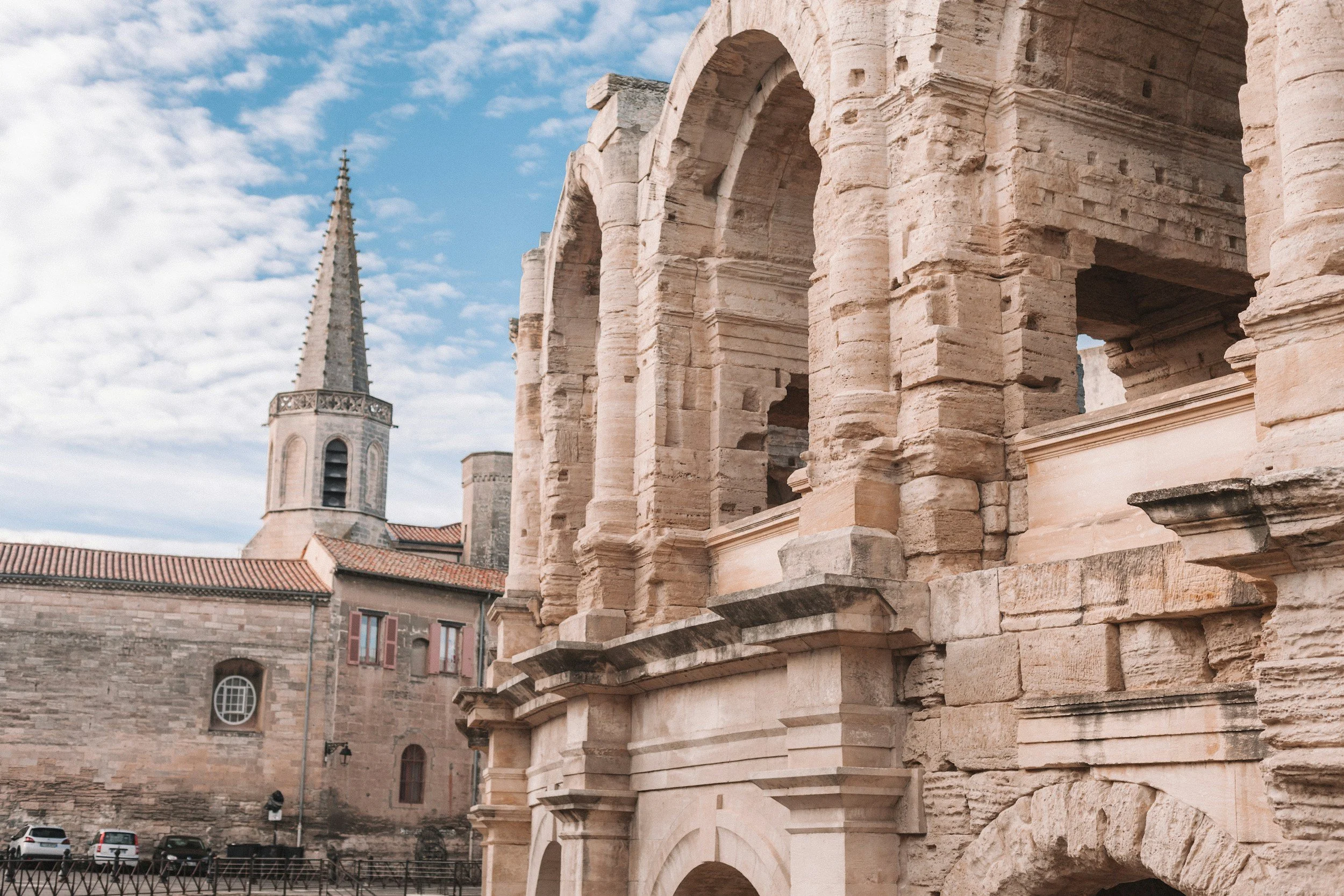
Keep walking straight and you’ll come out by the amphitheatre (Arènes d’Arles). The space opens up around you, and it’s easier to slow down. People are more spread out, and you’re not adjusting your steps all the time.
From there, you can continue towards Place du Forum. Take Rue du Grand Prieuré or follow the small connecting streets, and in about 4–5 minutes you’ll reach the square. It’s still central, but much calmer. You’ll pass smaller shops, shaded corners, and cafés that aren’t packed with people coming straight from the market.
Another option is to turn earlier into Rue de la République from Boulevard des Lices. The first part is still busy, but if you keep walking a bit further in, it opens up and feels more like a regular street again.
When to leave the Arles market
The easiest time to leave is around 10:30–11:30.
If you start around 8:30–9:00 at the southern end of Boulevard des Lices and walk it in one direction, then cross over and continue along Boulevard Émile Combes, you’ll have seen the full stretch by then without rushing. You’ve had time to stop at a few stalls, maybe go back for something, and it still feels easy to move.
Around 10:30, you’ll start noticing the shift. The middle parts of Boulevard des Lices get tighter first, especially where people enter from Rue de la République and Rue Porte de Laure. That’s where it slows down. People stop in the middle, queues form at the rotisserie and prepared food stalls, and you end up walking at the same pace as everyone else.
On Boulevard Émile Combes, it feels even tighter once it fills, especially near the crossing points where people move between the two sides. You can still get through, but you’re not really choosing where to stop anymore.
If you stay past 11:30, it becomes more about moving through the crowd than actually looking at anything. You’ll notice yourself skipping stalls just to keep going.
Arles works much better outside peak season as well, which you notice straight away if you compare it to Arles in autumn.
Smaller village markets
Bonnieux Friday market (small Luberon market on Avenue des Tilleuls, easy to combine with a drive)
Bonnieux is small, everything is right there, and you’re in and out without thinking about it.
The market runs along the main road through the village, around Place Gambetta and along Avenue des Tilleuls (D943). If you’re coming in from Apt or Lourmarin, you’ll drive straight into it. The stalls line both sides of the road, so you’re in the market before you even realise it.
If you arrive around 9:00–10:00, everything is already set up. You can park, walk a couple of minutes, and start straight away.
Parking is easiest just before the center tightens. Coming in on Avenue des Tilleuls, you’ll see small parking spots along the road or just before Place Gambetta. Leave the car there and walk the last stretch instead of trying to get into the narrow part where the market is.
The market itself is quick. You walk past a few produce stalls set up along the road, a couple of cheese stands, bakery tables with fougasse and small loaves, and usually a rotisserie setup with chickens turning slowly and trays of potatoes underneath. It’s all within a short stretch, so you naturally loop through it in about 20–30 minutes.
Most people do one pass from Place Gambetta down towards the lower end of Avenue des Tilleuls, then turn back on the opposite side and head towards the car again. No need to plan a route, it just works like that.
Once you’re done, you’re already on the road. From here, it’s about 15 minutes to Lourmarin via D943, or around 20 minutes up to Roussillon. You don’t need to go through busy areas to get there, which is why this market fits so easily into the rest of the day.
Eygalières (more local feel, fewer stalls, easy to walk without thinking about it)
Eygalières feels different as soon as you step into it. You’re not arriving into something that’s been set up for visitors. It’s just the weekly market happening in the middle of the village.
The stalls sit around Place des Deux Tilleuls and continue along Avenue Général de Gaulle (D24). If you’re coming from Saint-Rémy, you’ll drive straight into it, slow down, and realise you’ve already arrived.
It’s not spread out. You walk a few minutes, pass the vegetable stalls, a couple of cheese stands, a bakery table, and then you’re already near the other end. Most people keep going, turn around without thinking about it, and walk back on the other side.
What stands out is how people move. You’ll see someone stop at one stall, fill a bag, then move on to the next. Same pattern over and over. No one really hovering or trying to see everything.
If you get there around 9:00–10:00, it’s at its best. Everything’s open, but it still feels easy. You can stop, ask a question, take your time choosing something, and then step aside without feeling like you’re in the way.
Parking is simple. As you come in along Avenue Général de Gaulle, you’ll see a few spots just before the market starts. Most people leave the car there and walk in. It takes a minute or two, and you’re straight into the middle of it.
Carpentras (Friday market, larger, but still easier to move than nearby towns)
Carpentras feels more open than most Provence markets. You’re not squeezed into one square, and you don’t get that stop-start feeling when it fills. It spreads out, which makes it easier to walk even later in the morning.
The market runs through the center around Place Maurice Charretier and continues into streets like Rue de la République, Rue Porte de Monteux, and parts of Boulevard Albin Durand. It’s not one single loop. You move through it in sections, crossing from one street to the next without really noticing.
If you arrive around 9:30–10:30, everything is already set up. You can enter from different sides, but coming in near Place Maurice Charretier works well because you’re straight into the main flow of stalls. From there, most people naturally move towards Rue de la République where a lot of the food stalls are grouped.
Even closer to midday, it still works. The wider streets make a difference here. You can stop at a stall, step aside, and keep moving without getting stuck behind people.
Parking is easier than in most nearby towns. As you come into Carpentras, aim for areas around Boulevard Albin Durand or Parking Jean Jaurès. From there, it’s about a 5–10 minute walk into the market. You’ll come in through wider streets and step straight into the stalls without dealing with narrow village roads.
The stalls are more mixed than in smaller villages. Along Rue de la République, you’ll find produce, cheese, olives, and bakery stands, but also clothing, fabrics, and everyday goods further out. It feels like a proper weekly market where people are buying for the week, not just browsing.
How to choose between small village markets and the bigger ones
The easiest way to decide is to think about how much time you actually want to spend at a market.
If you’re staying nearby and just want something to do in the morning, places like Bonnieux or Eygalières make more sense. You park, walk in, do one loop, maybe pick up fruit, bread, or cheese, and you’re done in 20–30 minutes. No planning, no pressure to “see everything.”
If you go to one of the bigger markets instead, it turns into a longer stop whether you planned that or not. You walk further, you stop more often, and it’s harder to leave once it gets busy.
The other thing is what you want to combine it with. Smaller markets are easier if you’re driving between places. You can stop in Bonnieux, then continue towards Lourmarin or Roussillon without needing to adjust your whole day.
With larger markets, the market becomes the plan.
So it’s less about which one is “better,” and more about how you want the day to work.
Some of the better market stops are the ones people don’t plan for in advance, like these smaller market towns in Provence where it’s a nice atmosphere to stroll and browse.
Planning a market-focused route through Provence
The easiest way to get this wrong is to pick a different market every day without looking at where they sit on the map. It looks fine when you plan it, but once you’re driving between them, it turns into more time in the car than at the market.
It works better if you treat Provence in sections and stay within one area at a time.
Grouping markets by area (so you’re not driving across Provence every morning)
In the Luberon, most markets sit within a short radius. You can stay near Bonnieux and reach Lourmarin in about 15 minutes via D943, or drive 20–25 minutes to Apt along the same road. Roussillon is about 20 minutes in the other direction.
These drives are simple. You’re on one main road, not constantly turning or checking directions.
In the Alpilles, it’s even tighter. Saint-Rémy-de-Provence and Eygalières are about 10 minutes apart via D24. You can do one on Wednesday, the other later in the week, without moving your base.
Nyons is different. From Bonnieux, it’s about 1 hour 15 minutes if you go via Vaison-la-Romaine. The road is narrower, with more turns, and it doesn’t feel like a quick drive even if the distance doesn’t look far.
If you’re heading further north, Nyons fits better if you continue into Drôme Provençale rather than trying to do it as a return trip in one day.
Driving times that actually matter
Distances in Provence look short, but the driving feels longer.
Bonnieux to Saint-Rémy is around 50–60 minutes, usually via Cavaillon. Lourmarin to Carpentras is about 45 minutes, depending on traffic near the town.
Even short routes can slow down. On roads like D943 or D973, you’ll often end up behind cyclists or slower cars, especially mid-morning when everyone is already out.
That’s why adding “just one more market” usually doesn’t work. A 40-minute drive easily turns into over an hour once you factor in slower sections and getting in and out of towns.
Where to base yourself if markets are the priority
If markets are the focus, it’s easier to stay in one place for a few nights rather than moving constantly.
In the Luberon, staying near Bonnieux or Lourmarin means you can reach several markets without thinking about it. You leave in the morning, drive 15–25 minutes, and you’re there.
In the Alpilles, staying near Saint-Rémy works well because you’re already close to other villages like Eygalières, and you don’t need to plan much beyond checking the market day.
For Nyons, it only really makes sense if you stay there or nearby. Driving up from the Luberon and back in the same day turns into a long morning.
Before heading into the Luberon, it often helps to spend a night or two in Aix-en-Provence in spring, especially if you’re arriving by train.
Alternating market days
Markets start to feel repetitive if you do them every day…
If you do a larger one like Saint-Rémy or Arles, the next day is better without a market. Just a drive, maybe stop in a village, sit down somewhere, and take it slower.
Then come back to a smaller market like Bonnieux or Eygalières the following day. These take less time and don’t feel as full.
It keeps the pace balanced. Otherwise, it starts to feel like you’re repeating the same morning in a different place.
If you’re trying to avoid the busiest towns altogether, it’s easier to build your route around quieter Provence market towns instead.
Timing your day so the market actually feels enjoyable
Most markets feel either easy or frustrating depending on small timing decisions. Same place, completely different experience.
Early morning routine (coffee first or straight into the stalls)
This depends on how busy the town gets.
In places like Uzès, you can arrive around 8:30, sit down on Place aux Herbes, order coffee, and watch the stalls finish setting up around you. Nothing feels rushed, and when you’re done, you just stand up and walk straight into the market.
In Lourmarin, it’s similar. You can park along Avenue Philippe de Girard, grab something small, and then walk the market once everything is already open.
In bigger places like Arles or Saint-Rémy-de-Provence, it works better the other way around. Go straight into the market when you arrive. Walk Boulevard des Lices or the streets around Place de la République first while they’re still open, then stop for coffee later.
If you sit down first in those places, you’ll come out into a much busier market than you expected.
When to leave
Around 10:30–11:30 is usually the turning point.
In smaller markets like Eygalières or Bonnieux, you’re usually done before that anyway. You’ve walked the full stretch, picked up what you need, and you’re already heading back.
In bigger markets, you’ll feel it change. In Arles, the middle of Boulevard des Lices slows first, especially where people come in from Rue de la République. In Saint-Rémy, it’s around Place de la République where everything tightens.
You can stay, but it’s not the same experience anymore. You’re not really browsing, you’re just moving forward with everyone else.
Leaving before that point means you still enjoyed it. Leaving after usually means you’re ready to be done.
Carrying purchases vs dropping them off (what actually makes it easier)
If you’re staying close to the center, use that.
In towns like Uzès or Lourmarin, everything is within a short walk. You can do one pass, buy a few things, go back to your place, drop it off, and head out again. It doesn’t take more than 10–15 minutes.
If you’re parked further away, it’s easier to wait before buying anything heavy. Walk the market first, see what you want, then pick things up at the end.
You’ll notice people doing this. Walking empty-handed first, then coming back with a bag once they’ve decided. Carrying multiple bags through a busy street like Boulevard des Lices or Rue de la République makes everything slower.
Planning the rest of the day around the market
Markets work best when they’re the first thing you do.
If you try to fit one in between other stops, it usually doesn’t work. You end up checking the time, skipping parts of it, or leaving just when it starts getting good.
If you start your day with the market, it’s much easier. You go early, walk it properly, then decide what to do next.
That might mean staying in the same town for lunch, or leaving around late morning and driving somewhere else. From Lourmarin, for example, you can be in Bonnieux in about 15 minutes, or head towards Roussillon without needing to plan anything in advance.
If you’re loving a weekend in Paris (who doesn’t…) there are also markets near Paris by train that are well worth a day trip!
FAQ: Provence markets (when to go, where to park, and which ones are worth it)
What day are the best markets in Provence?
The most popular ones are Saturday in Arles, Sunday in L’Isle-sur-la-Sorgue, Wednesday in Saint-Rémy-de-Provence, and Friday in Lourmarin. Smaller villages like Eygalières and Bonnieux also have weekly markets that are easier to visit.
What time should you go to a Provence market?
The easiest time is between 8:30 and 10:00. Before 9:00, everything is open and easy to walk. After 10:30, larger markets like Arles and Saint-Rémy-de-Provence start to slow down.
Which Provence markets are less crowded?
Smaller markets like Bonnieux, Eygalières, and Nyons are easier to walk, even mid-morning. They don’t require an early start and take less time.
Do you need a car to visit markets in Provence?
For most villages, yes. Markets in the Luberon and Alpilles are spread out and hard to reach without a car. Larger towns like Arles can be reached by train, which avoids parking.
Where should you stay in Provence for market visits?
Stay within one area. For the Luberon, base yourself near Lourmarin or Bonnieux. For the Alpilles, stay near Saint-Rémy-de-Provence. For Nyons, it’s easier to stay locally rather than drive from further south.
Are Provence markets worth visiting in July and August?
Yes, but timing matters. Arrive before 8:30 in larger towns. Smaller inland markets are easier to enjoy later in the morning.
What are the best Provence markets for food?
Markets like Apt and Vaison-la-Romaine have a wide selection of produce and prepared food. Nyons is known for olives and olive oil.
How long should you spend at a Provence market?
Small markets take 20–45 minutes. Larger ones like Arles or Saint-Rémy can take 1.5–2 hours depending on crowds and whether you stay for food.
Is it better to visit one market per day or several?
One per day works best. Driving between markets takes longer than expected, and trying to visit more than one often turns into too much time in the car.