Where I'd stay for a weekend exploring southern Burgundy
Choosing where to stay in southern Burgundy feels like one of those decisions you can leave until the very end. Tournus and Cluny are only about 35 kilometres apart, surrounded by vineyards, rolling farmland and small villages between Dijon and Lyon, so it's easy to assume that whichever hotel looks nicest or has the best reviews will do the job.
It's easy to assume that because two towns are only half an hour apart, choosing between them won't make much difference. I used to think that too. After a few weekends in southern Burgundy, I realised that the distance between places is often the least important part of the decision. What changes the trip is everything around the sightseeing. How easy it is to arrive on a Friday evening without another connection. Whether there are still a few people sitting outside after dinner or the streets are already empty by nine. Whether you naturally wander out for another walk before bed or find yourself back at the hotel much earlier than you'd expected. Those are the little things that stay with me long after I've forgotten which museum I visited first.
Staying in Tournus meant I could arrive on a Friday evening, leave the car where it was and not think about it again until I drove home. Staying in Cluny changed the weekend in a completely different way because once I was there, I found myself wanting to spend much longer in and around the town than I'd expected instead of rushing off to the next stop. Then there's Mâcon, which hardly anyone seems to mention when comparing where to stay, even though there are weekends when it quietly becomes the most practical choice of all, especially if you're arriving by TGV, eating out both evenings or planning to spend more time exploring the Mâconnais than staying in one town.
That's really what this article is about. Not which town is objectively better, because I don't think there is one, but which one makes the most sense for the kind of weekend you're actually planning. Sometimes that means being able to walk back from dinner through the centre of Tournus without thinking about the car. Other times it means waking up in Cluny before the first visitors arrive at the abbey, or finishing a Friday evening beside the Saône in Mâcon because it made the journey south so much easier. None of that is obvious when you're planning the trip. It only becomes clear once you've arrived and realise that where you're staying changes everything from how the first evening unfolds to what you end up doing with the hours between breakfast and dinner.
If you're already looking at Lyon flights, these market towns are some of the easiest weekends to add before or after the city.
Before you book your hotel, think beyond the map
It's easy to look at a map of southern Burgundy and think that Tournus and Cluny are close enough for it not to matter where you stay. They're only about 35 kilometres apart, and it's roughly a half-hour drive between them, so choosing a hotel can feel like something to sort out once you've decided what you want to see.
I actually think it's the other way around.
The easiest weekend I’ve had in this part of Burgundy started in Tournus, mostly because nothing needed sorting out once I arrived. I got off at Gare de Tournus, walked into town with my bag, and within a few minutes I was somewhere between Rue de la République and Place Carnot trying to decide whether to eat first or keep walking down towards the Saône. That’s the thing Tournus does well. It lets the weekend begin straight away. You don’t have to work out a bus connection, call a taxi from Mâcon or drive back out again after dinner, and if you arrive on a Friday evening there’s still enough of the town within easy reach to make the first night feel like part of the trip rather than just the travel day.
Cluny asks for a bit more planning before you get there, especially if you’re not driving. There’s no railway station, so the journey usually means arriving in Mâcon first and then continuing by bus or taxi, which is fine when the timings line up but less enjoyable if your train is late or you’re arriving after a long workday. The trade-off is that once you’re actually in Cluny, you don’t necessarily feel the same need to keep moving. It’s easy to spend longer than planned around the abbey, loop back through Rue Lamartine and Rue Mercière, stop again on Place du Marché, or wander towards the Haras National before dinner simply because everything sits close together and the town becomes much calmer later in the day.
One difference I didn't really expect until I'd stayed in both towns was what happened after dinner. In Tournus, I almost always ended up staying out longer than I'd planned, not because there was loads going on, but because it was easy to keep walking. I'd wander down towards the Saône, cross the Pont de Tournus to look back at the old town with the lights on, then somehow find myself back outside Café de la Paix or strolling past the illuminated façade of Abbaye Saint-Philibert instead of heading back to the hotel. Even later in the evening there are usually a few people sitting by the river, couples out for a walk or cyclists passing through on the Voie Bleue, so the town still feels alive without ever becoming noisy.
Cluny settles down much earlier, and I don't mean that as a criticism because it's part of what makes staying there different. Once the visitors have drifted away from the abbey and the restaurant terraces around Place du Marché begin to empty, the centre becomes remarkably quiet. Walking back along Rue Lamartine or Rue Mercière at nine o'clock in the evening in May or September can feel completely different from doing exactly the same walk a few hours earlier, and outside the main summer season you may find that the only places still open are one or two bars while the rest of the town has already switched into evening mode. It made me realise that I naturally used the evenings differently in Cluny. Instead of thinking, "Where shall we go next?", I'd usually pick up a bottle from Cave de Cluny before dinner, enjoy a slower evening and call it a day a little earlier, knowing I'd probably be back out walking through the town before most people arrived the following morning.
Market day is one of those things that's easy to overlook when you're booking a hotel, but it changes the feel of the weekend much more than I expected. If you're staying in Tournus on a Saturday, you'll wake up to Place Carnot already filling with traders unloading fruit, vegetables, Charolais beef, Mâconnais goat's cheese, flowers and baskets of still-warm bread while cafés begin setting out their terraces along Rue de la République. It's worth getting there before about ten o'clock if you want to browse before the busiest part of the morning, especially if you're planning to pick up cheese, pâté or pastries for lunch by the river later in the day. Cluny's market happens on Tuesdays instead, so unless your trip falls at the beginning of the week you'll experience a much quieter version of the town. I actually like both, but they create two completely different starts to the day, and it's something I'd always check before deciding where to stay.
Driving also changes the way the weekend unfolds, although not in the way I expected. I stopped planning my routes village by village quite quickly because southern Burgundy has a habit of distracting you. You might leave Cluny intending to drive straight to Tournus, then notice a sign for Château de Cormatin and decide to stop for an hour, carry on through Brancion because it's only a few minutes further, then take the smaller road via Berzé-la-Ville simply because someone at lunch mentioned the chapel, before finding yourself pulling over again beneath Berzé-le-Châtel to admire the view across the vineyards. None of those stops take very long on their own, but together they can easily turn a direct thirty-minute drive into most of an afternoon. I think that's one of the reasons trying to "cover" southern Burgundy in a weekend rarely works particularly well. The nicest parts of the day are often the ones you never planned in the first place.
Not sure whether to stay in Lyon or somewhere smaller? This comparison makes that decision much easier.
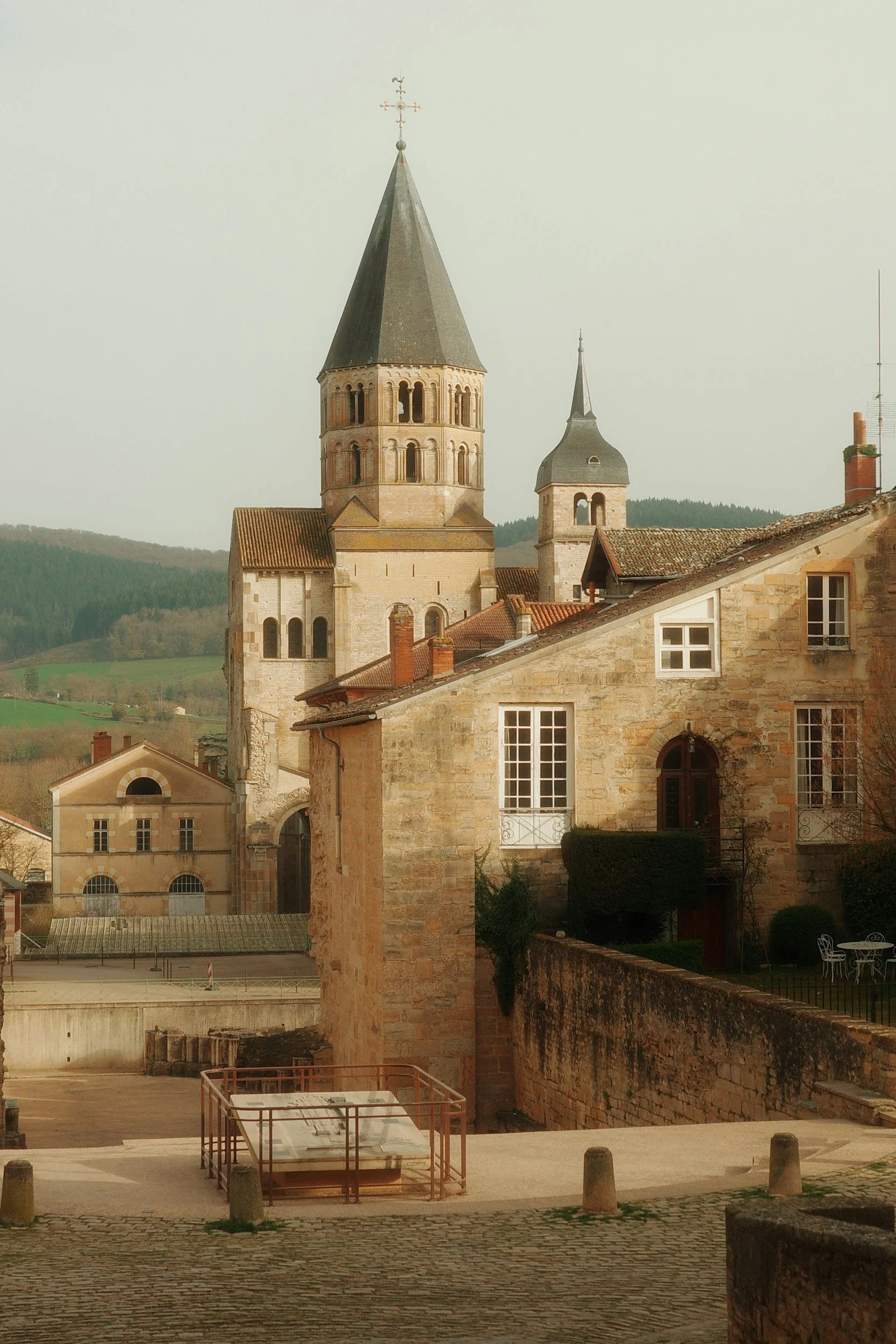
Cluny
If you're trying to choose between northern and southern Burgundy, this Chablis guide makes the differences much clearer than looking at a map.
Why I nearly always recommend staying in Tournus first
If someone asked me where to stay for a first weekend in southern Burgundy, I'd probably answer Tournus before I'd even started thinking about hotels. It isn't because there's more to see here than in Cluny or because I think it's the prettiest town in the region. It's because every time I've stayed here, the weekend has felt easy from the moment I arrived, and I don't think that's something you can tell from looking at a map.
Gare de Tournus is only a short walk from the old centre, so if you're coming down from Dijon or Lyon on the TER you can leave the station, roll your suitcase into town and be standing on Rue de la République a few minutes later wondering whether to stop at the bakery first or keep walking towards Place Carnot. That's one of the things I like most about staying here. By the time you've checked in, bought a pastry from a boulangerie on the high street and wandered down towards the Saône, it already feels as though the weekend has started properly. I don't find myself thinking about buses, taxi bookings or where I've parked the car because, for the next couple of days, I rarely need any of them.
Most people head straight for Abbaye Saint-Philibert, and rightly so, but I wouldn't rush through this part of Tournus. Some of my favourite corners are the ones between the landmarks. Walk through the narrow medieval streets behind the abbey, look out for the old traboules that connect buildings and courtyards, and if you notice signs for the Sur les Pas de Gerlannus walking route, follow them for a while rather than sticking to Google Maps. It's an easy way to discover parts of the old town that actually many visitors walk straight past.
A few minutes from the abbey, the former Hôtel-Dieu Museum is somewhere I'd actually slow down rather than rushing through. Most visitors head straight for the old apothecary, and it's easy to see why. The room is almost exactly as it was centuries ago, with long rows of blue-and-white ceramic pharmacy jars, original wooden cupboards stretching up to the ceiling and shelves still lined with handwritten labels. It's also usually much quieter than the abbey, so you're not moving from room to room with a group of people in front of you. I found myself spending far longer there than I'd expected, partly because it's one of the few places in Tournus where you can stop and look at the details without feeling as though you're holding anyone else up.
I don't think I expected the river to become such a big part of the weekend, but both times I've stayed in Tournus I somehow ended up back there after dinner. It starts almost without thinking about it. You leave the restaurants around Place Carnot, wander down towards the Saône, cross the Pont de Tournus to look back at the old town and then just keep walking because there's no real reason to head back yet. By that time of the evening the traffic has almost disappeared, a few cyclists are still following the Voie Bleue, people sit talking along Quai de Verdun and the reflections from Abbaye Saint-Philibert stretch across the water. It's not somewhere I'd have gone out of my way to find if I'd only been visiting for the afternoon, but after staying overnight it quickly became one of the parts of Tournus I looked forward to most.
If you're deciding between Friday and Saturday night, I'd always choose the weekend that lets you wake up in Tournus on a Saturday morning. Before nine o'clock, traders are still unloading vans around Place Carnot, the smell of fresh bread drifts out onto Rue de la République and locals arrive carrying empty shopping baskets rather than cameras. By mid-morning the market is in full swing, with stalls piled high with Charolais beef, Mâconnais goat's cheese, cherries, apricots, honey, saucisson and bunches of fresh flowers, while Café de la Paix is already filling up with people enjoying a second coffee instead of hurrying somewhere else. I usually wander through the market first, then duck into Les Halles to see what's in season before deciding whether lunch is going to be at a restaurant or picked up from the market instead. More often than not, I end up walking away with far more cheese than I'd planned and a fresh baguette tucked under my arm before heading down towards the river.
I never really struggle to find somewhere to eat in Tournus, which surprised me the first time I stayed here because it's a relatively small town. If it's a special occasion, I'd book Restaurant Greuze well in advance and build the evening around it, but most weekends I end up somewhere a little more relaxed. Aux Terrasses is a good choice if you're looking for modern Burgundian cooking without the formality of a classic gastronomic restaurant, while Le Quai comes into its own on warm evenings when you can sit outside near the river and take your time over dinner. If I've arrived on a Friday evening after work and don't feel like wandering too far, Le Terminus is an easy first stop because it's close to the station, whereas Le Rempart works well after a day exploring the old centre since you're already nearby. One thing I would do, especially outside July and August, is check opening days before you travel. Quite a few restaurants close one or two days a week, and I'd rather spend a couple of minutes checking that beforehand than realise my first choice isn't serving dinner after I'd already walked across town.
One thing I like about staying in Tournus is that you don't have to spend every hour moving from one major sight to the next. If the weather turns or you've had enough churches and castles for one day, Galerie Nakaï is an easy place to disappear into for half an hour before wandering back towards the river, and it adds something completely different to a weekend that's otherwise centred around Burgundy's history.
The same goes for wine tasting. Instead of trying to book several domaines, I'd rather drive the ten minutes to Les Vignerons de Mancey, where you can taste wines from producers across the Mâconnais in one place and work out which villages you might want to explore more closely on a future trip. I actually think it's one of the easiest introductions to the region if you don't already know the difference between appellations like Viré-Clessé, Saint-Véran and Mâcon-Villages.
If you're heading home by car towards Dijon or Beaune, I'd also think about taking a small detour to Cuisery instead of driving straight back. It's known as France's Village of Books, but what I enjoy most is that it doesn't feel like a tourist attraction built around that idea. The second-hand bookshops are spread through the village rather than clustered in one place, people browse at their own pace and it's the sort of stop where you often end up staying longer than you'd planned without really noticing the time.
The only thing I'd be slightly organised about in Tournus is the booking itself. Hotels fill up much faster than you'd expect on Saturday market weekends, particularly if you're travelling between May and September, so leaving it until the week before doesn't always give you much choice. I'd also have a quick look at restaurant opening days before you travel because quite a few close one or two days a week, and it's surprisingly easy to arrive with one place in mind only to find it's shut that evening. The same goes for the abbey and the Hôtel-Dieu. Their opening hours change through the year, and if you're only here for two nights it's worth checking them before you build the day around a visit.
Other than that, Tournus is one of the easiest towns I've found for a weekend in Burgundy. Once you've arrived, there isn't much else to think about, which is probably the biggest reason I keep recommending it to people who are visiting this part of the region for the first time.
If you're wondering whether Tournus is enough for a weekend or if you'd be happier somewhere bigger, this guide might save you a lot of second-guessing before you book.
Staying in Cluny is a completely different experience after 5 pm
Until I stayed overnight in Cluny, I'd always thought of it as somewhere you visited for a few hours before driving on. That's how a lot of weekends around here are planned. People arrive in the morning, spend a couple of hours around the abbey, have lunch, maybe wander through Rue Lamartine or Rue Mercière, and by the middle of the afternoon they're already on the road towards Tournus, Mâcon or Beaune.
The first evening I stayed, I realised I'd never really seen the town before.
Once the last guided tours finish and the coaches leave, Cluny becomes much quieter without ever feeling deserted. The conversations outside the cafés around Place du Marché die down, the little lanes leading away from the abbey empty out and you start noticing things that are easy to miss earlier in the day, like the old stone houses tucked away behind half-open gates, the sound of church bells carrying across the rooftops or how easily you can wander from the abbey to the Haras National without meeting many other people. I remember walking back through Rue Mercière just before dinner and thinking how strange it was that it felt like a completely different town from the one I'd walked through only a few hours earlier. That, more than anything, is why I'd choose to stay overnight instead of treating Cluny as another stop on a road trip.
The biggest mistake I made in Cluny was assuming I'd need a full day of sightseeing. I didn't. The abbey is obviously the main reason most people come, but once I'd finished there I realised the rest of the afternoon worked best without much of a plan. I'd wander back through Place du Marché, stop for a coffee because another terrace had caught my eye, duck into one of the little shops I'd walked past earlier, then find myself back near the abbey again without really intending to. Cluny isn't a town where I'd try to keep adding things to the itinerary because the historic centre is surprisingly compact. You're rarely more than a few minutes from where you started, which means you naturally revisit the same streets at different times of day instead of constantly looking for the next attraction. I actually think that's one of the nicest parts of staying overnight because you notice how much the town changes between lunchtime and early evening.
Tuesday is the one day I'd plan around if I had the choice. By eight-thirty, traders are already setting up around Place du Marché, and by nine the square is full of people buying vegetables, Charolais beef, Mâconnais goat's cheese, flowers and bread for the day rather than souvenirs. It's much more of a local shopping morning than a tourist market, which also means it starts winding down earlier than many visitors expect. If you arrive after lunch, most of the stalls have already packed away, the café terraces are quieter and it's easy to wonder why the square looked so busy in all the photographs you'd seen beforehand. That alone is worth knowing when you're deciding which days to book.
One thing I'd do before arriving in Cluny, especially between May and September, is book dinner if there's somewhere you've really got your eye on. It's a small town, and once the evening begins there aren't endless alternatives if your first choice is full or happens to be closed that day. Le Potin Gourmand is the place I'd reserve if food is going to be one of the highlights of the weekend, whereas La Halte de l'Abbaye makes much more sense on a warm evening when you can sit outside with the abbey only a few metres away and watch the square gradually empty as people drift home. If I've spent most of the day walking, I don't always feel like a long dinner, which is usually when I end up at Le Forum instead.
I almost never buy wine before I arrive because Cluny gives you a much better option. Cave de Cluny is one of my favourite stops before heading back to the hotel, partly because you can talk to someone who actually knows the local producers instead of standing in front of a supermarket shelf trying to guess. The first time I walked in looking for a bottle to have with dinner, I left with something from Viré-Clessé I'd probably never have picked up on my own, and it's become a habit ever since. If you're planning to bring a few bottles home, it's also a much more interesting place to buy them than waiting until you reach a motorway service station on the drive north the following day.
One place that's well worth the climb is the Tour des Fromages. The 120 steps don't take long, but from the top you immediately understand how compact Cluny really is, with the medieval streets clustered tightly around the abbey before giving way to rolling fields almost as soon as the rooftops end. The entrance is through the Tourist Office on Rue Mercière, and because many visitors head straight for the abbey instead, it's often much quieter.
If you've still got some energy before dinner, I'd also walk a short stretch of the Voie Verte. Most people think of it as a cycling route, but it's just as enjoyable on foot. Within ten minutes you've left the busiest streets behind, and early in the morning or later in the evening you'll mostly pass local walkers, runners and cyclists rather than other visitors.
The only time I'd really stop and think about booking Cluny is if I were relying entirely on public transport. Getting here isn't difficult, but it isn't quite as effortless as Tournus either. Most journeys mean travelling as far as Mâcon before changing to the regional bus for the last stretch, and while the journey itself only takes around half an hour, those buses don't run anywhere near as often as the TER trains that stop in Tournus. It doesn't make much difference if you're arriving in the middle of a Saturday, but if your train gets into Mâcon late on a Friday evening or you're trying to catch an early service home on Sunday, it's worth checking the timetable before you book a hotel rather than assuming there'll be another bus along in twenty minutes.
By car, it's a completely different story. I usually park on the edge of the historic centre and don't think about the car again until I'm leaving. Cluny is small enough that you can walk from one side of the old town to the other in a few minutes, and because there isn't much through traffic once you're inside the centre, the evenings are remarkably peaceful. I think that's what keeps drawing me back. Not that there are dozens of things to do, but that after dinner you can wander through streets that felt busy only a few hours earlier and suddenly find yourself almost alone, with the abbey lit up in the background and little more than the sound of footsteps echoing through the old lanes. It's a completely different version of Cluny from the one most people see before driving away in the afternoon.
Ps. Southern Burgundy isn't the only part of France that works like this. These inland market towns have the same calm feel but a completely different landscape.
Travelling without a car changes this region more than most people realise, and this TER guide explains why regional trains are one of the best ways to explore France.
Don't dismiss Mâcon too quickly
If you're arriving from Paris, Geneva or even Switzerland after work on a Friday, I'd seriously think about Mâcon before automatically booking somewhere smaller. It doesn't have the same medieval feel as Tournus or Cluny, but for some weekends it simply makes more sense, and I think a lot of people overlook it because they're so focused on the villages.
The first thing I noticed about staying in Mâcon was how little effort it took to get the weekend started. If you're coming from Paris, the TGV into Mâcon-Loché gets you here quickly enough that you can still have a proper Friday evening instead of feeling as though you've spent half of it travelling, and if you're arriving from Dijon or Lyon, Gare de Mâcon-Ville is only a short walk from the centre. It doesn't sound particularly exciting, but after a working week there's something nice about stepping off the train, dropping your bag at the hotel and realising you don't have another connection to think about before dinner.
I don't usually spend long in the shopping streets on that first evening. I almost always end up walking straight down to the Saône instead. Around Esplanade Lamartine there are usually people sitting outside with a drink, children playing by the river and locals out for an evening walk, and if you keep going across Pont Saint-Laurent the view back towards Mâcon is much better than most people realise. You can see the colourful façades lining the river, the towers rising above the old centre and the boats moored along the quay, and it's one of those walks that somehow turns into half an hour without you noticing. I actually think crossing the bridge is one of the easiest things to miss if you're only in Mâcon for the afternoon because most visitors never leave the town side of the river.
Mâcon is the sort of place where you don't need to keep checking Google Maps. After ten minutes or so, the streets between Rue Sigorgne, Place aux Herbes and Place Saint-Pierre start joining up naturally, and before long you're walking back through the same squares simply because another café or wine shop has caught your eye. I'll often find myself walking along Rue Sigorgne, cutting across Place aux Herbes to look at the timber-framed Maison de Bois for a few minutes, then drifting towards the Cathédrale Saint-Vincent almost without thinking about it before ending up back near Place Saint-Pierre looking for somewhere to sit down. None of those walks are particularly long, which means it's easy to double back if you spot an interesting wine shop, a bakery or somewhere for coffee that you missed the first time.
I also wouldn't feel as though every hour has to be spent outside. If the weather turns, or you've had enough vineyard roads for a day, the Musée des Ursulines is somewhere I nearly always recommend because it helps explain the region you've spent the rest of the weekend driving through without taking half the afternoon. The same goes for the Cité des Climats et vins de Bourgogne. I wouldn't necessarily make a special journey to Mâcon just to visit it, but if you're staying here anyway it's a really good place to begin a weekend in the Mâconnais. After half an hour or so, names like Pouilly-Fuissé, Saint-Véran, Viré-Clessé and Mâcon-Villages suddenly make much more sense, and you'll probably find yourself recognising them later when you stop at a cave or drive past the vineyards around Fuissé, Solutré-Pouilly or Lugny.
The evenings are probably where Mâcon feels most different from Tournus and Cluny. After dinner, you still have choices. If one restaurant happens to be full or closed that evening, it's usually just a matter of walking another couple of minutes rather than completely changing your plans, which isn't always the case in the smaller towns.
One place I kept coming back to was Lifestore Minuit Deux, partly because it never really felt like somewhere you visited just to eat. I'd often end up browsing the shelves before ordering anything, looking through the books, local food products and homeware, then staying for a glass of wine afterwards because there was no reason to rush anywhere else. It has the sort of atmosphere that works just as well in the middle of the afternoon as it does before dinner.
For a proper evening meal, Ma Table en Ville and L'Éthym Sel are both places I'd happily book again, but I don't think I'd plan the evening around a single restaurant. What I enjoy more is knowing that afterwards I can wander back towards Place Saint-Pierre, walk down to the quays along the Saône or cross Pont Saint-Laurent while the cafés are still busy enough that the city hasn't quite settled down for the night. That's something I miss when I stay in smaller towns, where dinner often feels like the final thing you'll do before heading back to the hotel.
The next morning is usually when I remember I'm staying in a small city rather than one of Burgundy's old market towns. Bakeries have queues before eight, people are cycling to work across Pont Saint-Laurent, delivery vans are pulling into Rue Carnot and cafés around Place Saint-Pierre are full of people grabbing a quick coffee before the working day starts. It feels completely different from opening the shutters in Tournus or Cluny, and I think it's worth knowing that before you book because some people are looking for exactly that quieter start to the day.
The reason I'd still choose Mâcon for certain weekends has very little to do with the town itself. It's because by the time I've finished breakfast, I'm already thinking about where I'm going rather than how I'm getting there. If I feel like driving out to Roche de Solutré before it gets busy, stopping at a winery around Fuissé, following the little roads through Chardonnay and Lugny or spending an hour in Cluny before lunch, none of it feels like a long journey. Then, when I get back later in the afternoon, I don't have to build the evening around one restaurant reservation or worry that everything will have closed by nine. I can decide where to eat once I'm hungry, stop for a drink afterwards if I feel like it, and finish the evening with a walk along the Saône before heading back to the hotel.
That's probably why I don't really think of Mâcon as the destination. I think of it as the place that quietly makes the rest of the weekend easier…!
If markets are your favourite part of travelling, this Burgundy weekend is built around them from start to finish.
If you're already thinking about the next wine weekend, Vongnes and Bugey deserves a place on your list long before the better-known regions.
A few things I wish I'd known before planning my first weekend here
One thing I completely underestimated the first time I came to southern Burgundy was how little time I actually wanted to spend in the car. Looking at Google Maps, it's easy to think, "Tournus is only half an hour from Cluny, and Cluny is only twenty minutes from Cormatin, so we might as well keep going." In reality, the roads are part of the experience. Before you know it you've stopped in a village because the bakery looked good, pulled over to photograph the vineyards around Lugny, or taken the quieter road through Chardonnay simply because it looked more interesting than the main route. Those unplanned stops are usually what I remember most.
I'd also think twice before trying to fit both northern and southern Burgundy into the same weekend. Beaune and Dijon sit comfortably together. Tournus, Cluny and the Mâconnais deserve their own trip. Every time I've tried adding "just one more stop" on the way south, I've ended up spending more time watching the sat nav than actually enjoying where I was.
Something else that caught me by surprise is how differently the villages behave once lunchtime begins! If you're still sightseeing at half past one on a Saturday, that's usually the point where the day slows down. Restaurant terraces fill, small independent shops begin closing for the afternoon and you'll often notice that the streets become quieter rather than busier. That's normal here. Instead of trying to squeeze another museum into those couple of hours, I've found it's much nicer to settle into a long lunch, order a second glass of wine and continue exploring afterwards.
I'd resist the temptation to plan this weekend too tightly because distances can be misleading in this part of Burgundy. On paper, it looks perfectly realistic to spend the morning in Cluny, visit Château de Cormatin, stop for a tasting at Les Vignerons de Mancey, have lunch in Brancion and still have time for Cuisery before dinner. You probably could, but it would mean driving straight past half the things that make this corner of Burgundy enjoyable in the first place.
A wine tasting at Les Vignerons de Mancey isn't just a quick stop to buy a bottle. There are dozens of wines to taste from producers across the Mâconnais, and it's the sort of place where conversations often begin with one recommendation and end up somewhere completely different. Cuisery is similar. The bookshops aren't concentrated around one square, so you're constantly crossing the village because you've spotted another sign, another second-hand bookshop or another narrow lane you hadn't noticed the first time. Brancion looks tiny on a map, but once you're walking through the village you'll probably stop at the church, climb towards the château, spend a while looking out across the Grosne Valley and realise an hour has disappeared without ever feeling rushed.
That's why I'd choose two or three places for the day rather than five or six. Southern Burgundy isn't difficult to get around, but it's much easier to enjoy when you stop treating the drive between places as something to get through as quickly as possible.
One thing I have learnt is not to leave Mâcon with the fuel gauge already getting low. Once you're driving between Cluny, Cormatin, Brancion, Lugny and the smaller villages scattered across the Mâconnais, the day has a habit of unfolding quite differently from how it looked when you first left the hotel. You stop at a winery that wasn't on the plan, take a different road because the view looks more interesting or decide to carry on to another village while you're already nearby, and before long you're much further from Mâcon than you'd expected. Filling up before leaving the city has become part of my routine simply because it's one less thing to think about once the weekend has properly started.
More than anything else, this part of Burgundy changed the way I book hotels. I used to spend far too much time comparing room photos, wondering whether one hotel had a nicer terrace or a better breakfast, when the decision that ended up making the biggest difference was the town itself. Staying somewhere with vineyard views sounds lovely until you realise you're getting back in the car every time you want dinner, a glass of wine or even a morning coffee. Staying somewhere simpler in the middle of town often gives you a much better weekend because everything else becomes easier without you really thinking about it. Looking back, I can remember plenty of evenings wandering back through Tournus after dinner, picking up a bottle from Cave de Cluny before heading to the hotel or walking along the Saône in Mâcon while deciding where to eat. I can barely remember what most of the hotel rooms looked like.
If this article has convinced you to explore more of Burgundy, Semur-en-Auxois is one of those places that feels completely different from the wine villages around Tournus and Cluny.
So where would I stay?
If I were travelling down by train on a Friday afternoon and wanted the easiest possible weekend, I'd book Tournus without spending much longer looking at the alternatives. Being able to walk from Gare de Tournus into the old centre in a few minutes, buy breakfast from the bakery the next morning, wander down Rue de la République whenever I felt like another coffee and finish the evening beside the Saône without thinking about buses, parking or driving is exactly what I want from a two-night break.
If the abbey was the main reason I'd come to southern Burgundy, I'd stay in Cluny instead. Most people only see it during the busiest part of the day, but staying overnight gives you a completely different perspective on the town. You have time to wander back through Place du Marché once the terraces have emptied, walk past the abbey when there are only a handful of people around and enjoy the quieter side of Cluny that most visitors never really experience because they're already back on the road.
Mâcon is the place I'd choose for a different kind of weekend. If I were arriving late from Paris, wanted the biggest choice of hotels and restaurants or knew I'd be spending most of Saturday and Sunday exploring villages like Cluny, Brancion, Cormatin, Fuissé and Solutré-Pouilly, I'd happily stay there without feeling as though I was missing out. It takes the pressure off the logistics, gives you much more flexibility in the evenings and makes a very comfortable base if the countryside is going to be the main focus of the trip rather than the town itself.
That's probably why I don't think there's a single right answer to the question this article started with. I'd recommend all three, but for completely different reasons. Tournus is the one I'd choose when I want to leave the car behind for most of the weekend. Cluny is the one I'd book when I know I'll spend more time in the town than most people ever do. Mâcon is the one I'd pick when I want to explore as much of southern Burgundy as possible without making the journey itself any harder than it needs to be.
By the time you've worked out which of those weekends sounds most like your own, the decision about where to stay is usually much easier than it first seemed.
If you see a brocante sign while driving through Burgundy, read this first. It'll help you tell the difference between somewhere worth pulling over and somewhere you'll be back in the car five minutes later.
FAQs about visiting southern Burgundy
Is Tournus or Cluny better for a weekend?
It really depends on what you want from the weekend. If you're arriving by train, want everything within walking distance and like the idea of wandering out for dinner without thinking about transport, I'd usually choose Tournus. Cluny suits travellers who don't mind driving a little more and want to spend longer exploring the abbey and surrounding countryside. The two towns are only about 35 kilometres apart, but they create surprisingly different weekends.
Should I stay in Tournus or Mâcon?
Tournus is the more enjoyable place to base yourself if atmosphere is your priority. Mâcon is the easier choice if you're arriving by TGV from Paris, want a wider choice of hotels and restaurants or plan to explore several parts of southern Burgundy by car. I wouldn't choose one over the other because it's "better". I'd choose the one that makes the rest of the weekend easier.
Is Cluny worth staying overnight?
Yes, especially if you've only ever visited as a day trip. Once the abbey closes and most visitors have left, Cluny becomes much quieter, and that's when I think the town is at its best. Staying overnight also gives you time to explore places like the Haras National, the Voie Verte or the Tuesday market without trying to fit everything into a few hours.
Can you visit Tournus and Cluny in one weekend?
Very comfortably. They're close enough that you don't need to change hotels unless you want to. I generally prefer choosing one base and making a day trip to the other town, which leaves more time to stop at places like Château de Cormatin, Brancion or the vineyards around the Mâconnais instead of spending part of the weekend packing and moving.
Is southern Burgundy easy to explore without a car?
It's possible, but your options are quite different. Tournus works well because it's on the TER railway between Dijon and Lyon, while Cluny doesn't have a railway station and usually requires a regional bus from Mâcon. If you're planning to visit villages, vineyards or places like Château de Cormatin, hiring a car gives you much more flexibility.
How many nights do you need in southern Burgundy?
Two nights is enough to enjoy Tournus and Cluny without feeling rushed. If you want to add wine tasting in the Mâconnais, visit Château de Cormatin, spend time around Roche de Solutré or explore smaller villages such as Brancion and Cuisery, I'd recommend staying three nights instead.
What day of the week is best to visit Tournus and Cluny?
If you can choose, I'd arrive on a Friday. That gives you Saturday morning in Tournus when the market is in full swing around Place Carnot and Rue de la République, then Sunday for exploring the countryside. If visiting Cluny's weekly market is important to you, plan your trip so you're there on a Tuesday instead.
Where should I stay if I'm arriving by train from Paris?
If you're travelling entirely by train, I'd normally stay in Tournus. You can travel from Paris via Dijon or Lyon and walk from Gare de Tournus into the historic centre in just a few minutes. If you're arriving very late on Friday evening, Mâcon is another practical option because of its direct TGV connections before continuing to the smaller towns the following day.