
The small towns near Marseille I'd get on a train for
If you’re staying in Marseille and thinking about getting out to smaller towns for the day, the train setup is honestly pretty straightforward once you’ve done it once. Everything starts from Marseille Saint-Charles, and most of the places you’re probably looking at, like Cassis, La Ciotat, Carry-le-Rouet or Aix-en-Provence, all run from there.
The station looks bigger than it is when you first arrive. There are a lot of stairs, and the platforms stretch out quite far, but it’s not confusing once you understand the flow. The main departure board is right in the central hall, and trains usually show their platform about 10 minutes before departure. If you get there 15–20 minutes early, you have enough time to check the board, grab a coffee, and walk down without rushing.
Most of the trains you’ll be using are TER trains, which are the regional ones. You’ll see stops like Cassis, Toulon or Arles on the board. There are no seat reservations, you just get on and sit where there’s space. In the mornings, especially on weekdays, you’ll notice it’s not just people heading out for the day. A lot of locals use these trains to get to work, which actually makes everything feel a bit more reliable.
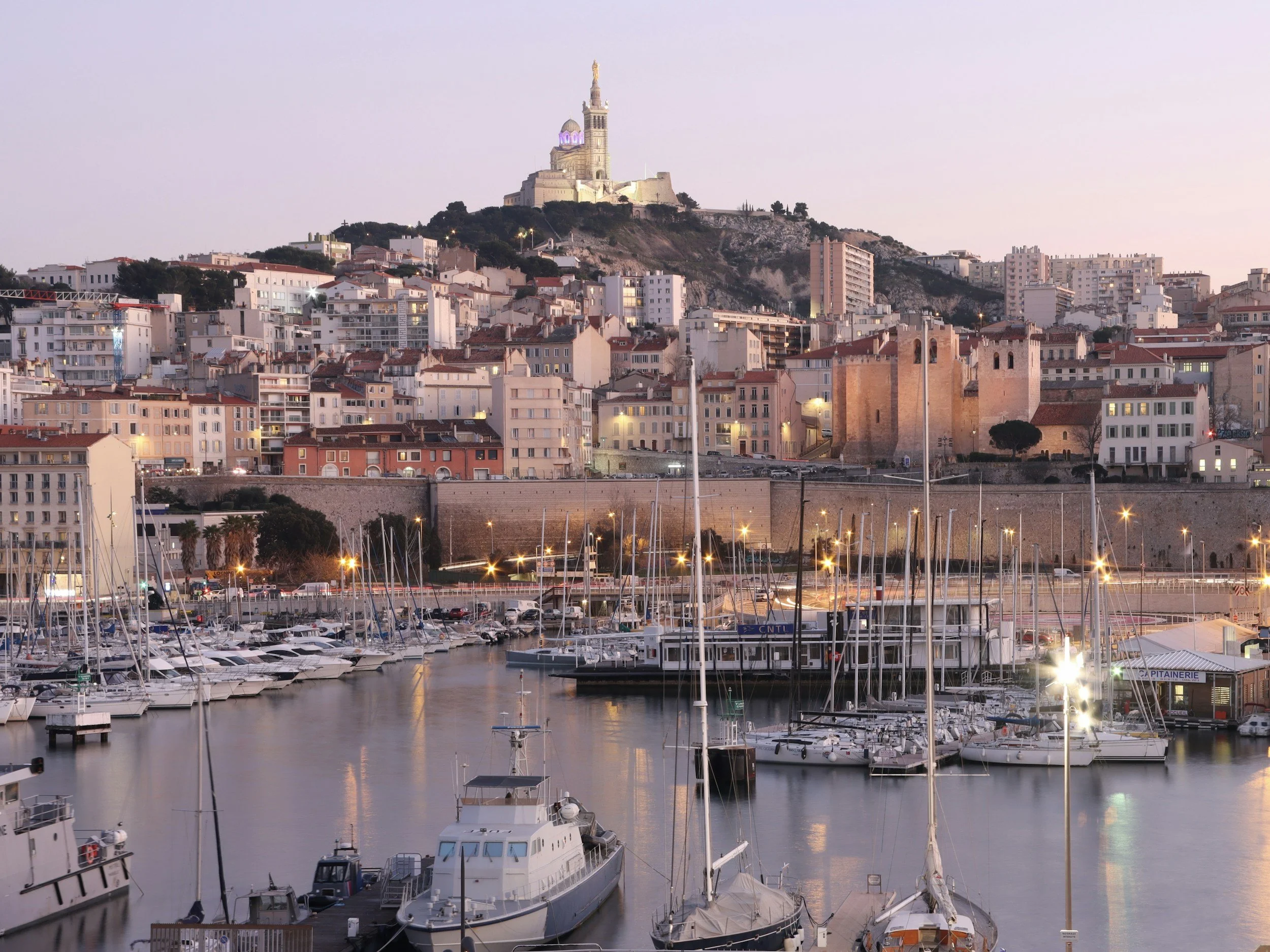
You can leave Marseille sometime in the morning, spend a few hours somewhere, and head back late afternoon or early evening. In summer, it’s worth going earlier than you think. Trains towards Cassis and along the coast start getting busy from mid-morning, and by the time you arrive closer to midday, both the train and the town feel quite full.
The distances are short enough that it never feels like a big trip. Cassis is about 25 minutes, La Ciotat around 35–40, Carry-le-Rouet just over 30, and Aix-en-Provence about 30 minutes plus a short bus into the centre. Arles is closer to an hour, but still easy to do without planning your whole day around it.
Summer makes a bigger difference than people expect. By late morning, especially in July and August, it gets properly hot, and places near the coast fill up quickly. If you take an earlier train, you arrive when cafés are just opening and the streets are still relatively quiet. It’s easier to find a table, easier to walk around, and you’re not immediately trying to find shade.
Starting earlier also gives you more flexibility. If it gets too warm or crowded, you can head back mid-afternoon without feeling like you’ve missed anything. On hotter days, that tends to work better than trying to stay out until evening.
Once the station part feels easy, it really just comes down to choosing where to go first. Cassis is the closest and the most obvious starting point.
If you’re planning to explore more of southern France by rail, there are also smaller inland stops that work just as well for slower days, especially places like those featured in this guide to castle towns in southern France by train.
If you’re thinking about Provence but want something a bit quieter, this guide to quiet alternatives to Provence in southern France is a really good one to browse.
Cassis: the easiest train day trip from Marseille
The train from Marseille to Cassis takes about 25 minutes, and it’s one of the easiest routes to figure out, but the part that confuses people is when you arrive. The station isn’t anywhere near the harbour. You step off the train and you’re basically above the town, surrounded by pine trees and a small parking area, and from there it’s still about 3 kilometres down to the centre.
There’s a shuttle bus waiting just outside the station that lines up with most trains, usually with a small queue already forming. It takes around 10–15 minutes to get down into Cassis and drops you close to the harbour. If you decide to walk instead, it’s a long downhill along Avenue du Revestel with almost no shade, and in summer it feels much longer than it actually is. Going down is fine, but walking back up later in the heat is not something most people enjoy.
If you take an early train from Marseille, you arrive at a completely different time of day compared to most visitors. Around 09:00, the harbour is still quiet enough to walk through without stopping every few seconds. Along Quai des Moulins, café owners are setting out chairs, and places like Café Liautaud already have a few locals sitting outside with coffee. You can stop at Maison Casalini on Rue Séverin Icard and pick up something fresh without waiting in line, which won’t be the case an hour later.
The harbour itself is small, so once it fills up, it fills up properly. Most people stay right along Quai Barthélémy, moving between the same few streets, and by late morning it gets crowded enough that even finding a place to stand near the water can take a bit of patience.
If you just walk a few minutes away from the port, it changes quickly. Rue Alexandre Gervais and the smaller streets just behind it feel more like an actual town rather than a day-trip stop. There’s a small independent bookstore, Le Comptoir du Livre, where people actually stop and browse rather than just walking past, and a few boutiques selling ceramics and linen pieces that feel more local than souvenir-driven. It’s not a shopping destination, but it’s enough to break away from the harbour loop.
For something to eat, it’s easier to either go early or step away from the front. Around lunchtime, the restaurants along the water fill up quickly, and you’ll see people waiting for tables in the sun. If you walk slightly uphill, there are simpler places where people grab a sandwich or a salade niçoise and move on rather than settling in for a long meal.
If you want to see the calanques without turning it into a full hike, the path towards Calanque de Port-Miou starts just past the harbour. You walk along Avenue Notre-Dame, pass the marina, and continue onto the path that follows the coastline. Within about 30 minutes, you’re already looking down over the water and the narrow inlet at Port-Miou. Most people keep going towards Port-Pin, but you don’t have to. Even just going this far is enough for a few hours out of the centre.
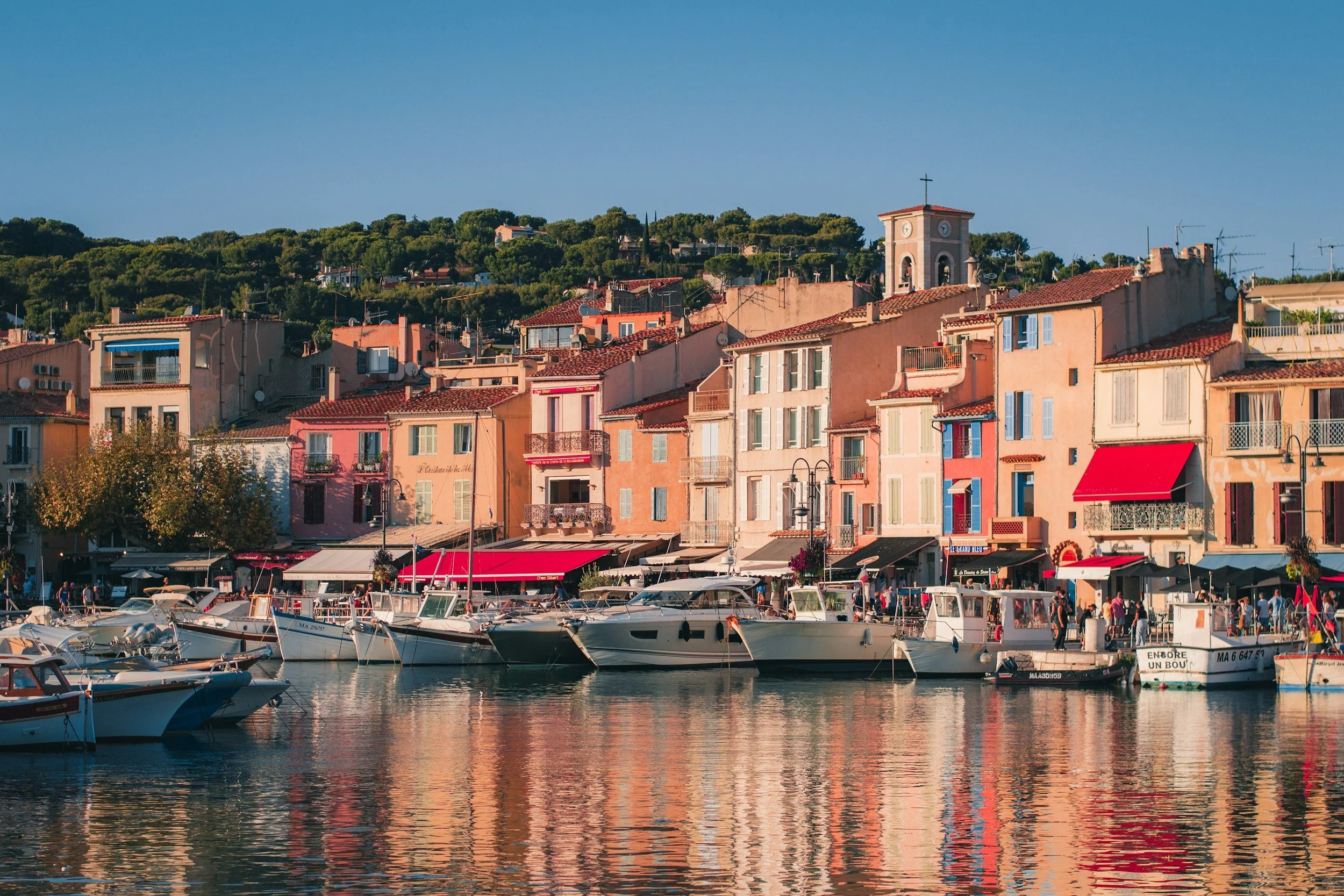
Swimming depends a lot on timing. Plage de la Grande Mer is right by the harbour, so it’s the easiest option, but it gets crowded quickly once it’s midday. If you go earlier, before 11:00, or later in the afternoon, it’s much easier to find space. There’s also Plage du Bestouan, a short walk from the port in the opposite direction of the calanques, where people spread out a bit more on the rocks. The water is just as clear, but you’ll want shoes that can handle uneven ground.
Heading back to Marseille is simple, but it’s worth thinking about when you leave. If you go back mid-afternoon, you’re leaving at the busiest part of the day. If you stay a bit longer, closer to early evening, it shifts slightly. Some of the day visitors start heading back, and the harbour feels less crowded. Restaurants start filling up again, but in a more relaxed way, and it’s easier to sit down without waiting. Just check the last train before you do that, because once you’re in Cassis in the evening, getting back without a train isn’t straightforward.
Cassis is usually the first place people go, but if you stay on the same train line a little longer, La Ciotat feels very different.
If you’re planning to spend more time here, there’s a slower way to experience the town beyond a day trip, especially in spring when the pace feels different. You can find more detail in this Aix-en-Provence slow travel guide.
If you’re interested in food experiences beyond restaurants, this piece on cheese caves in France (Comté & Beaufort) is worth saving for later.
La Ciotat from Marseille by train: a slower coastal town that still feels local
La Ciotat is just a bit further along the same train line as Cassis, around 35–40 minutes from Marseille Saint-Charles, but it feels noticeably different once you get there. The train itself is easy, but like Cassis, the station isn’t in the centre. You arrive at La Ciotat–Ceyreste, which sits slightly above the town, with a small forecourt, a bus stop, and not much else around.
From here, most people either take bus 10 down towards the harbour or walk. The bus is the easier option, especially in summer, and usually lines up with train arrivals. If you walk, it takes about 30 minutes and follows a steady downhill route along Avenue du Président Wilson. You pass quiet residential streets, shuttered houses, and the occasional small shop, but it’s mostly just a functional walk rather than something you’d stop for. There’s very little shade, so by late morning it can already feel too warm.
Once you reach Vieux-Port de La Ciotat, the space changes straight away. The harbour runs along Quai Ganteaume, and it’s longer and more spread out than Cassis, so people aren’t all concentrated in one place. You’ll see locals sitting along the edge of the quay with their feet over the water, small fishing boats tied up along the side, and people stopping briefly for coffee rather than settling in immediately.
If you stay along the front, you’ll pass places like Café de l’Horloge where people stand at the counter or sit down for a quick espresso before moving on. It feels more like part of a daily routine than a stop during a day trip.
A few minutes back from the harbour, around Rue des Poilus and Rue Gueymard, it starts to feel more local. This is where Café Acacia – Curiosity & Coffee sits, slightly tucked away from the waterfront. It’s small, a few tables inside, a couple outside, and people actually come here for the coffee rather than just ending up here. Mid-morning, you’ll see people sitting with a notebook or laptop, staying longer than they would by the harbour.
If you keep walking through the streets behind the port, especially around Rue François Donzel, you’ll pass a mix of small boutiques, a few ceramics shops, and simple clothing stores. Most places look like they’ve been there for a while rather than “set up” for visitors.
Back at the harbour, if you follow the curve of the water towards Boulevard Anatole France, the town opens up into the beachfront. This is where you reach Plage Lumière, which is one of the main swimming spots. People spread out across the sand and along the low edges by the water, so even in the afternoon it doesn’t feel as compressed as Cassis. Further along, Plage Cyrnos is slightly quieter, with fewer cafés directly behind it.
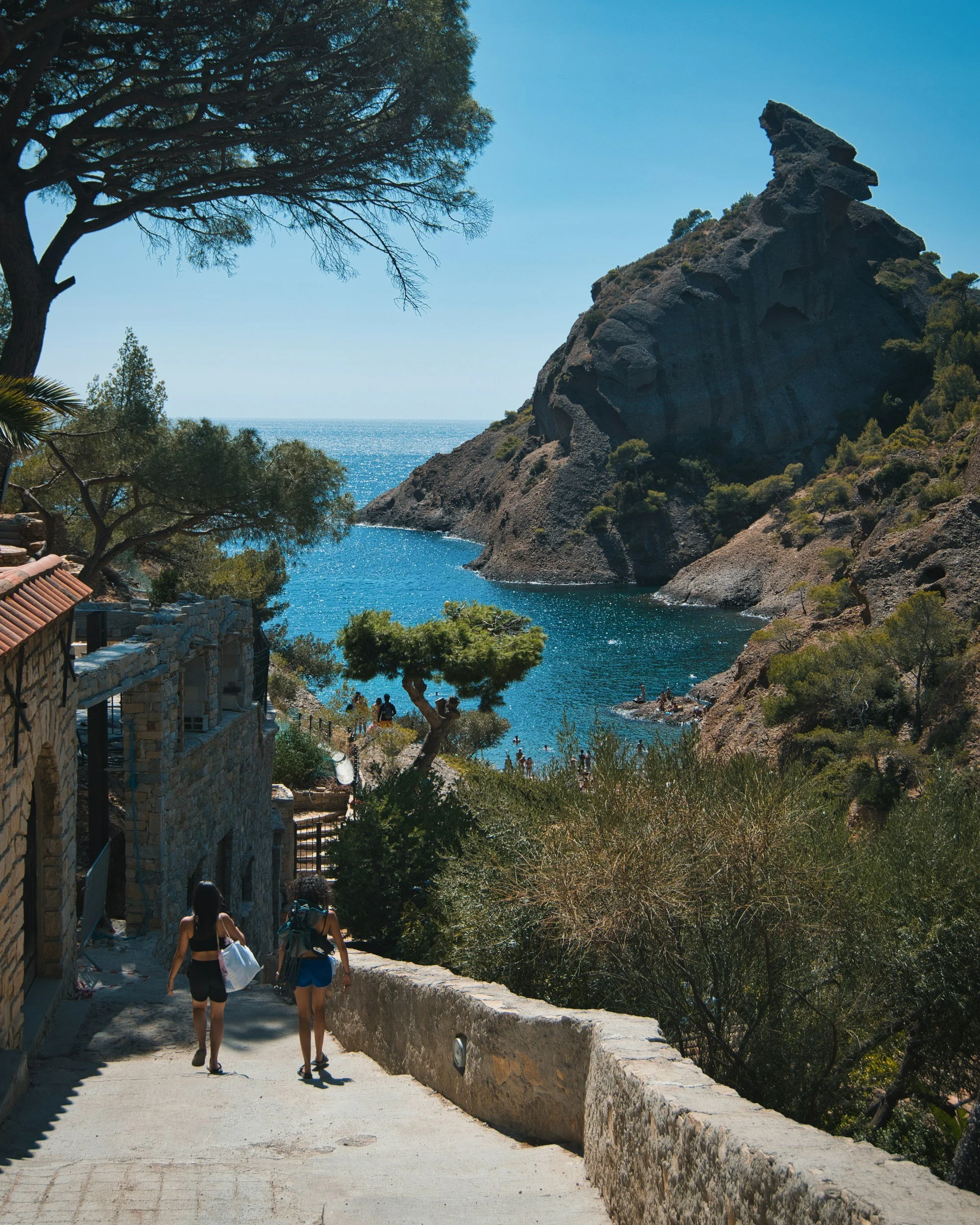
Closer to the old port is where it makes more sense to stop for food. 2 Frères sits right along the harbour, and you’ll notice people staying there for a long time rather than eating and leaving. If you arrive after 12:30, most tables are already taken, and the same people are still there an hour later. It’s the kind of place where lunch stretches without anyone paying attention to the time.
Later in the afternoon, around 16:00–18:00, the harbour fills again, but in a slower way. People gather along the quay, sit on the low walls, or drift between cafés. At 14 Degrés, just off the port, people usually start with one glass and then order another. Tables turn slowly, and by early evening most people are still sitting in the same spot they took earlier.
If you keep walking past the main harbour, you’ll find quieter stretches along the water where people sit directly on the rocks or go for a swim without using the main beaches. It’s not far, but it’s enough to step away from the centre without needing to plan anything.
One of the easier things about La Ciotat is that it still works outside peak summer. Around the port, cafés stay open throughout the day, and you don’t have to plan everything around specific opening hours. Even mid-afternoon, it’s easy to find somewhere to sit without waiting.
Getting back to Marseille is straightforward. Trains run regularly from La Ciotat–Ceyreste, and even later in the day it doesn’t feel crowded in the same way as Cassis. You can stay into the early evening without worrying too much about getting a seat, which makes the whole day feel a bit less rushed.
If you’re thinking about slowing things down more and staying somewhere longer, this piece on countryside places in France people actually live in year-round is probably the closest to that feeling.
Aix-en-Provence from Marseille by train - where to go once you arrive
Aix-en-Provence is one of the easier places to get to from Marseille, but it’s not as direct as the coastal towns, and that’s usually where people get confused. The train from Marseille Saint-Charles takes about 30 minutes, but you arrive at Aix-en-Provence TGV, which isn’t in town. When you step off, it’s just a modern station, parking, buses, and not much else.
To get into Aix itself, you take the shuttle bus from right outside the station. It’s clearly marked “Navette Aix Centre,” runs often, and takes around 15 minutes. Most people from your train will be heading straight for it, so you can just follow the flow. It drops you at Gare Routière, and from there it’s a short walk into the centre, maybe 5–10 minutes depending on how fast you walk.
Once you get into town, you’ll end up on Cours Mirabeau almost without trying. It’s the main street, wide, shaded, and lined with cafés on both sides. Places like Les Deux Garçons and Le Grillon are always full, with people sitting facing the street. It’s easy to stop here, but it also gets crowded quickly, especially from late morning.
If you turn off into smaller streets like Rue Espariat or Rue des Bagniers, it changes within a minute. The streets get narrower, there’s less movement, and people aren’t just passing through anymore. Around Rue Mazarine, especially in Quartier Mazarin, it feels quieter and a bit more spaced out. You’ll see small galleries, closed wooden doors, and cafés where people are actually sitting rather than just watching the street.
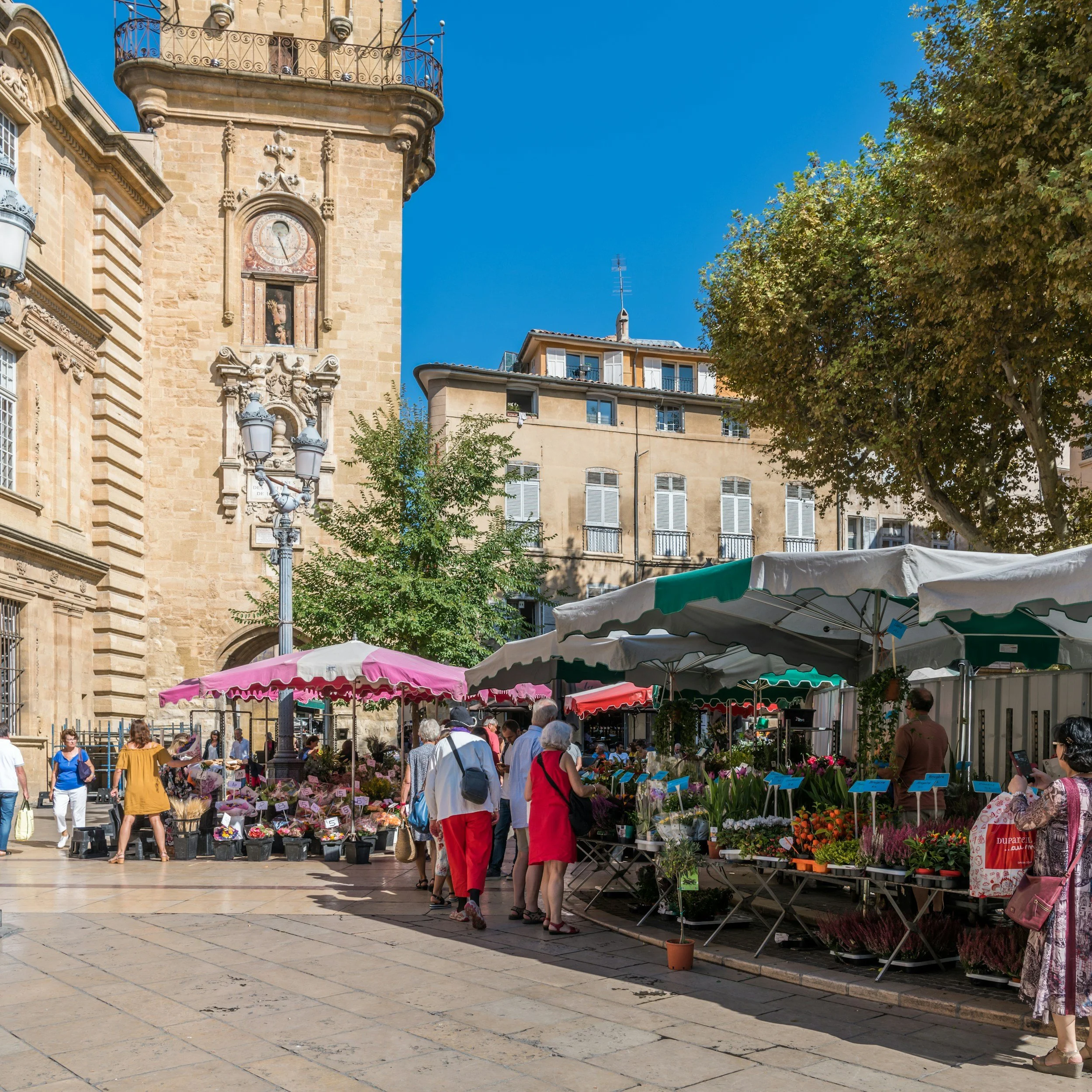
Place Richelme is worth going to if you arrive early enough. Around 08:30–10:00, it’s mostly locals buying vegetables, cheese, olives, and bread. People move quickly, stop at the same stalls, and leave again. By 11:00, it’s still busy, but in a different way. More people standing around, slower to move, harder to get close to the stalls.
A few minutes away, Place de l’Hôtel de Ville usually has flower stalls set up in the morning. It’s a bit more open than Place Richelme, so it’s easier to walk through even when it gets busier.
For coffee, it’s better to step slightly away from Cours Mirabeau. Mana Espresso on Rue des Tanneurs is one of the few places focusing properly on coffee, and it fills up quickly in the morning. Most people grab takeaway rather than sitting. Just nearby, Book In Bar is easier if you want to sit down for longer, especially earlier in the day before it gets busy.
Lunch is where people often get caught off guard. Between 12:30 and 14:00, most places are full, especially in the centre. If you arrive at 13:30 without a reservation, you’ll probably walk around for a while before finding somewhere. It’s easier to either eat just before 12:30 or wait until after 14:00 when things open up again.
If you don’t feel like sitting down for a full meal, there are plenty of smaller places around Rue des Cordeliers where people pick up something simple and sit on a bench or in one of the squares.
In the afternoon, it gets easier to move around. The main streets are still busy, but once you’re in the smaller streets, you can walk without constantly adjusting your pace. If you keep going towards Quartier Mazarin, it becomes quieter, more residential, and you start to notice how people actually live here.
Around early evening, roughly 17:30–19:00, things shift again. Some people start heading back towards Marseille, and it feels less crowded overall. Restaurants begin to fill up, but not all at once like at lunch.
Getting back is simple, but it’s the same connection in reverse. You walk back to Gare Routière, take the shuttle to Aix TGV, and then the train to Marseille. Trains run regularly into the evening, but it’s still worth checking the timing so you’re not stuck waiting longer than you need to at the station.
If you’re thinking about slowing things down more and staying somewhere longer, this piece on countryside places in France people actually live in year-round is probably the closest to that feeling.
And if you’re planning around the season, this overview of spring markets in Europe gives you a wider idea of what’s happening where.
Martigues from Marseille by train - where to walk along canals and between districts
Martigues sits just west of Marseille and takes around 40–50 minutes by train. You arrive at Gare de Martigues, which is outside the centre, so this is where a lot of people lose time. The easiest option is Bus 30 towards “Martigues Centre,” which drops you near Place des Aires. From there, it’s a short walk into the canal area.
If you’re unsure where to go first, aim straight for Quai Brescon. That’s where you start to see the canals, small bridges, and the pastel buildings Martigues is known for. Within a couple of minutes, you’ll reach Miroir aux Oiseaux, where the houses reflect in the water. It’s one of the more photographed spots, but if you arrive before 10:00, it’s still quiet enough to sit along the edge without it feeling staged.
The Île district is compact, but it’s not somewhere you rush through. You’ll naturally stop a lot. Small bridges, narrow walkways, and corners that open up into little squares.
For coffee, La Grange à Café is one of the more reliable spots in the morning. It’s small, with just a few tables, and people tend to come and go rather than stay long. If you want something a bit more relaxed, L’Instant Café near the canal has outdoor seating where people sit facing the water.
Around lunchtime, the stretch along Quai Brescon and nearby streets fills up, but it’s not hectic. Le Bouchon à la Mer sits right by the canal and is one of those places where people order a carafe of wine and stay for a long time. Just a few streets back, around Rue de la République, there are simpler places where menus are shorter and the pace is even slower.
After you’ve walked through Île, cross over into Jonquières. The change is immediate. Fewer cameras, more everyday shops, bakeries, and people running errands. Streets like Rue Lamartine feel more functional, less curated. It’s worth walking through just to get out of the canal loop and see how the town actually works.
If you keep going, you’ll reach Ferrières, crossing over another bridge. This part feels more spread out, with wider streets and less of a defined centre. It’s not where you “need” to go, but walking between the districts gives you a better sense of Martigues as a whole. It’s not one postcard spot - it’s three areas loosely connected.
If you want to be near the water again without the same concentration of people, you can walk towards Jardin de Ferrières. It’s a small green space where people sit in the shade, especially in the afternoon.
Swimming isn’t really a central part of Martigues itself, but if you’re staying longer, Plage de Ferrières is nearby. It’s more practical than scenic, but locals use it.
By mid-afternoon, things slow down even more. If you step away from the canal, streets go quiet quickly. Shutters half-closed, laundry between windows, not much movement.
Trains back to Marseille run regularly, but not as often as Cassis or Aix. It’s worth checking times before you leave the centre so you’re not stuck waiting at the station, which is fairly basic and not somewhere you’d want to spend extra time.
If you’re there on a market day, smaller Provence towns can feel completely different - this guide to quiet Provence market towns is a good one to look through.
Carry-le-Rouet from Marseille by train - harbour, coves, and where to get in the water
Carry-le-Rouet is one of those places that’s almost too easy to get to. You leave Marseille Saint-Charles, sit down on the train, and about half an hour later you’re stepping off by the coast.
If you can, grab a seat on the right side once the train passes L’Estaque. It’s not a dramatic scenic ride the whole way, but there are stretches where the sea suddenly appears between the rocks, with small inlets and a few houses tucked into the cliffs. It’s one of those moments where people look up from their phones for a second.
When you get to Gare de Carry-le-Rouet, you don’t really need directions. You walk out, follow the slight downhill slope, and within a few minutes you’re already by the water. No transfers, no confusion, just a short walk that naturally leads you into the centre.
Everything revolves around Port de Carry-le-Rouet. It’s small enough that you don’t need a map. A few boats, a line of restaurants, people sitting facing the water. You’ll see the same tables filling up as the morning goes on, but it never feels like a place you rush through.
If you arrive early, there’s a quiet window where the harbour is still half-empty. Staff setting up tables, locals stopping for coffee before heading off, not much movement yet. Le Café du Port is the obvious stop if you just want to sit down straight away and look out over the marina.

If you walk just one street back, along Avenue Aristide Briand, it shifts slightly. A couple of small bakeries, people picking up bread, less of that “everyone facing the water” feeling. You can grab something simple here and bring it back down instead of sitting at a restaurant.
For swimming, you’ll need to leave the harbour. There isn’t a central beach right there, so everyone spreads out a bit.
The easiest option is Plage du Rouet. You follow the coastal road for about 10–15 minutes, and you’ll see it open up below you. It’s a mix of sand and pebbles, with clear water, but it fills up quickly once it gets closer to midday. By late morning, most spots are already taken.
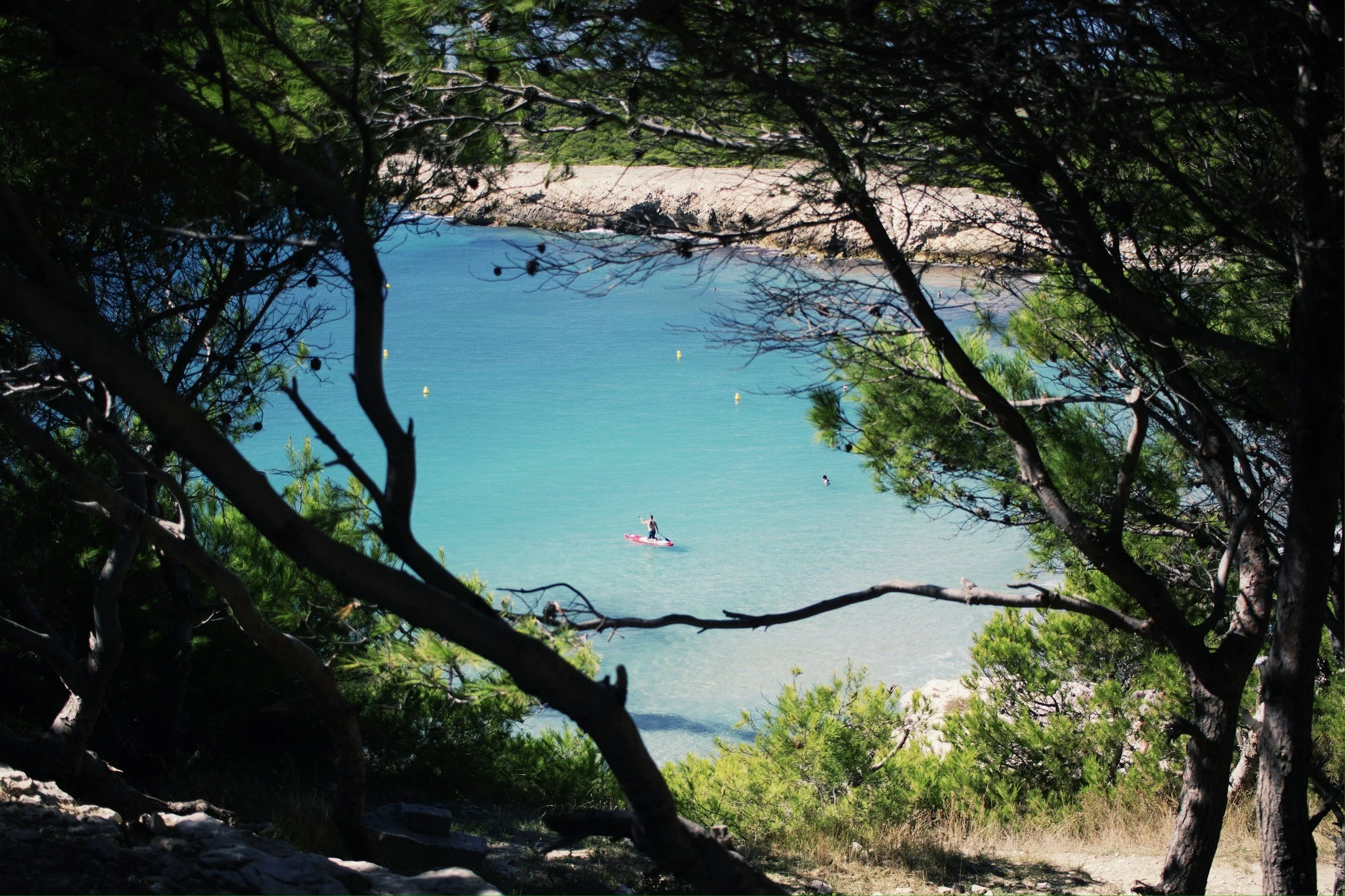
If you keep going past that, the path becomes a bit less defined, with low pine trees and rocky edges, and you eventually reach Calanque des Eaux Salées. This is where it feels quieter again. No real beach, just flat rocks, people laying out towels wherever they can, bags tucked into corners. You climb down into the water rather than walk in. It’s not difficult, but you notice it, especially without proper shoes.
The vibe of the place changes depending on when you’re there. Early on, it feels slow, almost like nothing is really happening yet. Around midday, it’s a different story. Even a place like Carry fills up, especially with people coming out from Marseille for the day. Then later, around 16:30 or 17:00, it loosens again. People start packing up, heading back, and the same spots that were crowded earlier feel open again.
Back at the harbour, lunch is simple. You’ll see people settling in at places like Le Sigata or La Table du Port, ordering something straightforward, maybe a glass of wine, and staying for a while. It’s not really a place where you hop between spots - you pick one and stay.
If you’re not in the mood for a full lunch, grabbing something from a bakery and sitting by the water works just as well. People do that all the time… on the low walls by the harbour or slightly further out on the rocks where it’s quieter.
A few streets away from the marina, it becomes residential almost immediately. Shutters half down, not much going on, very little reason to wander unless you just feel like walking.
Getting back to Marseille is easy, but it’s one of those things you want to check once before you forget. Trains run regularly, but not constantly, and the station isn’t somewhere you want to be waiting around longer than necessary. It’s a short walk back uphill, so it’s worth giving yourself a bit of time rather than rushing it.
If you’re planning to keep travelling by train beyond this area, it’s worth understanding when a rail pass actually makes sense - this breakdown of which Eurail pass works for slower regional travel explains it in a very straightforward way.
Arles from Marseille by train - Roman streets, quiet corners, and where to slow down
Arles is a bit further out, but still easy to do in a day. The train from Marseille Saint-Charles takes around 50–60 minutes, usually direct. It’s one of those journeys where you just sit down and don’t think about it until you arrive.
When you step out at Gare d’Arles, it’s simple. You cross over Pont de Trinquetaille, with the Rhône on your left, and follow the road straight towards the centre. After about 10–15 minutes, the streets start to narrow and you’re suddenly in the older part of town.
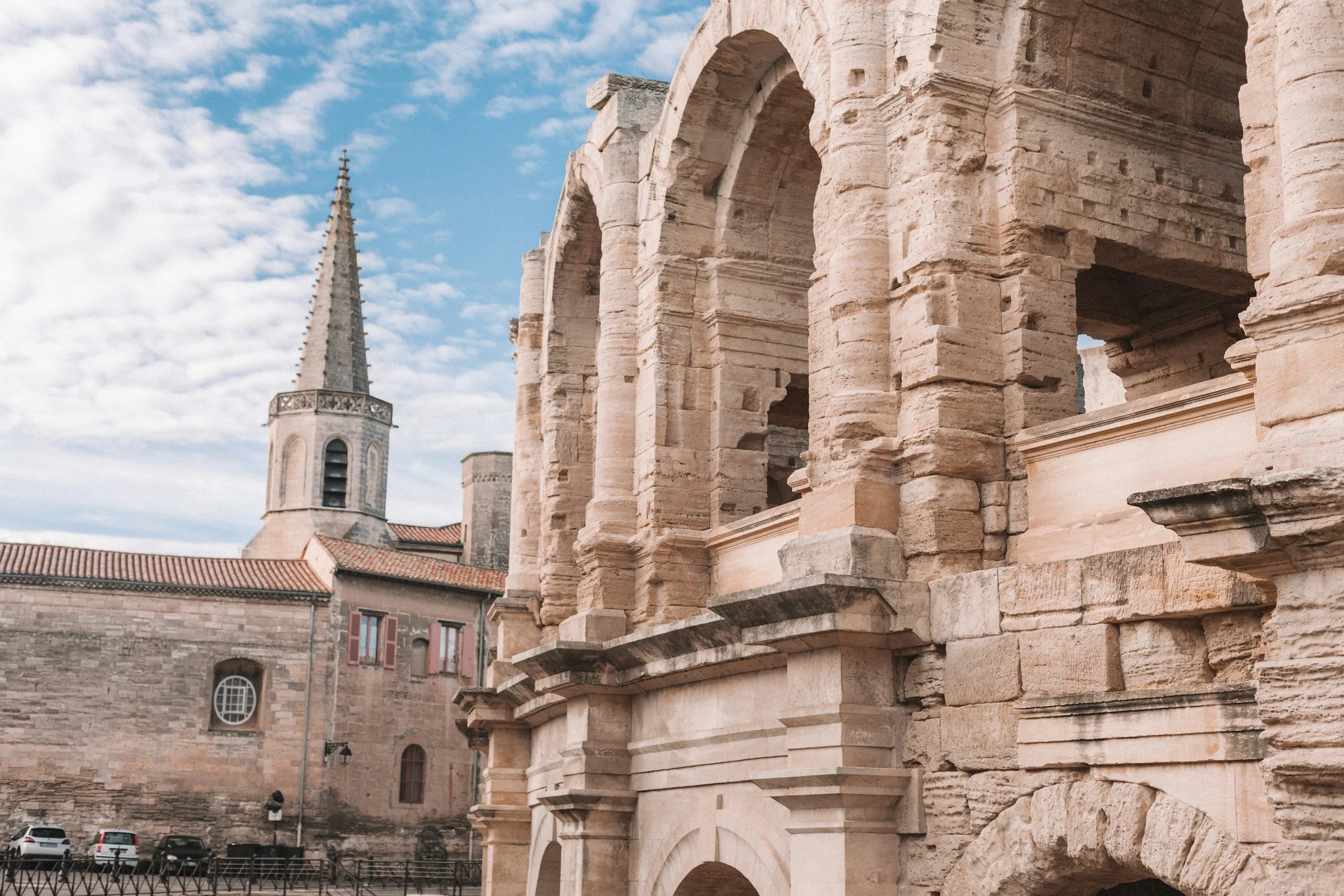
Most people end up at the Arènes d’Arles first without planning it. It’s right there, slightly elevated, and you’ll see it from a distance as you walk in. Just a few minutes away is the Théâtre Antique, which you’ll probably pass between streets rather than heading to directly.
From there, it’s better to stop following the obvious flow and just turn into smaller streets. Around Rue des Porcelets and Rue du Forum, things already feel a bit calmer. You’re still in the centre, but people aren’t moving as quickly.
If you keep walking towards Place du Forum, it picks up again - cafés, terraces, people stopping for a drink. It’s also where you’ll find Café Van Gogh, which most people recognise immediately, but it tends to be more about the location than the experience.
A few streets away, around Place du Cloître, it’s quieter again. You’ve got the cathedral, a bit of open space, and places like L’Épicerie du Cloître where people sit longer and the pace slows down.
For coffee earlier in the day, Café Factory République on Boulevard de la République is one of the easier places to stop. It’s more practical than atmospheric, but reliable if you just want something quick before continuing.
If you walk south from there, you’ll reach Rue de la Roquette, which feels more residential. Fewer visitors, more everyday life - laundry between buildings, people walking through without stopping. It’s one of the areas where Arles starts to feel less like somewhere you’re visiting.
Heading towards the river again, you end up along the Rhône, near Quai du Rhône. It opens up after the narrow streets, and people sit along the edge or on the steps later in the day. Across the water, you’ll see Trinquetaille, which feels quieter and less central.
Heat is something you notice here more than in the coastal towns. Around midday, the stone streets hold the warmth, and even the shaded areas feel heavy. This is usually when people stop. They sit down, go inside, or stay somewhere longer instead of walking continuously.
Lunch follows the same rhythm. Between 12:30 and 14:00, most places are already full. Around Rue du 4 Septembre and the streets near Place du Forum, you’ll see people settled in rather than arriving. Slightly earlier or after 14:00 is much easier.
Places like Le Galoubet or smaller restaurants tucked into side streets are where people tend to stay for a while rather than eat quickly and move on.
In the afternoon, once you step a bit further away from the main squares, it quiets down a lot. Around Rue du Sauvage or the edges of La Roquette, it’s mostly just residential streets, very little movement, shutters partly closed.
If you stay into the evening, Arles shifts again. It doesn’t get too busy, but there’s a steady flow - people heading out, sitting down, staying longer once the heat drops.
Getting back to Marseille is straightforward, but trains are less frequent later in the evening. It’s worth checking the return time before you settle in for dinner, so you don’t end up rushing back across the bridge to the station.
If you’re drawn to places like Arles, you’ll probably enjoy smaller, quieter towns with a similar pace. This piece on slow travel in Montolieu is a good example of that kind of experience.
Small practical things that make these train trips easier from Marseille
You don’t need to overplan these.
TER tickets are easy to get on the day. At Saint-Charles, there are machines in the main hall and along the sides before you go down to the platforms. If you’re using your phone, the SNCF Connect app works fine — you just open the ticket when you need it.
The only thing that’s slightly chaotic is the platform. It doesn’t always show early, so people stand around the board and then move all at once when it updates. If you’re there 15–20 minutes before, it feels relaxed. If not, it’s a bit of a rush.
Weekends are different. You’ll notice it straight away on trains towards Cassis or along the Côte Bleue — more people, more noise, harder to find a seat. Midweek is much easier.
And honestly, shoes matter more than anything else. You end up walking more than you think. From stations, along uneven streets, down towards the water. Nothing difficult, just… not the day for bad shoes.
The only thing really worth checking in advance is the last train back.
It’s easy to lose track of time once you’re there - especially if you sit down somewhere in the afternoon and just stay. Knowing your way back is sorted makes the whole day feel a lot calmer.
If you’re drawn to quieter, more everyday towns, there are similar places further north too, especially in this guide to quiet towns near Lyon.
After that, it’s pretty simple!
You pick one place and go.
FAQ - train day trips from Marseille
Can you do day trips from Marseille by train without a car?
Yes. All of these places (Cassis, Aix-en-Provence, Martigues, Carry-le-Rouet, and Arles) are reachable by direct TER trains. You don’t need a car for any of them, but some require a short walk or local bus from the station.
How do you get from Marseille to Cassis by train?
Trains run from Marseille Saint-Charles to Cassis in about 20–25 minutes. From Cassis station, you either take the local bus to the harbour or walk around 3 km downhill into town.
Which town near Marseille is closest by train?
Cassis and Carry-le-Rouet are the closest, both around 20–30 minutes depending on the train. Carry is easier on arrival since the station is close to the harbour.
Is Carry-le-Rouet worth visiting from Marseille?
Yes if you want a simple coastal stop. It’s small, easy to walk, and good for swimming, especially around Plage du Rouet or the rocky coves near Calanque des Eaux Salées.
Is Martigues or Cassis better for a day trip?
Cassis is easier and more compact, but gets busy quickly. Martigues is quieter and more spread out, with canals around the Île district and fewer day visitors.
How do you get from Aix TGV station into Aix-en-Provence centre?
You take the shuttle bus from outside the station to Gare Routière in Aix. The journey takes about 15–20 minutes, and from there it’s a short walk into the centre.
What is the easiest day trip from Marseille by train?
Carry-le-Rouet is the most straightforward. Cassis is also simple, but requires a bus or longer walk from the station.
Are trains from Marseille to these towns reliable?
Yes, but platform announcements at Marseille Saint-Charles can be late. It helps to arrive 15–20 minutes early so you’re not rushing when the platform is posted.
What time should you leave Marseille for a day trip?
Early trains (before 10:00) are noticeably calmer and get you there before places like Cassis fill up. Late afternoon departures are also easier if you want to avoid peak hours.
Do you need to check the last train back from these towns?
Yes. Evening trains are less frequent, especially from smaller towns like Martigues or Carry-le-Rouet. It’s best to check before you leave Marseille so you don’t have to rush later.
Can you swim near Marseille without a car?
Yes. Cassis and Carry-le-Rouet are the easiest options by train. Both have accessible spots for swimming within walking distance or a short bus ride.