

If you're only visiting L'Isle-sur-la-Sorgue once, make it a Sunday
L’Isle-sur-la-Sorgue sits about 25 minutes from Avignon, right at the edge of the Luberon, and every Sunday the entire centre turns into one of the largest antique markets in southern France. Not in a staged or overly curated way, but in a way that feels like it has grown slowly over time and never really stopped.
If you arrive early, just after eight, the town is already in motion. Stalls line the canals along Quai Jean Jaurès, tables fill Place de la Liberté, and smaller streets start to spill over with dealers who have been coming here for years. You’re not walking into a single market square. You’re stepping into something that takes over the whole town.
What makes it worth coming here, instead of any other brocante in Provence, is how much of it still feels unfiltered. Things aren’t arranged to look perfect. You’ll see boxes half unpacked, linen stacked unevenly, glassware still wrapped in paper. It’s not about presentation. It’s more about what’s actually there.
If a weekend in L’Isle-sur-la-Sorgue makes you want more of this pace, this guide to French market towns for a weekend trip is a good next step. It’s built around the kind of places that work well for slow browsing and café breaks rather than rushed sightseeing.
Walking the market (what you actually notice when you’re there)
The market spreads out more than people expect. It’s not one square. It runs along Quai Jean Jaurès, loops past the church, cuts into smaller streets, then opens up again somewhere else. You think you’ve seen most of it, and then you turn a corner and there’s another stretch.
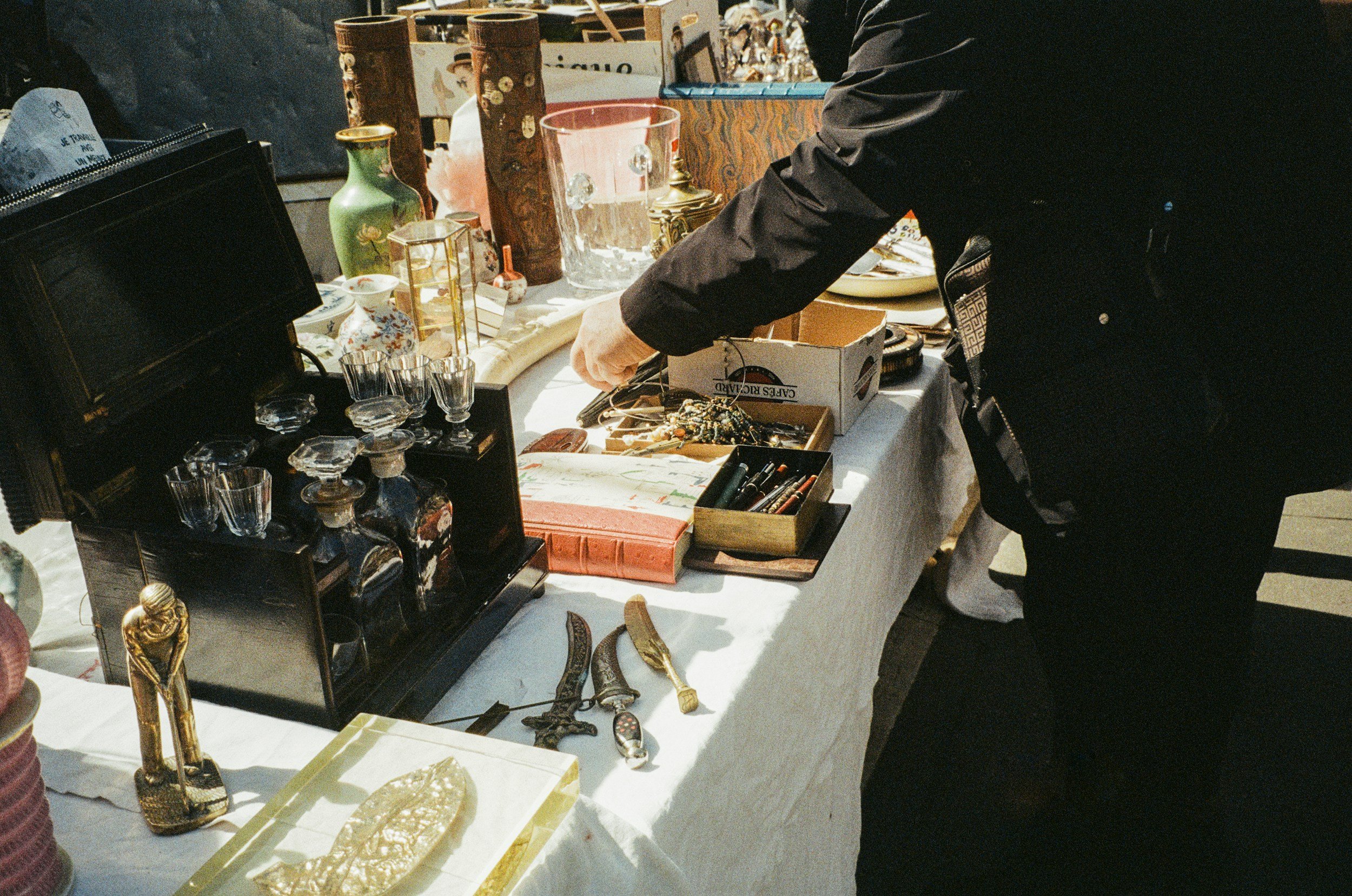
Some stalls are set up like proper antique stands, neatly arranged, priced clearly. Others are just tables filled with things pulled out of boxes that morning. Those are usually the ones worth stopping at.
You start recognising certain things after a while.
The same type of heavy linen napkins, slightly rough to the touch, often with stitched initials in one corner. Old café glasses that feel thicker than anything made now. Wooden boards with knife marks still visible. Not styled, not cleaned up too much, just used objects that have ended up here.
There are always a few stalls with piles of postcards. If you flip through them long enough, you’ll find messages written in careful handwriting, sometimes dated, sometimes not. Places mentioned that still exist, others that don’t.
It’s not a fast market. You don’t move in a straight line. You stop, step aside, go back, pick something up again. No one rushes you, but it’s also not quiet. There’s always a bit of noise, people talking, chairs scraping, glasses clinking from nearby cafés.
If you stay too long in the busiest part near the main canals, it starts to feel a bit tight. That’s usually when it’s better to drift into the side streets instead of pushing through. The smaller lanes behind Rue de la République are easier to walk, and some of the more experienced sellers tend to set up there anyway.
At some point, you’ll probably need a break without planning it.
Café Fleurs is an easy option because it sits right along the water, slightly away from the most crowded section. You can usually find a table if you’re patient for a few minutes. Coffee is simple, nothing fancy, but consistent. The almond croissants come out in batches, so if you’re lucky, you’ll get one that’s still warm in the middle.
After sitting down, going back into the market feels different. You notice things you missed the first time, or stalls that weren’t even set up properly earlier. If you’re there early in the morning, there’s more room to move and a bit more flexibility on prices. Later on, it’s more about browsing than finding something specific. By early afternoon, some traders have already started packing up, especially on hotter days.
Cash makes things easier. You can pay by card in some places, but not everywhere, and it slows things down. If you’re buying more than one thing from the same seller, it’s normal to ask for a slightly better price, but it’s not a big negotiation. More like a quick “can you do a little better on this?” and see what happens.
What makes this market work isn’t that everything is beautiful or rare. A lot of it isn’t. But every now and then you find something that feels like it has a bit of weight to it. Something you didn’t come looking for, but end up carrying around for the rest of the morning.
What to look for at the L’Isle-sur-la-Sorgue flea market
This isn’t a market where everything is rare or valuable, and that’s part of the appeal. A lot of what you’ll see are everyday objects that have simply stayed in circulation. The key is knowing what tends to show up here consistently, and what’s actually worth picking up.
One of the easiest things to recognise is Provençal linen. You’ll see it folded in stacks across multiple stalls, usually slightly faded, sometimes with hand-stitched initials in one corner. Tablecloths, napkins, tea towels. Prices vary depending on condition, but smaller pieces often start around €15–€25, while larger tablecloths can go anywhere from €40 to €90. If the fabric feels too stiff or perfectly white, it’s usually newer. The older pieces have a softer, worn texture that’s hard to replicate.
Ceramics are everywhere, but certain styles repeat. Thick bowls in muted yellow, olive green, or off-white, often with visible glaze variations. You’ll also see a lot of tian dishes (the shallow Provençal baking dishes with curved edges), which are still practical if you cook. Expect around €20–€60 depending on size and condition. Small chips are common and usually not a problem, but cracks are.
There’s also a steady mix of mid-century glassware and café pieces. Simple tumblers, carafes, old apéritif glasses. These are easy to carry and tend to be reasonably priced, often between €5 and €20 per piece. You’ll find better quality sets at the more organised stalls along the main canal, but the looser tables sometimes have more interesting variations.
If you’re willing to spend time digging, the paper goods are where things get more personal. Boxes of postcards, envelopes, old photographs. Some are purely decorative, but others still carry handwritten notes, addresses, stamps. Prices are usually low, a few euros each, but this is where you’ll find the most individual pieces.
You’ll also come across wooden kitchen tools and boards, often with visible wear. Knife marks, uneven edges, slight warping. These aren’t decorative reproductions, they’ve been used. They’re usually priced between €10 and €40 depending on size.
What’s worth being slightly more cautious with is anything that looks too perfectly coordinated. Sets that match too well, or items that look recently “aged,” tend to be brought in for resale rather than sourced locally.
The easiest way to find better pieces is to pay attention to how the stall is set up. If everything is spaced out, cleaned, and labelled clearly, you’re likely looking at a dealer who has already selected and priced accordingly. If things are still in boxes or grouped loosely, you have a better chance of finding something unexpected.
And in most cases, you won’t know immediately. It’s usually the second or third time you walk past something that it starts to stand out.
If the flea market terms in France get confusing, this breakdown of brocantes and vide-greniers across France explains what’s what, how they work, and what kind of finds you can realistically expect.
How to get to L’Isle-sur-la-Sorgue
Getting to L’Isle-sur-la-Sorgue is fairly straightforward, but the way you arrive does shape the day more than you might expect, especially if you’re planning around the Sunday market.
Most people come via Avignon, which is the closest major transport hub. From Avignon Centre station, there’s a direct TER train to L’Isle-sur-la-Sorgue – Fontaine-de-Vaucluse that takes around 25 minutes. Trains usually run every hour on Sundays, sometimes a bit less frequently early in the morning, so it’s worth checking the schedule the day before rather than relying on assumptions.
When you arrive, the station is about a 10-minute walk from the centre. You don’t need a taxi. Just follow the road straight ahead, and within a few minutes you’ll start seeing signs for the market and small groups of people heading in the same direction. The closer you get to the canals, the more obvious it becomes.
If you’re coming from Marseille or Aix-en-Provence, the easiest option is usually to take a train to Avignon first and then change there. It’s not complicated, but connections aren’t always perfectly timed, so give yourself a bit of margin rather than aiming for the tightest transfer.
Driving is an option, especially if you’re already staying somewhere in the Luberon, but Sundays require a bit of patience. Roads into town get busy from around mid-morning, and parking close to the centre fills up quickly. If you do drive, it’s better to arrive before 8:30 and park on the outer edges rather than trying to get close to the canals. There are several designated parking areas just outside the old town, and from there it’s an easy walk in.
One thing that’s easy to underestimate is how much easier the whole experience feels when you arrive early. Not just for the market itself, but for logistics. The walk from the station is quieter, cafés still have space, and you’re not navigating through a steady stream of people before you’ve even started browsing.
If you’re staying overnight, which makes the experience much more relaxed, the town settles quickly in the evening once the market is gone. That contrast between a busy Sunday morning and a quiet evening by the canals is part of what makes L’Isle-sur-la-Sorgue worth more than just a quick visit.
In case you’re based in Paris and wondering where else you can reach without a car, this guide to markets near Paris by train is useful for planning slower weekends away from the city.
Where to eat in L’Isle-sur-la-Sorgue
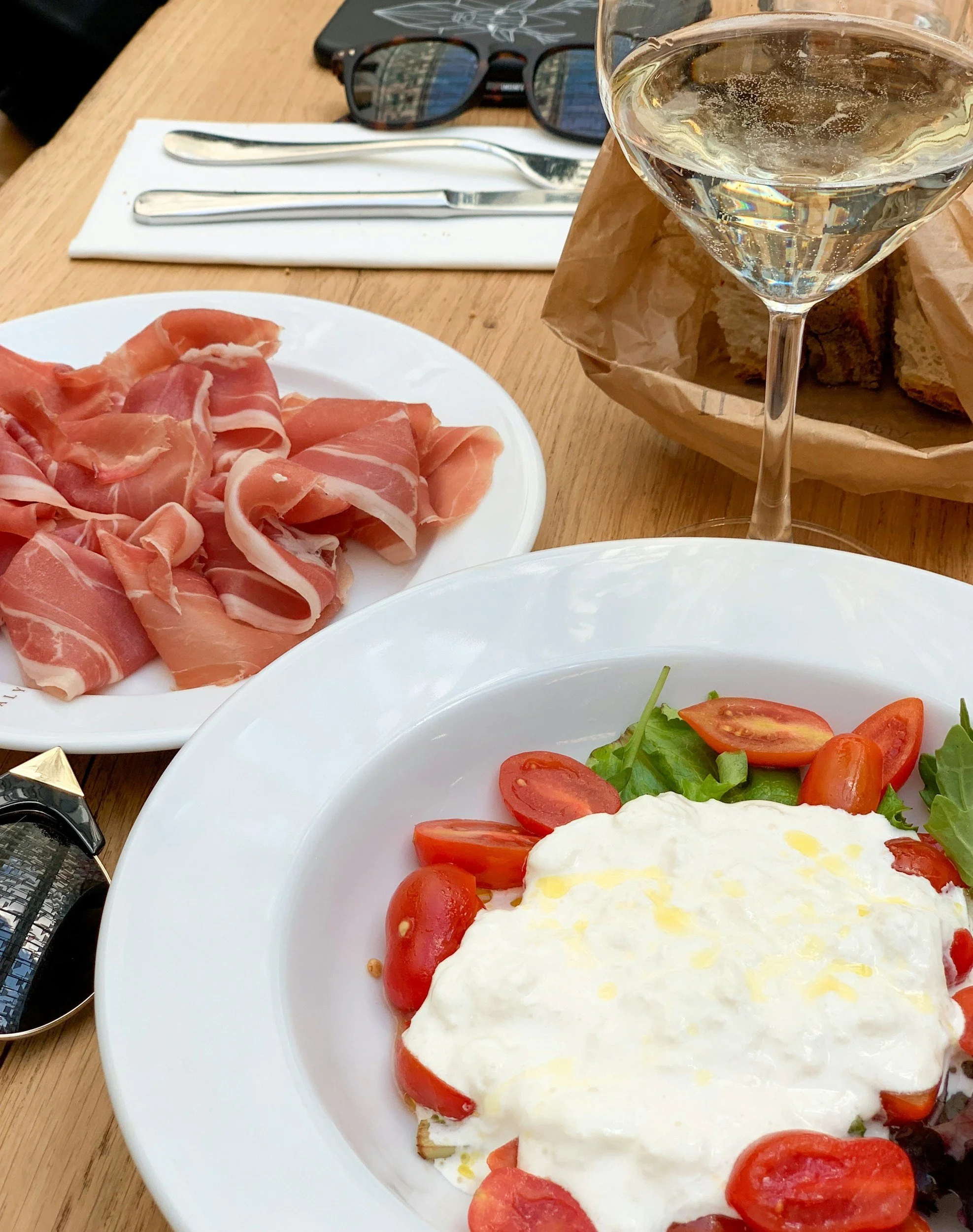
Food in L’Isle-sur-la-Sorgue is easy to get wrong if you just sit down at the first place you see along the busiest canal. A lot of those terraces look good at first glance, but they’re set up for turnover rather than anything memorable. It’s worth walking a few extra minutes.
If you’re there for the Sunday market, the day usually starts with something small rather than a full breakfast. Café Fleurs is one of the more reliable stops early on, mainly because of its location right by the water and the fact that it opens early. Coffee is simple and consistent, and if you arrive at the right moment, you’ll catch a fresh batch of almond croissants coming out. Sit outside if there’s space. It’s one of the few spots where you can pause without feeling like you’re in the middle of the crowd.
For something slightly more substantial later in the morning, Le Nego Chin sits just off the main flow of the market, which already makes a difference. The terrace is shaded, the pace is slower, and it’s a good place to sit down properly once you’ve done a few loops around the stalls. Their salads and simple Provençal dishes work well if you don’t want anything too heavy, especially if you’re planning to keep walking afterwards.
If you’re still in town around lunch and want something that feels a bit more considered, La Balade des Saveurs is one of the more interesting places to book ahead. It’s not right in the middle of the market streets, which helps. The menu leans seasonal, and the cooking is more precise without feeling overworked. It’s the kind of place where you sit down for a proper break rather than just refuel and leave.
Closer to the water, Le Jardin du Quai works well if you want something relaxed but still good. Tables are set along the canal, and if you time it right, you can sit slightly removed from the busiest stretch. Expect simple dishes done properly, grilled fish, vegetables, local wines, nothing complicated but well handled.
One thing that makes a difference here is timing. Eating earlier, around 11:30, or later, closer to 14:00, avoids the tightest rush. Between those times, most places fill up quickly, especially on Sundays, and service can slow down noticeably.
If you’re staying into the evening, the town shifts again once the market disappears. A lot of the day visitors leave, and the same restaurants feel calmer, less crowded, and more local. That’s usually when it makes sense to take your time and choose somewhere you actually want to sit, rather than wherever happens to have a free table.
If the quieter feel of L’Isle-sur-la-Sorgue is what appeals most, this guide to quiet French villages in Auvergne and Limousin shares places where the pace stays slow all week, not just on market days.
When in France…
Where to stay in L’Isle-sur-la-Sorgue (and what actually makes sense here)
Most people arrive for a few hours on Sunday, walk the market, have lunch, and leave. By late afternoon, the streets clear out, the stalls are gone, and the town settles into something much quieter. That contrast is part of why it’s worth staying at least one night.
If you want to be in the middle of everything, staying inside the old town means you can step straight out into the market in the morning without thinking about logistics. Small guesthouses and apartments are scattered around the canals, especially near Rue Carnot and the streets just behind the main market loop. You’ll hear the setup early on Sunday, vans arriving, tables being unfolded, but that’s part of the experience rather than a downside.
Grand Hôtel Henri is one of the more central options that still feels considered rather than generic. It’s set in a former townhouse, with rooms that lean classic but not overly formal. The main advantage here is location. You’re a short walk from both the station and the market, which makes arrival and early mornings easier.
Closer to the canals, Hôtel Les Névons sits right by the water. Some rooms overlook the Sorgue, and if you open the windows early in the morning, you’ll hear the market setting up in the distance. It’s a practical choice if you want to be right in the centre without overthinking it.
If you’d rather stay somewhere quieter, just outside the busiest streets, there are a few good options within walking distance of the town. Mas de Cure Bourse is a short drive away and feels more like a countryside stay, with a garden, pool, and more space around you. It works well if you’re combining the market with a slower few days in Provence rather than just passing through.
Another option slightly outside town is Domaine de la Petite Isle, which is set along the river with multiple low buildings rather than one central structure. It’s quieter in the evenings and easier for parking, which matters if you’re driving.
One thing to keep in mind is timing. Saturdays and Sundays fill up quickly, especially from spring through early autumn. Booking ahead makes a noticeable difference, particularly if you want something small and central.
If you’re arriving by train, staying near the centre saves you from needing a car at all. Everything you’ll want to see, the market, cafés, antique shops, is within walking distance. And once Sunday ends and the town slows down, having your room close by means you can step out again in the evening and see a completely different side of the same place.
Want to explore France by train and want to slow down rather than rush between stops? This piece on which Eurail pass makes sense for slow regional travel helps you choose the option that actually fits this style of travel.
And in case you’re thinking of going further inland after this, the Drôme Provençale markets and hilltop villages guide is a natural continuation. It’s the same region but even more tucked away.
Before you go (small things that make a real difference)
The market isn’t centred in one square. It starts along Quai Jean Jaurès, crosses the river near Square de la Rode, loops around Place de la Liberté, and then continues into the narrower streets behind Rue Carnot. If you only stay along the main canal, you’ll miss a large part of it.
Arriving around 8:00–8:30 means you’ll see stalls still being set up, especially near the edges of the market where dealers unload directly from vans. By 10:30, the walkways along the canals, particularly near the small pedestrian bridges, slow down noticeably.
Bring cash in smaller notes. Some of the more established antique dealers take cards, but many of the brocante-style stalls in the side streets don’t, especially for lower-value items.
The ground isn’t as flat as it looks. Between the cobblestones, narrow pavements, and small bridge crossings, you’ll be stepping up and down more than expected. Flat shoes make a difference after an hour or two.
If you’re carrying anything fragile, like glassware or ceramics, it’s worth having a proper tote or wrapped bag. Sellers will often wrap items in paper, but not always enough if you’re walking around for a while.
FAQ: L’Isle-sur-la-Sorgue Flea Market
When is the L’Isle-sur-la-Sorgue flea market on?
The main flea market runs every Sunday across L’Isle-sur-la-Sorgue, spreading through the old town along Quai Jean Jaurès, around Place de la Liberté, and into the smaller streets behind the church. In addition, two major antique fairs take place each year, usually in April and August, when international dealers set up across a much larger area and the town feels noticeably more intense.
What time should you arrive at the market?
If you want space to move and actually look at things, aim to arrive between 8:00 and 9:00. By that point, most stalls are open, but the narrow sections along the canals are still easy to walk. After 10:30, the central stretches near the water start to slow down with foot traffic, especially around the bridges where people naturally bunch up.
Where exactly is the flea market located?
It’s not in one place. The market loops through the entire centre of town. The busiest sections run along Quai Jean Jaurès and circle around Place de la Liberté, but some of the better stalls are set up in the smaller streets just behind Rue de la République, where it’s slightly less crowded and easier to stop without blocking the flow.
Is L’Isle-sur-la-Sorgue flea market worth visiting compared to other markets in Provence?
Yes, mainly because of the scale and consistency. Many Provençal markets are good for an hour. This one holds your attention for much longer because it mixes proper antique dealers with more informal brocante stalls. You’re not just browsing tables, you’re moving through a town that’s built around this trade.
How do you get to L’Isle-sur-la-Sorgue from Avignon?
From Avignon, take the TER train to L’Isle-sur-la-Sorgue – Fontaine-de-Vaucluse. The journey takes around 25 minutes. From the station, it’s a straightforward 10-minute walk straight into town. You’ll start seeing market stalls as soon as you reach the canals.
Can you visit without a car?
Yes, and in many cases it’s easier. Parking on Sundays gets complicated after mid-morning, and streets close around the centre. Arriving by train means you walk straight in without needing to think about where to leave your car.
Where are the best stalls in the market?
The most polished antique pieces are usually along the main canal routes, but the more interesting finds tend to be in the side streets behind Rue de la République and around the edges of the market loop. Look for stalls that aren’t overly arranged, open boxes, mixed items, handwritten prices. That’s often where things haven’t been picked over yet.
If you love the antiques and brocante scene here, you might also like this round-up of European towns with antique markets worth planning a summer trip around. Some of them have the same old-world feel, just in quieter settings.
Do you need cash at the flea market?
Yes. Some larger dealers accept cards, but many smaller stalls don’t, especially for lower-value items. Having smaller notes makes buying quicker and avoids awkward delays, particularly in busier areas.
Is bargaining normal at L’Isle-sur-la-Sorgue?
Yes, but it’s understated. If you’re buying multiple items or something larger, it’s normal to ask for a slightly better price. It usually happens in a short exchange rather than a long negotiation.
How crowded does it get?
The busiest period is late morning, especially around the bridges and central canal paths where foot traffic slows naturally. If you stay into early afternoon, parts of the market begin to thin out again as some traders start packing up.
What else should you see in L’Isle-sur-la-Sorgue?
Beyond the Sunday market, the town has permanent antique shops throughout the centre, as well as larger spaces like Le Village des Antiquaires just outside town. It’s also worth walking away from the busiest streets to see the waterwheels along the Sorgue, especially once the market starts to wind down.
Is it worth staying overnight?
Yes, because the town changes completely once the market ends. By early evening, most visitors have left, the stalls are gone, and the same streets feel quiet again. Staying overnight lets you see both sides of the town instead of just the busiest version.
If you’re trying to build a trip around one base instead of moving every day, this guide to French towns worth staying 3–5 nights makes it easier to pick places that you’ll actually enjoy staying.
Want more slow travel ideas like this?
Sign up for our newsletter and get hand-picked hidden gems, cozy café tips, and soulful travel guides delivered straight to your inbox.