Which market town would I stay in? Here's how I'd choose.
One of the easiest mistakes to make in Drôme and Ardèche is assuming that a market town is just somewhere to spend a Saturday morning.
You arrive early, circle a few streets looking for parking, buy a bag of olives or a wedge of local cheese, stop for a coffee in the main square and then continue towards the next destination on the map. From a distance, many of the towns seem remarkably similar. They all have market days, old centres, café terraces and the kind of streets that photograph well. It's only when you stay overnight that the differences start to become obvious.
Nyons, for example, feels completely different on a Saturday evening than it does at eleven o'clock in the morning when the market is at its busiest. Die changes again once the stalls disappear and the centre quietens down, while Tournon-sur-Rhône often feels less like a market town and more like a small wine town stretched along the Rhône. Crest can easily fill a full weekend if you enjoy wandering between cafés, river walks and local shops, whereas other places work better as part of a longer route through the region rather than as a destination in their own right.
That's why I wouldn't choose between these towns based on the market alone.
The more useful question is what you want the rest of the weekend to look like once the market has finished. Do you want somewhere you can explore entirely on foot from Friday evening until Sunday afternoon? Somewhere with enough restaurants to linger over dinner without making reservations weeks ahead? A town where you can arrive by train and never think about the car again? Or somewhere that feels noticeably quieter once the day visitors head home?
The towns in this guide all have good markets, but that's not really the reason they're here. They're here because they're the places where staying the night changes the experience, and in a region full of market towns, that's often what makes the difference between a pleasant stop and a weekend you'll want to repeat.
Getting to Drôme and Ardèche and travelling between the towns
If you haven't travelled around this part of France before, it's worth knowing that Drôme and Ardèche sit on opposite sides of the Rhône River, just south of Lyon. The towns in this guide aren't far apart as the crow flies, but they don't always feel close once you're on the road. Rivers, vineyards and low mountain ranges shape the routes, so journeys often take a little longer than you'd expect from looking at a map.
Most people arrive through Valence, whether they're driving down from Lyon or taking the TGV from Paris, Marseille or elsewhere in France. From there, regional TER trains continue to places like Romans-sur-Isère, Die and Tain-l'Hermitage. If you're heading to Tournon-sur-Rhône without a car, it's actually easier than it first appears. You simply get off at Tain-l'Hermitage station and walk across the Marc Seguin footbridge over the Rhône, which takes around ten minutes.
Once you leave the main railway line, though, travelling becomes a bit slower. Die is easy enough to reach by train, but Nyons and Crest are much more convenient with a car, especially if you're hoping to explore more than one town over a weekend. Regional buses do connect many places, although they're not always frequent and Sunday services can be fairly limited.
If you're planning to visit several market towns, I'd definitely recommend having a car. Not because the distances are huge, but because you'll have far more freedom to stop at vineyards, village bakeries or roadside viewpoints without worrying about the next bus. If you're travelling entirely by train, I'd keep things simpler and base yourself in one or two towns instead of trying to fit everything into a single weekend. Romans-sur-Isère, Die and Tournon-sur-Rhône work particularly well for that, while Nyons is usually easier to include if you're already exploring southern Drôme by road.
Travelling without a car? These TER train routes open up far more of rural France than most people realise.
The market only lasts a few hours. The rest of the weekend doesn't.
It's easy to plan a whole trip around market day (in fast, most people do). Thursday points you towards Nyons, Saturday usually means Die or Crest, and if you're looking at Tournon-sur-Rhône you'll probably end up there on a Wednesday or Saturday morning.
The thing is, the market is only one part of the weekend!
By early afternoon the crates have disappeared, the vans have driven away and the squares begin returning to everyday life. That's usually when you find out whether you've chosen somewhere you'd actually like to spend the night.
One of my favourite times in Nyons is actually after the busiest part of the market has passed. Around one o'clock, people drift away from the stalls and onto the restaurant terraces beneath Place des Arcades instead, while the little food shops around Rue des Déportés suddenly become much easier to wander through. If you've still got a bit of time before dinner, it's worth walking over to the Pont Roman. It's only a few minutes from the centre, but it already feels much quieter, and looking back towards the rooftops and the olive-covered hills gives you a completely different picture of the town than you get in the middle of the morning.
Die is noticeably quieter by late afternoon, although not in a way that makes the town feel empty. The market stalls have disappeared, bikes are propped against café walls, walkers drift back into the centre after a few hours in the vineyards or up towards the Vercors, and the queue outside the bakery has more local residents than visitors in it again. By then, the market already feels like something that happened earlier in the day, and the mountain setting quietly takes over.
Romans-sur-Isère goes in the opposite direction. Long after the market has packed away, Rue Jacquemart is still busy with people carrying shopping bags, the terraces around Place Ernest Gailly are filling for a late coffee and Les Halles still has people coming and going. It's one of the reasons I'd happily stay here for a full weekend. The market is only one part of the day, and once it's over there's never any sense that the town has run out of things to do.
Then there's Tournon-sur-Rhône, where the market almost becomes an excuse to spend the rest of the day by the river. It's surprisingly common to cross the Marc Seguin footbridge more than once, perhaps for lunch in Tain-l'Hermitage, back again in the afternoon, then over once more for a glass of Crozes-Hermitage in the evening without really thinking about which side of the Rhône you're on anymore.
In the end, that's usually what decides it for me. Not how busy the market is between nine and noon, but how the town feels a few hours later when the stalls have been packed away, the day-trippers have started driving home and you're still genuinely happy you've booked another night.
Nyons for olive groves, long lunches and France's best olive market
The Thursday market has been part of Nyons for so long that it's difficult to imagine the old centre without it. By seven-thirty, stallholders are already unloading crates of olives, apricots and tomatoes beneath the arcades, cafés are dragging tables onto the pavements and delivery vans are squeezing through streets that will soon belong almost entirely to pedestrians.
It's also the easiest time of day to get caught out if you're driving. The streets around Place de la Libération and the old centre start filling much earlier than they look as though they should. I learnt that the hard way after following the one-way system round in circles, convinced another parking space would appear if I just kept going. It never did. Now I leave the car outside the centre and walk in instead. It's quicker, and it's a much nicer way to arrive. By half past eight the market is properly coming to life, but people are still stopping to chat while the fruit stalls are being topped up, florists are arranging fresh buckets outside their stands and the cafés beneath the arcades are only just filling with their first customers. Leave it until ten and you'll be sharing those same streets with everyone else.
The Thursday market spreads through the historic centre around Place des Arcades and Place de la Libération, but the best way to experience it is not to rush straight for the busiest part. I would start slightly away from the square, then come in slowly through Rue des Déportés or the lanes behind the arcades, where you still catch the smell of roasted chicken, cheese, olives, honey and fruit before you are properly inside the crowd. Nyons AOP olives are everywhere, but not in a decorative way. They are part of the weekly shop here, along with olive oil, tapenade, goat’s cheese, apricots in season, lavender products, small jars of local preserves and whatever vegetables look best that morning.
The arcades make the town feel older than the usual market-day prettiness, especially once the tables beneath them start filling for lunch and the stalls begin thinning out. Around midday, Nyons changes rather than empties. People stop trying to move through the market and begin settling around it, which is why I would avoid planning anything too ambitious afterwards. This is the kind of town where a good Thursday is simply market, coffee, lunch, a slow walk, maybe one proper olive oil stop, then dinner later if you are staying overnight.
For that olive oil stop, I would not only rely on the market stalls. La Maison des Huiles d’Olive et Olives de France is useful if you actually want to understand the difference between the oils rather than just buy a bottle because the label looks nice, and Vignolis is the obvious place to go if you want a broader sense of Nyons olives, olive oil and local wines in one stop. La Scourtinerie is the more unusual detour, and the one I would make time for if you like places that still feel tied to a specific local craft. It is the last scourtin factory in France, making the traditional fibre mats once used in olive oil production, and it gives the olive culture in Nyons a bit more texture than simply tasting oil and moving on.
The Pont Roman is worth saving until later in the day, not because it is difficult to see in the morning, but because the walk feels better once the town has calmed down. Cross towards the Eygues when the market noise has dropped and you get a different sense of where Nyons sits, with the old centre behind you and the olive-growing hills around the town suddenly feeling much closer. The Jardin des Arômes is another small place I would add if you are staying overnight rather than passing through. It is not the kind of stop that needs a plan, but it works well when you want twenty quiet minutes away from the main streets without driving anywhere.
This is why Nyons is better as a short stay than a quick market stop. The Thursday market is the obvious reason to come, but the town makes more sense if you arrive the afternoon before, have dinner near the old centre, wake up early enough to reach the market before it gets busy, and stay long enough afterwards to see the streets return to normal. If you only come for the busiest two hours, you will understand why the market is popular, but not why people keep choosing Nyons as a base in southern Drôme.
If Nyons is the town you're leaning towards, this Thursday market guide will save you from making a couple of very common mistakes first.
Curious how a Provençal market morning compares with Nyons? Saint-Rémy before 10 a.m. feels like a completely different experience.
Die for train travellers, Clairette and weekends beneath the Vercors
One of the things I like most about Die is that you don't have to spend the first hour working out where everything is.
The station sits only a short walk from the old town, so if you've arrived on the TER from Valence, you'll be walking along Avenue de la Division du Texas and through Porte Saint-Marcel before you've even had time to think about finding a taxi. Within a few minutes you're standing on Rue Camille Buffardel, which quietly becomes the backbone of the whole weekend. Almost every walk seems to pass along it sooner or later, whether you're looking for breakfast, heading towards the Saturday market or wandering back after dinner.
Saturday is easily the busiest day of the week. By 08.00, traders are already setting up around Place de la République and the neighbouring streets, and by mid-morning the market has spread through much of the historic centre. You'll find Clairette de Die, Picodon goat's cheese, walnuts from the Diois, mountain honey, seasonal fruit and vegetables, local charcuterie and plenty of small producers from villages scattered across the valley rather than the large commercial stalls you often find in bigger towns.
One thing I wouldn't do though, is spend the whole morning inside the market.
It's worth ducking into the Cathédrale Notre-Dame every now and then, simply because the contrast between the busy square outside and the cool, quiet interior feels surprisingly welcome after an hour or two of browsing. A little further along Rue Camille Buffardel, Le Café des Lys is a good place to pause once you've finished shopping rather than carrying bags around for another hour, especially if you manage to get one of the outside tables. Die isn't a town with dozens of fashionable cafés, more local small places with excellent coffee and pastries.
Clairette de Die is impossible to ignore once you've spent a few hours here, but I'd save the tasting until later in the afternoon. Jaillance, just outside the centre, becomes much calmer once the market crowds have disappeared, and taking the guided tour then feels far less rushed than trying to squeeze it in before lunch. If you're more interested in small producers than visitor centres, the Cave de Die is also worth a look for local wines from across the Diois.
By late afternoon, Die changes quite a bit. The market stalls disappear surprisingly quickly, the delivery vans return, and people begin drifting back towards the bakeries and cafés. If you walk down towards the River Drôme instead of staying around the main square, you'll often find yourself almost alone apart from a few families by the water and cyclists finishing rides through the vineyards around Chamaloc and Pontaix. It doesn't feel sleepy. It simply goes back to being a small mountain town.
That's probably why I'd stay two nights here instead of one.
Sunday isn't really about sightseeing. It's a good morning for picking up pastries from Boulangerie Brunel, wandering through the streets while shopkeepers begin opening up, then driving towards Col de Rousset before the day gets too warm. If you'd rather stay closer to town, Abbaye de Valcroissant, tucked beneath the cliffs outside Die, is one of those places that's surprisingly easy to miss if you're only passing through, yet makes a peaceful detour before lunch. Another favourite is Châtillon-en-Diois, around twenty minutes away, where flower-covered stone houses, tiny wine cellars and quiet lanes make it an easy addition if you've based yourself in Die for the weekend.
Die isn't somewhere I'd come for shopping or long evenings moving between restaurants. What keeps bringing me back is how uncomplicated the weekend feels. The station is only a short walk from the old centre, the market spills naturally into lunch, Clairette de Die is never far away and, before long, you're walking through vineyards with the cliffs of the Vercors filling the horizon. By Sunday morning it doesn't really feel as though you've spent two days in a town. It feels as though you've spent a weekend in the whole Diois.
Thinking about staying somewhere surrounded by vineyards and olive groves rather than right in town? These cottage stays might be exactly what you're looking for.
Crest for a small historic centre and Saturday market
The first time I stayed in Crest, I realised fairly quickly that the market wasn't really the reason I'd come back.
The Saturday market is the reason most people come to Crest, and it's easy to see why. Before long you'll find yourself wandering between the stalls on Place du Général de Gaulle, turning into Rue de l'Hôtel de Ville because something caught your eye or stopping to taste a local Picodon before carrying on. The market is wonderful, but I don't think it's the best part of the day. By the time lunch comes around and the stalls begin disappearing one by one, Crest somehow becomes even easier to enjoy.
The old town is small enough that you almost stop looking at a map after your first walk. One street naturally leads into another. Grande Rue gives way to Rue Archinard, a narrow lane lined with old stone façades and little independent shops, before opening back towards the cafés around the centre, and before long you find yourself walking without any particular destination in mind. I always end up stepping into Librairie Mosaïque, even if it's only for a few minutes, because it feels like the sort of bookshop every market town ought to have, and if Chapelle des Cordeliers happens to be hosting one of its temporary exhibitions, it's well worth twenty quiet minutes away from the bustle outside.
If you're driving into Crest on a Saturday morning, it's usually not worth trying to get right into the old centre. By half past eight the streets around the tower are already filling up, delivery vans are still squeezing through alongside market shoppers and the search for a parking space can easily take longer than the walk itself. I nearly always leave the car on the other side of the Drôme now and cross Pont Frédéric Mistral instead. It's a much nicer way to arrive anyway. The first thing you see is the Tour de Crest rising above the rooftops, then the market slowly comes into view as you get closer to the centre.
By lunchtime the flower stalls are disappearing one by one, traders are folding tables and loading vans, and the streets that were shoulder to shoulder only an hour earlier suddenly have room to breathe again. Outside Le Karakafé, hardly anyone seems in a hurry to ask for the bill, while the terrace at Café de Paris fills steadily with people settling in over lunch rather than squeezing in a quick coffee before heading home.
A few minutes later, down by Plage de Crest, children are splashing in the Drôme, cyclists have their shoes off at the water's edge and people wander back from the bakery with a baguette tucked under one arm. It's a lovely time to walk through the town because the market is no longer competing for your attention. You notice the old façades, the little side streets leading away from Grande Rue and the conversations drifting out from open café windows in a way that's much harder to do during the busiest part of the morning.
If you're staying overnight, don't rush to climb the Tour de Crest during the busiest part of the day. I much prefer walking up in the late afternoon when the market has almost disappeared and the valley begins changing colour. Afterwards, take the quieter route back through the residential lanes instead of heading straight down the main streets. It's one of those small detours that reminds you people actually live here.
Dinner is another reason I'd stay rather than drive on. La Salle à Manger is a lovely choice if you're looking for seasonal local cooking, while the terraces around the centre stay pleasantly busy well into the evening without ever becoming loud. Crest doesn't have the restaurant scene of a larger town like Romans-sur-Isère, but it doesn't really need one. Everything is close enough that after dinner it's easy to wander down towards Quai de Verdun, listen to the river for a while and eventually find yourself back beneath the illuminated tower without having planned the walk at all.
If you have a second day, I'd resist the temptation to tick off another market town. Instead, drive twenty minutes to the Forêt de Saou, stop at one of the small villages on the way back, then return to Crest for a late lunch. That's the kind of weekend this town suits best!
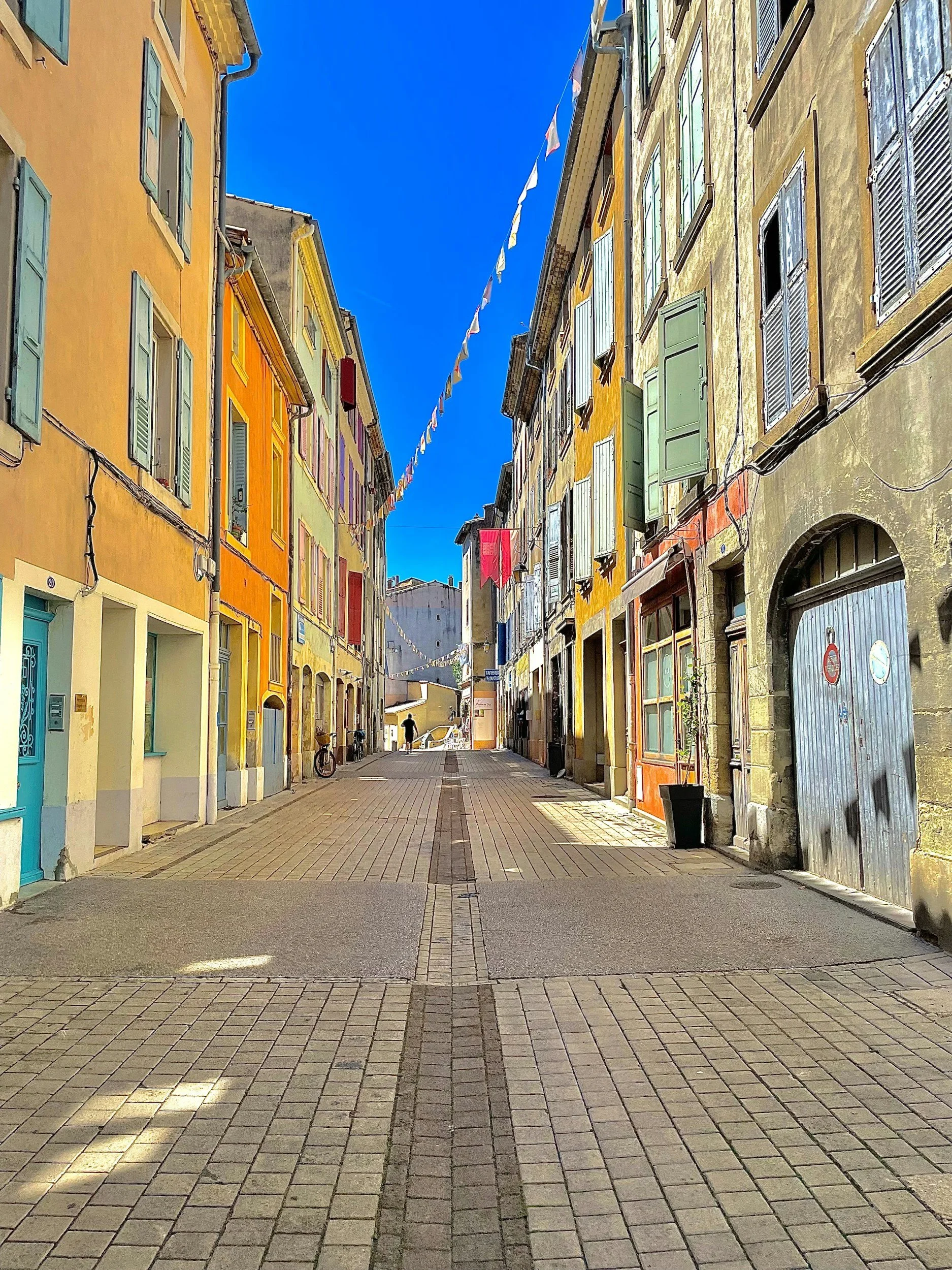
September is one of my favourite times to come back here, and Drôme Provençale in autumn explains why the whole region feels surprisingly different once summer ends.
Romans-sur-Isère for browsing, long lunches and local life
Romans-sur-Isère is probably the least obvious choice in this guide, which is exactly why I think it deserves your attention.
Romans-sur-Isère doesn't have the same instant appeal as Nyons or Crest. The first impression is of a bigger, busier town, and I think that's why a lot of people only stop for the morning before moving on. Spend a couple of days here instead and it starts to feel completely different. The Sunday market is excellent, but once it's over the town doesn't suddenly lose its energy. People are still out shopping, meeting friends for coffee or picking up bread on the way home, and that's when Romans really starts to come into its own.
I somehow always end up back on Rue Jacquemart. Maybe it's because there's always something that catches my eye. A queue outside a bakery usually means it's worth joining, Librairie Le Marque-Page is the sort of place where a quick look easily turns into half an hour, and the little food shops tempt you to buy things you hadn't planned on taking home. It's an easy street to wander because it feels like people are there for ordinary Saturday and Sunday errands rather than sightseeing.
The Sunday market stretches through Place Maurice Faure, Place Ernest Gailly and the surrounding streets, but it never feels as though everyone is following the same route. Some people arrive with shopping trolleys, buy exactly what they came for and disappear again before the cafés have properly filled up. Others seem perfectly happy to spend the whole morning drifting between Les Halles, the cheese stalls, the bakeries and whichever terrace happens to have a free table in the sun. If you arrive early enough, you'll still catch stallholders setting out the last of their produce and locals stopping for a quick chat before carrying on with the weekly shop. An hour or two later, the market is busier, the cafés are noisier and you'll probably find yourself taking a quieter side street simply because it's easier than squeezing through the crowds.
I never seem to spend an afternoon in Romans quite the way I'd imagined. I'll head towards the Musée International de la Chaussure, stop for coffee on the way back, wander through Rue Jacquemart, browse a couple of food shops and then realise I've somehow walked a much bigger loop through the old centre than I'd intended. That's probably because Romans has enough cafés, independent shops and everyday life woven between them that it never feels as though you're moving from one attraction to the next.
When the centre starts feeling a little busier, I nearly always end up walking towards Parc Jouvet. It only takes a few minutes before the cafés and shopfronts give way to tall trees and wide paths overlooking the Isère, and from there it's easy to wander down towards the river, cross the Pont Vieux and come back through the quieter streets behind the old town. Those back streets aren't especially grand and there isn't a famous viewpoint waiting at the end of them, but they're full of little details that are easy to miss if you never leave the main squares. Someone watering plants outside their front door, a workshop with its door open onto the street, laundry hanging above the narrow lanes, neighbours stopping for a chat on the pavement. By the time you arrive back at Place Maurice Faure, it feels as though you've seen a different side of Romans altogether.
Dinner is another reason I'd choose Romans over one of the smaller market towns if I wanted a full weekend away. There are simply more options, and they're spread naturally through the centre rather than concentrated around one square. Le Comptoir des Loges is a lovely choice if you're after seasonal local cooking, while the terraces around Place Ernest Gailly stay pleasantly busy well into the evening. Even after nine o'clock, you'll still find people finishing dinner, walking home across the old bridges or stopping for one last drink before calling it a night.
One small thing that's worth knowing if you're driving is that market mornings can make the streets closest to the centre surprisingly slow. Rather than trying to edge your way through, it's usually easier to leave the car outside the busiest area and walk the last few minutes in. Romans isn't difficult to explore on foot, and once you're in the old centre there's very little reason to move the car again until you're ready to leave.
I wouldn't come to Romans looking for the prettiest market in Drôme. I'd come because it's one of the few towns where the market feels like just one part of the weekend. Long after the stalls have disappeared, people are still meeting friends for coffee, wandering in and out of independent shops, crossing the river for an evening walk or deciding where to have dinner. It feels less like a place that puts on a market once a week and more like a town that's simply enjoyable to spend time in.
If this article has put French market weekends firmly on your radar, these summer markets are some of the ones I'd build an entire road trip around.
And in case you love wandering around a market but always seem to miss the brocantes happening nearby…? This guide makes it much easier to match the two.
Tournon-sur-Rhône for wine, river walks and a weekend that naturally spills across the Rhône
Out of all the towns in this guide, Tournon-sur-Rhône is probably the one where I spend the least time looking at a map.
After the first walk across the Passerelle Marc Seguin, you almost stop thinking about which side of the river you're on. Breakfast might be in Tournon, a wine tasting ends up being in Tain-l'Hermitage, you wander back for dinner beneath the castle walls, then find yourself crossing the bridge again after sunset simply because the evening light over the Rhône is too nice to ignore. Before long it feels less like two separate towns and more like one weekend spread across both riverbanks.
The Saturday market is a good example of that. It fills the streets around Place Jean Jaurès and below the Château-Musée de Tournon, but I never feel the need to arrive the minute it opens. It has a much calmer feel than markets further south, so it's perfectly possible to spend an hour wandering between the cheese stalls, fruit growers, walnut producers and wine merchants before stepping into one of the little side streets simply because something caught your eye. Some of my favourite moments here have nothing to do with shopping at all. They're the few quiet minutes you suddenly find behind the castle while everyone else is still browsing the market below.
I nearly always walk up to the Jardin d'Éden before lunch, although not really for the garden itself. It's the view that keeps bringing me back. Looking across the Rhône towards the steep Hermitage vineyards, you suddenly understand how close everything is. The vineyards don't feel like somewhere you'll visit later in the day. They're already part of the view from almost everywhere in town!
By early afternoon I usually find myself crossing the bridge. Ten minutes later you're in Tain-l'Hermitage, perhaps wandering around Cité du Chocolat Valrhona, tasting wines at Cave de Tain or Maison M. Chapoutier, or simply sitting outside with a glass of Crozes-Hermitage watching cyclists roll past on the ViaRhôna. That's one of the reasons I'd stay overnight here rather than making it a day trip. You never feel as though you have to squeeze everything into one side of the river before moving on.
By late afternoon, Tournon has settled back into itself. The market stalls have gone, the delivery vans are back on the streets and Quai Farconnet fills with people out for an evening walk before dinner. Some head across the Passerelle Marc Seguin into Tain-l'Hermitage for another glass of wine, others stay on the Ardèche side and drift between the cafés beneath the château. I usually end up doing a bit of both. Dinner at Le Tournesol is always tempting, but just as often I'll walk a little further until somewhere else catches my eye. That's one of the nice things about staying overnight here. Once you've stopped worrying about fitting everything into a few hours, there's no real reason to decide too much in advance.
If you've got another day, I'd save it for everything around the town rather than trying to find another market. The Train de l'Ardèche still leaves from the old station just outside the centre, and even if you don't take the full journey through the Doux Valley, it's worth arriving a little before departure to watch the steam locomotive being prepared. Afterwards, drive up into the vineyards above Tain-l'Hermitage. There are dozens of little places where you can pull over for a few minutes, look back across the Rhône towards the château and the old rooftops of Tournon, then carry on until another view makes you stop again. It isn't really the sort of drive where you're trying to get somewhere.
By the end of the weekend, I usually have to stop and think about where I actually did things. Was lunch in Tain-l'Hermitage or back in Tournon? Which side of the river did that little wine shop happen to be on? After you've crossed the bridge a few times, it all starts to blur together in the nicest possible way, and I think that's one of the reasons staying overnight makes such a difference here.
If you're continuing north after Tournon-sur-Rhône, this Bugey weekend fits surprisingly well before heading towards Lyon.
A few things I'd do differently after spending time here
When I first started travelling around Drôme and Ardèche, I kept making the same mistake because the distances looked so manageable on the map that squeezing two or three towns into a weekend felt completely realistic. I'd book one night in Nyons, another in Die, convince myself I'd still have time for Crest on the way back towards Lyon, and only realise halfway through Saturday afternoon that I'd spent more time loading the car, finding another parking space and working out where everything was than I'd spent sitting in any of the cafés I'd actually wanted to visit.
It took a couple of trips before I stopped travelling through the region like that. Now I'd much rather arrive in Nyons on Wednesday afternoon, wander through the old streets while they're still quiet, have dinner somewhere beneath the arcades, wake up properly for the Thursday market and let the rest of the weekend happen without feeling I ought to be somewhere else by three o'clock. The same thing happened in Die. I remember sitting with a glass of Clairette after the market had finished, watching people drift back through Rue Camille Buffardel carrying bread instead of shopping bags, and thinking I'd almost driven somewhere else that afternoon simply because I felt I should make the most of the weekend. Looking back, staying exactly where I was turned out to be the better decision!
That's something I keep noticing in this part of France. The moments I remember rarely happened because I planned them. They usually appeared somewhere between one thing and another. Walking back from dinner in Tournon-sur-Rhône and crossing the Passerelle Marc Seguin simply because the evening light over the Rhône looked different from the night before. Pulling over outside Pontaix because someone's selling apricots from a table at the end of their driveway and realising twenty minutes have disappeared in conversation. Walking into Librairie Mosaïque in Crest to cool down for a few minutes and coming back out with a book that somehow found its way into your bag. Taking a different road back from Châtillon-en-Diois simply because it passes another vineyard you'd never noticed before. Those are the moments I remember afterwards, much more clearly than which stall had the best olives or exactly what I bought at the market.
I don't really think about these weekends in terms of markets anymore, even though that's usually the reason I go in the first place. I remember sitting outside with a coffee after everyone else had finished shopping, finding a bakery I'd somehow walked past twice already or taking the long way back to the hotel because one narrow street looked more interesting than the next. Somehow that's how these towns work. The less I try to fit into a weekend, the more it feels as though I come home having seen more of the place than I did on those early trips when I was constantly looking at the clock.
If you're already wondering where to go after Drôme and Ardèche, Montolieu has the same kind of weekend where you'll happily spend hours without ever looking at the time.
FAQs about Drôme and Ardèche
Which market town in Drôme is best if you want to stay for the whole weekend?
If you're planning two nights rather than one, I'd narrow it down to Nyons, Romans-sur-Isère or Tournon-sur-Rhône. They all have enough going on outside market hours that you never feel like you're simply waiting for the next morning. In Nyons, that might mean spending Thursday afternoon visiting Vignolis or walking down towards the Pont Roman after lunch. In Romans-sur-Isère, the market naturally blends into cafés, independent shops and the streets around Rue Jacquemart, while Tournon-sur-Rhône gives you two towns instead of one because crossing into Tain-l'Hermitage becomes part of the weekend almost without thinking about it.
Where should you stay for the Thursday market in Nyons?
I'd stay somewhere within walking distance of the old centre rather than outside town. Being able to wander into Place des Arcades before eight o'clock, while stallholders are still arranging fruit, olives and flowers, feels completely different from arriving by car once the streets around Place de la Libération have filled up. The evening before is just as enjoyable because the restaurants beneath the arcades are busy, the market hasn't arrived yet and it's much easier to get your bearings.
Is Die or Crest better for a relaxed weekend?
They're surprisingly different despite being less than an hour apart.
I'd choose Die if you like vineyards, mountain scenery and the idea of arriving by train without needing a car for the rest of the weekend. Crest feels more like somewhere to browse. You might spend an hour in the Saturday market, then end up in Librairie Mosaïque, follow the Drôme River for a while, stop for another coffee at Le Karakafé and realise the afternoon has disappeared without ever having made a plan.
Which market town in Drôme has the best local food?
Nyons is difficult to beat if food is the reason you're travelling.
The Thursday market is full of Nyons AOP olives, olive oil, tapenade, Picodon goat's cheese, fruit from the surrounding orchards, lavender honey and seasonal vegetables, but I'd also leave time for the permanent food shops around the old centre because some of the nicest places to browse aren't part of the market at all. Romans-sur-Isère is another excellent choice if you enjoy spending as much time in bakeries, delicatessens and cafés as you do at the market itself.
Which market town in Drôme is easiest to visit without a car?
Die is the simplest choice. The TER station is only a short walk from Rue Camille Buffardel, so you can arrive from Valence, drop your bag at the hotel and be wandering through the old town a few minutes later. Tournon-sur-Rhône also works surprisingly well because you can take the train to Tain-l'Hermitage and cross the Passerelle Marc Seguin on foot instead of hiring a car.
Is Tournon-sur-Rhône worth staying overnight?
Definitely, especially if you enjoy Rhône Valley wine.
Most people stop for a couple of hours before moving on, but staying overnight changes the experience completely. You can spend Saturday morning at the market, cross into Tain-l'Hermitage for an afternoon at Cave de Tain or Maison M. Chapoutier, walk back across the Rhône for dinner beneath the château and still have Sunday morning to explore Jardin d'Éden or watch the Train de l'Ardèche leave the station before heading home.
Can you visit Nyons, Die, Crest and Tournon-sur-Rhône in one weekend?
You could, but I think you'd spend most of the weekend in the car.
I'd rather use the extra time to explore the places just outside each town instead. From Nyons, drive through the olive groves towards Mirabel-aux-Baronnies or Venterol. From Die, head towards Châtillon-en-Diois or Col de Rousset. From Crest, spend a few hours in the Forêt de Saou. Those shorter detours usually become the moments people remember most because they never feel rushed.
Which market town in Drôme feels the most local?
Crest would probably be my answer.
Even on Saturday, the market feels like something that's happening for the people who live there rather than for visitors. By early afternoon you'll see families carrying bread and vegetables down towards the river, neighbours stopping to chat on Grande Rue and the cafés settling into their usual weekend rhythm. It never feels as though the town is putting on a performance.
What's the best month to visit the market towns in Drôme and Ardèche?
Late May, June and September are my favourite months because the markets are overflowing with local produce, the vineyards are full of colour and you can comfortably spend the whole day outside without the intense heat of mid-summer. If you're visiting for lavender, southern Drôme around Nyons is usually at its best from late June into July, while September brings grape harvests across the Rhône Valley and the vineyards around Die and Tain-l'Hermitage become especially beautiful.
Which market town would you return to the most?
Probably Nyons.
Not because it has the biggest market or the most attractions, but because every visit seems to unfold a little differently. One weekend might revolve around olive oil and long lunches beneath the arcades, another around a drive through the surrounding villages, and another around doing very little apart from wandering the old streets, buying good food and sitting outside with a coffee. It's the kind of town that doesn't feel finished after one visit, which is usually a good sign.