Where to stay in Tuscany without a car: Arezzo or Lucca?
You can make both Arezzo and Lucca work without a car, which is exactly why this choice is slightly annoying. You find a hotel inside Lucca’s walls, another near Piazza Guido Monaco in Arezzo, open Trenitalia to see what you could actually do from each one, and suddenly the answer depends on much more than which city you would rather come back to for dinner.
Arezzo puts you on the Florence–Rome line, which opens up a useful stretch of eastern and southern Tuscany and makes places like Florence, Castiglion Fiorentino and the station below Cortona realistic day trips, with parts of Umbria possible too. Lucca points you in almost the opposite direction: Pisa is close, Viareggio and the coast are easy, Pistoia fits naturally, and arriving through Pisa Airport is much less of a faff. Then there is the everyday part of the decision, which matters more over four or five nights than it might seem when you are staring at a map. Lucca is flat and its station is almost beside the walls; Arezzo’s station is close to the centre too, but the streets you will probably want to spend your evenings in are uphill.
The trap is choosing either one because somebody has called it a “good base for Tuscany”. Tuscany is far too awkward geographically for that to mean very much on its own. A train can get you to Camucia-Cortona, for example, but Cortona itself is still sitting up on the hill above you, and neither Arezzo nor Lucca suddenly makes Pienza, Montalcino, rural Chianti or a string of countryside wineries easy without another bus, taxi or organised trip.
So I would not choose between them by asking which city is prettier, and I definitely would not choose based on a list of attractions. Look instead at the journeys you actually want to make, the airport or city you are arriving from, how much you want to be on trains once you are there, and what you want an ordinary morning or evening in your base to feel like. Once you look at it that way, Arezzo and Lucca stop looking like two interchangeable smaller alternatives to Florence, and the better choice becomes much clearer.
Getting there from Florence or Pisa airport
Your airport can actually make this decision quite a bit easier. If you are flying into Florence Airport, Arezzo is the more natural arrival: the T2 tram takes you from the terminal to the Santa Maria Novella station area in around 20 minutes, and from there the useful regional trains to Arezzo take roughly 55–60 minutes, with some faster services available. Lucca is perfectly possible from Florence too, but the train from Santa Maria Novella is closer to 1 hour 20 minutes, so you notice the difference when you are doing it with a suitcase after a flight.
Pisa Airport swings the advantage very clearly towards Lucca. The PisaMover runs straight from the airport terminal to Pisa Centrale in about five minutes, and from there Lucca is normally only another 25–30 minutes or so by regional train. Lucca station is then just outside the city walls, so you can realistically go from baggage reclaim to walking towards your hotel without the arrival becoming a half-day exercise.
Arezzo from Pisa is a much less elegant journey. You can absolutely do it, but rail journeys from Pisa generally run via Florence and take roughly two to two and a half hours before you have even added the PisaMover from the airport. If the flights are otherwise similar, I would take that seriously when choosing the base: Pisa Airport makes Lucca considerably easier, while Florence Airport fits Arezzo much more naturally.
I would not let the airport decide everything if one flight is dramatically cheaper or better timed, but for a short four- or five-night trip, saving a couple of awkward travel hours at the beginning and end is worth factoring in.
If Florence still feels like the most practical arrival point but you would rather stay somewhere calmer, have a look at quiet towns near Florence.
Arezzo or Lucca? The train lines matter more than the map
This is where I would stop looking at Tuscany as a map for a minute, because map distance can be surprisingly misleading here. Arezzo and Lucca can both be described as “well connected”, but that phrase is almost useless unless you know what they are connected to, and once you start looking at the railway lines rather than the number of kilometres between towns, the difference between the two bases becomes much clearer.
They also feel very different before you even get on a train.
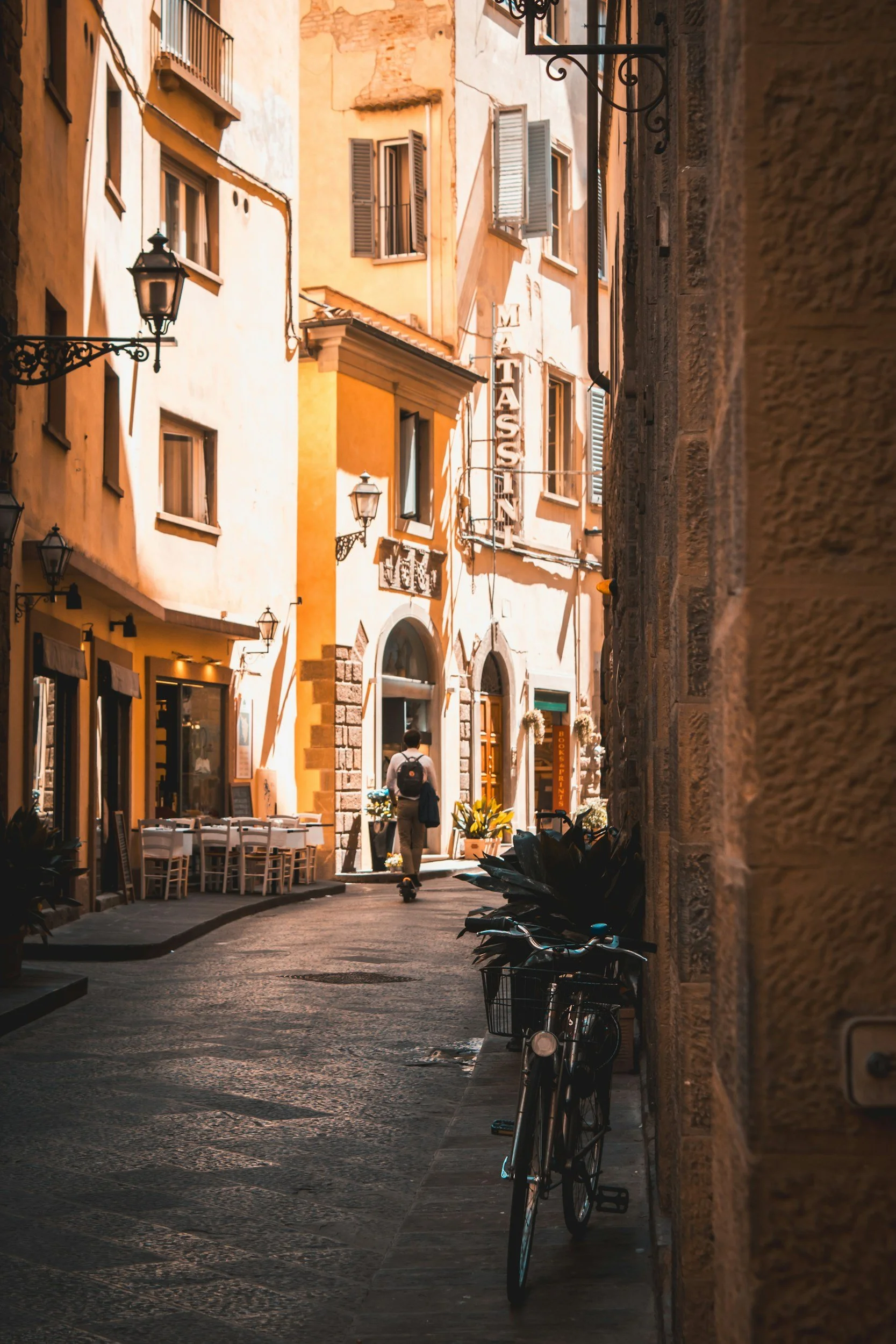
Arezzo has grown around a much older city that rises above the station area. It was an important Etruscan settlement before becoming Roman Arretium, but the Arezzo you will probably spend most of your time in is layered with medieval and Renaissance history, and you physically feel that as you walk uphill from the station. Piazza Grande itself sits on a slope, with the Romanesque apse of Santa Maria della Pieve at one end and Giorgio Vasari’s Logge running along the upper side. Vasari was born in Arezzo in 1511, and his presence is still unusually visible around the city, from Casa Vasari to Piazza Grande and the Cathedral, while Piero della Francesca’s Legend of the True Cross is inside San Francesco.
There is also a more everyday, working side to Arezzo that I think gets lost when it is described simply as a Renaissance city. Goldsmithing is still a major local industry, and the Orodautore Museum inside Palazzo della Fraternita displays more than 300 contemporary jewellery pieces made by Arezzo goldsmiths from designs by Italian artists and designers. On Via Cesalpino, Arti/già/nato brings together contemporary craft from makers around the Arezzo area. Put that alongside the city’s antiques culture and you start to get a better sense of Arezzo as somewhere where objects, craft and trade still feel tied to the city rather than something packaged up purely for visitors.
Lucca has a completely different backstory. It was Roman too, and you can still read that particularly clearly at Piazza dell’Anfiteatro, where the buildings follow the oval footprint of the Roman amphitheatre underneath them, but later Lucca became extremely wealthy through banking and the silk trade. Lucchese merchants sold textiles across Europe, and for around four centuries the city existed as an independent republic. Piazza San Michele was not originally just somewhere to stand and photograph San Michele in Foro; it was one of the commercial centres of the city, filled with money changers and textile merchants.
You still see some of that wealth inside places such as Palazzo Mansi, once the home of a wealthy merchant family, and Villa Guinigi, commissioned in the early 15th century by Paolo Guinigi when he ruled Lucca. Then there are the walls, more than four kilometres around the historic centre, which eventually stopped being useful as military defences and became the tree-lined walking and cycling route locals still use every day. Add Giacomo Puccini, who was born here, and Lucca feels much less tied to one particular period than Arezzo does.
And strangely, all of this history helps explain something very practical about staying in the two places. Arezzo makes you move between the newer city around the station and the older city above it, whereas Lucca feels almost absurdly contained once you step through one of the gates in the walls. Lucca sits on the plain and its station is immediately south of the historic centre; in Arezzo, the station is close on a map too, but close does not necessarily mean flat when you are dragging a suitcase uphill.
Once you start taking trains out of them, the difference becomes even bigger.
Lucca naturally pulls you towards north-western Tuscany. Its station sits on the Pisa–Aulla and Florence–Pistoia–Viareggio networks, so the easy outings tend to be Pisa, Viareggio, Pistoia, Montecatini Terme and places farther up the Serchio Valley towards Garfagnana. That rail direction is far more useful to think about than whether Lucca looks “central” on a regional map.
Viareggio, for example, gives you a completely different day from Lucca without much effort. Once you arrive, the station is roughly a 13-minute walk from the sea, so you can head straight towards the Passeggiata rather than dealing with another bus. The seafront has a surprising amount of Liberty and Art Nouveau architecture, including the very elaborate Gran Caffè Margherita, while GAMC, Viareggio’s modern and contemporary art gallery, gives you somewhere worth going even if the weather turns the beach part of the plan into a bad idea.
Pistoia is another Lucca day trip that sounds less interesting on paper than it actually is. Around Piazza della Sala, the old market area still folds into food shops, cafés and the surrounding lanes, while Palazzo Fabroni focuses on 20th-century and contemporary art. It is the kind of place where you can have lunch, wander, look into a few shops and go home without needing one enormous attraction to justify the train fare, which fits very naturally with the sort of trip Lucca sets you up for.
Then there is the line running north from Lucca into the Serchio Valley and Garfagnana, which gives you access to a much greener, more mountainous side of Tuscany. This is where I would become more careful with planning, though. The railway follows the valley floor, and a station having the same name as the wider area you want to explore does not automatically mean you step off in the middle of a beautiful hill town. Some places still involve an additional walk or local transport, so check the final part before deciding that a Garfagnana day is “easy”.
Arezzo sends you in almost the opposite direction. The main railway runs north to Florence and south through the Valdichiana towards Rome, with connections around Terontola opening another useful route towards Umbria. That is why Arezzo can work so well for a rail-heavy trip even though it is not sitting in the geographical centre of Tuscany.
One of the simplest examples is Castiglion Fiorentino, only a short direct train ride south. From the station you can walk up through the historic centre towards Piazza del Municipio, where the loggia opens onto views across the Val di Chio, then continue into the Cassero area for the tower, archaeological museum and wider views over the Valdichiana. This is much closer to the sort of small hill-town day many people actually imagine when they start planning Tuscany, and you can do it without committing to a complicated chain of buses.
Cortona
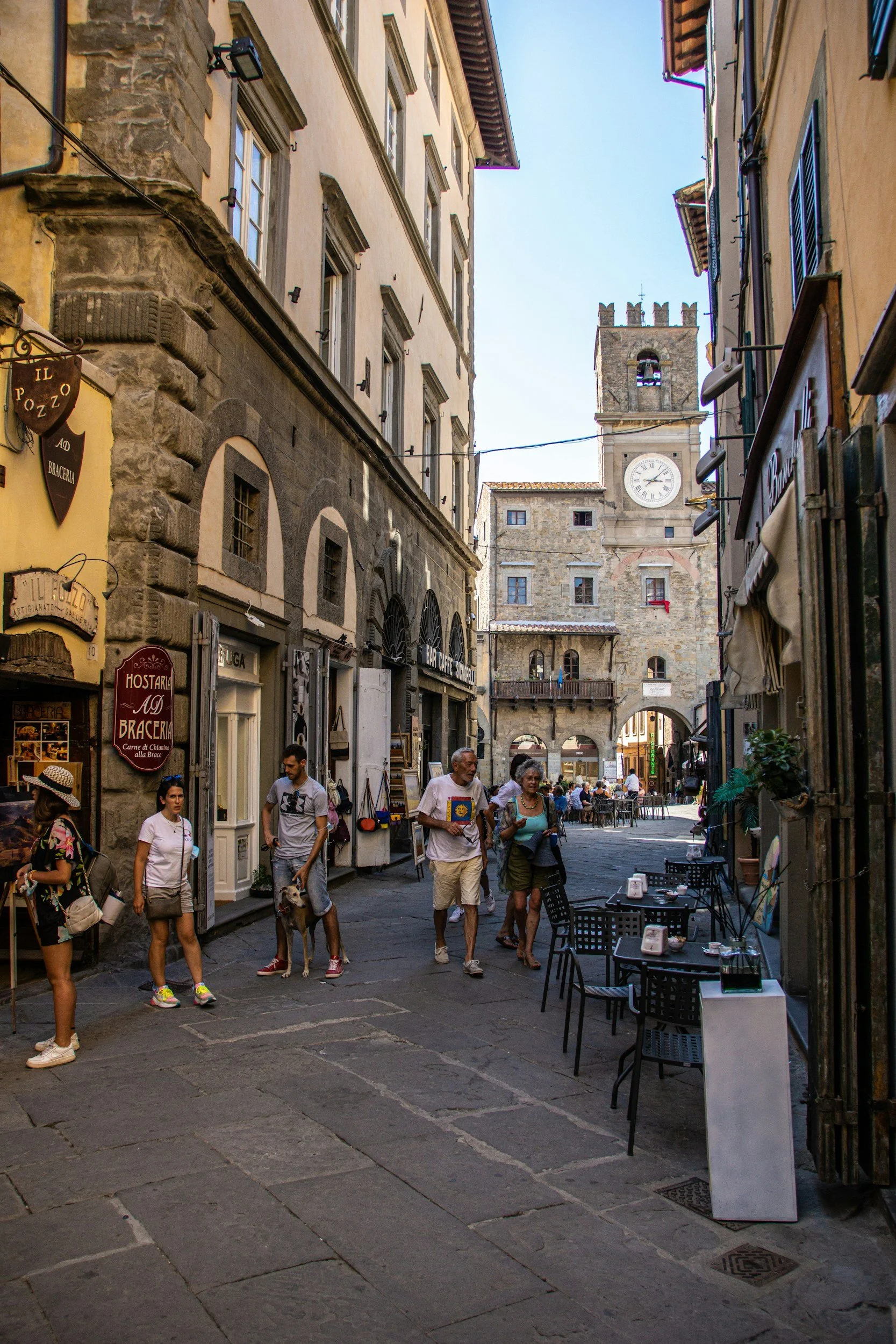
Cortona is where I would be especially careful with the phrase “easy by train”. The train from Arezzo to Camucia-Cortona takes around 20 to 25 minutes, which looks brilliant when you first search it, but Camucia is down on the valley floor and the Cortona you are picturing is still above you. Piazza della Repubblica, the MAEC museum, the steep stone streets and those big views towards Lake Trasimeno all sit up on the hill, so you still need a local bus or taxi for that final stretch.
That does not make Cortona a bad day trip from Arezzo at all. It just means the train has solved the first 90 per cent of the journey rather than the whole thing, and that last ten per cent is exactly the sort of detail I would want to know before booking five nights somewhere.
Arezzo also has a local rail network that is easy to overlook if you only search Trenitalia. The Arezzo–Pratovecchio–Stia line runs north into the Casentino valley, serving places such as Subbiano, Bibbiena and Pratovecchio-Stia, and gives you another way into eastern Tuscany without a car. I would check the current TFT service before building a whole day around it, though, because local railway lines are where temporary replacement buses and engineering works can turn a wonderfully clever itinerary into a morning spent working out where your train went.
What I would not do is take all of that and conclude that Arezzo is therefore “good for southern Tuscany”. That is still too vague. Arezzo works particularly well for the Florence–Rome corridor, Valdichiana and routes towards Umbria, but Siena sits inconveniently west of the main line, and places such as Pienza show exactly why geography and public transport are two different things in Tuscany.
Pienza does not have a railway station at all. By public transport you are generally looking at reaching somewhere such as Chiusi-Chianciano Terme or Buonconvento and then continuing by bus. Montalcino has the same sort of last-mile problem, and rural Chianti is another case where being relatively nearby on a map does not make it an easy spontaneous day out.
Lucca has its own version of this with Cinque Terre. It looks close enough to be tempting, particularly when you are already in north-western Tuscany, and yes, you can get there, but the trip normally means travelling through Viareggio and often La Spezia before continuing onto the Cinque Terre line. It is a perfectly possible long day if seeing the villages is important to you. I just would not put it in the same category as getting on a direct regional train to Pisa or Viareggio and being there half an hour later.
That distinction between possible and actually convenient is probably one of the most important things to keep in mind when choosing a car-free Tuscany base.
And it is why Florence still wins if your only priority is having the widest possible rail network. Firenze Santa Maria Novella is the major regional hub, with lines spreading towards Pisa, Livorno, Prato, Lucca, Siena, Arezzo, Cortona and Chiusi. If your wishlist has Pisa on Monday, Siena on Tuesday and Cortona on Wednesday, neither Arezzo nor Lucca is going to beat Florence for sheer flexibility.
But that does not mean Florence is automatically the better place to stay. You may specifically want somewhere smaller to come home to at night, somewhere where you can walk out for dinner without feeling that you are still in the middle of a major sightseeing city, and somewhere that is enjoyable enough that you do not feel obliged to board another train every morning. The trade-off is simply that Arezzo and Lucca give you more directional trips, so choosing the right direction matters.
Before booking anything, I would write down the three day trips you care about most and look at the entire journey from your prospective hotel to where you actually want to stand at the other end. Not just “Cortona has a station”, but “how am I getting from Camucia-Cortona up to Piazza della Repubblica?” Not just “Lucca is near the coast”, but “how long does it take me to get from the train to the part of Viareggio I actually want to spend the afternoon in?”
Do that for three places, and the Arezzo-or-Lucca decision usually becomes much less mysterious!
Stay in Arezzo: easy by train, less easy on foot
Arezzo is very manageable without a car, but there is one detail I would want to know before booking a hotel: the station being “close to the historic centre” only tells half the story. It is close. It is also below quite a lot of the city you are probably coming to see.
Arriving in Arezzo and where I would actually stay
Arezzo station is in Piazza della Repubblica, right at the edge of the central city, and you can start walking towards the historic centre as soon as you leave the platform. The official Tuscany tourism route describes it as roughly a one-kilometre walk to the upper historic centre, with most of that route climbing rather than staying level. There are urban buses if you do not fancy doing it with luggage, and a taxi is worth considering if your hotel is up near the Cathedral or the highest part of town.
This is one place where I would pay more attention to the exact hotel address than to whether the listing says “historic centre.” If I were staying for several nights and taking trains in and out of Arezzo, I would look roughly between Piazza Guido Monaco, Piazza San Francesco and the lower part of Corso Italia. Piazza Guido Monaco itself is not the romantic bit you are coming to Tuscany for, but as a base it is incredibly practical: you can walk back to the station quickly in the morning, while Piazza San Francesco, Via Cavour and the older streets are still close enough that you do not feel as though you are sleeping outside the city you wanted to visit.
If you continue all the way up towards Piazza Grande, the Duomo and the Medici Fortress, you gain atmosphere but you also turn every early train into a downhill walk followed by an uphill one when you come home. That may be completely fine if you travel light and like walking, but with a large wheeled suitcase or limited mobility I would think twice before booking solely because the room has a beautiful view.
The route itself is easy to understand. From the station you move through the lower centre towards Piazza Guido Monaco, then the city starts becoming more obviously historic as you approach Piazza San Francesco, Via Cavour and Corso Italia. Coffee O’Clock at Corso Italia 184 is useful on this lower stretch if you want breakfast before an early train; it has been operating in Arezzo since 2000 and is still trading there now, so it is a much safer practical recommendation than some of the historic cafés that appear in older Arezzo guides.
In fact, I would be careful with one particularly famous recommendation. You will still see Caffè dei Costanti opposite San Francesco mentioned in plenty of Arezzo articles because it dates back to the early 19th century and appeared in Life Is Beautiful, but its recent operating history has been unsettled and it has spent long periods closed while awaiting a new chapter. I would admire the building if you pass it, but I would not currently build breakfast plans around it without checking first.
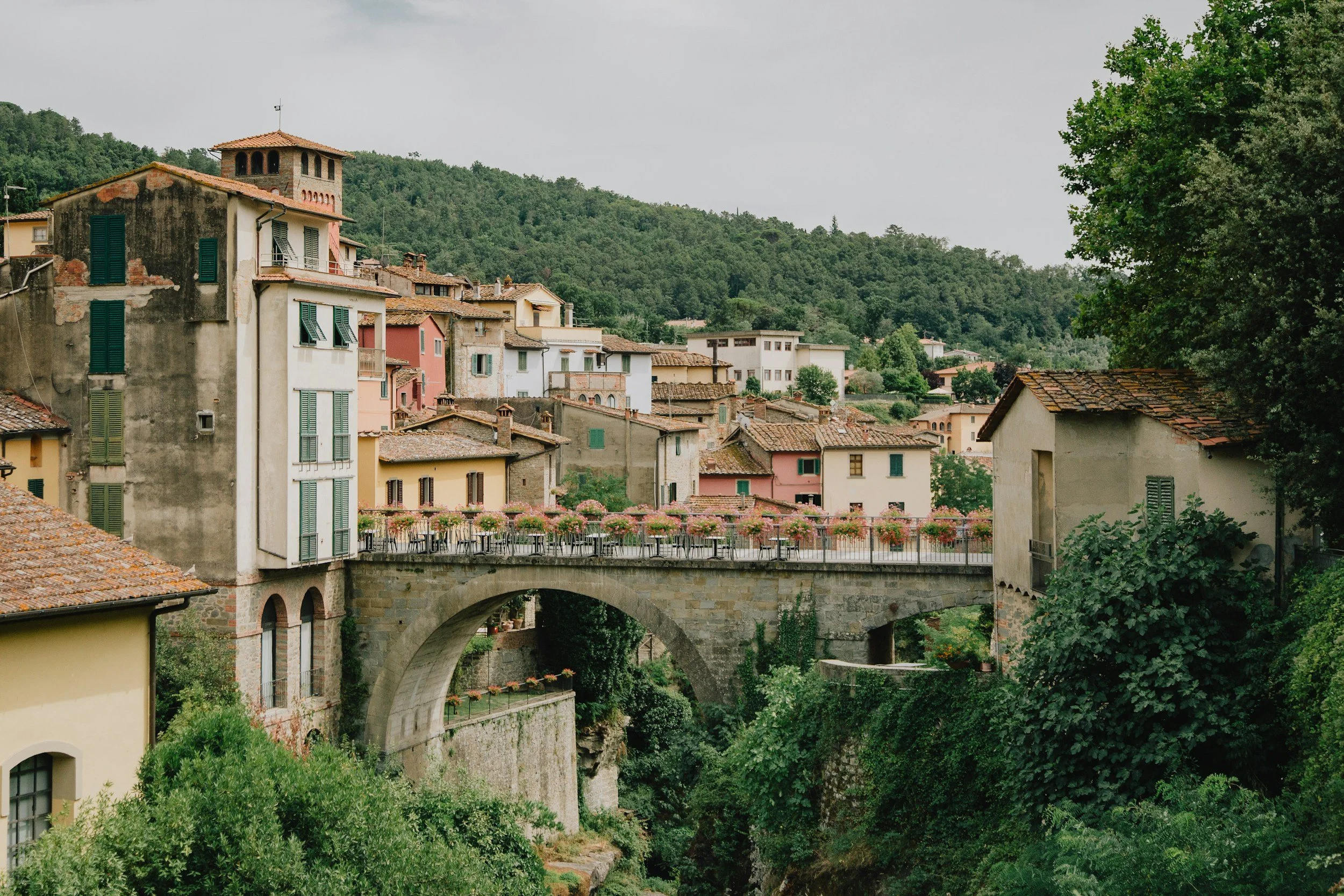
The day trips from Arezzo that genuinely make sense
The most useful thing about Arezzo is not that you can theoretically reach dozens of Tuscan towns from it. It is that a handful of very good trips are unusually straightforward, while others that look equally sensible on a map are not.
Florence is genuinely easy. The most useful Regionale Veloce trains take around 55 to 60 minutes, while a smaller number of high-speed services stopping in Arezzo can cut that to roughly 35 to 40 minutes. That makes Florence perfectly realistic for a museum booking, lunch and a full afternoon without needing to leave Arezzo at dawn, and it also means you can stay somewhere calmer while still having Florence available when you actually want it.
Castiglion Fiorentino is even easier, with the train taking around 15 minutes. This is the sort of Arezzo day trip I particularly like on paper because the journey is so short that you do not feel obliged to turn it into an exhausting sightseeing day. Once there, the old centre climbs towards Piazza del Municipio and the Cassero, with views opening across the Val di Chio and Valdichiana. It is still a hill town, so there is walking involved, but the rail part itself is about as uncomplicated as Tuscany gets.
Cortona is easy until it suddenly isn’t. The train to Camucia-Cortona takes roughly 25 minutes, but Camucia is the lower town on the valley floor; Piazza della Repubblica, the MAEC museum, the steep lanes and the views you are actually travelling for are still up the hill. Autolinee Toscane’s local network links Camucia and Cortona, and taxis are another option, so I would still absolutely consider it from Arezzo. I just would not describe it as a direct train day trip without explaining that final part.
And I would check the return bus before you start wandering around Cortona rather than assuming one will conveniently appear when you are ready to go home. This is exactly where car-free Tuscany goes wrong when a guide stops its instructions at the railway station.
Chiusi-Chianciano Terme is another station name that can give the wrong impression. It is a useful rail junction on the Florence–Rome corridor and can be reached from Arezzo on the same southbound network, but the platform is not sitting beside the spas of Chianciano Terme, and it does not magically deliver you into Pienza or Montepulciano either. Tuscany’s own transport guidance uses Chiusi-Chianciano Terme as one of the rail gateways for Pienza precisely because you still need an onward bus from there.
So I would think of Chiusi primarily as a gateway, not automatically as a simple sightseeing day. If your trip continues into southern Tuscany, it is useful. If you simply saw “Chianciano Terme” in the station name and imagined stepping off beside a spa hotel, it is not doing what the name suggests.
Perugia can work too, but I would put it in the “check the timetable first” category rather than the effortless one. Current official Arezzo guidance puts regional journeys via Terontola at roughly 1 hour 15 to 1 hour 30 minutes, and Trenitalia also runs some Frecciarossa services extended from Florence through Arezzo towards Perugia. That can make Perugia a very good option on the right day, but I would choose the train first and then plan the day rather than assuming there is a convenient direct departure every hour.
Arezzo’s Casentino line is the more interesting extra if you are staying longer. The TFT railway currently runs north through Subbiano, Bibbiena, Poppi, Pratovecchio and Stia, with official information listing around 35 daily services along the line and approximate journeys of 50 minutes to Bibbiena, 55 minutes to Poppi and an hour to Stia. It follows the Arno into a greener, much more mountainous part of the province, so it gives you a very different day from Florence or Cortona.
Again, though, check what happens after the station. Poppi station is down in Ponte a Poppi, while the medieval town and Castello dei Conti Guidi sit above it on the hill. The castle itself is worth the climb, with the Rilli-Vettori library, frescoed chapel and views across Casentino, but this is another case where “the train goes to Poppi” should not be translated into “the train drops me outside the castle.”
The same caution applies to the separate Arezzo–Sinalunga TFT line, which reaches places including Monte San Savino, Foiano della Chiana and Sinalunga. It gives Arezzo another useful regional direction, but I would always check the current TFT timetable before relying on it, especially because local lines are more vulnerable to temporary service changes and replacement buses than the main Florence–Rome railway. Current official Valdichiana information still lists the railway as operating and gives roughly 25 minutes to Monte San Savino, 35 minutes to Foiano and 45 minutes to Sinalunga.
So the distinction I would make is simple: Florence and Castiglion Fiorentino are easy; Cortona is easy with a last mile; Perugia and Casentino are very workable when the timetable suits; Siena, Pisa and Lucca are where I would stop trying to make Arezzo do everything.
What I would do on a day I stayed in Arezzo
Arezzo would be a much weaker base if every good day required leaving it, but that is not really the case. I think one of its strengths is that you can have a completely convincing day without boarding anything.
I would book Piero della Francesca’s Legend of the True Cross first and let the rest of the day happen around that, because this is one of the few things in Arezzo where spontaneity is not your friend. Access to the Bacci Chapel inside the Basilica di San Francesco is by compulsory reservation, with visits currently limited to 30 people and 30-minute slots. The fresco cycle was painted between 1452 and 1466, and it is the one sight here I would organise in advance rather than simply hoping to walk in.
Then I would walk, because this is where Arezzo becomes more interesting as a place to stay than as a list of museums.
From Piazza San Francesco, head through Via Cavour and Corso Italia towards Piazza Grande, which is much stranger architecturally than the standard “beautiful Tuscan square” description suggests. It is trapezoidal and noticeably sloping, with medieval towers and houses on one side, the apse of Santa Maria della Pieve nearby, and Vasari’s long Logge running along the upper edge. The Palazzo della Fraternita has an astronomical clock, while the loggia itself was designed by Vasari in the 16th century.
And this is where I would make time for a couple of smaller places instead of adding another major museum. Aretè Terrecotte at Piazza Grande 38/39 is a working ceramics and terracotta studio under the loggias, with pieces handmade and painted by Anna Laura Perticucci using local and Tuscan motifs. It is exactly the sort of shop that makes more sense in Arezzo than another generic souvenir store.
A few minutes away on Via Cesalpino, there is a surprisingly contemporary little cluster. Arti/già/nato at no. 15 works as a permanent showcase for craftspeople from the wider Arezzo area, with jewellery, ceramics, leather, textiles, wrought iron and other pieces made by local artisans, while Rosy Boa at no. 29 is a contemporary art gallery and lab rather than another Renaissance collection. That mix is one of the things I find more interesting about Arezzo: you can spend the morning looking at Piero della Francesca and then walk five minutes to see what local artists and makers are doing now.
If you are more interested in the antiques side of the city, Casa Museo Ivan Bruschi at Corso Italia 14 is the one I would choose. Bruschi was the dealer and collector who founded Arezzo’s Antiques Fair in 1968, and his former home now holds archaeological pieces, sculpture, paintings, old books, coins and the wonderfully miscellaneous things a serious collector accumulates over a lifetime. It gives the monthly market a bit of context rather than leaving it as something that simply turns up in the streets once a month.
Casa Vasari, at Via XX Settembre 55, is more intimate than a big civic museum and makes particular sense if you have already noticed how often Vasari’s name appears around the city. He designed and frescoed the house himself, and the rooms still contain his Mannerist decoration and collection context rather than feeling like a museum that has simply borrowed his name.
After that, I would keep climbing towards the Cathedral and Medici Fortress, not because you need another two “must-sees” but because this is where the shape of Arezzo finally makes sense. The Cathedral sits high on the San Pietro hill and contains another Piero della Francesca work, the Magdalene, while the 16th-century fortress occupies the highest part of the city. From the walls you look out over Arezzo, the Arno valley, Pratomagno and the surrounding hills, which feels like a much better payoff for all that climbing than simply being told Arezzo is hilly.
For something less art-historical on the way back down, Cremeria Cecconi on Via Madonna del Prato 85 is a local artisanal gelateria that plays quite deliberately with Tuscan ingredients, including flavours such as its “Terra d’Arezzo” and even pecorino sorbet. Or, if you want a proper traditional dinner, Antica Osteria l’Agania on Via Mazzini 10 has been run through several generations and still focuses on local Tuscan cooking rather than trying to turn dinner into a tasting-menu performance.
This is also where staying in Arezzo starts to make more sense than visiting it for six hours. You do not have to finish Piazza Grande, photograph the Pieve and immediately walk back to the station. You can come down through Via Cavour, stop somewhere because it looks busy, go back to your room for an hour, then come out again for dinner. I would especially like that flexibility here because the city has enough ordinary local life around the historic core that the day does not feel over once the museums start closing.
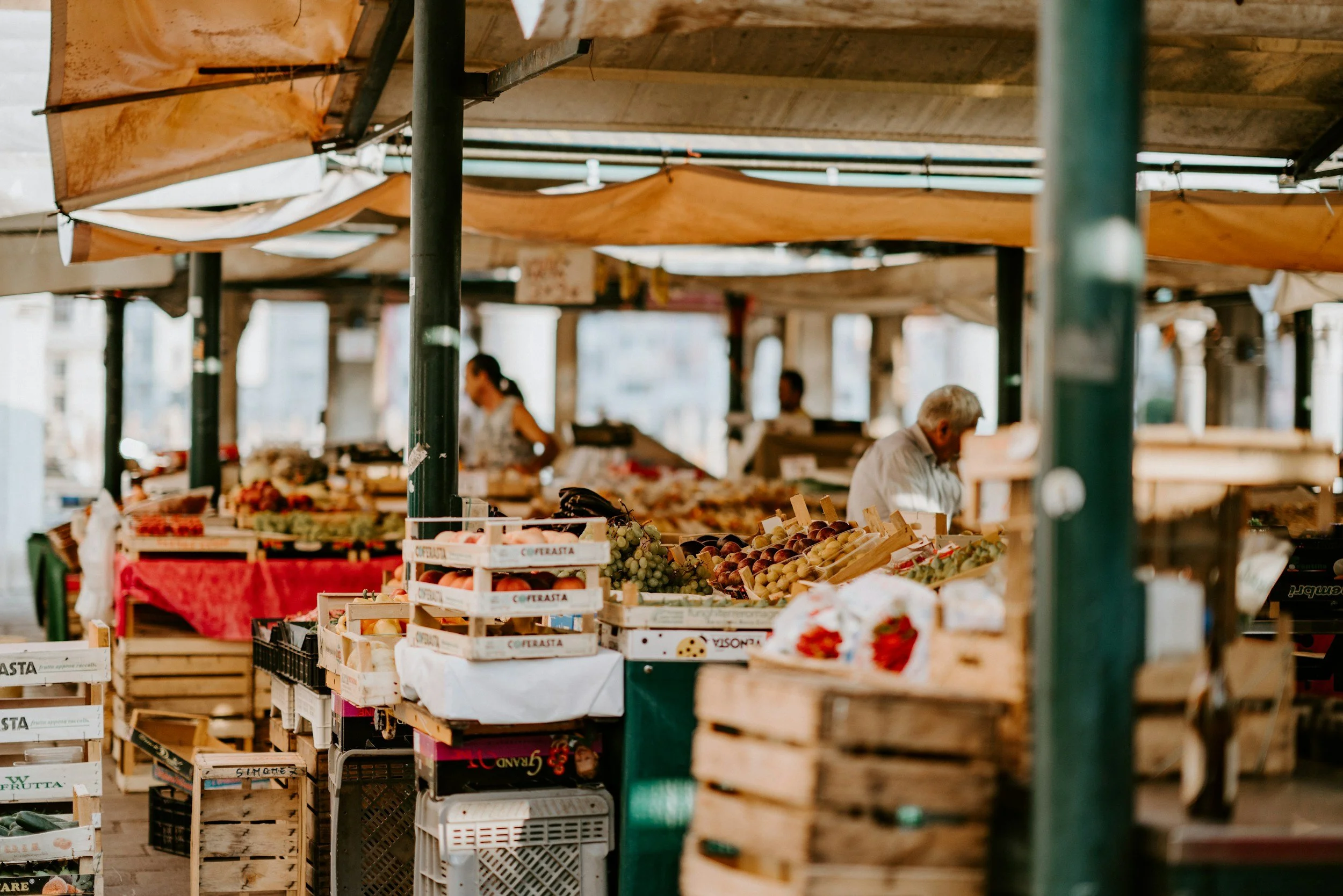
Where Arezzo becomes less convenient
The hills are the obvious drawback, but I would not reduce the problem to one climb from the station. Arezzo keeps climbing once you are already in the historic centre. Piazza San Francesco, Piazza Grande, the Cathedral and the fortress sit at different levels, so a day spent “just walking around Arezzo” can involve quite a lot more elevation than the map suggests. Visit Tuscany’s own station-to-centre guidance specifically flags the predominantly uphill approach.
The second limitation is direction. Siena is awkward by train, while Pisa and Lucca are simply too far west to make sensible repeat day trips. Official Arezzo guidance currently puts Pisa at roughly two to two and a half hours by regional train via Florence, which tells you pretty quickly whether that belongs in a relaxed week based here.
Then there are the hill towns. Arezzo gives you excellent access to the Valdichiana rail corridor, but it does not remove the last-mile problem once you want places built above the valley floor. Cortona is the clearest example, and the same logic starts appearing again as soon as your wishlist moves towards Montepulciano, Pienza or countryside wineries. At that point, buses, taxis or a tour become part of the plan rather than an occasional backup.
Flying through Pisa also makes Arezzo considerably less elegant than Lucca. Arezzo’s own tourism office currently estimates the rail journey from Pisa at around 2 hours 15 to 2 hours 30, generally via Florence, before you even start thinking about the airport connection itself.
And finally, Arezzo is not always the quiet provincial base you may have pictured when you booked it. The Fiera Antiquaria takes over the historic centre on the first Sunday of every month and the preceding Saturday, bringing more than 500 exhibitors into Piazza San Francesco, Piazza Grande, the Vasari Logge and surrounding streets. If you love antiques, I would deliberately arrange the trip around it; if your whole reason for choosing Arezzo is having a calm base, check the calendar first.
The Giostra del Saracino changes the city even more dramatically twice a year, with the joust taking place in Piazza Grande in June and again on the first Sunday of September, accompanied by the historic quarters, procession, costumes and events around the centre. It is a brilliant reason to come if that is what you want, but a terrible weekend to discover accidentally after booking somewhere overlooking Piazza Grande and expecting silence.
That is really the trade-off with Arezzo. It is not the easiest Tuscan base in every practical sense, and the hills and last-mile transport do require a little more thought, but it gives you a surprisingly good combination of serious art, ordinary city life and rail access into this side of Tuscany. If the places you actually want to visit line up with it, the inconveniences start to feel much more reasonable.
If food is becoming a bigger part of the trip than sightseeing, my guide to slow food in Tuscany goes into smaller villages, markets and local kitchens worth planning around.
Lucca as a base: easy to live in, best for north-western Tuscany
Lucca is one of those places where travelling without a car can actually make the trip simpler rather than making you feel as though you are constantly working around something. The train arrives almost absurdly close to the old city, most of what you will want day to day is inside the walls, and once your suitcase is in the room there is very little reason to think about transport again until you decide to leave town.
That ease is probably Lucca’s biggest advantage over Arezzo, but I would not translate it into “Lucca is better connected to Tuscany”. It is not. What it gives you is a very easy base to live in, with a particularly neat group of trips around north-western Tuscany.
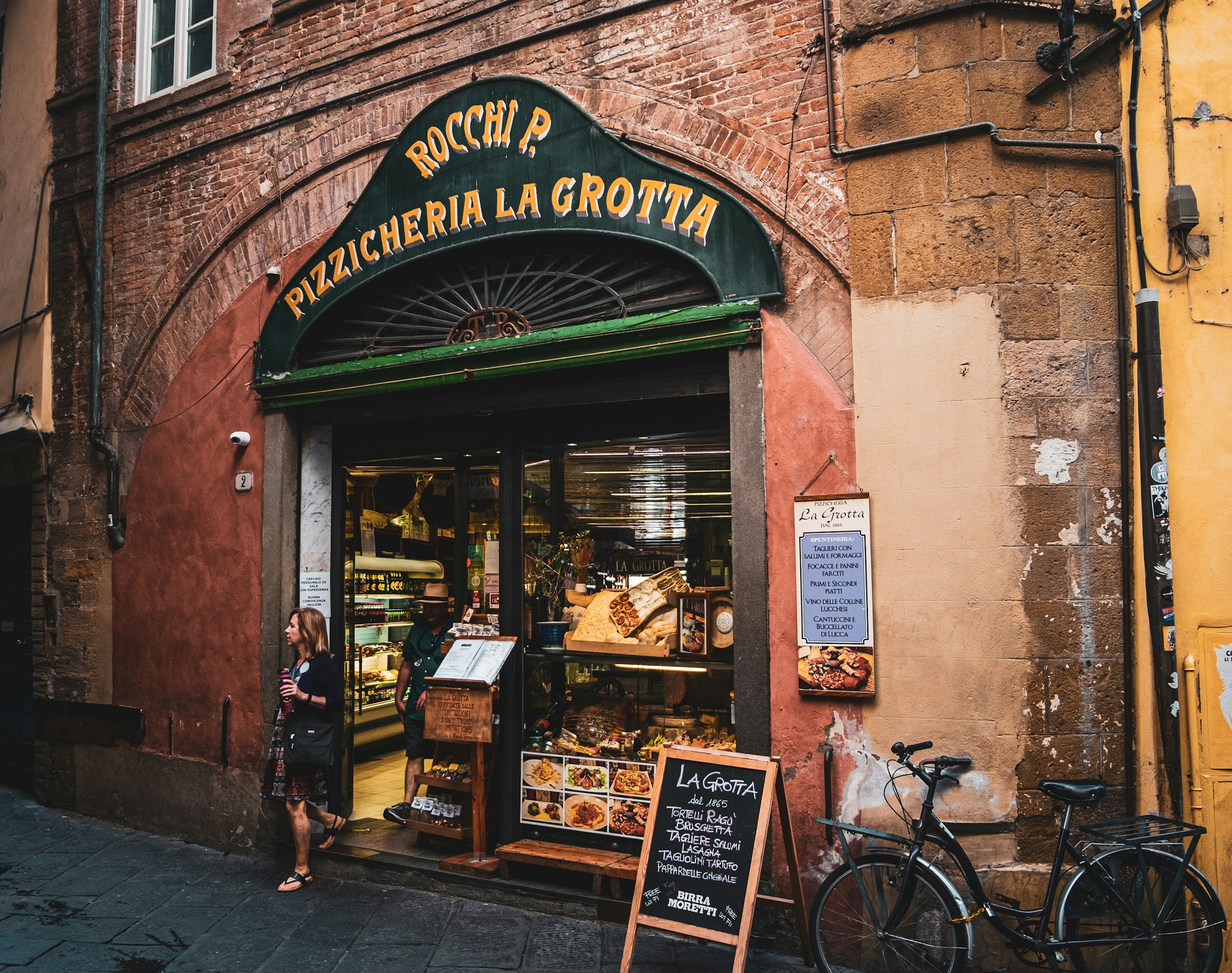
Arriving in Lucca and where I would stay
The first time you leave Lucca station, the walls are basically staring back at you. Official Lucca tourism information puts them around 200 metres from the station, with Porta San Pietro roughly 350 metres away, so this is not one of those Italian cities where “the station is near the centre” turns out to mean a 25-minute walk beside traffic.
That makes the southern side of the historic centre particularly useful if you are staying for several nights. I would look around Porta San Pietro, Piazza Napoleone, Via San Paolino and towards Piazza San Michele, rather than assuming the prettiest-looking accommodation anywhere inside the walls is equally practical. From here you can walk to the station with luggage, come back between outings if you want to, and still be properly inside Lucca rather than sleeping beside the railway. Lucca’s historic centre is also predominantly flat, and the city has specifically developed accessible routes through the centre, which is a meaningful difference if hills, stairs or pulling luggage over gradients are something you are trying to avoid.
There is even a useful little stop on the station side of the walls that I would remember for arrival or departure day. LuccaLibri Libreria Caffè Letterario is at Viale Regina Margherita 113, very close to the station, and combines an independent bookshop with a café. If you arrive before check-in, have 40 minutes before a train, or simply want coffee somewhere that does not involve dragging your suitcase through the centre first, this is exactly the sort of place that becomes much more useful once you are actually travelling.
Where I would be much more cautious is with anything described as “Lucca countryside”, “just outside Lucca” or “near the hills of Lucca.” Those addresses can look wonderfully close when you are booking, but the experience is completely different without a car. Once you move beyond the walls, walking distances get longer very quickly and local buses are not a substitute for having a car whenever you feel like going out for dinner. If the whole reason you have chosen Lucca is to make Tuscany easier without driving, I would take advantage of that and stay inside the walls, or immediately beside them.
The day trips from Lucca that are genuinely easy
Pisa is the obvious one, but it is obvious for a reason. Direct regional trains normally take around 25 to 35 minutes, and there are plenty of departures through the day, so this is a trip you can decide on over breakfast rather than something that needs to be organised weeks ahead. Pisa Centrale is not directly beside Piazza dei Miracoli, though, so remember there is still a walk across the city or a local bus at the other end.
That actually makes Pisa a nice full-day option rather than a two-hour leaning-tower operation. You can walk north through the city, see the Arno and streets around Borgo Stretto on the way, continue to Piazza dei Miracoli, and then wander back without needing to retrace exactly the same route. It is one of the trips where Lucca’s short rail journey leaves enough of the day to be pleasantly inefficient.
Viareggio is even easier if what you want is a complete change of scenery. Direct trains generally take around 20 to 30 minutes, which means you can wake up to blue sky in Lucca and decide that you would rather spend the afternoon by the sea. I would think of Viareggio as the coastal counterweight to Lucca rather than as one more Tuscan art city: you get the long seafront, beach, Liberty architecture and a much more open, seaside feeling, then come back behind Lucca’s walls for dinner.
Pistoia is one I would include precisely because it does not feel like another headline Tuscany excursion. Direct trains are available and the faster services take around 40 minutes, with the centre walkable from the station. If you have already done Florence and Pisa, Pistoia makes much more sense than adding increasingly complicated day trips just for the sake of collecting famous names. You can build the day around Piazza del Duomo, the striped Baptistery and Cathedral, then spend the rest of the time around the smaller central streets rather than racing between major sights.
Montecatini Terme is another surprisingly easy one, with direct trains commonly around half an hour. What makes this more interesting than simply visiting a spa town is the possibility of continuing up to Montecatini Alto on the historic funicular. The two little red cars have been climbing between the lower spa town and the old settlement since the end of the 19th century, and once you are up there the day feels very different from Lucca even though you have barely travelled.
Florence is completely realistic from Lucca, but this is where I would stop using the word effortless. Direct regional services exist, with the faster journeys around 1 hour 20 minutes and others closer to 1 hour 30 or more. That is perfectly fine for one planned Florence day, especially if you have booked something specific such as the Uffizi or Accademia, but if you imagine travelling into Florence every second morning, Arezzo starts making more sense as a base.
The Serchio Valley and Garfagnana are where Lucca becomes more interesting for a longer stay, but also where I would start checking the final kilometre much more carefully. The railway runs north into the valley and gives you a way of seeing a greener, more mountainous part of the province, but not every beautiful place is sitting beside its station.
Barga is the perfect warning. It is one of the best-known towns in this part of Tuscany, but its nearest useful railway stop is down at Gallicano, around five kilometres from the historic town, so this is not a simple case of getting off the train and walking through a medieval gate. If Barga is high on your list, check the current onward bus before leaving Lucca.
Borgo a Mozzano is a more natural rail-based idea if you want something in this direction, with the famous Ponte della Maddalena, usually called the Devil’s Bridge, as well as a small historic centre and the Serchio Valley around it. The area also has its own very local food identity, including chestnut-flour necci and biroldo.
So this is where I would draw the line between easy and merely possible. Pisa, Viareggio, Montecatini and selected Pistoia services fit comfortably into the first category. Florence is still straightforward but takes more of your day. Garfagnana can be excellent, but you need to check the particular town rather than treating the whole valley as one train-accessible destination.
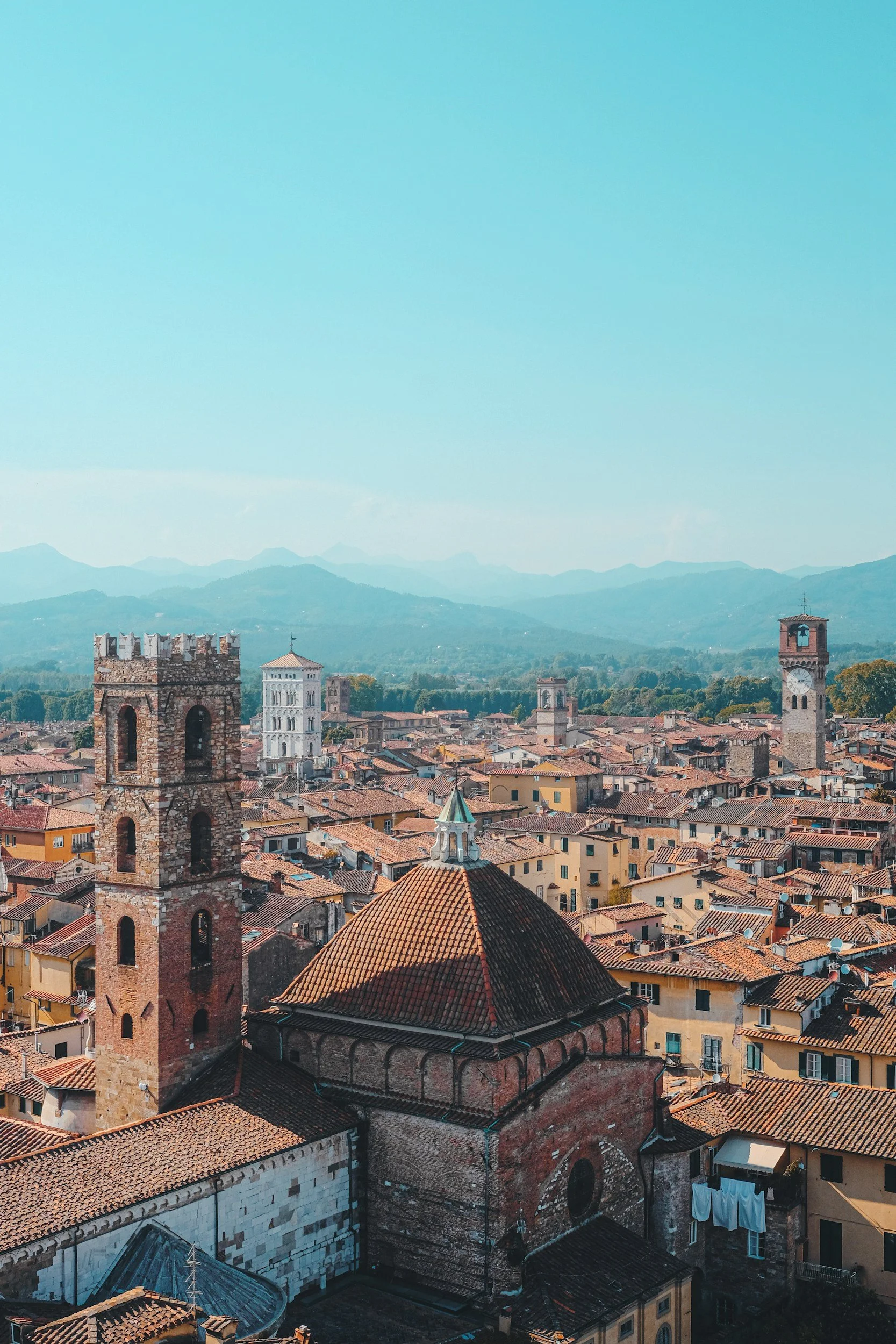
What I would do when I did not feel like catching a train at all
This is where Lucca makes a very strong case for itself, because a “nothing planned today” day does not feel like a wasted day here.
I would probably start on the walls. The complete circuit is about 4.2 kilometres, wide enough that this feels more like an elevated city park than walking along the top of a fortification, and you can either do the full loop or simply use part of it to get from one side of town to another. The old defensive walls were eventually turned into a public promenade, and that is still how they function: people walk, cycle, run and sit under the trees rather than treating them as an attraction that requires a ticket and an allotted hour.
I actually think that repeated use is more important to Lucca as a base than seeing the walls once. You can do a lap before breakfast, walk part of them after dinner, rent a bicycle when you cannot face another museum, or just go up for ten minutes because you have an hour to fill. That sort of low-effort option is something Arezzo does not really have in the same way.
Then I would come down somewhere around the centre and let the streets do most of the work.
Via Fillungo is the main spine through the old city, and it is not some untouched street of artisans anymore. There are international brands mixed among old shops, jewellers, cafés and surviving historic storefronts, which I actually think is worth saying because pretending every shop is a centuries-old family workshop makes Lucca sound less real than it is. The northern end brings you towards San Frediano and Piazza dell’Anfiteatro, while Torre delle Ore rises just off the street.
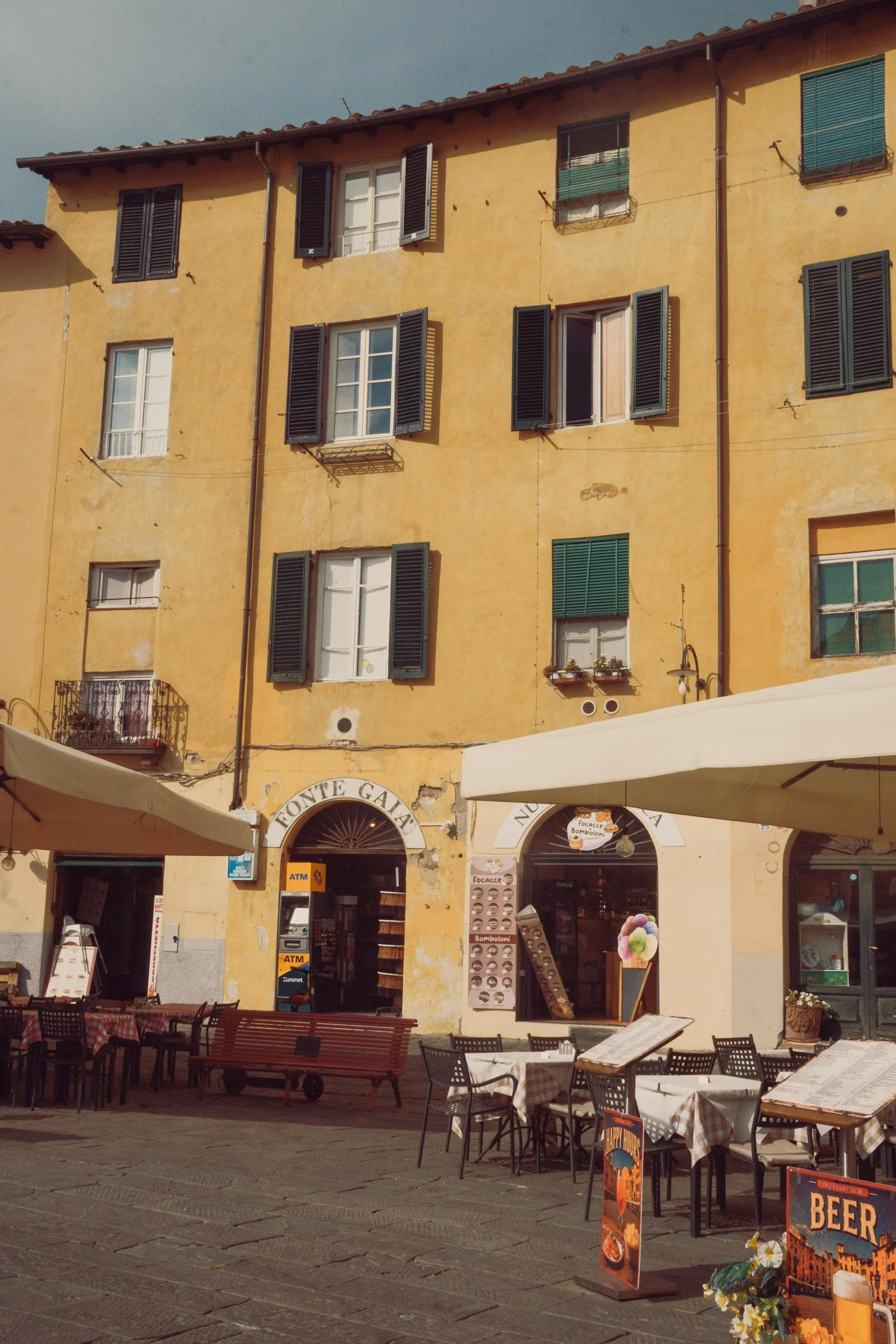
Piazza dell’Anfiteatro is one of those places you will probably cross several times if you stay here rather than only visit for the day. Its oval form follows the Roman amphitheatre underneath the present buildings, so even the entrances into the square feel a little odd because you enter through narrow passages rather than approaching along one grand axis. I would absolutely see it, but I would not necessarily choose it for every meal simply because the tables look good in photographs. It is one of the most visitor-facing parts of Lucca.
For something that feels more connected to everyday food shopping, head instead towards Mercato del Carmine. The market complex sits around Piazza del Carmine and Via Mordini in what Lucca Tourism still describes as a distinctly local neighbourhood, with fruit and vegetable sellers and other food businesses alongside temporary craft exhibitions and cultural events. The covered market itself was created in the 1930s inside the former Carmelite complex, although the site has a much older history.
There is another very Lucca-specific detour around Via del Battistero and Via del Gallo. This was historically the centre of the city’s antiques trade, and the streets still have antique and design galleries, art and furniture shops, specialist textiles and even bibliographical businesses mixed in. If your stay happens to overlap the third weekend of the month, the much larger antiques market spreads through the streets and squares around the Cathedral, including Piazza Antelminelli, Piazza San Giusto, Piazza San Giovanni, Piazza Bernardini, Piazza San Martino and Via del Battistero, with roughly 200-plus dealers.
For something much more edible, Buccellato Taddeucci on Piazza San Michele is one local institution I would actually name. The family bakery has been making buccellato, Lucca’s raisin-and-anise sweet bread, since 1881 and is now in its fifth generation. It is the kind of local speciality that makes more sense as breakfast or something you carry back to your room than as another “must-try food” to force into an already full lunch.
For bread rather than pastry, Forno a Vapore Amedeo Giusti is still operating on Via Santa Lucia 20, right in the centre. I would keep places like this in mind if you are staying in an apartment or simply want to buy bread and something small instead of eating every meal at a restaurant.
If you want one proper restaurant that connects to the city rather than just somewhere with a nice terrace, Buca di Sant'Antonio on Via della Cervia is the historical choice. There is documentary evidence of the osteria going back to 1782, possibly earlier, and it still serves traditional Lucchese and Tuscan cooking. For a more informal traditional option near Piazza dell’Anfiteatro, Osteria Baralla occupies the old stables of Palazzo Buonvisi and has been associated with Lucchese cooking since the 19th century.
Sightseeing-wise, I would keep a base day deliberately light. San Martino Cathedral and San Michele in Foro are both worth going inside, and Piazza San Michele is particularly useful for understanding Lucca because it sits on the site of the Roman forum, at the crossing of the old cardo and decumanus. It later became one of the centres of the city’s silk and money-changing trade, so this is one square where the history actually explains why the streets still seem to radiate out from it.
Then I would choose one tower, and for a first stay I would make it Torre Guinigi. You climb 230 steps to the terrace beneath the holm oaks, with the red roofs of Lucca below and, on a clear day, the Apuan Alps, Apennines and Monte Pisano beyond the city. There is no real reason to climb every available tower just because the tickets exist.
The Puccini Museum makes sense here too, because Giacomo Puccini was born in the house on Corte San Lorenzo and this is one of the places where Lucca’s connection to him feels specific rather than decorative. And if you continue along Via Fillungo, the historic Caffè Di Simo is another part of that story: Puccini and other artists and intellectuals gathered there when it was run by Alfredo Caselli. Its public opening has been intermittent in recent years, so I would treat the interior as something to check rather than promising readers a normal coffee stop, but the building itself is still part of the Puccini trail through the city.
By late afternoon, I would probably stop sightseeing completely. Lucca is very good at that. Go back onto the walls, buy something from Taddeucci, browse Via del Battistero, sit in Piazza San Michele, or take another route through the streets simply because you did not walk that way yesterday.
Where Lucca gets less convenient
The first downside is that Lucca is not especially undiscovered, and parts of the centre make that obvious. Piazza dell’Anfiteatro, Via Fillungo and the main route between the towers and Cathedral can be busy with day visitors, particularly in the warmer months, and there are plenty of businesses aimed very directly at visitors. That does not make Lucca unpleasant, but if what attracts you to Arezzo is the feeling of staying in a working provincial city where tourism is not always the dominant thing in the street, Lucca can feel more polished and visitor-facing.
The good thing about actually staying here is that you get the city outside those busiest hours. Even Lucca Tourism points to the evening as a particularly enjoyable time inside the walls, when temperatures drop and the centre moves into aperitivo, dinner and evening walking rather than daytime sightseeing. That is a fairly important distinction when deciding where to sleep rather than where to spend six hours.
The second problem is Florence. It is easy enough for one day but noticeably slower from Lucca than from Arezzo, and if Florence keeps appearing in your plans again and again, you are probably fighting the geography rather than using Lucca well.
Southern Tuscany is an even clearer mismatch. Siena, Pienza, Montalcino, Val d’Orcia and the wine countryside south of Florence do not naturally fit a Lucca-based week without long journeys, multiple connections or buses. If those places are the Tuscany you have actually been picturing, I would not book Lucca just because you love the idea of the walls.
And I would be careful with Cinque Terre, because this is one of the trips that gets oversold from Lucca. There are no direct Lucca–La Spezia trains in the current timetable search, and the journey usually needs at least one change before you even join the local line running between La Spezia, the five villages and Levanto. Current journey planners show that getting as far as Monterosso can average well over two hours depending on the connection, even though a perfectly timed journey can be much quicker.
That means Cinque Terre is absolutely possible from Lucca, but I would treat it as a long, deliberately planned day, not evidence that Lucca gives you easy access to Liguria. Trenitalia operates a dedicated Cinque Terre regional system between La Spezia and Levanto during much of the visitor season, which adds another layer of trains and ticket rules once you reach the coast.
And then there is Lucca Comics & Games. This one matters enough that I would check the calendar before booking any late-October stay, even if you have absolutely no interest in comics. The festival takes over the city across several days around the end of October and beginning of November, using the historic centre itself rather than one isolated convention venue. The official festival reports more than a million tickets sold across its last five editions, which gives you some idea of the scale.
If you are going for the festival, brilliant. If you chose Lucca because you wanted a calm, easy base for autumn walks on the walls, finding out about it after you have booked would be a rather different experience.
That is really Lucca in a nutshell as a car-free base: the day-to-day part is unusually easy, but the geography still sets limits on how much of Tuscany you can sensibly use it to explore. If your plans naturally involve Pisa, Viareggio, Pistoia, Montecatini and perhaps one carefully chosen trip into the Serchio Valley, it fits together beautifully. And on the mornings when you decide you cannot be bothered catching a train at all, you still have 4.2 kilometres of walls, a bakery selling buccellato, independent shops, markets, Puccini, a tower full of trees and an entire walled city outside your door.
Arezzo or Lucca: which one suits your trip better?
At this point, I would stop trying to decide which city is “better” in general, because that is probably not going to get you much further. If there is one thing you know will make or break the trip, whether that is dragging a suitcase over hills, wanting to catch trains every morning or planning the whole weekend around antiques, I would let that be the deciding factor.
Arriving with luggage: Lucca
This is probably the easiest call in the whole comparison.
Lucca station is only around 200 metres from the walls and roughly 350 metres from Porta San Pietro, and once you are inside, the centre is predominantly flat. There is also luggage storage directly opposite the station at the tourist centre in Piazzale Ricasoli, which is genuinely useful if your train arrives hours before check-in or you want one last walk around town after checking out.
Arezzo station itself is not difficult to use. There are step-free routes and lifts for the platforms that need them, taxis wait outside in Piazza della Repubblica, and the centre really is close. It is simply the combination of suitcase plus gradient that changes things. If your hotel is around Piazza Guido Monaco or the lower part of the centre, I would not worry much. If you have booked somewhere right up near the Cathedral because the rooftop view looked wonderful, I would probably spend the small amount on a taxi when I arrived rather than beginning my holiday by fighting a wheeled suitcase uphill.
Taking trains several days in a row: Arezzo
If you already know that you are going to wake up, have breakfast and head back to the station on three or four mornings, Arezzo makes more sense to me.
The difference is not that Lucca has poor trains. It is that Arezzo station functions as part of a major north–south railway, with regional and high-speed services using the same Florence–Rome axis, while local lines branch into the surrounding valleys. You therefore have more options for building a trip around rail rather than using the railway for one or two excursions.
Lucca’s network is more contained. It works beautifully when the places you want are along its north-western corridors, but if I were planning a five-night stay with only one day trip, I would hardly care about that difference. If I were planning four train days, I would.
Flat, low-effort walking: Lucca
Also not particularly close.
Lucca’s historic centre is largely pedestrian or ZTL territory, bicycles are part of everyday movement around town, and you can spend hours walking without being forced into any significant climb unless you deliberately decide to go up a tower. The walls make this even easier because they give you a wide, traffic-free route around the entire centre rather than another sightseeing street you have to negotiate.
Arezzo has plenty of very walkable streets, but you cannot really opt out of its topography. The city keeps climbing towards Piazza Grande, the Cathedral and the fortress, so even a day when you have “nothing planned” can quietly turn into rather a lot of uphill walking.
If I had knee problems, limited mobility or simply knew that I wanted the easiest possible place to wander for five days, I would choose Lucca and not overthink it.
Quiet evenings and more ordinary local life: probably Arezzo
This is more subjective, and I would not pretend there is a scientific winner, but on an ordinary weeknight I would lean Arezzo.
Lucca absolutely gets better once the day visitors start leaving, and staying overnight is one of the best arguments for choosing it as a base rather than visiting from Florence. But the central loop around Via Fillungo, Piazza dell’Anfiteatro and the main monuments has more restaurants, shops and businesses clearly aimed at visitors.
Arezzo still feels more like a provincial city that happens to contain a lot of extraordinary art. Once museums close and the day-trip crowd thins, places around Piazza San Francesco, Via Cavour and the streets below Piazza Grande shift back towards people meeting for aperitivo, eating dinner and getting on with an ordinary evening.
There is one fairly large asterisk here, though: do not book Arezzo for quietness without looking at the events calendar. On an Antiques Fair weekend or during the Giostra del Saracino, the version of the city outside your window may be very different from the one you imagined.
Markets and antiques: Arezzo if this is part of the reason you are going
Both cities are genuinely good for antiques, rather than having a token flea market that appears on a tourism calendar twice a year, but they feel different.
The Arezzo Antiques Fair is the bigger event, with more than 500 exhibitors coming from across Italy on the first Sunday of the month and the preceding Saturday. And the interesting bit is the range: paintings and old prints sit beside watches, porcelain, glass, fabrics, copper and iron objects, toys, books and the completely unclassifiable things that make a proper antiques market dangerous if you have limited suitcase space. The fair has been running since 1968, but Arezzo’s connection to collecting also continues through permanent antiquarian shops and galleries around the historic centre.
Lucca’s market is smaller, with more than 200 exhibitors on the third Sunday of the month and the Saturday before, but I really like where it happens. Rather than feeling like one enormous event dumped onto a square, the stalls run through the streets around San Martino, San Giovanni, San Giusto and Via del Battistero, which is still Lucca’s traditional street of antique dealers. Expect lace, old textiles, silver cutlery, ceramics, jewellery, furniture, paintings, glassware and all sorts of smaller objects spilling through the streets.
So if I were booking an entire weekend because I wanted to go antiques hunting, I would pick Arezzo. If I liked the idea of an antiques market becoming part of an already-planned weekend in Lucca, the smaller scale would not bother me at all.

Art and museums: I would choose by what you want to see…
I do not think there is a useful winner here.
Arezzo is the stronger choice if Renaissance painting is one of the reasons you came to Tuscany. Piero della Francesca’s Legend of the True Cross is still one of those rare works where seeing it in the church for which it was painted is completely different from seeing another Renaissance panel in a large museum. Visits to the Bacci Chapel are timed, currently capped at 30 people per slot and need to be booked, so it is worth treating this as the thing you plan the day around rather than hoping to squeeze it in somewhere.
Lucca gives you a much more mixed cultural day. Puccini’s birthplace is tucked between Corte San Lorenzo and Piazza Cittadella, but I would not reduce the city to Puccini and churches either. Palazzo Mansi is particularly useful for understanding the wealth that came from Lucca’s silk trade, while Villa Guinigi takes you through the art and history of the city and surrounding territory. Inside San Martino, the tomb of Ilaria del Carretto, commissioned by Paolo Guinigi after her death in 1405 and sculpted by Jacopo della Quercia, is one of those works I would make a point of looking for rather than simply walking around the cathedral and leaving.
So I would put it like this: choose Arezzo if there is a particular Renaissance work or artist you are excited to see. Choose Lucca if you prefer a cultural day that moves between music, churches, historic houses, sculpture and the city itself.
Flying through Pisa: Lucca
If I were flying into Pisa and the two cities appealed to me equally, this would settle it.
PisaMover connects the airport directly with Pisa Centrale, and Lucca is then on the regional rail network from Pisa. Once you reach Lucca, you are arriving just outside the walls rather than beginning another long transfer. Lucca Tourism specifically treats Pisa Centrale, Pisa San Rossore and PisaMover as part of the city’s natural public-transport connections.
Arezzo is doable from Pisa, of course, but you are usually travelling across Tuscany via Florence first. On a longer trip that may not matter much. On a four-night break, I would rather spend those extra hours in Lucca than prove that the journey is technically possible.
One small thing I would check if your flight lands late is the final evening train connection, rather than assuming the airport-to-Lucca journey works just as smoothly at 23:00 as it does in the middle of the afternoon.
Continuing south to Rome: Arezzo
This is where Arezzo slots into an Italian itinerary almost suspiciously neatly.
Because it already sits on the Florence–Rome railway, you can check out and simply continue south instead of travelling west or north before turning back towards Rome. There are direct high-speed as well as slower services on the route, so it feels like the natural next chapter of the trip rather than a separate transfer day.
Arezzo
Does the season change which place makes more sense?
A little, yes. I would not choose Arezzo in May and suddenly declare it a bad idea in November, but the balance between the two does shift once heat, daylight, trees, events and the amount of time you actually want to spend outside start changing.
Spring: probably the easiest time to choose either
Spring is the season when I would worry least about making the “wrong” choice. Arezzo’s hills are much easier to deal with before summer heat arrives, while Lucca starts giving you more reason to spend time outside again rather than treating the walls simply as a way of getting around.
Lucca is particularly nice once the trees along the walls come back into leaf. There are around 700 plane trees along the Renaissance walls and their avenues, so the circuit starts feeling much more like the elevated park it really is rather than just a historical monument. The Botanical Garden adds another easy green stop inside the walls, and Tuscany’s official spring guidance specifically points to Lucca as a good place for walking the walls and seeing the Guinigi Tower garden at this time of year.
If I knew I wanted several longer days out from Arezzo, spring would probably be my favourite time to do them too, simply because you have useful daylight without having to come back and tackle the upper city at the hottest point of the day.
The only thing I would be slightly more organised about is Easter, when church access, museum hours and regional transport can work differently from a normal weekday. I would check the specific dates once you know when you are travelling rather than assume everything will run as usual.
Summer: Lucca gets easier to enjoy slowly, but check the events calendar
This is where the difference in terrain starts to matter more.
Arezzo still works perfectly well in summer, but there is no getting around the fact that the historic centre climbs. If the forecast is very hot, I would organise the day a little differently: do the upper parts of town in the morning, disappear indoors or out on a train during the hottest hours, and leave dinner and an evening walk for later rather than repeatedly marching up towards the Duomo at 15:00.
Lucca is easier to adapt. The walls give you a broad, tree-lined route for an early walk or evening cycle, and having Viareggio so close suddenly becomes much more useful when you wake up and decide you would rather spend a day by the sea than look at another church. That is one of those seasonal advantages that does not really show up when you simply compare train maps.
But I would not assume Lucca means quiet summer evenings. Lucca Summer Festival takes place around June and July, with major concerts staged in Piazza Napoleone and around the historic walls, so particular dates can make the centre considerably busier, noisier and more expensive than usual.
Arezzo has its own version of this with the June Giostra del Saracino. I would not avoid either city because events happen there, but I would absolutely check whether your hotel window is overlooking the square that is about to host one.
Autumn: this is where the choice gets more interesting
If I were planning the trip specifically for September or October, I would probably spend more time looking at the calendar before booking because both cities gain something in autumn, but in completely different ways.
Lucca becomes particularly good for walking. Those plane trees around the walls start changing colour, and there is an even more specific little autumn detail inside the Botanical Garden, where the old ginkgo turns bright gold. It sounds small, but this is exactly the kind of thing that suits staying in Lucca rather than rushing through for a day: you can walk part of the walls in the morning, go somewhere for lunch, come back through the garden later and never feel that the day needed a formal itinerary.
September in Lucca is also much busier culturally than you might expect. The city traditionally has a full programme around Settembre Lucchese, with markets and events around places such as Piazza San Francesco and the walls, and the monthly antiques market continues as usual. That can make September feel lively rather than like the beginning of the off-season.
Arezzo gives you a different kind of autumn. The September Giostra and monthly Antiques Fair can make the historic centre extremely busy on particular weekends, but Arezzo also gives you access towards Casentino, where autumn colour becomes one of the strongest reasons to use those local rail connections we talked about earlier. Tuscany’s official autumn material specifically highlights the Casentino forests for foliage, with colour running from yellow and orange through deep red and purple.
So if I were travelling in October and fancied one day outside the city as well as art and markets in Arezzo, I would be much more tempted by the Casentino line than I would be in August.
Then there is late October in Lucca, which is almost its own season.
Lucca Comics & Games does not simply add a few events to the city. It takes over the historic centre. The festival uses streets, squares and buildings throughout Lucca and has sold more than a million tickets across its last five editions. If you are coming for it, great. If you have booked Lucca because you pictured quiet autumn walks and only discover the festival afterwards, you have booked a completely different trip.
Autumn is also when I would start being less ambitious with very long day trips. Once daylight shortens, spending several hours on trains and connections feels much less attractive than it does in June, particularly if the final part of the journey involves waiting for a bus in a hill town. That does not suddenly make Lucca the automatic winner, but its easy days inside the walls become more valuable.
Winter: choose somewhere you would be happy staying put
Winter is when I would care less about the theoretical number of day trips and more about whether I would still enjoy the base if I woke up to cold rain and decided I was not going anywhere.
Lucca does very well in that situation because everything is so contained. You can leave the hotel, have coffee, go into San Martino or Palazzo Mansi, browse a few shops, walk twenty minutes of the walls if the weather improves and be back somewhere warm without organising transport. Piazza Napoleone also traditionally has a Christmas market from December into the Epiphany period, so the city does not simply shut itself away once autumn ends.
I would not oversell Lucca as an indoor winter destination, though. A large part of what makes it enjoyable is still walking, cycling and using the walls, so three days of heavy rain would remove some of its biggest advantages.
Arezzo is actually a strong winter option too if museums and art are high on your list, because Piero della Francesca, Casa Vasari, Ivan Bruschi and the archaeological and art collections do not depend on warm weather. The compromise is simply physical: those hills that barely register on a cool April morning become considerably less appealing when they are wet, it is dark early and you are carrying an umbrella.
Winter would also make me much less enthusiastic about ambitious trips that already need a train plus a bus. If Cortona, Barga or another hill town involves a last-mile connection, I would look much more closely at the timetable than I would in May, because missing one bus becomes considerably more annoying when you only have a few hours of daylight left.
If you’re travelling in autumn 2026
There are a few dates worth knowing this year because they genuinely change what staying in either city will feel like:
5–6 September: Arezzo’s Antiques Fair coincides with the September Giostra weekend, with the Giostra itself on 6 September.
3–4 October: Arezzo Antiques Fair.
17–18 October: Lucca Antiques Market.
28 October–1 November: Lucca Comics & Games.
31 October–1 November: another Arezzo Antiques Fair weekend.
I would check these calendars again before booking in future years, because the monthly markets follow a pattern but the exact dates of festivals and special events move.
If I had to simplify the seasonal difference, I would say spring leaves the decision almost entirely down to your itinerary, summer makes Lucca’s flatter everyday life more noticeable, autumn gives both cities some of their strongest reasons to stay longer, and winter makes the question much more personal: which one would you still be happy waking up in if you decided not to catch a train that day?
And if you are travelling in spring, autumn or winter, these Italian food markets outside summer are useful for planning a trip around places that still feel worth visiting once peak season is over.
Arezzo makes more sense if your trip is built around trains, art and eastern Tuscany
Choose Arezzo if you already know you are going to be the person checking Trenitalia over breakfast and disappearing somewhere else for the day. Not necessarily every morning, but often enough that having several genuinely useful directions from the station matters more to you than having the easiest possible town to walk around.
It makes particular sense if the rest of your trip is already moving from Florence towards Rome, because Arezzo slots into that journey without asking you to cross Tuscany sideways and then double back again. And if the places you keep saving are Cortona, Castiglion Fiorentino, the Valdichiana or somewhere over towards Umbria, you are starting from the side of Tuscany that makes those plans much easier to work with.
But I would not choose Arezzo only for the trains, because that makes it sound much more functional than it actually is.
This is a really good base if you like art but do not necessarily want another city where every day revolves around one enormous museum. San Francesco has Piero della Francesca’s Legend of the True Cross, San Domenico has an early Cimabue Crucifix, and Vasari keeps turning up in places around the city because he was born here. You can see his own decorated rooms at Casa Vasari, then walk back into streets where the city’s creative side feels much more current.
Arezzo still has a serious goldsmithing and jewellery industry, alongside leatherworkers, ceramicists and other craftspeople, and I think that gives the city a bit more personality than simply calling it a Renaissance art destination. Arti/già/nato on Via Cesalpino brings together work by artisans from the wider Arezzo area, while Rosy Boa gives you contemporary art a few doors away. I like that combination: Piero della Francesca in the morning, then local jewellery, ceramics or contemporary art without having to pretend the city stopped producing anything interesting five centuries ago.
The antiques side runs deeper than the monthly fair too. Ivan Bruschi, who founded the Fiera Antiquaria in 1968, filled his own home with archaeological pieces, paintings, sculpture, old books, coins and all sorts of things collected over a lifetime, and that house is now the Casa Museo Ivan Bruschi on Corso Italia. So if you are the sort of person who notices old shop signs, stops at antique windows and somehow ends up examining a box of vintage silverware for twenty minutes, Arezzo is probably going to suit you rather well.
I would also lean this way if you want your evenings to feel a little less built around visitors. Not because Arezzo is some untouched place that nobody else has discovered, because it absolutely is not, particularly on Antiques Fair and Giostra weekends, but on an ordinary evening it still feels very much like a provincial Italian city where people are going out for dinner, meeting friends around Piazza San Francesco and walking home through streets that happen to contain some fairly extraordinary art.
And then there are the hills.
If you have read this far and are still thinking, honestly, I don’t really care, that is another point in Arezzo’s favour. Over several nights, you are going to walk uphill for dinner, come back down towards the station, climb again towards Piazza Grande and probably discover that a restaurant which looked ten minutes away on Google Maps is ten minutes away in a rather optimistic sense. If that sounds completely manageable rather than mildly exhausting, you get to enjoy Arezzo without spending the whole stay wishing it were flatter.
I would choose Arezzo if I wanted train days mixed with days that are interesting enough to stay put, if my Tuscany wishlist leaned towards Cortona and the Valdichiana rather than Pisa and the coast, and if Renaissance art, antiques, jewellery and a city that still feels quite lived-in sounded more appealing than having everything arranged as easily as possible.
If that sounds suspiciously close to the trip you are planning, I would stop trying to make Lucca win.
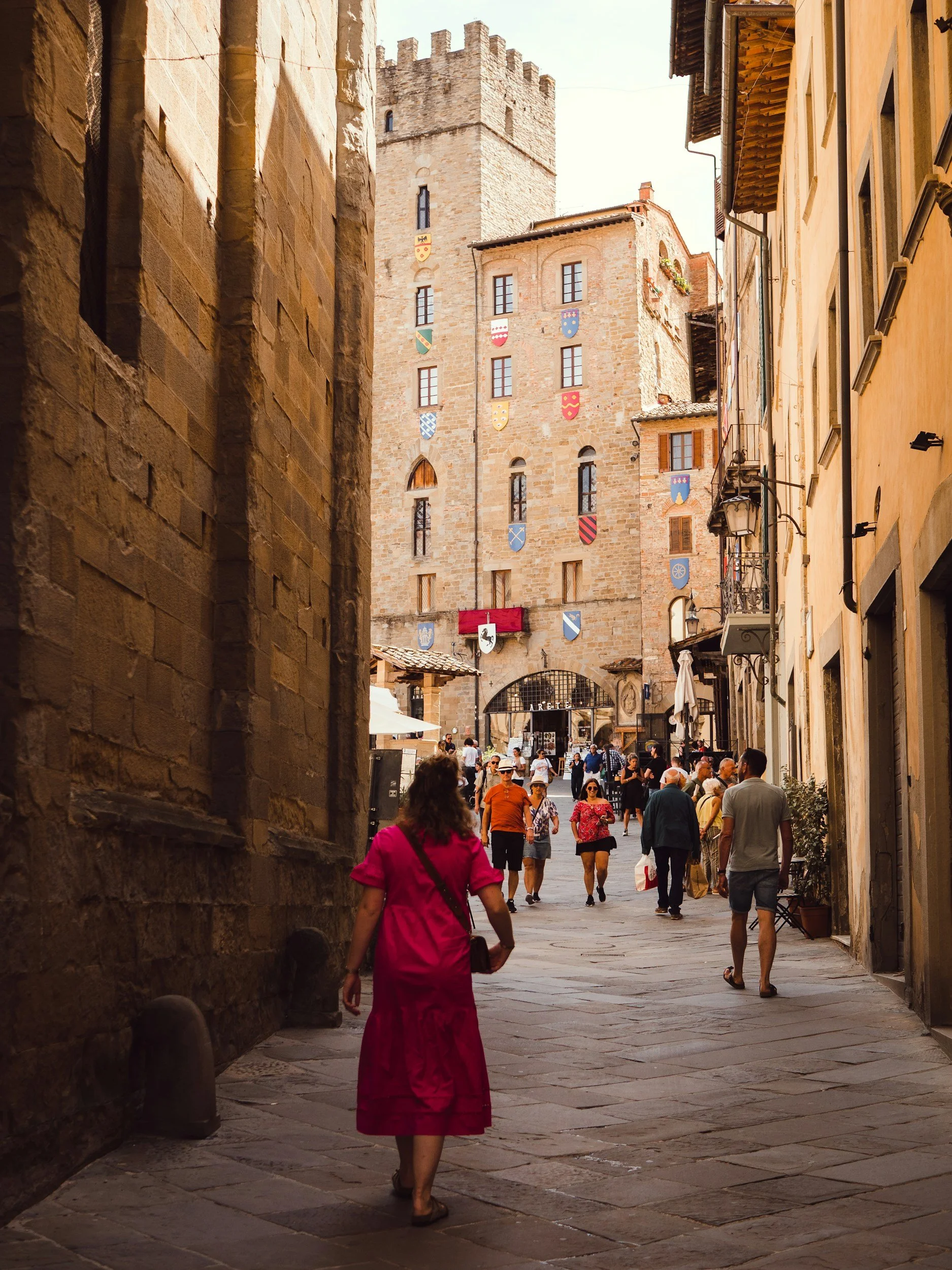
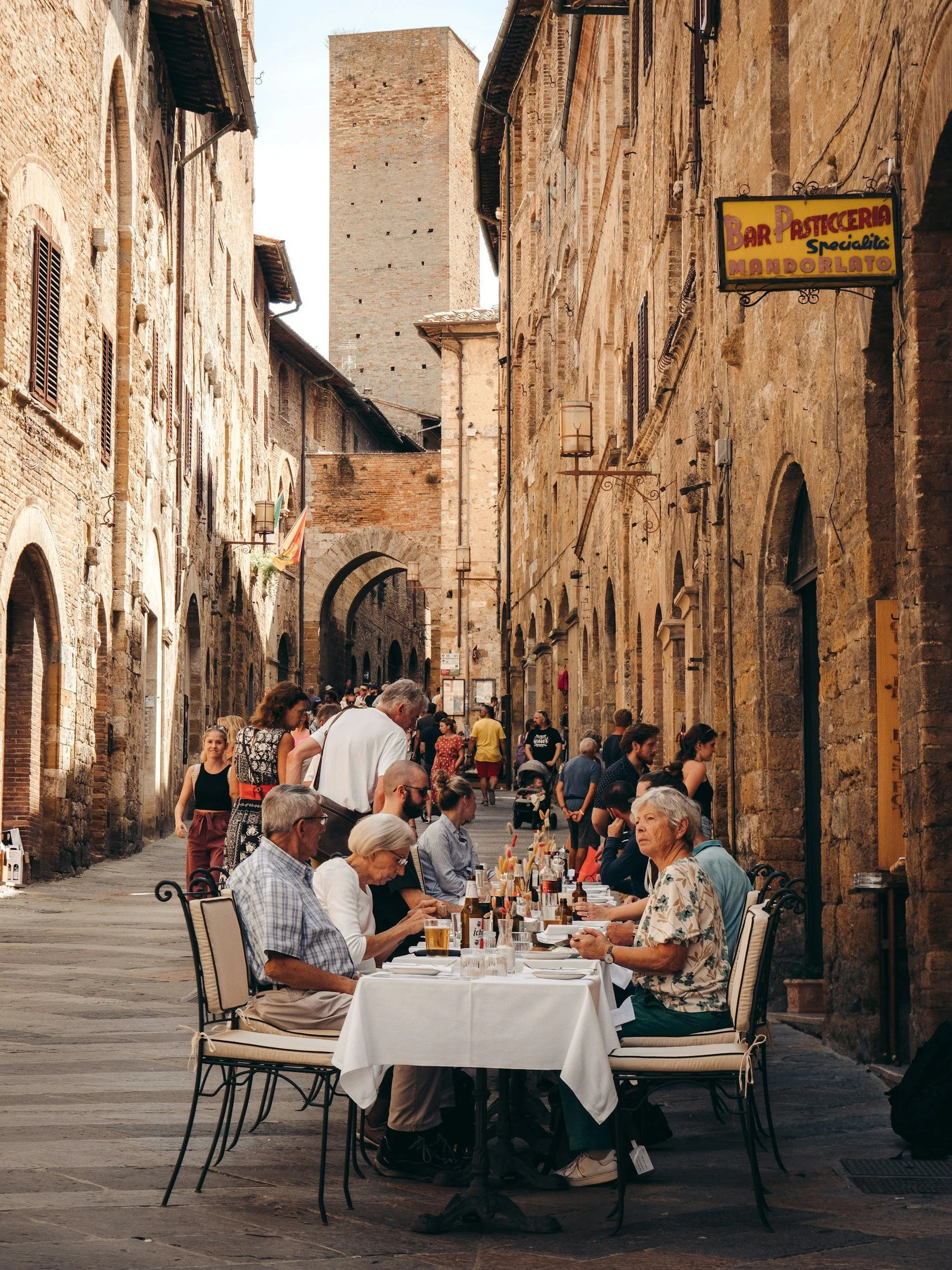
If the Tuscany you pictured is really about beautiful old streets, long lunches and a smaller Italian city rather than Tuscany itself, Ascoli Piceno is a really good alternative to look at before you book.
Lucca makes more sense if you want the base itself to be part of the trip
Choose Lucca if you suspect there will be mornings when you wake up, look at the train times and decide you would actually rather stay where you are.
That is probably the strongest argument for it. Lucca suits a trip where the base is not simply somewhere you sleep between day trips, because you can spend a completely unstructured morning walking, cycling, buying something for lunch, looking through a few shops and taking whichever street looks interesting without feeling that you have wasted one of your Tuscany days.
If easy everyday movement matters a lot to you, I would lean this way too. We have already talked about the flatter streets and how simple the arrival is, so I will not go through all of that again, but over four or five days the difference becomes less about getting your suitcase to the hotel and more about how easily you can change your mind. You can go back to your room for an hour, head out again before dinner, walk part of the walls because you have half an hour to spare, or cycle somewhere without having to turn the outing into an organised excursion.
And once you move away from the obvious Piazza dell’Anfiteatro–Via Fillungo route, there are plenty of little parts of Lucca that make those wandering days more interesting.
I would definitely walk Via dei Fossi, on the eastern side of the centre, where water still runs alongside the street through what locals call il Fosso. It is not simply a decorative canal. The wider public water system stretches for around 13 kilometres across the Lucca plain and was developed from the late 14th century onwards, eventually powering mills, spinning works, wool processing and other industries that helped support the city’s textile economy. It is one of those places where Lucca suddenly feels less like a beautifully preserved walled city and more like somewhere that actually had to function.
Nearby Piazza San Francesco is another area I would drift towards when I had no particular plan. On Wednesdays it hosts the local WednesdayBio market, with its hours changing between summer and winter, and this is exactly the kind of small recurring event that becomes more useful when you are staying for several days rather than trying to squeeze Lucca into one afternoon.
Then there is Via San Paolino, which gets more interesting after the shops close. Several shutters have been painted with women from Puccini’s operas, turning the street into a small evening gallery, and the nearby Church of San Paolino has its own Puccini connection because this is where he debuted as a composer while still a student. I like details like this much more in a base than in a sightseeing itinerary, because you do not have to schedule them. You just notice them when you happen to walk home that way.
There is another tiny place I would probably miss completely on a rushed visit: the Tegrimi garden in front of Palazzo Orsetti on Via Santa Giustina. It is genuinely small, with old trees and wisteria inside the walls around the palace, so I am definitely not suggesting you travel across Lucca purely to see it, but that is sort of the point. If you are staying here, you have time for the five-minute places as well as the famous ones.
If you like books, old prints and things you did not intend to buy, I would also keep Piazza San Giusto in mind. On the last weekend of the month, the Arti & Mestieri market has been bringing craftspeople here since 1988, with handmade pieces rather than the usual souvenir stalls. Beside it is Piazzetta del Libro, a little corner for out-of-print books and vintage prints. We have already talked about Lucca’s larger antiques market elsewhere in the article, so I would not repeat that here, but this smaller book-and-craft side of the city is another reason an unscheduled weekend can work surprisingly well.
Lucca also becomes much more interesting if you think you might rent a bike for more than one lap of the walls. The walls are the obvious starting point, but there are properly easy routes beyond them too. South of the station you can pick up the route alongside the 19th-century Nottolini Aqueduct, following its long line of arches through the countryside; the suggested loop is around 15 kilometres. North of the centre, the Serchio River has an approximately 11-kilometre dirt loop through poplars and willows, starting close enough to town that you do not need to arrange transport to reach it. There is even a farmers’ market near the San Quirico bridge on Saturday mornings, so this can turn into a very normal half-day rather than some serious cycling expedition.
That is the version of Lucca I think is most convincing as a base. Not just “you can cycle around the walls”, because everyone already knows that, but that you can wake up, hire a bike and follow an aqueduct into the countryside, walk beside an old industrial waterway later, browse old prints in Piazza San Giusto and still be back inside the walls for dinner without ever having planned a proper day trip.
I would also choose Lucca if your wider trip naturally sits on this side of Tuscany. If you are flying through Pisa, the arrival already works in your favour, and if Pisa, Viareggio, Pistoia or the coast keep appearing in your plans, you are not going to spend the week fighting the geography. We have gone through those journeys already, so I would not overanalyse them again here: if that is the part of Tuscany you want to see, Lucca points in the right direction.
But I think Lucca makes the most sense for someone who does not expect to take a train every morning.
Maybe one day you go to Pisa, another you decide on Viareggio because the weather is good, and another morning you simply walk out of your hotel with no particular idea beyond coffee. That third day is where Lucca starts to justify the choice, because there is enough happening between the walls, the canals, markets, little gardens, cycling routes and surrounding plain that staying put does not feel like the day when you failed to organise anything.
If that sounds closer to the Tuscany trip you want, I would choose Lucca and stop worrying that Arezzo technically gives you more railway options.
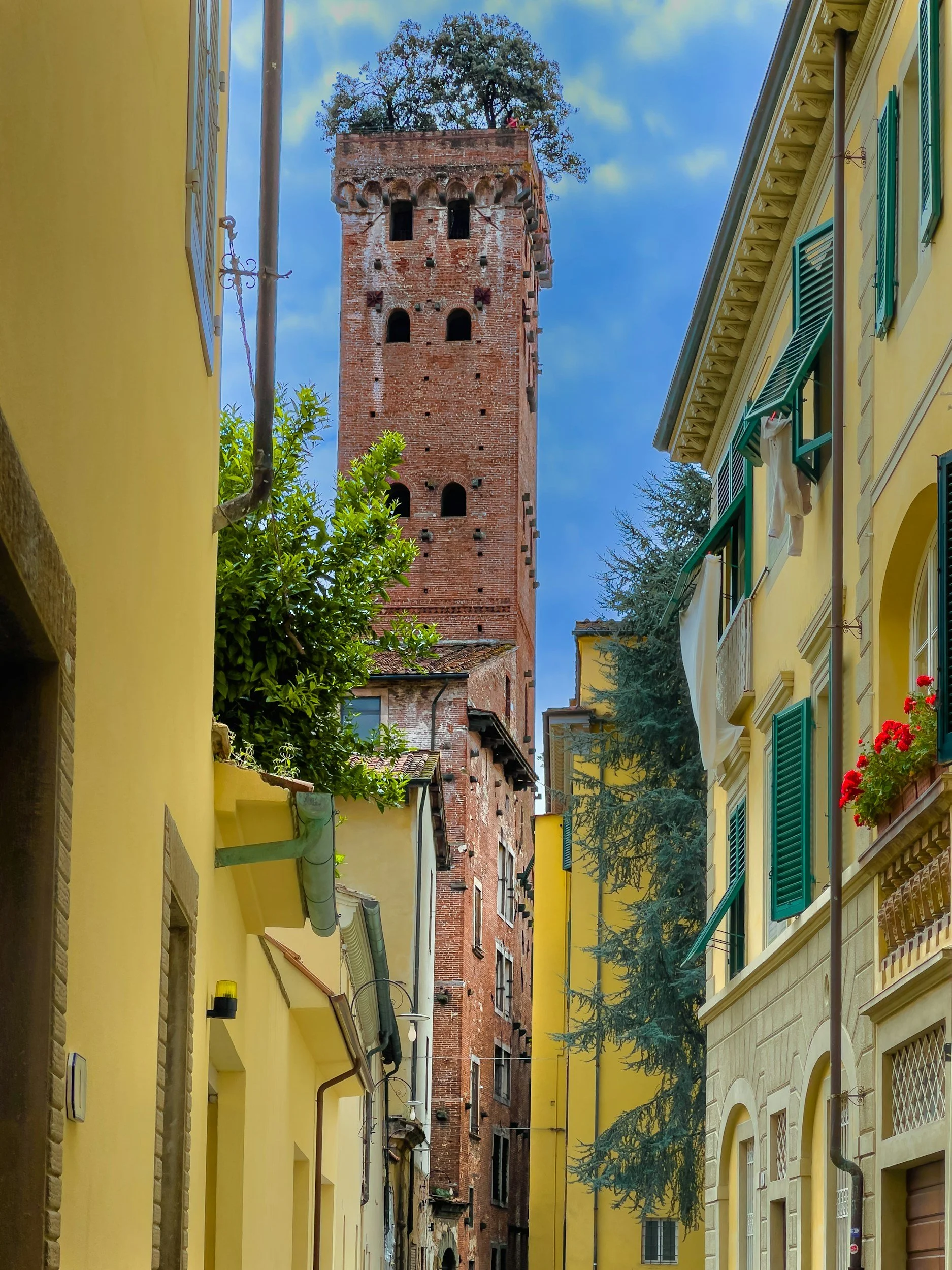
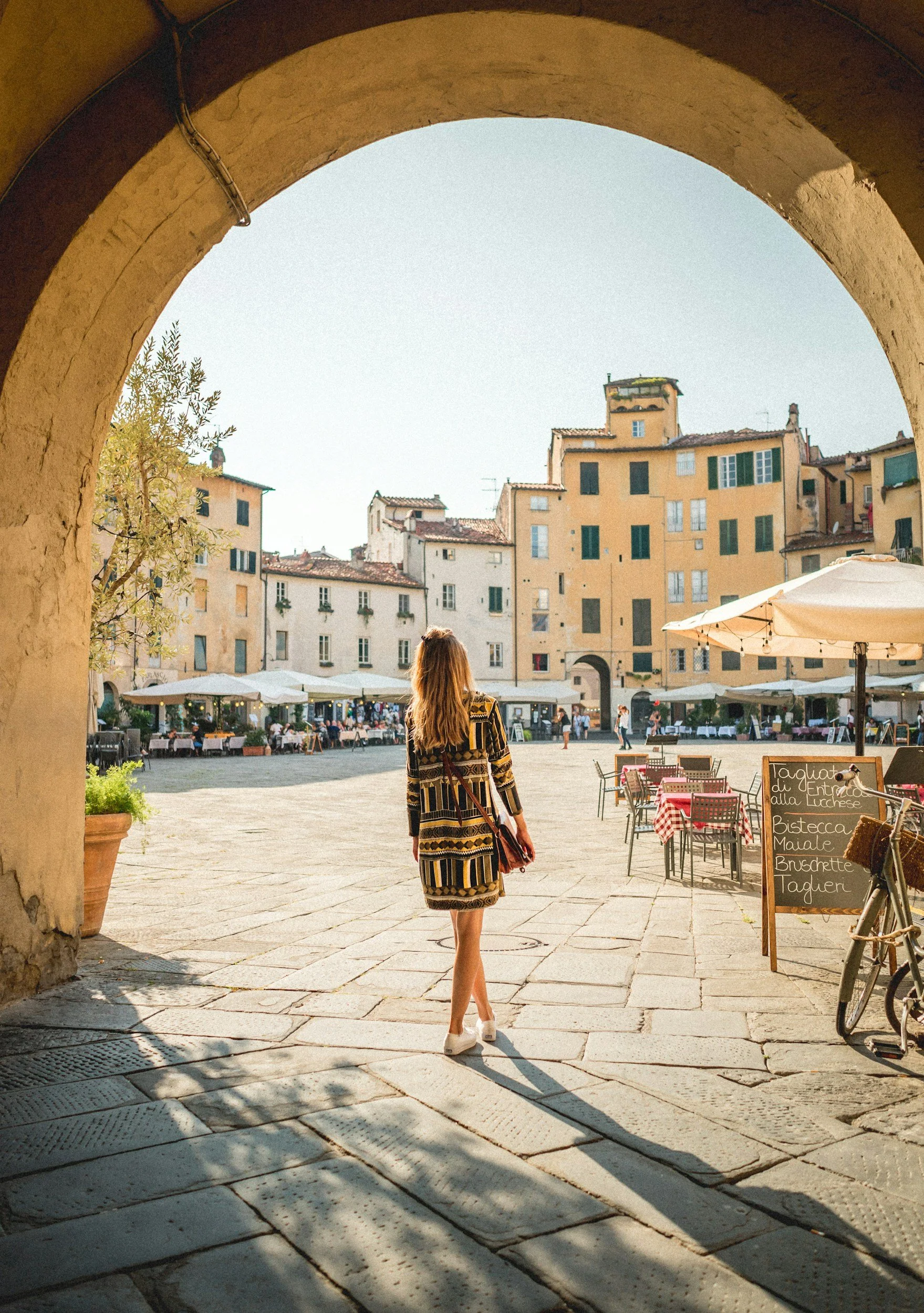
If you want the trip to revolve as much around food as the towns themselves, my guide to slow food in Tuscany looks at smaller places, local markets and traditional kitchens that are worth building a route around.
If the countryside is the real reason you are going, I would rethink both
There is one situation where I would stop comparing Arezzo and Lucca altogether: when you look at the places you have saved and realise that what you really want is not a small Tuscan city at all.
If your folder is mostly Pienza, Montalcino, Bagno Vignoni, vineyards around Chianti, long lunches at wine estates and a farmhouse somewhere between olive groves, then choosing the perfect railway base is only solving the wrong problem very efficiently.
You can still do rural Tuscany without driving, but I would plan it differently.
If Val d’Orcia is the priority, look seriously at Siena
For Pienza, Montalcino and the southern Tuscan countryside, Siena is worth considering before either Arezzo or Lucca, not because it suddenly gives every village a railway station, but because several of the useful regional buses start there.
Autolinee Toscane’s 112 route runs from Siena through Buonconvento towards Pienza and Montepulciano, while the Siena network also has the 114 corridor through Buonconvento and Torrenieri, useful for this part of the Val d’Orcia and Montalcino area. These are still buses with timetables you need to plan around, particularly outside the busiest season, but at least you are beginning the day on the transport corridor that actually serves the places you came to see.
That distinction matters. If you are staying in Arezzo, reaching southern Tuscany can mean first travelling to a rail junction and then starting the bus part of the journey. From Lucca, you are even farther away. I would rather choose a base that makes the first connection simple than spend three mornings congratulating myself on having avoided a rental car while standing at a bus interchange.
Buonconvento is especially useful to know about because it is one of the places where rail and the Val d’Orcia bus network meet. It is not Pienza or Montalcino, but it can work as a stepping stone into this part of Tuscany, and it also gives you a small historic centre worth seeing in its own right rather than functioning purely as a transport stop. The official Pienza guidance specifically points car-free travellers towards either Buonconvento or Chiusi-Chianciano Terme before continuing by bus.
And this is where I would stop thinking in terms of “nearest station”. The useful question is not whether a station somewhere has Montepulciano, Chianciano or another familiar name attached to it. It is whether you can get from that platform to the historic town, have several useful hours there and still have a sensible way home.
Chianti is possible without a car, but visiting a town and visiting wineries are two different trips
Chianti has a slightly different problem.
If what you want is Greve in Chianti, or perhaps Radda and Gaiole on the right service, Florence is actually a much more logical starting point than either Arezzo or Lucca. Autolinee Toscane’s 365 network links Florence with Greve and continues through parts of the Chianti area towards Radda and Gaiole, so a car-free town day can be completely realistic.
But I would be careful with the sentence “you can visit Chianti by bus”, because that can mean two completely different things.
You can take a bus into Greve, walk around Piazza Matteotti, have lunch, browse the food and wine shops and catch a bus back to Florence.
That is not the same trip as visiting three wineries scattered along country roads between Greve, Panzano and Radda.
The vineyards and estates are spread across the hills, and Tuscany’s own Chianti wine itineraries are largely built around road travel for exactly that reason. A bus can get you into the area, but it cannot conveniently move you between a tasting at 11:00, lunch at an estate six kilometres away and another cellar in the afternoon.
If the wineries are the main event, I would budget for one organised wine day, a pre-booked driver or taxis arranged with the estates themselves rather than trying to turn a rural wine route into a public-transport puzzle.
It may cost more than the bus, but you have also travelled all the way to Tuscany to enjoy the wine, not to spend half the afternoon calculating whether you can walk 4.8 kilometres along a country road before the next connection.
The same applies to Val d’Orcia once you leave the towns
You can absolutely reach individual towns without a car. The problem begins when the countryside between them is the thing you want.
A bus can take you into Pienza, but it cannot give you the freedom to stop on the road towards San Quirico d’Orcia, continue to the thermal square at Bagno Vignoni, have a long lunch and then decide that you would also like to visit a producer outside Montalcino before dinner.
There are actually walking itineraries that make a slower car-free version possible. Visit Tuscany, for example, features a multi-day route beginning from Montepulciano and continuing on foot from Montepulciano to Pienza and then Pienza to Bagno Vignoni, with the first walking stage around 13 kilometres and the next around 12 kilometres. That is a completely different way of experiencing the Val d’Orcia, and for the right traveller it could be brilliant, but it also shows why treating the area as a collection of easy rail day trips misses how the geography really works.
If you want the countryside itself rather than simply one famous town, I would decide whether you want to walk it, tour it or stay in it. Trying to commute into it repeatedly from Lucca or Arezzo is usually the least satisfying version.
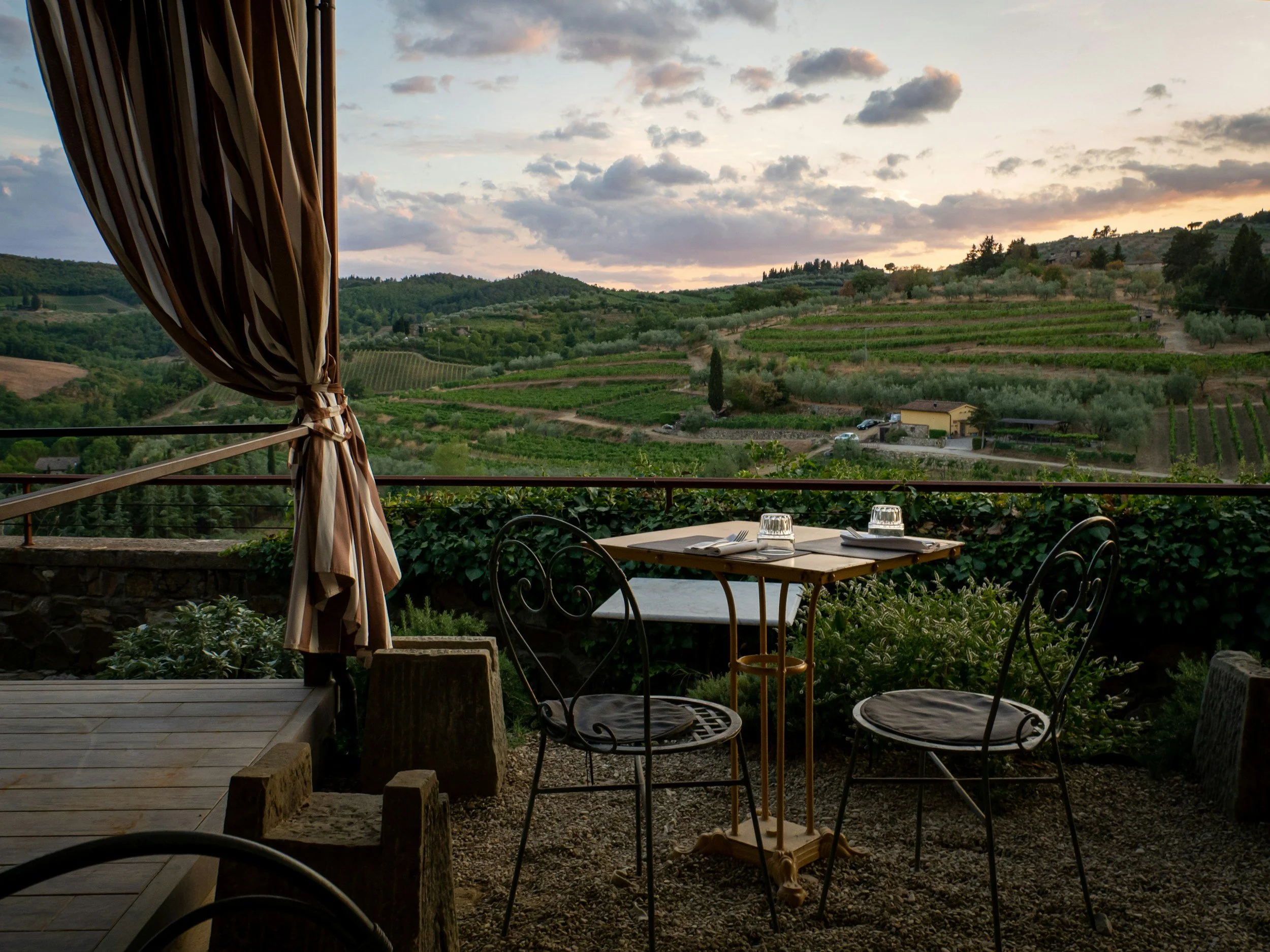
A countryside stay can work without a car, but I would verify the transfer before booking
I also would not take any of this to mean that a car-free traveller has to sleep in cities every night.
A carefully chosen agriturismo can work extremely well, but I would reverse the normal booking process.
Do not find the stone farmhouse with the pool, fall in love with the terrace and then scroll to the bottom of the page hoping to find a bus stop.
First find out:
where the nearest usable station or bus stop is;
how you get from there to the property with luggage;
whether the hosts will collect you;
whether that transfer is available on arrival and departure days;
whether dinner is available on site or somewhere genuinely walkable;
and how you would spend a day there if you did not go anywhere at all.
There are properties that make this work properly. Casanova di Lucignano, south of Siena, is a good example of the difference between a genuinely car-free countryside stay and a farmhouse that merely happens to appear close to a town on a booking map. Its official listing tells guests to take the bus from Siena to Monteroni d’Arbia, where the property will collect them in the village and drive them the rest of the way.
That is the sort of sentence I would want to see in writing before booking.
Other accommodation listings on Tuscany’s official tourism site explicitly mention services such as station pickup too, so transfer availability is something worth actively searching for rather than assuming that every agriturismo expects you to arrive in a Fiat.
And I would pay just as much attention to food as transport. A remote farmhouse with breakfast but no dinner can be surprisingly awkward without a car when the nearest restaurant is technically “only three kilometres away”. A property with dinner, a farm shop or a host willing to arrange transfers gives you a completely different amount of freedom.
I have gone much deeper into that in my guide to Tuscan farm stays without a car, including the places where a station plus a planned transfer can get you into the countryside without hiring a car for the whole trip.
And if what you really want is a smaller place rather than a farmhouse, I would look at these Tuscan villages you can manage without a car before automatically booking Arezzo or Lucca and commuting out every day.
So if your saved map is covered in pins across Val d’Orcia, rural Chianti and winery country, I would not ask which of these two cities wins. I would look at Siena or Florence for the relevant bus corridors, consider splitting the trip with a countryside stay that has a confirmed transfer, or deliberately pay for one or two days where somebody else handles the driving.
Arezzo and Lucca are both excellent car-free bases. They just cannot turn rural Tuscany into a rail network, and I would much rather know that before booking the hotel than discover it halfway through the trip.
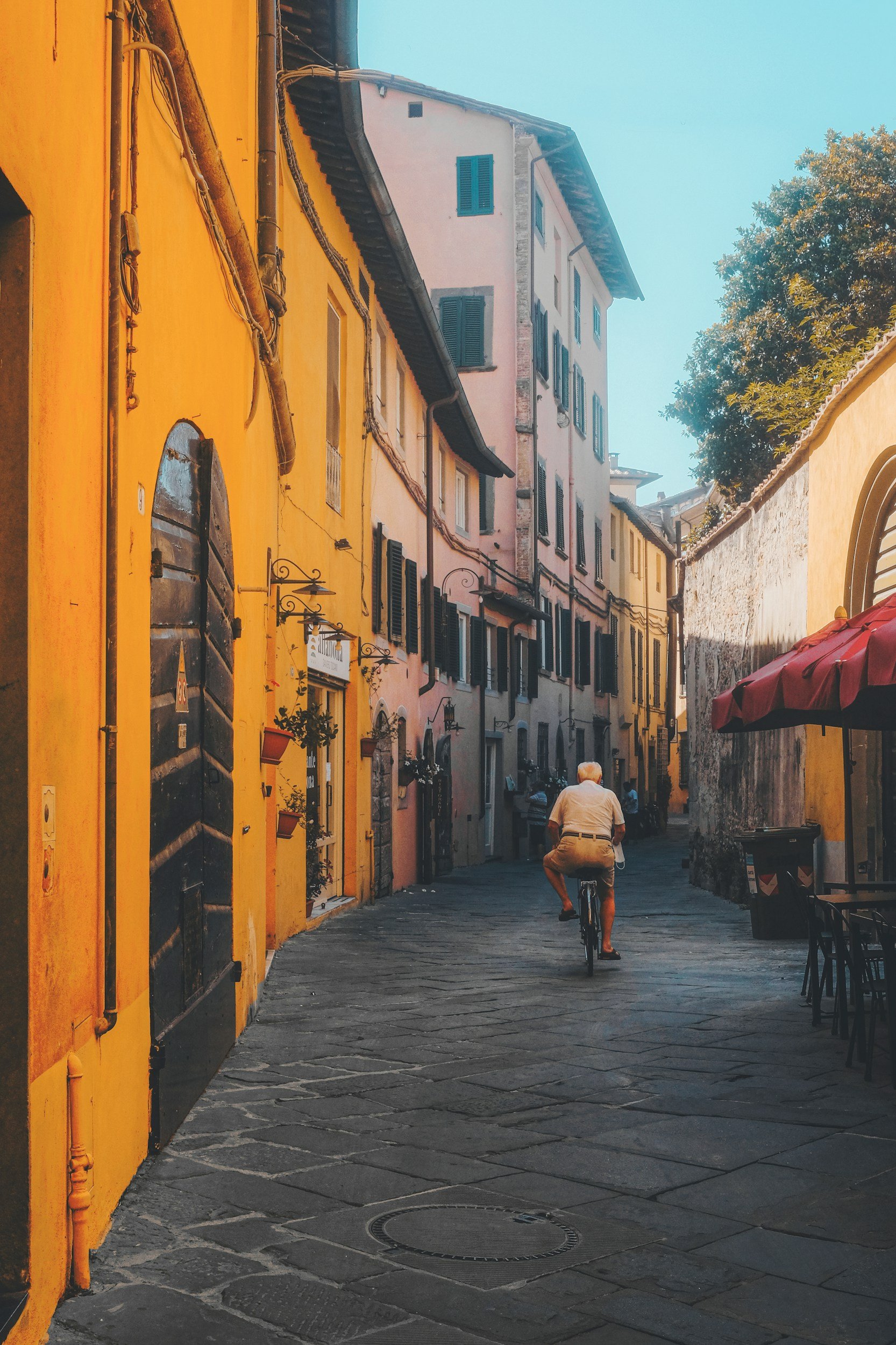
How many nights do you actually need?
I would be slightly careful with the usual “three nights is plenty” advice, because three nights often means two proper days once you factor in arriving, checking in and leaving again. That can be enough, but it depends on whether you want the city to be part of the trip or mainly somewhere convenient to sleep between trains.
For Arezzo, I would aim for three nights at the absolute minimum and four if you want to use it properly as a base. Three nights works if you arrive reasonably early, give Arezzo one full day and take one day trip before moving on. If you already have two outings in mind, perhaps Florence and Cortona or Castiglion Fiorentino, I would much rather stay four nights so Arezzo itself does not become the place you only see on the walk between your hotel and the station. There is enough here between San Francesco, Piazza Grande, Casa Vasari, the antiques and craft side of the city and the upper streets around the Cathedral that I would want at least one day when I was not watching a departure board. Arezzo’s own tourism site has multiple themed city itineraries rather than treating it purely as a transport base, which backs up that slower approach.
Lucca is the place where I would be even more tempted to add an extra night. Three nights is enough to see the city and take one easy trip, but four feels much better if the reason you chose Lucca was to have slower mornings and days when you do not need a plan. Its official tourism material is built around walking, cycling, markets, food routes and itineraries both inside and beyond the walls, and there is even a three-day city pass aimed at short stays, which gives you a reasonable sense of how much there is to fill several days without leaving town every morning.
If you want Pisa plus Viareggio or Pistoia, I would go to four or five nights. That gives you two or three outings while still leaving time for the version of Lucca that made it appealing as a base in the first place: a morning on the walls, lunch somewhere you found the day before, a bit of cycling, a market if the dates line up, or simply an afternoon when you decide not to go anywhere.
For a full week in one base, I would resist the urge to fill six days with six different train trips just because you technically can. At that point you are basically using Arezzo or Lucca as a cheaper hotel outside the places you really wanted to visit, which rather defeats the point of choosing a smaller Tuscan city in the first place. I would probably plan two or three proper day trips, keep at least two days for the base itself, and leave one day deliberately loose for weather, a market, something you discover after arriving or the completely reasonable decision that you cannot face another regional train.
And I would only split a seven-night trip between Arezzo and Lucca if your itinerary genuinely pulls in both directions. For example, three or four nights in Arezzo could make sense for Cortona, Valdichiana and an onward journey towards Rome, followed by several nights in Lucca because you also want Pisa, the coast or north-western Tuscany. But I would not split simply because you cannot decide which city you prefer.
Arezzo and Lucca are not particularly convenient day trips from each other, and moving between them by rail normally takes a little over two hours on the better connections and involves at least one change. Add checking out, walking to the station, waiting for the train and checking in again, and changing bases uses up a meaningful chunk of the day.
So for most trips, I would choose one base for three to five nights and use it properly. Split them only when doing so solves a geographical problem in your itinerary, not because both places look nice and you are afraid of choosing the wrong one.
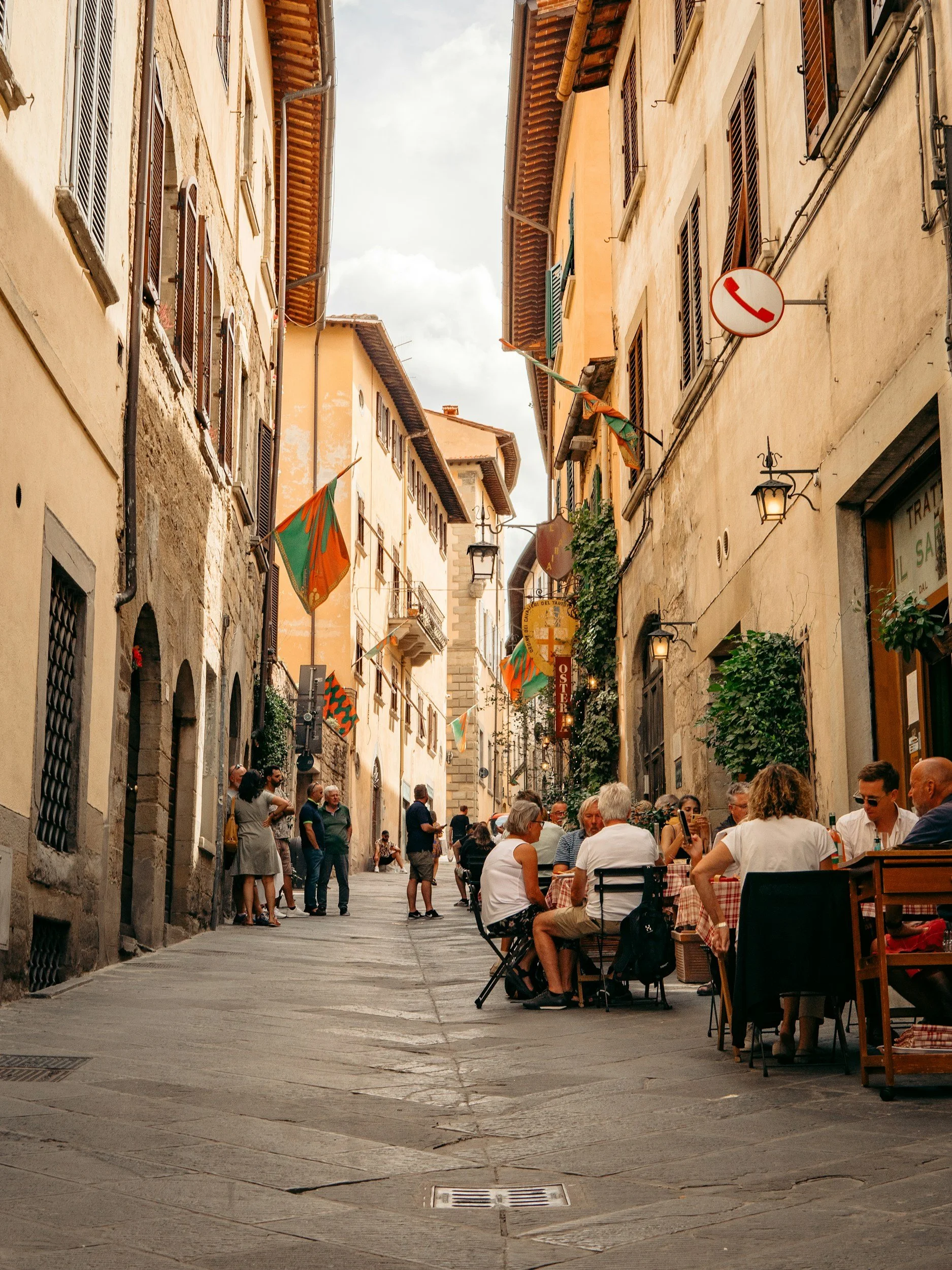
So, Arezzo or Lucca?
If you are still going back and forth between the two, I would stop thinking about arrival day and picture the third morning of the trip instead.
You have already walked around your base, seen a few of the main things and found somewhere you like for coffee. Now you have another three or four days ahead of you. Are you opening Trenitalia over breakfast because you are excited to see where else you could go? Or are you hoping the weather is nice enough to forget the train completely and just spend the day where you are?
That is probably your answer.
I would choose Arezzo if I knew I wanted to move around quite a lot. The train connections are the practical reason, of course, but I also think Arezzo is the more interesting choice if you want somewhere that still feels like a proper city rather than somewhere you picked mainly because it makes Tuscany easy.
You have Piero della Francesca and Vasari, but also the antiques culture, the goldsmithing, small craft shops and galleries, and plenty of ordinary streets where nothing has been arranged especially for visitors. There is more to get curious about once you start looking beyond Piazza Grande, and that is probably why Arezzo would be my pick for this kind of trip.
I would just be quite deliberate about where I stayed. Somewhere around Piazza Guido Monaco, lower Corso Italia or Piazza San Francesco gives you a much better balance between being able to walk into the old centre and actually using the station without turning every train day into an extra workout.
Lucca is the one I would choose if I wanted everything to feel easier.
Maybe you are flying into Pisa. Maybe Pisa and Viareggio are already on your list. Or maybe you simply know yourself well enough to know that after two busy days, you are going to want a morning where the only plan is coffee and a walk.
Lucca is very good for that kind of trip. You can go around the walls again without feeling silly for repeating yourself, rent a bike for a couple of hours, wander down Via dei Fossi, browse a few shops, go back to your room in the afternoon and come out again for dinner. You do not constantly need another destination to make staying there worthwhile.
And I think that is the real difference between the two.
With Arezzo, I would be excited about everything I could reach from the base as well as the city itself. With Lucca, I would be excited about having fewer reasons to leave.
Before booking anything, I would do one last very unglamorous thing: open Google Maps and look at all the places you have saved.
If most of the pins are around Cortona, Castiglion Fiorentino, the Valdichiana, Umbria or somewhere you are continuing towards Rome, book Arezzo.
If they are around Pisa, Pistoia, Viareggio and the north-western side of Tuscany, book Lucca.
And if you zoom out and realise practically every heart you have saved is sitting around Pienza, Montalcino and rural Chianti, I would book neither and rethink the route before paying for the hotel.
That is much more useful than trying to decide which city is prettier, because I genuinely do not think that is the decision here.
For this particular kind of car-free Tuscany trip, Arezzo would be my choice. Lucca is easier, and for some trips that makes it the better option. But if you want markets, local life, good rail connections and a base that still gives you plenty to get interested in when you stay put, I think Arezzo has a little more to it.
If this whole comparison has made you realise that what you are really looking for is somewhere quieter rather than the most efficient base, have a look at my guide to small towns in Tuscany for a slower trip next. And if Tuscany is only one possibility and you are still deciding where in Italy would suit this kind of trip, these seven peaceful places in Italy go a little wider.
The important part is choosing the place that fits the trip you actually want, rather than the one that looked nicest when you first opened twenty hotel tabs.
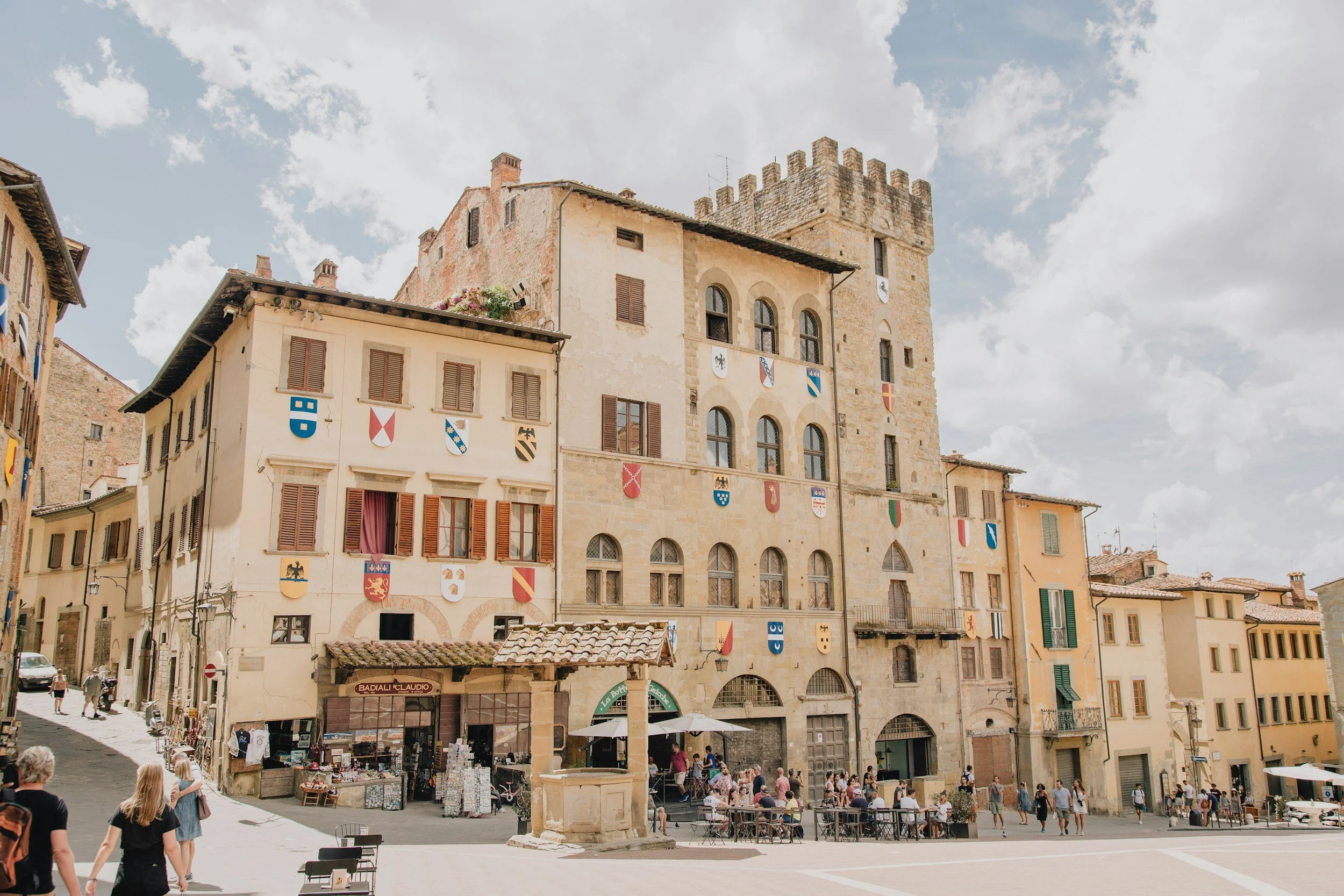
If wine is one of the main reasons you are planning Tuscany, this guide to Tuscany’s quieter vineyards, wine, art and local culture is useful for finding places that feel more thoughtful than simply jumping between the best-known wine towns.
FAQ: Arezzo or Lucca without a car?
Is Arezzo or Lucca better for a Tuscany trip without a car?
For a train-heavy trip, I would choose Arezzo. For the easiest place to actually stay and move around every day, I would choose Lucca.
Arezzo has the stronger position if you want to keep taking trains, particularly towards Florence, the Valdichiana and the Rome direction. Lucca is flatter, its station is almost beside the walls, and it works particularly well for Pisa, Pistoia and the north-western side of Tuscany. Trenitalia’s Tuscany Line specifically links Pisa, Lucca and Pistoia, while Arezzo also sits on national services extending through Florence towards Rome.
So I would not ask which one is “better for Tuscany” in general. I would ask whether you want the stronger transport base or the easier base to live in for a few days.
Is Arezzo a good base for Tuscany without a car?
Yes, especially if the places you want to see are on the eastern and south-eastern side of Tuscany.
Arezzo works well because you are not relying on one little branch railway. You have the main rail corridor towards Florence and Rome, local journeys through the Valdichiana, and additional connections towards the Casentino. There are also buses from Arezzo towards places including Castiglion Fiorentino and Camucia-Cortona.
Where I would be more cautious is if your saved places are mostly Pisa, Lucca, the coast, Pienza or rural Chianti. Arezzo is a very useful base for the right part of Tuscany. It is not a clever way of making the entire region easy without a car.
Is Lucca a good base for Tuscany without a car?
Yes, particularly if you want Pisa, Pistoia, Montecatini Terme, Viareggio or a trip that stays mainly in north-western Tuscany.
Trenitalia’s Tuscany Line connects Lucca directly into the Pisa–Lucca–Pistoia corridor, and that is the part of the regional network I would build a Lucca stay around.
The other reason Lucca works so well is that you are not dependent on those day trips. If the weather changes or you decide you cannot be bothered catching the 09:12 anywhere, you still have the walls, markets, museums, churches, cafés, cycling and plenty of streets to explore inside the city itself.
That is why I like Lucca more as an actual holiday base than its railway map alone would suggest.
Which has better train connections, Arezzo or Lucca?
Arezzo has the better overall rail position.
It sits on the main north-south corridor through Florence towards Rome, and some Frecciarossa services extend through Arezzo as well. Lucca has a good regional network, but it is much more useful for a particular part of Tuscany: Pisa, Pistoia, Montecatini and the north-west.
That distinction is more useful than simply counting trains. If you are planning several rail day trips and then continuing south towards Rome, Arezzo makes more sense. If Pisa and the coast are the places you actually want to see, Lucca’s smaller network is pointing in exactly the right direction.
Which day trips are actually easy by train from Arezzo and Lucca?
From Arezzo, the easiest rail days include Florence and Castiglion Fiorentino, while Camucia-Cortona is also straightforward by train as long as you remember that Cortona itself is uphill from the station. Arezzo also gives you access towards the Valdichiana and useful connections in the direction of Umbria.
From Lucca, Pisa and Pistoia sit directly on the regional Tuscany Line, while Viareggio is another very practical rail day from this side of the region.
This is one place where I would still check Trenitalia for your actual travel dates rather than saving a list of journey times months in advance. Regional schedules change, and “easy” should mean more than finding one train that happens to work at 06:17.
Is Cortona easy to visit from Arezzo without a car?
Yes. Cortona is a realistic day trip from Arezzo without a car, but it is not a train-straight-into-the-old-town journey.
The railway station you want is Camucia-Cortona, down in the valley below the historic centre. From there, local Autolinee Toscane services connect Camucia with Cortona, including stops at Camucia station and Cortona’s Piazza Mercato.
I would happily do it from Arezzo. I would just check the bus back before heading uphill, particularly later in the day or outside the busiest travel periods. It is a good example of a very Tuscan planning rule: finding a railway station with the right town name is only half the job.
Can you visit Cinque Terre from Lucca as a day trip?
Yes, you can, but I would not choose Lucca specifically because of it.
You need to travel north towards the Ligurian rail network and then use the regional trains serving the Cinque Terre villages. Trenitalia’s Cinque Terre rail system runs between La Spezia and Levanto, so from Lucca you are adding the journey to that corridor before the Cinque Terre part of the day even begins.
For one day that may be completely fine, especially if Cinque Terre is high on your list. If you want two or three days there, I would move north and stay closer rather than repeatedly travelling from Lucca. Possible and sensible are not always the same thing.
Which is easier with luggage, Arezzo or Lucca?
Lucca wins this one.
When you walk out of Lucca station, the city walls are directly in front of you. The nearest pedestrian access is around 200 metres away, while Porta San Pietro is about 300 metres from the station.
Arezzo station is central too, and there is a taxi rank directly outside in Piazza della Repubblica, but the historic city rises away from the station. Most urban bus routes also pass through Piazza Guido Monaco or close to the station, so you do have alternatives to dragging a suitcase uphill.
If you travel light, I would not let this decide the whole trip. With a large suitcase, mobility issues or a strong dislike of uphill arrivals, Lucca is noticeably easier.
Where should you stay in Arezzo or Lucca without a car?
In Arezzo, I would look around Piazza Guido Monaco, lower Corso Italia and towards Piazza San Francesco. That keeps you close enough to the railway station for day trips without making you feel as if you are staying outside the part of Arezzo you actually came to enjoy. Piazza Guido Monaco is also one of the main points for Arezzo’s urban bus network.
In Lucca, I would stay inside the walls, preferably towards the southern or central part of the historic centre if train access matters. Porta San Pietro is particularly handy because it is only a few hundred metres from the station.
And I would always check the exact map pin before booking anything described as “Lucca countryside”. Ten beautiful kilometres from Lucca is still ten kilometres when you do not have a car.
Which is quieter, Arezzo or Lucca?
For an ordinary stay, I would give Arezzo a slight edge if what you want is more everyday local life around you.
Lucca can be very pleasant once day visitors have gone, but its central streets and major squares are more obviously part of the visitor route. Arezzo has tourism too, of course, but there is a stronger sense that the historic centre is still attached to a working city rather than existing mainly as somewhere people come for the afternoon.
The calendar can completely change that answer. Arezzo’s monthly Fiera Antiquaria brings more than 500 exhibitors into the centre, while Lucca’s big events can transform the city just as dramatically.
So if quiet really matters, I would check the weekend before I checked the hotel rating.
Does Arezzo or Lucca have the better antiques market?
If antiques are one of the reasons you are making the trip, I would choose Arezzo.
The Fiera Antiquaria brings more than 500 exhibitors into the city and spreads through the historic centre with paintings, books, prints, watches, porcelain, glass, textiles, metalwork and all sorts of objects you absolutely did not plan to carry home in your hand luggage.
Lucca’s antiques market is smaller but still serious, with more than 200 exhibitors. It takes place around Via del Battistero and the squares near San Martino, San Giusto, San Giovanni and Piazza Bernardini, and the third-Sunday market feels particularly nice because it is woven through the streets rather than contained in one market square.
Arezzo is the one I would travel for specifically. Lucca is the one I would be very happy to discover was happening while I was already there.
Is Arezzo or Lucca better in autumn?
For a straightforward autumn city stay, I would probably choose Lucca. For antiques, September events and a trip that also reaches towards the Casentino, Arezzo becomes very tempting.
Lucca’s walls are genuinely good in autumn, not just because somebody has written “autumn colours” in a travel guide. The walls are lined with plane trees, lime trees, oaks and other mature trees, and Lucca Tourism specifically highlights their autumn foliage.
Arezzo has a different autumn appeal, particularly with its antiques weekends and September Giostra, and the countryside towards the Casentino gives you another reason to be on this side of Tuscany once the landscape starts changing.
One warning for Lucca: late October is not automatically quiet autumn. Lucca Comics & Games takes over the city around the end of October and beginning of November, so always check the dates before booking.
Can you visit Val d’Orcia or Chianti from Arezzo or Lucca without a car?
You can reach individual places, but I would choose neither Arezzo nor Lucca if rural Val d’Orcia or winery-hopping in Chianti is the main point of your trip.
For the Val d’Orcia side, Siena has much more useful bus corridors. Autolinee Toscane’s 112 serves Siena, Buonconvento, Pienza and Montepulciano, while the 114 serves the Siena–Buonconvento–Torrenieri–Montalcino corridor.
Chianti has the same basic distinction between reaching a town and reaching scattered wineries. Public transport can get you into parts of the region, but a vineyard several kilometres down a country road is still several kilometres down a country road.
If wine estates and countryside are the real priority, I would rather arrange one guided or driver day, or choose a farm stay where the final transfer has been confirmed before booking.
Which airport is easiest for Arezzo and Lucca?
For Lucca, Pisa Airport is by far the more natural arrival.
The PisaMover links Pisa Airport with Pisa Centrale in about five minutes, and from Pisa Centrale you can continue on the regional line towards Lucca.
For Arezzo, Florence Airport usually fits the geography better because you can travel into Florence and then continue south by rail towards Arezzo rather than crossing Tuscany from Pisa.
I still would not pay a ridiculous amount more for the “correct” airport. If Pisa gives you a much cheaper direct flight and Florence means two connections before you have even reached Italy, compare the whole journey. Airport convenience matters, but not enough to ignore the flight itself.
How many nights should you stay in Arezzo or Lucca?
For Arezzo, I would stay three nights at the minimum and preferably four if you want two day trips as well as proper time in Arezzo.
For Lucca, three nights works for the city plus one outing, while four or five makes more sense if you want to add Pisa, Viareggio or Pistoia and still have those slower Lucca days that are half the reason for choosing it.
And I would not turn a seven-night stay into six day trips. Having a useful railway station does not mean you need to prove it every morning.
If you have a full week and your plans genuinely cover both eastern and north-western Tuscany, splitting the trip can make sense. Otherwise I would choose one, unpack once and actually enjoy the place you chose.