
Talloires or Annecy? Here's how I'd choose where to stay.
Annecy is the obvious base because the train drops you close to the old town, the lake is right there, and everything looks simple on a map. For a first visit, that can make sense, especially if you only have one night or you want restaurants, shops, canals, markets, boat departures and transport all within a short walk.
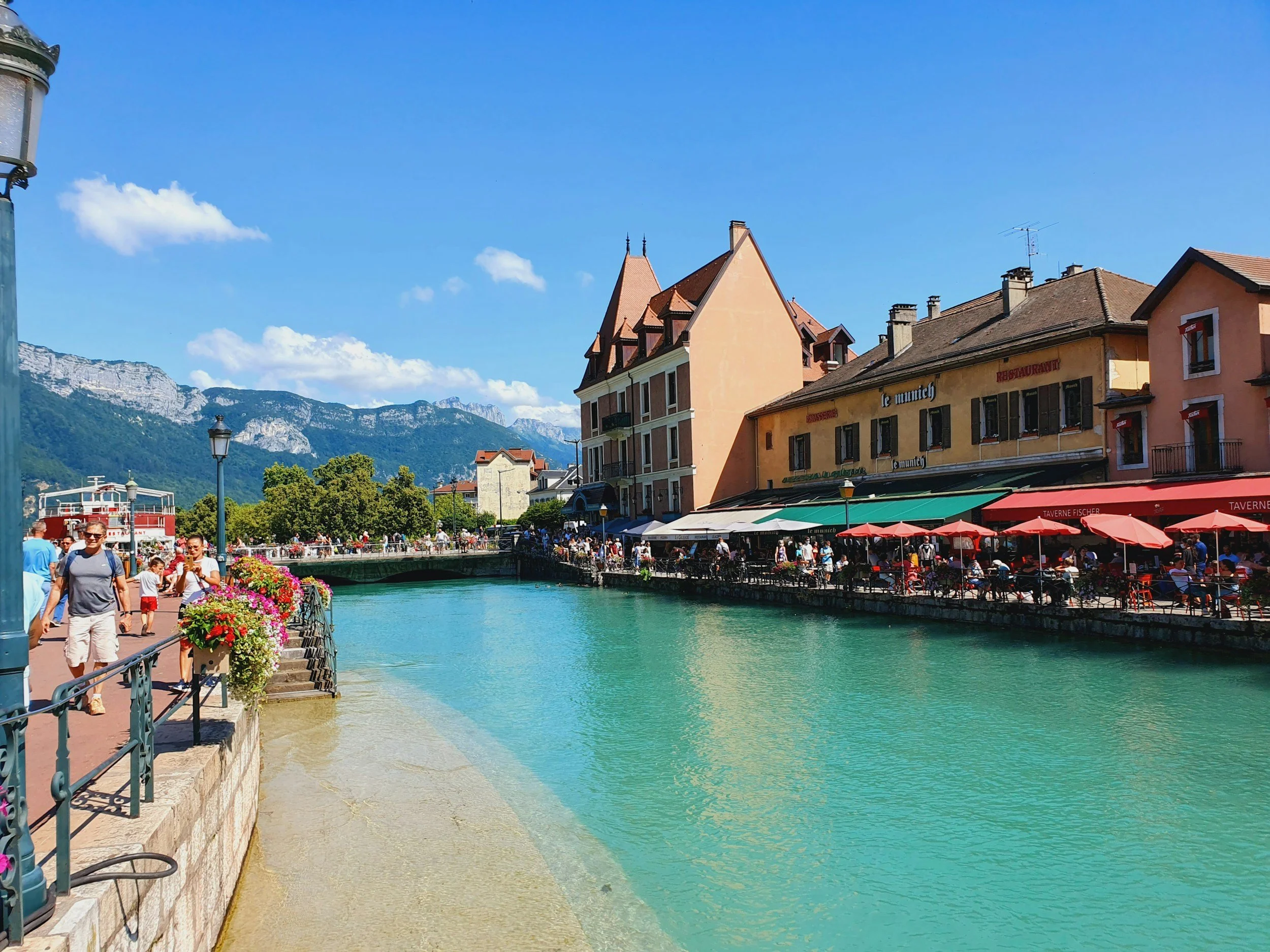
The problem is that early summer changes the feeling of staying there. By late May and June, the old town starts filling earlier in the day, especially around the canals, Rue Sainte-Claire, Pont des Amours, Jardins de l’Europe and the lakefront paths near the centre. It is still beautiful, but it becomes a place where you are constantly moving around other people. Even simple things like finding a quiet coffee, choosing a bench by the lake, or walking along the water without stopping every few metres can take more effort than expected.
Annecy also has that day-trip pressure. People arrive from Geneva, Lyon, Chambéry and nearby holiday rentals, often for the same few streets and the same photos. If you stay in the centre, you are not just visiting the busy part. You are sleeping inside it, eating dinner inside it, and starting every morning there unless you make a plan to leave early.
For those who like staying somewhere calmer but still practical, this is where the choice becomes more interesting. Annecy is useful. Talloires is not as convenient at first glance, but for a few days by Lake Annecy in early summer, it often gives you the part people are hoping Annecy will give them.
What changes when you stay on the east side of the lake instead
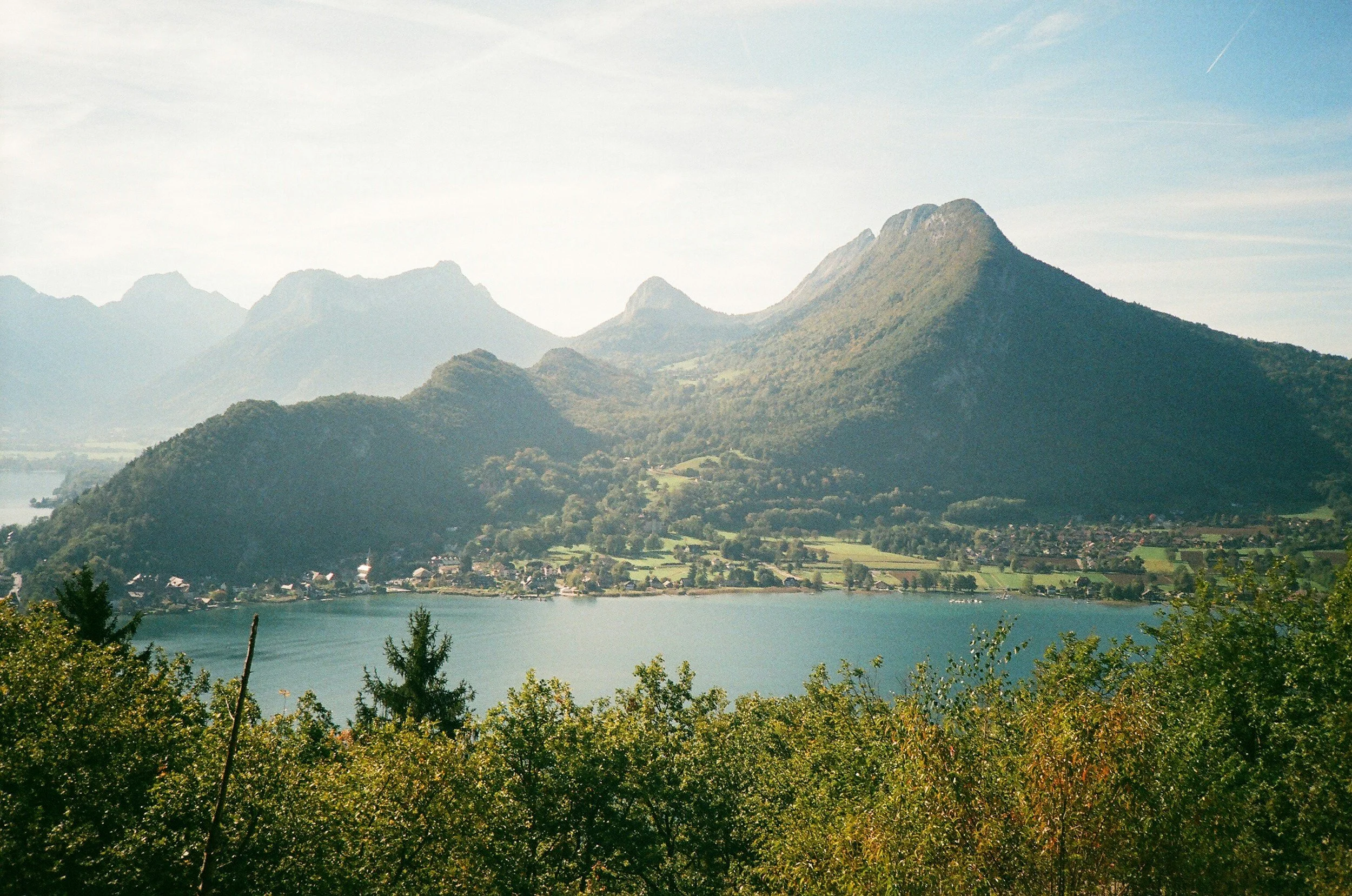
Staying in Talloires changes the trip because you stop treating Lake Annecy as something you visit from the busy end of the lake. Annecy is still close enough for a market morning or a proper wander through the old town, but your everyday base sits on the east shore, around the bay, the small harbour, Plage Municipale de Talloires and the road towards Angon. It feels more like staying with the lake beside you, rather than trying to reach it after moving through the most crowded part of town.
Around Talloires village, you have the port, the municipal beach, the older lakeside hotels, restaurants such as Abbaye de Talloires and Auberge du Père Bise, and the small roads that lead towards Angon and the quieter bathing areas further along the shore. It is not packed with choices in the way Annecy is, but that is exactly what makes it easier for a few days. You are not constantly deciding where to go next. You are choosing between a swim, a walk towards Angon, lunch near the water, or the short trip to Menthon-Saint-Bernard.
The east side also makes the lake feel more usable. From Talloires, you can go towards Menthon-Saint-Bernard for the castle area, head to Angon for beach time or the waterfall walk, take the road up towards Col de la Forclaz if you want the wider lake view, or use the bus towards Annecy when you actually want the old town. In summer, line 60 runs along this side of the lake between Annecy, Veyrier-du-Lac, Menthon-Saint-Bernard and Talloires-Montmin, so you are not completely cut off without a car, even if you still need to check timings properly before planning dinner around it.
That is the real difference. Annecy gives you more immediately, but it also puts you in the busiest part of the lake from the moment you wake up. Talloires gives you fewer streets, fewer restaurants and fewer distractions, but the things you came for are closer to your actual day: the morning swim, the walk along the east shore, the quieter return after Annecy, and the simple pleasure of not having to restart the trip every time you want to be near the water.
If you are building a wider France trip around smaller places insetad of the major towns, this fits neatly with the same kind of thinking as French towns worth staying 3–5 nights: choose the place that makes the days easier, not just the place everyone recognises first.
The kind of trip Talloires suits better (and when annecy still makes more sense)
Talloires suits a stay where the lake is the point. Not just seeing it once, but being near it at different times of day. It suits those who want to swim before breakfast, walk to dinner instead of searching for parking, spend part of the afternoon reading near the water, and take one or two small trips instead of treating the lake as a base for constant sightseeing. So if you picture starting the day with a swim at Plage Municipale, walking back through the village before it gets busy, and deciding later whether to head towards Angon or stay near the bay, you’re in the right mindset for staying here.
It is also a better fit if you are staying three or four nights. With only one night, the extra transfer from Annecy can feel like a lot for a small village. With two nights, it starts to make sense if the weather is good and you are mainly there for the water. With three or four, Talloires becomes much easier to justify because the slower logistics start paying off. You unpack once, learn the little walking routes, notice which beach is calmer in the morning, and stop feeling like you need to keep returning to Annecy because it is the “main” place.
Annecy still makes more sense in a few very clear situations. If you’re arriving late by train and don’t want to deal with a second transfer, staying near the station is easier. Or in case you’re visiting in poor weather when you want museums, shopping streets, covered cafés and more restaurant choice, Annecy gives you that without planning ahead. It also works better if your trip is short and you want everything within walking distance from the moment you arrive, or if you like having a wide choice of restaurants without needing reservations.
It’s also worth being honest about food and variety. In Talloires, you’ll likely return to the same part of the village for meals, and you may end up choosing between a small number of places around the lake. In Annecy, you can change neighbourhood, try somewhere different each night, and keep walking if something is full. That difference matters depending on what you expect from the trip.
So the choice is less about which place is better overall and more about how you want the days to actually work. If you want everything immediately available, Annecy is easier. If you want the lake to be part of your routine from the moment you wake up, Talloires usually ends up being the better base for a few early summer days.
Getting to Talloires and the extra 20 minutes people hesitate about
Train to Annecy then bus, taxi, or bike along the lake
Most trips to Talloires start the same way, even if you’re coming from different countries. You arrive into France through a larger hub like Paris, Geneva, or Lyon, and then continue to Annecy before heading around the lake. Talloires doesn’t have a train station, so Annecy is the access point you need to think about first.
If you’re flying into Paris, the simplest route is a direct high-speed train (TGV) to Annecy, which usually takes around 3 hours 40 minutes to 4 hours from Gare de Lyon. From Geneva airport, it’s much shorter. You can either rent a car and drive about 45 minutes to an hour depending on traffic, or take a train to Annecy via the Swiss side, which often takes just over an hour including a transfer. From Lyon, trains run regularly and take around 2 hours.
Once you arrive at Annecy station, you’re right at the edge of the old town. This is where most people pause, and it’s worth doing it deliberately. If your connection to Talloires isn’t immediate, walk five minutes towards the canals, grab something to eat, or sit by the lake near Jardins de l’Europe before continuing. Trying to rush straight out again after a long journey often makes the second part feel more complicated than it is.
From Annecy to Talloires, the distance is short, but the road wraps around the lake, passing Veyrier-du-Lac and Menthon-Saint-Bernard before reaching the bay. In light traffic, it’s around 20 minutes. On a warm Saturday in June, it can easily stretch closer to 30 or more, especially mid-afternoon when people are moving between beaches and villages.
A taxi is the easiest option if you’re arriving late, carrying luggage, or staying slightly above the village. Drivers know the lake road well, and the drop-off will usually be directly at your accommodation, which matters more here than in Annecy because not everything is flat or central. It’s not cheap, but after a train or flight, it’s often the most straightforward way to start the stay without overthinking the last step.
The bus works well if your timing lines up. The main line running along the east side of the lake connects Annecy with Talloires and nearby villages, stopping in places like Menthon-Saint-Bernard. The key thing is not just that it exists, but that it fits your arrival. If your train gets in at 16:20 and the next bus is at 17:30, that gap needs to be planned for. It’s usually easier to accept that pause, have a proper break in Annecy, and continue once you’re ready rather than trying to rush everything into one tight connection.
Cycling between Annecy and Talloires is common once you’re settled, but it’s not the best arrival plan unless you’re travelling very light. The route follows the lake, and parts of it are beautiful, but with luggage and after a long journey, it turns into a task rather than a good start to the trip. It makes more sense to arrive first, then rent a bike locally for shorter rides once you know the area.
How frequent the buses actually are in early summer
The bus along the lake is useful, but it doesn’t run like a city system. In early summer, you’ll usually have more options than in spring, but you’re still working with a timetable that has gaps, especially outside peak hours. Midday can be reasonably well connected, while early mornings, late afternoons, and evenings require more attention.
This matters most on arrival day. If you land in Annecy mid to late afternoon, you need to know whether there’s a bus that realistically gets you to Talloires without waiting too long. It’s not unusual to have a gap of 40 minutes to over an hour between services depending on the day. That’s why it’s better to build your plan around one specific departure rather than assuming you’ll “just take the next one.”
If there is a gap, use it properly. Annecy is an easy place to wait. You can leave your luggage at the station if available, walk towards Rue Sainte-Claire, grab something simple to eat, or sit by the lake near the Pont des Amours area. That break often makes the rest of the journey feel much more manageable.
Once you’re in Talloires, the bus becomes easier because you’re using it for shorter, optional movements. Going into Annecy for a morning, heading to Menthon-Saint-Bernard for lunch, or moving between nearby villages works well if you check the return times in advance. The only place where it becomes restrictive is in the evening. If dinner is in Annecy and you’re relying on the bus back, you need to know exactly when the last connection runs. For a more relaxed trip, it’s easier to keep evenings local and use buses during the day.
If you’d rather shift into something more food-focused after this (France really is a dream for all foddies), the southwest of France works really well. A stay like a quiet weekend in Périgord Noir is built around markets and small villages rather than water.
Whether that short distance changes the trip in practice
On a map, the distance between Annecy and Talloires doesn’t look like a decision. It’s a short stretch along the lake, and it’s easy to assume it won’t change much. In reality, it changes the structure of the whole stay.
If you stay in Annecy, every morning begins in the busiest part of the lake. Even if you plan to leave quickly, you’re still stepping out into the same streets everyone else is using. You walk through the old town, cross towards the lake, and only then start your day properly. It’s not difficult, but it adds a layer to everything you do.
From Talloires, you start already where you meant to be. The lake is a short walk away, the swimming spots are part of your morning rather than something you travel to, and places like Angon or Menthon-Saint-Bernard are closer than they seem on a map. You’re not moving in and out of Annecy all the time. You’re choosing when to go.
That’s the real trade-off. You give up the convenience of having everything at your doorstep the moment you arrive. In return, you get a base where your days don’t need to be built around leaving the busiest part of the lake. You don’t need to plan every movement, but you do need to accept that things take a bit more thought.
For some trips, that’s not worth it. If you’re staying one night, arriving late, or want everything immediate, Annecy is the easier choice. But if the goal is to spend a few days by the lake and actually use it, that short distance ends up being the thing that makes the biggest difference.
Where to stay in Talloires and how the village is actually laid out
Talloires is small enough that everything looks close when you zoom out on a map, but where you stay makes a real difference once you’re there. The bay area is the most straightforward option. This is where you’ll find the harbour at Port de Talloires, Plage Municipale, and most of the places people naturally walk between during the day. If your hotel or guesthouse sits somewhere between the port and the main road running along the lake, you can move between swimming, lunch and dinner without thinking about transport.
This is also where a few of the better-known stays are located. Abbaye de Talloires sits right by the water with its own gardens and direct lake access, and Auberge du Père Bise is just along the bay with a more higgh-end feel and a restaurant that people come to specifically. Slightly more relaxed but still well placed, Hotel Le Cottage Bise is also near the water and works well if you want something central without needing to move around much.
Staying in this part of the village means your day can stay simple. You can walk down to the lake in a few minutes, swim at Plage Municipale or one of the smaller access points nearby, go back to your room to change, and head out again for lunch or dinner without planning anything in advance. Even small things like popping back for a jumper in the evening or drying off properly after a swim become easy, which matters more than expected over a few days.
Once you move slightly uphill, the feel changes quite quickly. You’ll start seeing more private rentals, smaller guesthouses and properties with wider lake views, often along the roads leading up towards Montmin or the slopes below Col de la Forclaz. The views can be genuinely better from here, especially in the morning or late afternoon, but you need to look closely at access. A place that looks like a short distance from the lake might involve a steady uphill walk on a narrow road with no pavement.
That’s not necessarily a problem, but it changes how you use the day. Walking down in the morning is easy. Walking back up after dinner, or in the heat of the afternoon, feels different. If you’re relying on the bus, you’ll also need to check where the nearest stop is, because not all uphill areas connect as easily as the road along the lake. If you have a car, this is less of an issue, but parking closer to the water can still be limited in busy periods.
For a first stay, the bay area is usually the safer choice because it gives you more flexibility. You don’t need to commit to a plan each time you leave your room. You can swim before breakfast, come back for a short break in the afternoon, and head out again in the evening without thinking about the return. If the weather shifts or you decide to stay local for a day, you’re not stuck needing to organise every movement.
The uphill stays make more sense if the view is important to you and you’re happy to structure your days a bit more. They can also work well if you plan to spend time driving or exploring beyond Talloires, rather than staying close to the water most of the time. But if the goal is to use the lake easily throughout the day, staying close to the bay usually ends up being the better decision.
If you’re not ready for somewhere busier after Talloires, it usually feels better to continue somewhere that keeps that slower pace but gives you a bit more space to move around. The Lot Valley fits into that kind of route really easily.
How compact the village really is compared to Annecy
Talloires looks small on a map, and in practice it really is. The part you’ll use most sits around Port de Talloires, Plage Municipale, and the short stretch of road that runs between the lakeside hotels and a handful of restaurants. You can walk from one end of this area to the other in about 10–15 minutes without rushing. That includes the harbour, the main beach, a few small lake access points, and most of the places you’ll realistically eat or stop during the day.
The centre isn’t a “town centre” in the way Annecy has one. There’s no network of streets to wander through for hours. Instead, you have a few key spots that everything revolves around. The harbour area, where boats are moored and people gather in the morning and early evening. The beach at Plage Municipale, which becomes busier as the day warms up. And the cluster of hotels and restaurants along the water, including Abbaye de Talloires and Auberge du Père Bise, where people tend to linger for lunch or dinner.
You’ll notice quickly that most people follow the same short routes. From their hotel to the water, from the water to lunch, back to change, and out again in the evening. There isn’t really a need to “explore” Talloires in the way you would explore Annecy. You get a sense of the place within a few hours, and after that it becomes more about using it rather than discovering new streets.
That’s where the comparison with Annecy matters. In Annecy, you can spend hours just walking. The old town stretches across multiple streets and canals, with places like Rue Sainte-Claire, Quai de l’Île, and the lakefront paths near Jardins de l’Europe all feeding into each other. Even after a full day, you can still feel like there’s more to see. It’s designed for movement, browsing, stopping and continuing.
Talloires works differently. It’s not built for wandering in that way. It’s built for repeating the same short distances without effort. You’ll likely walk past the same stretch of lake several times a day, recognise the same boats in the harbour, and return to the same part of the village in the evening. That repetition is part of the stay, not something to avoid.
It also means you need to adjust expectations slightly. If you’re someone who likes having ten different café options within a few streets, or the ability to change plans constantly, Annecy will feel easier. In Talloires, you’re working with a smaller set of places. A couple of restaurants you return to, a few spots by the water, and short walks rather than long explorations.
For a few days, though, that scale is what makes it work. You’re not spending time figuring out where to go next. You already know the distances, you know how long it takes to reach the water, and you don’t need to build each day around moving through a larger town. Everything you need is close, and once you’ve settled in, the village starts to feel very easy to use.
What “walking everywhere” actually looks like here
Walking everywhere in Talloires sounds simple, and in one sense it is, but it depends entirely on where you stay and what you expect to do during the day. Around the bay, it works exactly the way people hope. If your hotel is near Port de Talloires or along the main lakeside road, you can move between the water, lunch spots, and your room without planning anything. From Plage Municipale to Abbaye de Talloires is only a few minutes on foot, and continuing along to Auberge du Père Bise or nearby terraces doesn’t add much distance.
A typical day might start with a short walk down to the lake, a swim, then back to your room to change before heading out again for lunch. In the afternoon, you might walk the same route again without really thinking about it, stop by the harbour, or sit near the water for a while. In the evening, dinner is usually within the same small area, so you’re not calculating distances or checking transport. Everything sits within that 10–15 minute walking loop around the bay.
Once you go beyond that immediate area, walking becomes more of a decision. Heading towards Angon is doable on foot, but it’s not a flat promenade the whole way. You’ll move along sections of road, pass small beach areas, and occasionally need to pay attention to traffic or uneven paths. It’s a nice walk in the morning, especially if you plan to stop along the way, but it’s not something you casually add after a long day or late dinner.
Walking towards Menthon-Saint-Bernard is similar. It’s possible, but it turns into a longer outing rather than something you do spontaneously. Most people either take the bus part of the way or combine walking with a return by bus or boat, depending on the day. That’s where expectations matter. “Walking everywhere” in Talloires really means walking easily within the village and choosing when to extend that further.
The uphill side of the village changes things again. If your accommodation sits above the lake, even a short distance on the map can turn into a steady climb. Walking down in the morning is straightforward. Walking back up after swimming, or after dinner, especially in warmer weather, feels very different. Some roads are narrow, with limited space for pedestrians, and there aren’t always pavements the entire way.
This doesn’t mean you can’t walk, but it does mean you need to be realistic. If your plan is to rely entirely on walking, staying close to the lake makes a big difference. It keeps your day flexible. You can go back and forth without turning every outing into a small effort. If you’re higher up, you’ll likely group activities together more and return less often.
Compared to Annecy, the difference is clear. In Annecy, walking is about covering ground, moving between neighbourhoods, and constantly finding something new. In Talloires, walking is about repeating short routes and occasionally stretching them when you feel like it. It’s less about distance and more about ease, especially if your stay is built around being near the water rather than moving through a larger town.
For anyone who like train-friendly and car-light trips, Talloires is manageable, but it is not “effortless” in the same way as a town built around a station. It belongs in the same practical category as the places in train-friendly towns in Europe for a summer escape: possible without a car, but better when you understand the local movement before you arrive.
Lake Annecy in late May and June: water, weather, and daily timing
Late May to mid June is one of the more interesting times around Lake Annecy because the lake is waking up for summer, but the full July and August holiday pressure has not arrived yet. Swimming is possible, especially on warm days, but the water can still feel fresh. Some people will be in happily by late May, while others will only paddle and wait until later in June.
This is where Talloires is useful because you do not need to make swimming into a big outing. If the morning is warm, you can go down for a short swim, then return to your room. If the water feels too cold, you have not lost half a day. You can try again later when the sun has been on the lake for longer.
Bring proper sandals or shoes you can wear to the water because some lake access points are pebbly rather than soft sand. A small towel in your day bag is also useful even if you are not planning a “beach day”. Around Lake Annecy in early summer, the best swims are often short and casual rather than long afternoons planned around sunbathing.
Weekday vs weekend shifts around the lake
Weekdays and weekends feel different around Lake Annecy, even before high summer. A sunny Saturday in June can make the lake roads, beaches and parking areas feel much busier than a Tuesday with the same weather. Annecy town gets the most obvious pressure, but villages around the lake also feel the difference.
Talloires is not empty on weekends. It is attractive, small, and well known enough to draw visitors. The difference is that staying there lets you use the quieter hours better. You can swim early, eat before the lunch rush, walk in the morning, and avoid travelling around the lake at the most crowded times. Day visitors often arrive after breakfast and leave before or after dinner, depending on the season and weather.
If your trip includes a weekend, it is worth using that time locally rather than planning complicated lake movements. Save Annecy for a weekday morning if possible. Use Saturday for a swim, a nearby walk, lunch close to your stay, and a later dinner reservation. This kind of simple planning makes more difference here than trying to find a completely empty corner of the lake.
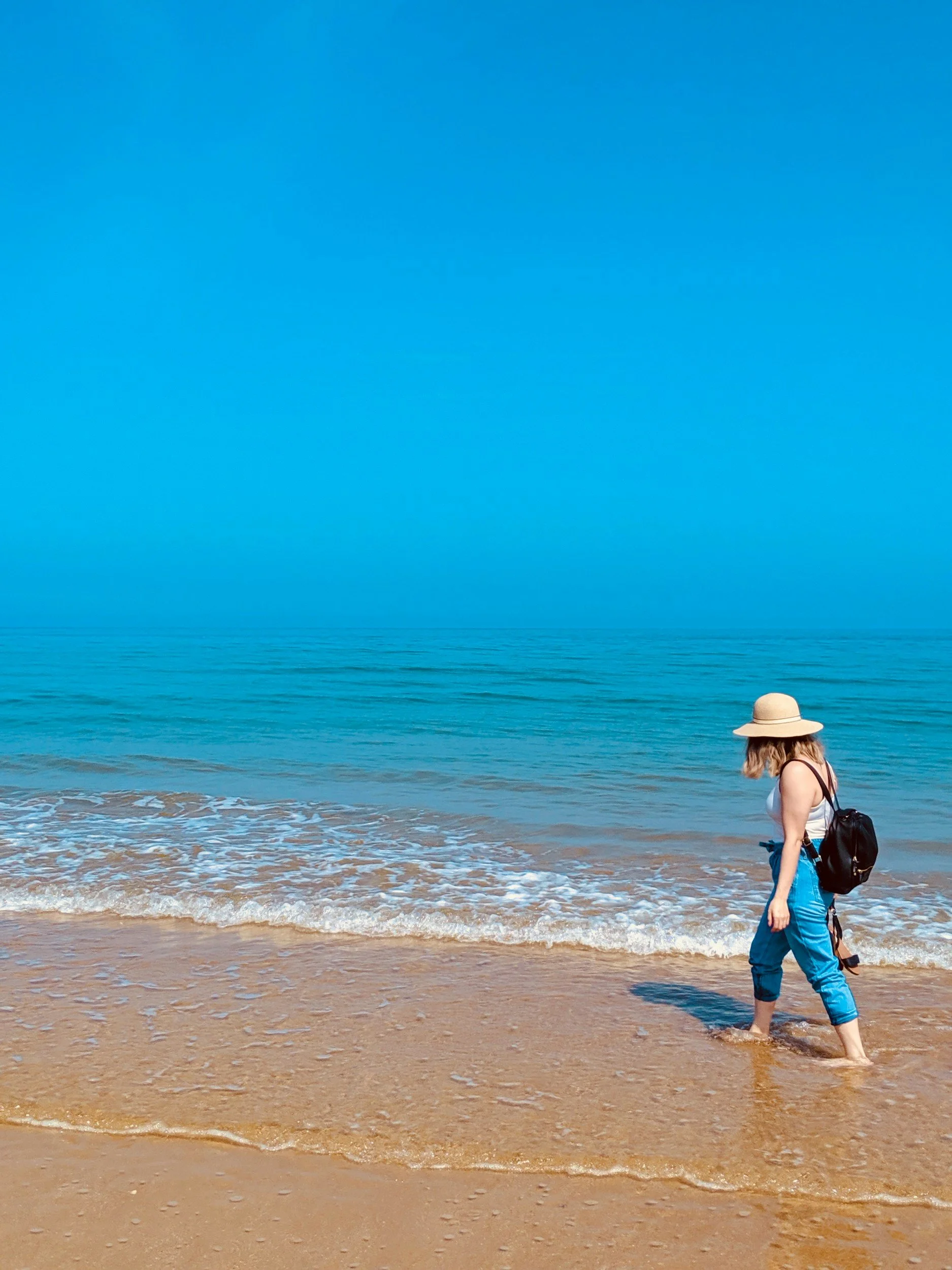
How sun and heat shift around Talloires and the east side of the lake
Early summer weather around Lake Annecy can shift between warm, bright days and cloudier periods with mountain showers. The lake and surrounding slopes also mean the day can feel different depending on where you are. On the east side, Talloires has easy access to water, wooded paths and higher ground, which helps when the afternoon gets warm.
The practical detail is timing!Walks with uphill sections are better in the morning, especially if you are heading towards steeper routes or exposed viewpoints. Swimming and lake time can sit later in the day when the water feels more inviting. Annecy visits are also better early or late because the centre can feel crowded and hot in the middle of the day.
Pack for variation rather than assuming one version of summer. A light layer for evenings, shoes that can handle paths, swimwear, sunglasses and something for sudden rain all make sense. If you are staying several days, leave space in the plan rather than fixing every activity to a specific day. The lake is much easier to enjoy when you can move a walk, swim or Annecy visit depending on weather.
You’ll probably notice that in smaller parts of France, markets shape the day more than anything else. If you’re curious how that actually works in practice, this guide to brocantes and vide-greniers across France explains it in a way that’s easy to use while travelling.
What mornings feel like in Talloires compared to Annecy

Quiet lake access before day visitors arrive
If you’re staying near the bay in Talloires, your morning usually starts the same way. You leave your room, walk a few minutes down towards Port de Talloires, and you’re already at the water without needing to cross through anything busy. From most lakeside hotels or guesthouses, it’s a 2–5 minute walk to Plage Municipale or the smaller access points just past the harbour.
At around 7:30–9:00 in early summer, the lake is still relatively calm. You’ll see a few people swimming, some hotel guests coming down with towels, and staff setting up breakfast terraces. If you walk past the main beach towards Angon, there are small spots where people slip into the water without staying long. It’s not organised beach time. People go in, dry off, and head back.
The practical part is what makes it work. You don’t need to plan it. You don’t need to pack a full bag or commit to staying out for hours. If the water feels cold, you leave. If it’s good, you stay a bit longer. Then you walk back, shower properly, and have breakfast. That loop can take less than an hour if you want it to.
From places like Abbaye de Talloires or Auberge du Père Bise, you’re directly on that stretch, so it becomes part of the routine rather than something you plan around. Even if you’re slightly further back, you’re still close enough that going to the lake doesn’t feel like starting your day properly. It’s just something you do before breakfast.
In Annecy, it’s different even at the same time of day. If you’re staying near the old town, you step out into streets that are already being used. Delivery vans, people heading to cafés, early market setups on certain days, and visitors walking towards the canals. To reach the lake, you usually walk 10–15 minutes through that area, often towards Jardins de l’Europe or the main lakefront.
Swimming from Annecy is also less immediate. The closest areas near the centre are not where most people choose to go in, so you either walk further out, find a designated swimming spot, or plan it as part of a longer outing. It’s something you decide to do, not something you do on the way to breakfast.
That’s the difference in the morning. In Talloires, the lake sits inside your routine. You go down, check it, maybe swim, and come back. In Annecy, the morning starts in town first, and the lake comes after.
Where people actually get coffee near the water
Coffee in Talloires is not something you build a whole morning around, and it helps to know that before you arrive. There isn’t a strip of cafés like you’ll find in Annecy around Rue Sainte-Claire or along the canals. Most mornings, people either have breakfast at their hotel or keep it simple near the lake.
If you’re staying somewhere like Abbaye de Talloires or Auberge du Père Bise, you’ll likely end up having coffee on-site, either as part of breakfast or on the terrace afterwards. These places open earlier than standalone restaurants and are already set up for guests by 7:30–8:00, which is why they become the default without much thought.
For something more casual, people tend to stop near the harbour area around Port de Talloires. There are a few spots where you can sit outside with a coffee and look out over the water, but opening hours are not always early, especially outside peak season. It’s common to arrive thinking you’ll grab a quick coffee by the lake at 8:00 and realise most places are still setting up.
What usually ends up happening is a mix of routines. Some people go down for a swim first, then come back and have coffee at their hotel. Others have breakfast first, then walk down with a takeaway or sit somewhere once places open properly. It’s not a place where you move between three different cafés in one morning. You pick one spot and stay there.
If you want a proper café-style morning with more choice, that’s when Annecy makes more sense. In Talloires, coffee is part of a slower routine rather than the focus… You’re usually drinking it because you’re already near the water, not because you’re looking for a specific café to try.
What it’s like waking up in Talloires vs staying in Annecy
In Talloires, mornings start quietly and stay that way for longer than people expect. If you’re near the bay, the main sounds are fairly predictable. You’ll hear water moving against the edge near Port de Talloires, a few cars passing on the lake road, cutlery from hotel terraces being set up, and people walking down towards Plage Municipale with towels. There’s movement, but it’s contained to a small area and it builds slowly.
Around 8:00–9:30, most of the activity sits between the harbour, the beach, and the handful of hotels along the water like Abbaye de Talloires and Auberge du Père Bise. People are either swimming, having breakfast, or heading out for a short walk towards Angon. You’re not dealing with groups moving through, and there isn’t a steady stream of new arrivals every few minutes. Even when it gets busier later in the morning, it still feels like everyone is using the same few spaces rather than spreading out across a town.
By contrast, Annecy has multiple layers of movement from early on. If you’re staying anywhere near the old town, you’ll hear delivery vans coming in, people rolling suitcases over cobbled streets, café terraces opening, and early visitors already heading towards the canals. On market days, the setup starts even earlier, and the streets around Rue Sainte-Claire and the old town begin filling quickly.
The difference isn’t just volume, it’s direction. In Annecy, people are constantly passing through. They’re arriving from the station, moving between the old town and the lake, joining tours, or heading out again. Even if you’re sitting still, there’s a steady flow around you. In Talloires, most people you see are staying nearby, so the movement loops rather than passes through. You’ll notice the same people at the beach, later at lunch, and again in the evening.
This changes how the day feels without you needing to plan for it. In Talloires, you can stay in one area for a few hours without feeling like you’re missing something elsewhere. In Annecy, it’s harder to ignore the sense that everything is happening in different parts of town at once, and that you need to keep moving to experience it.
If you like how compact Talloires is but want a completely different setting next, small villages in Provence have a similar scale but feel quite different. Moustiers-Sainte-Marie in spring is a good example of that shift.
Getting around from Talloires without a car
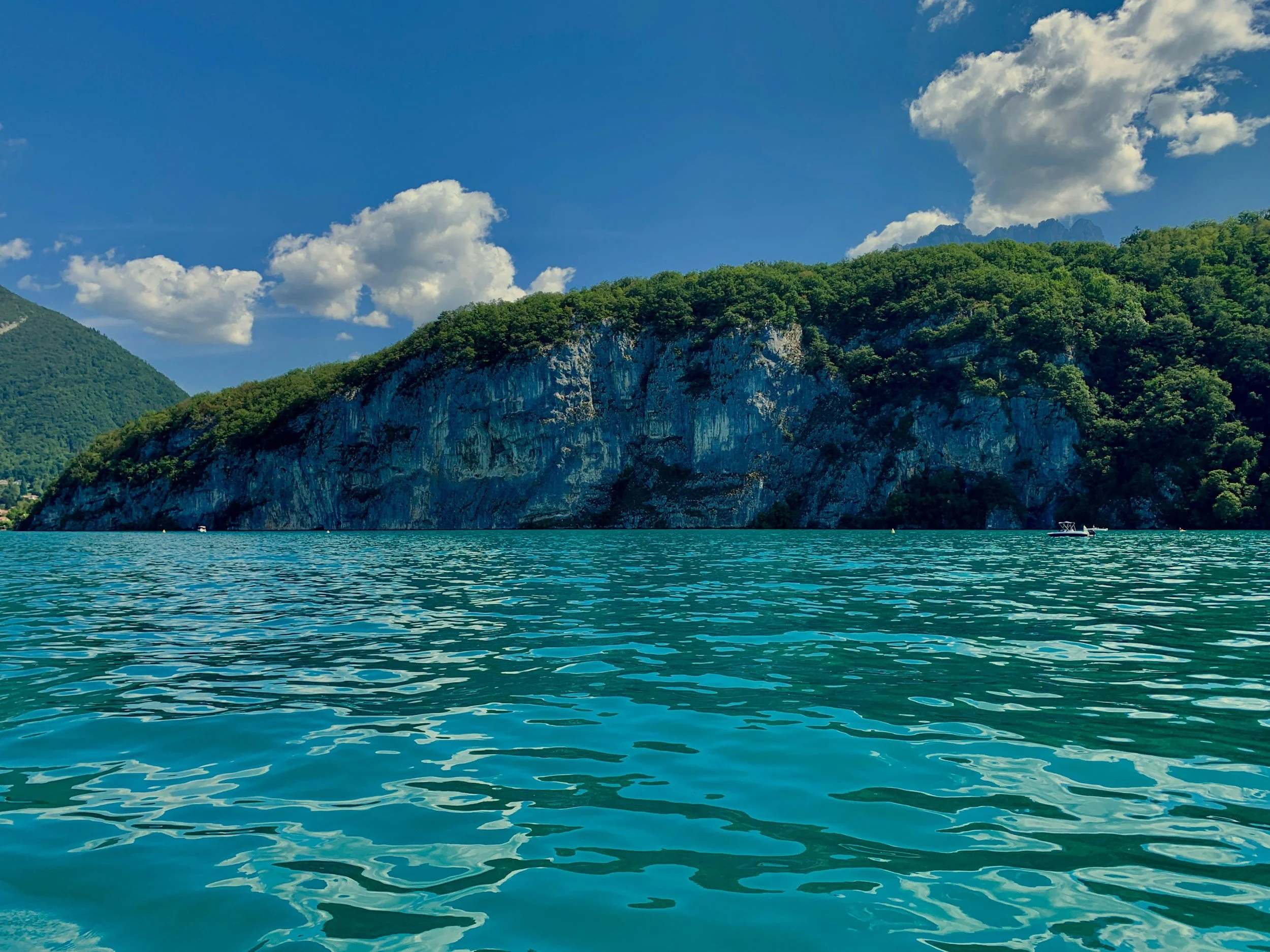
Bus routes along the east side of Lake Annecy and how often they run
Staying in Talloires without a car is possible, but it is not the same as staying in Annecy without a car. In Annecy, transport begins at the station and many things are walkable from there. In Talloires, you need to think in lake-shore movements: bus to Annecy, bus to nearby villages, taxi for awkward times, walking for short local routes, and possibly boat connections when the season and schedule make sense.
So, getting around from Talloires without a car is definitely manageable, but it only works well if you treat it as something to plan lightly rather than ignore completely. The main connection you’ll use is the bus running along the east side of Lake Annecy, linking Talloires with places like Menthon-Saint-Bernard, Veyrier-du-Lac, and Annecy.
The stop you’ll most likely use sits along the main lake road (D909A), a short walk from the bay if you’re staying near Port de Talloires or Plage Municipale. From there, buses head towards Annecy in one direction and towards Talloires-Montmin and nearby villages in the other. The ride into Annecy usually takes around 25–30 minutes, depending on traffic and how many stops it makes along the way.
During early summer, you can expect buses roughly every 30–60 minutes during the middle of the day, but that spacing isn’t consistent from morning to evening. Early departures are fewer, and late evening options drop off quickly. If you’re planning to go into Annecy, it’s much easier to aim for a morning bus, spend a few hours there, and return mid-afternoon rather than trying to stretch the day too late.
The stops themselves are simple. There’s no large station or covered waiting area in Talloires, just marked roadside stops where people gather a few minutes before the bus arrives. It’s worth arriving a bit early, especially in June when buses can fill up quickly on busy days. If it’s full, you may end up waiting for the next one, which isn’t ideal if you’ve planned something specific.
For short trips, the bus works well. Going to Menthon-Saint-Bernard for a walk near the château or heading into Annecy for a market morning are both straightforward. It’s less useful if you try to build a full day around multiple connections. Talloires works better when you keep movement simple and use the bus for one clear purpose rather than as a constant way of getting around.
Evenings are where you need to be more careful. If you go into Annecy for dinner and plan to return by bus, check the last departure before you go. It’s easy to assume there will be something later and then realise the final bus leaves earlier than expected. For a more relaxed trip, it’s usually easier to keep dinners near Talloires and use Annecy during the day.
Within Talloires itself, you won’t need transport if you’re staying near the bay. Walking covers most of what you’ll do locally. The bus becomes relevant only when you decide to leave that immediate area. That’s why it works here without a car, but it doesn’t feel as effortless as staying in a town built around a train station. You can get around, but you’re choosing when to move rather than doing it constantly.
Biking sections of the lake and where it’s easy vs awkward
Cycling around Lake Annecy is one of the easiest ways to cover distance, but from Talloires it’s not as straightforward as it looks on a map. The full loop around the lake is popular, but the experience depends a lot on which side you’re on, and the east side where Talloires sits requires a bit more attention.
If you’re staying near the bay, most rentals can be arranged locally or in Annecy before you head over. An e-bike is usually the better choice here, even for short distances, because it makes the small climbs and road sections much easier, especially in early summer heat.
The section from Talloires towards Menthon-Saint-Bernard is one of the more manageable rides on this side. It’s not completely separated from traffic, but it’s relatively short and commonly used. If you leave early in the morning, before the road gets busier, it’s a good way to reach Menthon, stop near the lake, and either continue a bit further or return at your own pace.
Between Talloires and Annecy, cycling becomes more mixed. You’ll pass through Veyrier-du-Lac, and while parts of the route have cycling infrastructure, other sections bring you closer to the road. It’s not difficult if you’re used to riding, but it’s not a completely relaxed, uninterrupted lakeside path either. Traffic increases as you get closer to Annecy, especially late morning and afternoon.
The west side of the lake, on the opposite shore, is where cycling feels easier and more continuous. There’s a well-known dedicated path that runs along much of that side, with fewer interruptions and less interaction with cars. Many people staying in Talloires choose to bike a short section on the east side, then take a boat or bus and continue riding on the west side instead of committing to the full loop from Talloires.
Shorter rides tend to work better than trying to do everything in one go. Going from Talloires to Menthon-Saint-Bernard, or exploring small stretches along the lake in the morning, feels manageable and enjoyable. Trying to cycle all the way to Annecy and back in the middle of the day, especially in June heat, can feel longer than expected.
The main thing is timing. Start early, bring water, and avoid the busiest hours if you’re on shared road sections.
Boat connections across the lake and when they’re useful
Boats on Lake Annecy are easy to overlook when you’re planning the trip, but once you’re in Talloires they start to make more sense, especially if you don’t have a car and don’t want to rely only on the bus.
From Port de Talloires, seasonal boats run across the lake towards Annecy and sometimes between smaller stops depending on the time of year. The exact timetable changes between late May and June, so it’s worth checking locally when you arrive rather than relying on a schedule you saw earlier. In early summer, you’ll usually have a few departures during the day, but they’re spaced out rather than frequent.
Using the boat to reach Annecy works well if you want to avoid the road entirely. The crossing takes longer than a direct bus or taxi, but it’s more relaxed, and you arrive directly at the lakefront rather than near the station. It makes sense for a morning or midday trip where timing isn’t tight. You can leave Talloires, spend a few hours in Annecy, and return in the afternoon without needing to deal with traffic.
Where boats are less useful is in the evening. Late departures are limited, so they’re not a reliable option for getting back after dinner. If you plan to stay in Annecy into the evening, you’ll likely need to return by bus or taxi instead.
For shorter distances, boats can sometimes connect Talloires with nearby places along the lake, but these are more seasonal and less consistent than the Annecy route. It’s better to think of the boat as a way to cross the lake once during your stay rather than something you’ll use repeatedly to move between villages.
In practice, most people use it once. Either as a way to reach Annecy without using the road, or as a simple half-day plan where the journey itself is part of the day. It works best when you’re not trying to fit it into a tight schedule. If you have a fixed reservation or a strict return time, the bus is more predictable. The boat is for the days when you have time to move more loosely and don’t mind planning around a set departure.
Walking routes and short hikes directly from Talloires
From Talloires, anything heading towards Col de la Forclaz means going uphill straight from the lake. There isn’t a gentle lead-in. If you start near Port de Talloires or Plage Municipale, you’re basically at water level, and within a few minutes the road begins to climb.
The most direct way up follows the road out of the village towards Montmin. It’s paved, easy to follow, and used by both cars and cyclists. There are sections with some shade early on, especially as you leave the immediate lakeside, but it opens up quickly and becomes more exposed as you gain height. In early summer, that matters. By late morning, the sun is already strong on the exposed parts, and there isn’t much cover once you’re higher up.
If you’re walking it, timing is the main decision. Starting around 7:30–8:30 makes a big difference. You avoid most of the traffic, the air is cooler, and the climb feels manageable. Starting closer to midday turns it into a much harder effort, especially if you’re not used to sustained uphill walking. It’s not a technical hike, but it is steady, and it doesn’t really ease off until you reach higher ground.
There are smaller paths that branch off the road in places, cutting through wooded sections, but they don’t remove the climb. They just change the surface and give you a bit more shade for parts of the route. It’s worth asking locally which paths are in good condition if you want to avoid the road for sections, but most first-time visitors stick to the main route because it’s simpler to follow.
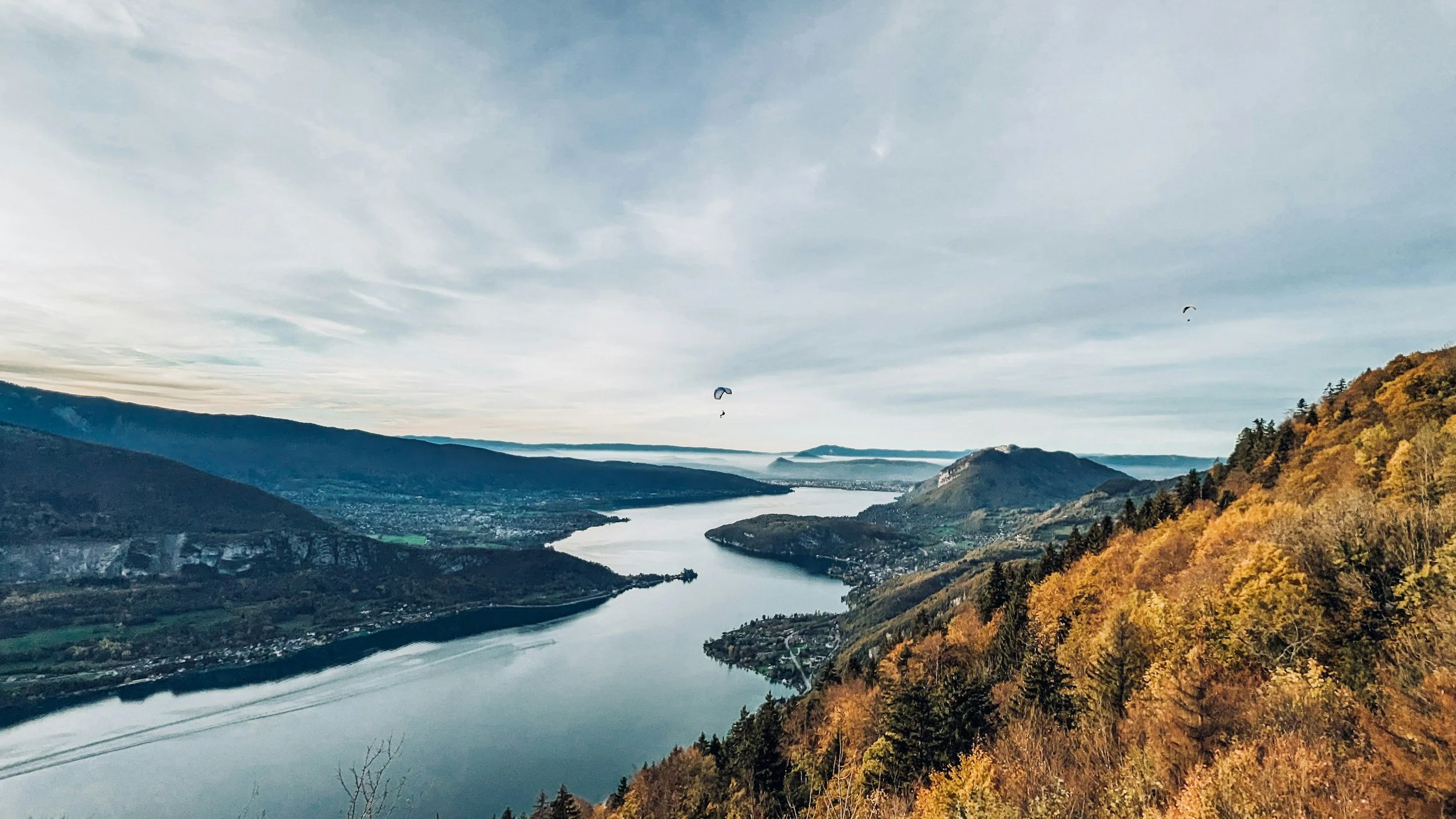
As you get higher, the views open up across Lake Annecy, with Talloires and the bay clearly visible below. The take-off area near the top, where paragliders launch, is one of the most recognisable spots. On clear days, there are usually several gliders in the air, and the viewpoint gives a wide look back across the lake towards Annecy.
Most people don’t walk the entire way from the lake unless they specifically want a longer climb. A more practical option is to combine transport and walking. Taking a taxi part of the way up and then walking a section near the top, or walking up for a while and turning back once the heat builds, often works better than committing to the full ascent.
Coming down is easier physically, but it still takes time and can feel long on your knees, especially on the paved road. If you’ve gone all the way up, it’s worth considering how you want to return before you start. Walking both ways is possible, but it turns into a proper half-day effort rather than a short outing.
This is not a quick add-on to a lake day. It’s the main plan for the morning if you choose to do it. If you want something lighter, the lakeside walks towards Angon or Menthon-Saint-Bernard are much easier to fit into the day without needing the same level of timing and effort.
Lakeside walks towards Menthon-Saint-Bernard
Walking from Talloires towards Menthon-Saint-Bernard works best when you treat it as a half-day outing rather than a quick stroll. The distance is roughly 4–5 kilometres depending on where you start, and while it follows the lake, it isn’t one continuous pedestrian path the whole way. You’ll move between sections of pavement, quieter stretches by the water, and parts of the road where you need to pay attention to cars and cyclists.
If you start near Port de Talloires or Plage Municipale, the first part is easy. You’re already at lake level, and the route heading out of the bay gives you open views back towards Talloires with the cliffs rising behind it. Early in the morning is the best time to do this, before traffic builds and before the sun hits the more exposed sections.
As you continue towards Menthon-Saint-Bernard, the walk becomes less about one defined path and more about following the shoreline where possible. There are small access points along the way where people stop for a short swim or sit by the water for a break. These aren’t organised beaches, more like informal spots where you can step down to the lake, stay for a while, then keep going.
Closer to Menthon, you’ll start seeing more residential areas, boats moored along the shore, and glimpses of the château above the village. Château de Menthon-Saint-Bernard is visible from several points as you approach, sitting above the lake on the hillside. Most people don’t walk all the way up to it, but it’s a clear marker that you’ve reached the village.
Once you’re there, it’s easy to stop for lunch near the water or take a short break before deciding how to return. Walking back is possible if the weather is comfortable and you’re not in a rush, but many people take the bus back to Talloires from the main road through the village. That combination works well. You get the movement of the walk without needing to repeat it in the heat of the afternoon.
Choosing between forest paths and exposed viewpoints in early summer
Around Talloires, the main decision with walks isn’t distance, it’s whether you’re in the trees or out in the open. That choice changes how the whole outing feels, especially from late May into June when the middle of the day can already be warm.
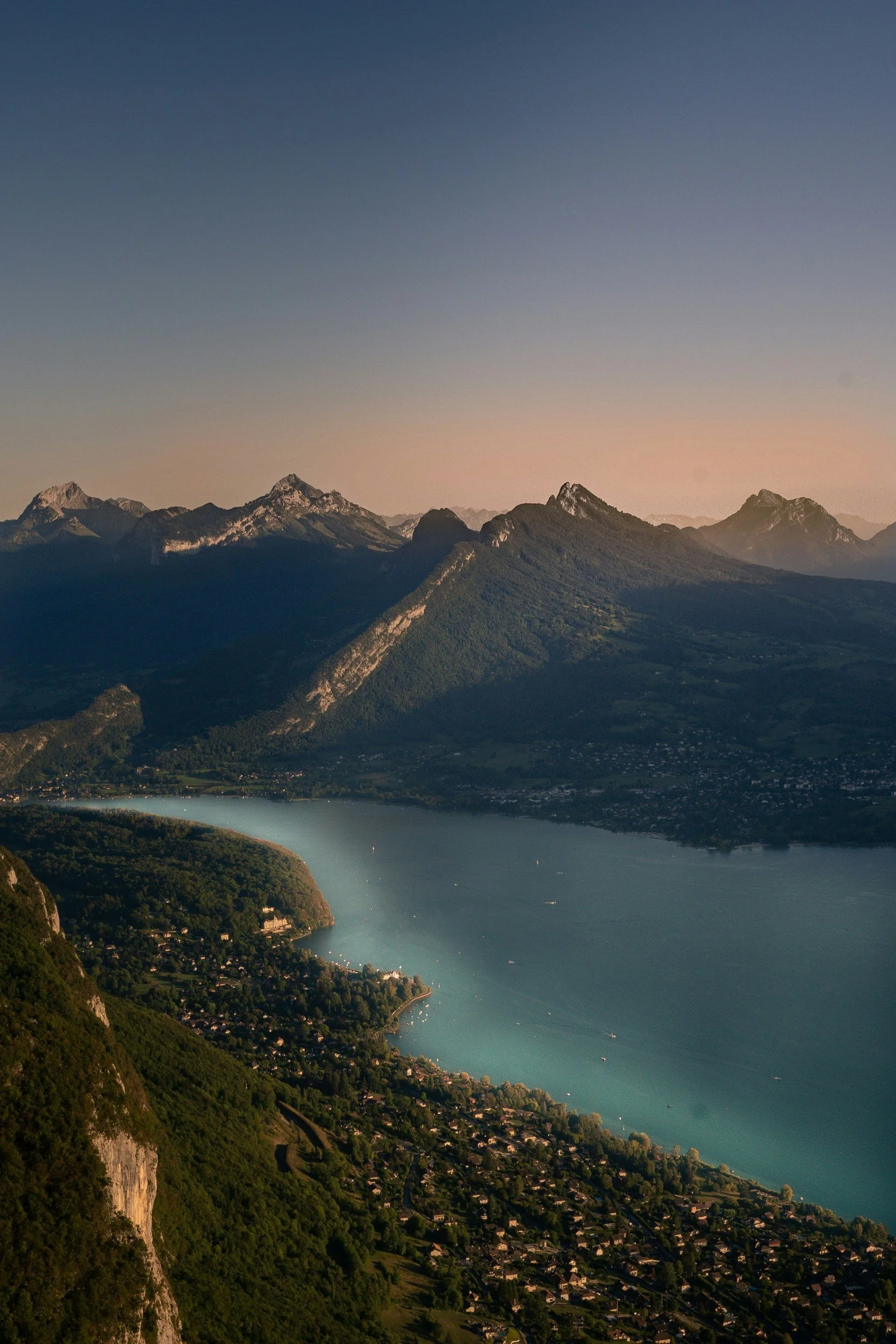
If you head up from the village towards Montmin or in the direction of Col de la Forclaz, you’ll notice quickly where the shade disappears. The lower sections can have some tree cover, but as you gain height the paths and road open up. The views over the lake are wide and clear, but there’s very little protection from the sun. By late morning, these sections can feel much hotter than expected, even if the temperature doesn’t seem high when you start.
Forest paths are the easier option on those warmer days. There are smaller trails above Talloires that cut through wooded areas before opening up in places, and these are much more comfortable if you’re walking between 10:00 and 15:00. The ground is uneven in parts, with roots and loose sections, but the shade makes a big difference. You can walk for longer without needing to stop constantly or carry as much water.
A simple way to plan it is to match the route to the time of day. If you want to go up towards a viewpoint, do it early when the sun is still low and the air is cooler. If you’re heading out later, stay closer to the lake or choose paths that stay under tree cover. The lakeside stretch towards Angon, for example, gives you a mix of light shade and access to the water, which makes it easier to stop and cool down if needed.
It’s also worth thinking about the return. An exposed viewpoint can feel manageable on the way up early in the day, but coming back down in full sun is different. Forest paths are more forgiving both ways, especially if you’re planning to walk for a couple of hours rather than just a short loop.
You don’t need to choose one type for the entire stay. Most people end up doing a mix. One morning for a higher viewpoint when the conditions are right, and another for a shaded walk where the goal is simply to move a bit without turning it into a full hike.
Talloires is not just a pretty lake village. It gives access to the kind of compact outdoor routine that makes places like Lake Orta in early spring useful comparisons for those who like lake towns but do not want the most obvious base every time.
Eating and evenings in Talloires vs Annecy
Lunch in Talloires tends to happen without much planning, but the location matters more than people expect. By the time you’re thinking about food, you’re usually already near the water again, somewhere between Port de Talloires and Plage Municipale, and that’s where most people end up staying.
The bay is small, so everything concentrates quickly. You have the harbour on one side, the main beach just next to it, and then the line of hotels and restaurants facing the lake. Once you’ve walked that stretch once or twice, you’ll recognise it immediately, and most lunches happen within that same loop.
Auberge du Père Bise is the place people actively plan for. Tables sit right on the edge of the lake, and on a clear day you’re looking straight across the water with boats moving slowly in and out of the bay. It’s not a quick lunch stop. People book, arrive on time, and stay for a proper meal. By 12:30–13:00 in June, it’s usually full, and you won’t get a table without planning ahead. If you want to eat there, it’s better to decide early in the day or even the day before.
A short walk away, Abbaye de Talloires works a bit differently. The terrace and garden give you more space, so it doesn’t feel as tightly packed as the front-row lake tables. You still get the same setting, but it’s slightly more forgiving if you arrive closer to lunchtime rather than right at opening. It’s also easier if you’re not looking for a long, formal meal but still want to sit properly and take your time.
Then there’s the more informal version, which is what a lot of people end up doing without thinking about it. After a swim, people walk up from Plage Municipale, still a bit damp, throw something light on, and sit down at one of the nearby terraces without making it into an event. You’ll see people ordering something simple, maybe sharing a plate, having a drink, and staying for a while because there’s nowhere else they need to be.
The practical detail that catches people off guard is how slowly tables turn. Once someone sits down near the water, they usually stay. It’s not like Annecy where you might see tables constantly freeing up. Here, if you arrive at 13:30 without a reservation, you’re often waiting or settling for a table further back from the lake.
Timing makes a big difference. Around 11:45–12:15, you can usually sit where you want without much effort. Between 12:30 and 14:00, it becomes much more fixed. Either you’ve planned it, or you work around what’s available.
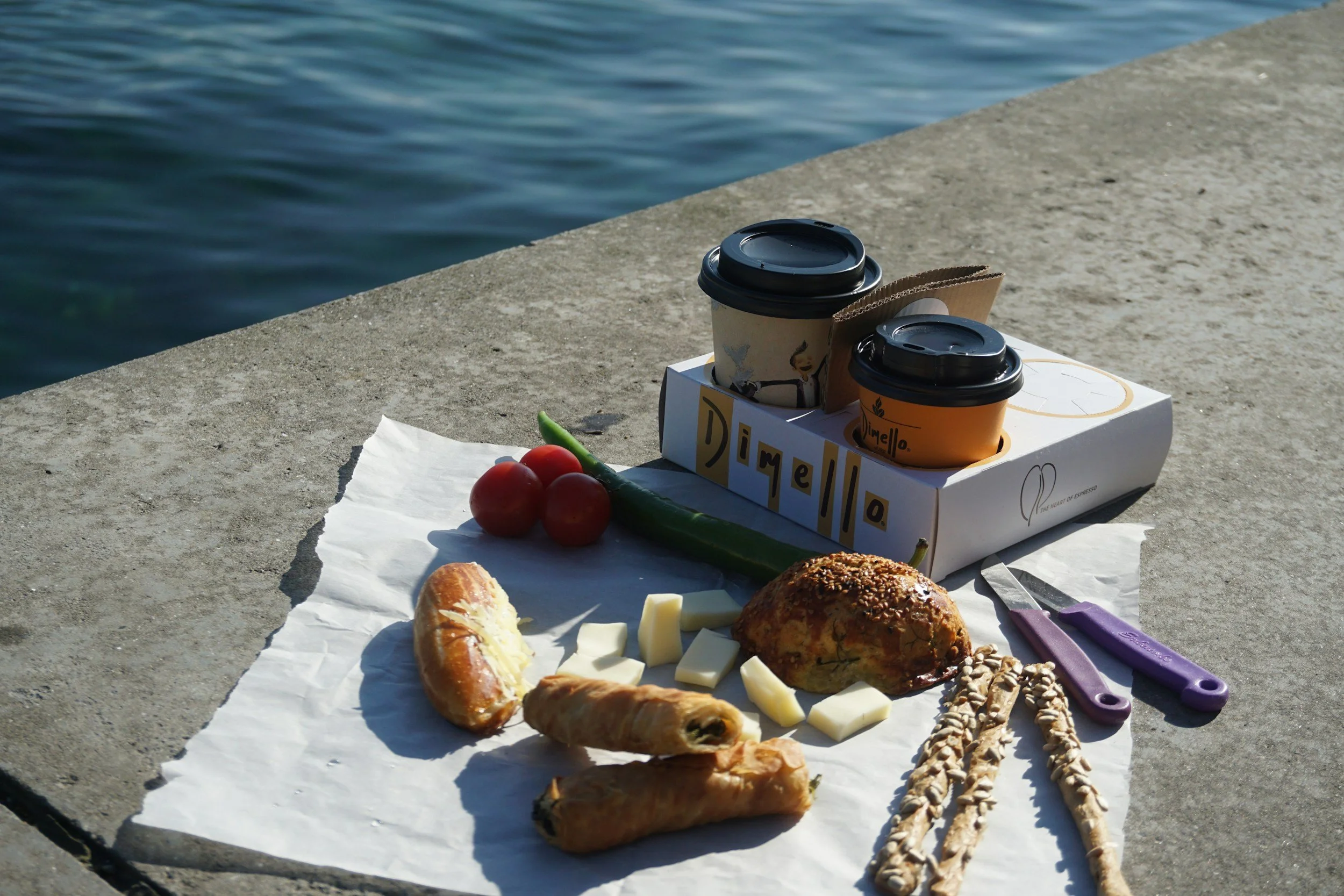
There’s also a quieter way to handle lunch if you don’t want to deal with any of that. A lot of people bring food down with them, especially if they’ve been through Annecy earlier in the trip. Bread, cheese, fruit, something simple, and then they sit near the water instead of booking a table. Around Plage Municipale, you’ll see people spread out on the grass or along the edges of the lake, eating slowly and going back into the water afterwards. It’s less structured, and it fits better if your day is already centred around swimming.
If you walk away from the bay towards Angon, the whole setup changes. There are fewer places to sit down for a proper meal, and more small access points where people stop briefly, eat something they’ve brought, and keep moving. It’s quieter, but you’re giving up the ease of having everything in one place.
Compared to Annecy, the difference is clear once you’ve done both. In Annecy, you might walk along Rue Sainte-Claire, check a few menus, sit somewhere, and then move on again later. There’s always another street, another café, another option if something doesn’t feel right.
In Talloires, you don’t really move around like that. You arrive at the lake, you pick a spot nearby, and you stay there. Lunch becomes part of the same place you’ve already been using all morning. It’s less flexible, but once you adjust to it, it feels much easier.
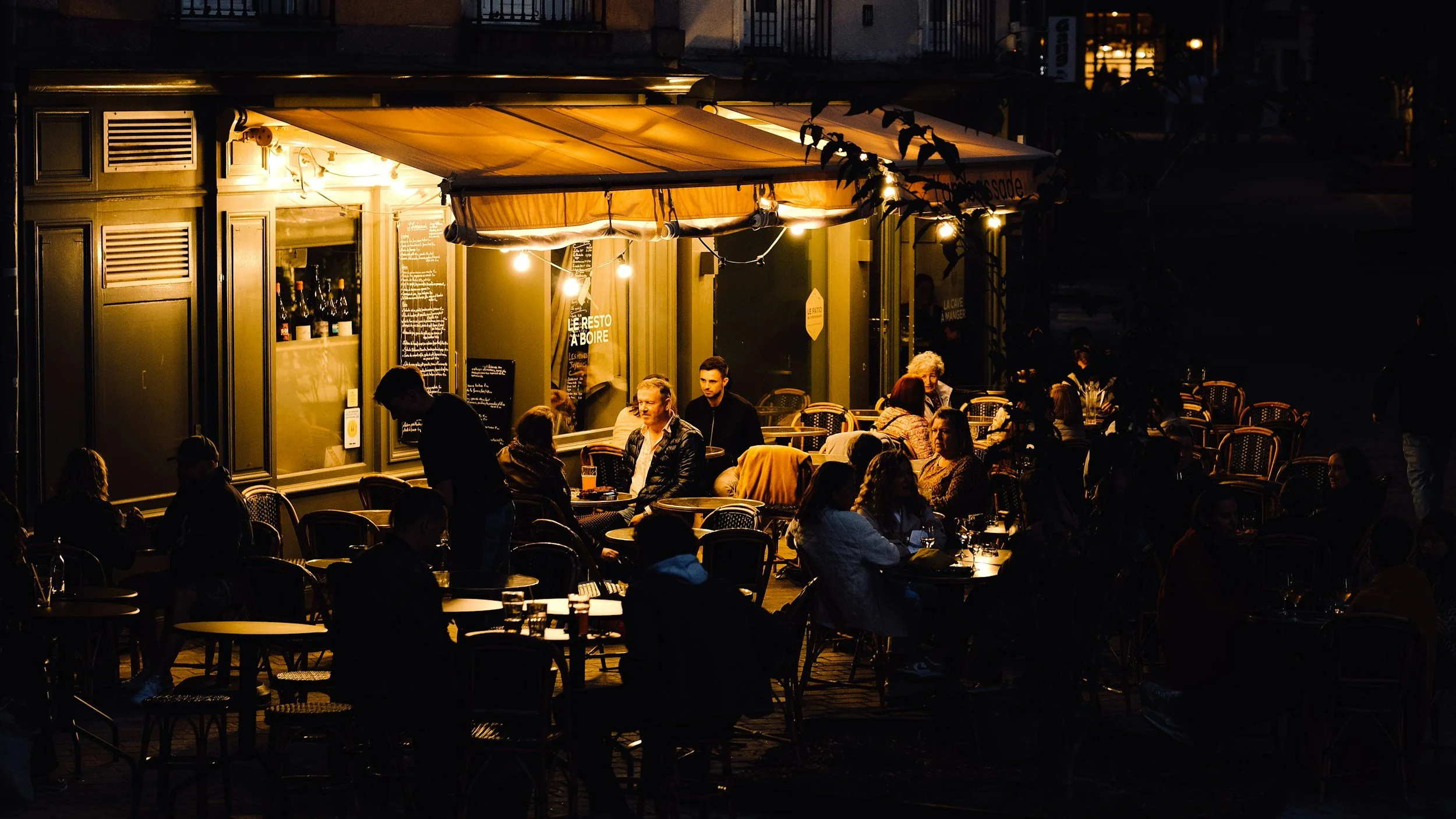
In case you’re planning a France trip around food markets and smaller places, Talloires will not replace a market town, but it pairs well with that style of travel. A few lake days here could easily sit beside a more market-focused route like summer markets in France, especially if the trip is about choosing places with a local feeling (and charming cobblestone streets).
How evenings actually unfold in Talloires vs Annecy
In Talloires, the evening starts as the lake day winds down rather than building into something new. Around 17:30–18:30, people come back from Plage Municipale, the small access points past the harbour, or the path towards Angon. You’ll see towels over balconies, windows open, and people moving slowly back through the same short stretch between the lake and their hotel.
If you’re staying near Port de Talloires, everything happens within a few minutes’ walk. From most places along the bay, you step out, follow the lakeside road, pass the harbour where small boats are moored, and reach the restaurants without needing to think about directions or distance. It’s the same route you’ve already used earlier in the day, which is why the evening feels connected to everything that came before.
Dinner usually starts earlier than in Annecy. Around 18:45–19:30, tables begin to fill, especially at places closest to the water like Auberge du Père Bise and Abbaye de Talloires. If you want a table directly facing the lake, it’s worth arriving on the earlier side or booking ahead, particularly on Fridays and Saturdays in June. By 20:00, most of the front-row tables are already taken, and what’s left tends to be set slightly further back.
Once people sit down, they stay. You won’t see much turnover, and you won’t see people moving between places afterwards. A table is taken for the evening, not just for the meal. Courses come out steadily, and the view remains the same the entire time, with the lake directly in front of you and the opposite shore gradually changing as the light shifts.
Between 20:30 and 21:00, there’s a short window where the area around the harbour becomes slightly busier again. People who have finished dinner step out, walk along the edge of the lake, or pause near the small docks where the water reflects the lights from the restaurants. You’ll often see a few people sitting briefly along the edge, looking back across the bay rather than heading anywhere specific.
After that, it settles quickly. By around 21:30–22:00, the movement drops off. The main road along the lake (D909A) becomes quieter, and the bay feels noticeably calmer than it did an hour earlier. If you walk back to your hotel at that point, you’re usually following a near-empty path past the same stretch of water you’ve seen all day, just with less noise and fewer people around.
Annecy works differently from the same starting point. Dinner can begin later, and even after eating, people keep moving. From the old town, you can walk along Rue Sainte-Claire, cross over the canals, and continue towards the lakefront near Jardins de l’Europe. There are more places open later, more light, and a steady flow of people arriving even into the evening. You don’t return immediately unless you choose to.
That difference shows up in small details. In Annecy, you might finish dinner and decide to walk further, stop somewhere else, or just stay out because there’s still activity around you. In Talloires, once dinner is done, most people take a short walk near the harbour and then head back. The evening closes naturally without needing a second plan.
When Annecy still fits into the trip without staying there
Going early morning or late evening instead of midday
From Talloires, Annecy works best as a short, timed visit rather than something you drift into in the middle of the day. The distance is small, but the difference in how busy it feels depends almost entirely on when you go.
Early morning is the easiest window. If you take one of the first buses from Talloires or go by taxi before 9:00, you arrive while the old town is still setting up. Around Rue Sainte-Claire and the canal streets, cafés are opening, deliveries are finishing, and the first visitors are just starting to move through. You can walk along the canals, cross towards Quai de l’Île, and continue out to the lakefront near Jardins de l’Europe without needing to slow down constantly.
If you’re there on a market day, this is when it works best. By around 8:30–10:00, the stalls are set up and active, but it hasn’t reached peak density yet. You can move between cheese, fruit, bread and local produce stands without it turning into a slow, crowded loop. Later in the morning, especially closer to midday, the same streets become much harder to navigate.
Late evening is the other option, but it works differently. If you arrive in Annecy after 19:30–20:00, most of the day visitors have already left, and the pace shifts slightly. The canals are still busy, but it’s more spread out, and you can walk through the old town without the same pressure as midday. Restaurants are full, but the movement between them is calmer.
The part to think about is the return. From Talloires, late buses are limited, so if you go into Annecy in the evening, you’ll likely need to check the last connection carefully or plan for a taxi back along the lake road. That’s why many people use Annecy for a morning instead. It’s easier to control, and you don’t need to think about getting back late.
Midday is the least comfortable time to go, especially in early summer. Between around 11:30 and 16:00, the centre fills quickly. The streets around the canals, the lakefront paths, and the main crossings all become more congested, and simple things like finding a place to sit or moving between streets take longer than expected. If you do go at that time, it helps to have a specific plan rather than wandering without direction.
From Talloires, the best approach is to treat Annecy as a focused visit. Go early for the market and a walk, or go later for a shorter evening loop if your return is sorted. The rest of the time, it’s usually better to stay on the east side of the lake where everything is already easier to access.
Which parts of Annecy are still worth seeing
If you’re coming in from Talloires, it’s worth keeping the visit tight and focusing on a few areas that actually make sense to walk through rather than trying to cover everything. Annecy looks bigger on a map than it feels once you’re in the old town, and most of what people come for sits within a fairly compact loop.
Start in the old town around Rue Sainte-Claire, but don’t stay only on that street. It’s the busiest part and fills quickly. Instead, move through the smaller lanes that run parallel and connect back towards the canals. Streets like Rue du Pont Morens and the area around Quai de l’Île give you the same setting but with a bit more space, especially before mid-morning.
This is also where you’ll pass Palais de l’Isle, the small building sitting in the canal that most people recognise from photos. It’s worth seeing once, but it’s also one of the main pinch points later in the day, so it’s better to pass through earlier rather than stopping too long there.
From there, it’s a natural walk out towards the lake. The transition happens quickly. Within a few minutes, you’re at Jardins de l’Europe, which is where people spread out a bit more. There are shaded paths, benches, and open views across the lake. Just beyond that is Pont des Amours, which gets crowded but is still worth crossing once for the view back towards the mountains and along the lake.
If you continue past the bridge, follow the lake rather than turning straight back. Even walking 10–15 minutes in either direction makes a noticeable difference. The path opens up, there’s more space to sit, and you’re no longer moving at the same pace as the main crowd.
For coffee or a short break, step slightly away from the busiest canal streets. Places just outside the tight centre are easier to manage and don’t require waiting. Near the canals, Le Sarto is a simple stop that works if you want something quick without committing to a long meal, while Café Bunna is slightly removed from the busiest flow and easier to sit down at earlier in the day.
If you’re there on a market day, focus on the area around Rue Sainte-Claire and the adjoining streets, but go early. Around 8:30–10:00 is when it works best. You can move between stalls selling cheese, bread, fruit and local products without being pushed along. After that, it becomes much more crowded, and it’s harder to stop properly.
Another small adjustment that helps is crossing the canals and looping back rather than staying on one side. Moving between both sides of the old town gives you a bit more variation without needing to walk far. You’ll still see the same core areas, but from slightly different angles and with a bit more space.
You don’t need to go much further than this on a short visit. Annecy has more streets, more shops and more places to stop, but for a few hours coming from Talloires, the canals, the lakefront, and one or two quieter side streets are enough. Once you’ve done that loop, it usually makes more sense to head back towards the lake rather than trying to extend the visit just to cover more ground.

Market days and how busy they get in June
The market in Annecy runs right through the old town streets, mainly around Rue Sainte-Claire and the narrow lanes leading towards the canals. It’s not a big open square where you can move freely. It’s tight, a bit uneven underfoot, and once people start arriving, it fills fast.
If you come in early from Talloires, it feels completely different. Around 8:30–9:30, everything is already set up, but people aren’t packed in yet. You can walk slowly, stop where you want, and actually look at things properly. You’ll see locals doing their shop at that time too, picking up bread, cheese, fruit, not just passing through for photos.
It’s also easier to move through the narrower spots then. Around the canal crossings and near Palais de l’Isle, the street gets tight very quickly later on. Early, you can walk straight through, cross the bridge, and keep going without getting stuck.
By around 10:30, it starts to feel different. You’re still in the same place, but the pace changes. People stop more, groups move together, and you end up slowing down whether you want to or not. Trying to stand still at a stall becomes awkward because there’s always someone behind you.
Closer to midday, especially on a sunny Saturday in June, it’s just busy. Not in a dramatic way, but enough that it’s harder to enjoy it properly. You’ll still see everything, but you’re moving with the crowd instead of choosing where to go.
The easiest way to use it from Talloires is to keep it short. Go in early, walk through once, pick up a few things, and leave before it gets too full. Bread, cheese, fruit, something simple you can take with you. It’s much nicer to eat that later by the lake than trying to sit down somewhere in Annecy when everything is at its busiest.
Back in Talloires, you’ll see why that works. Around Plage Municipale or along the quieter spots towards Angon, people sit down with exactly that kind of food and stay there for a while.
If you’re there on a Saturday, just expect everything to happen earlier. By 9:00 it’s already picking up, and by 11:00 it’s properly full.
Annecy isn’t where you go for a quiet market morning, but it works well if you get there early and treat it as a short stop rather than the main plan. If you’re looking for trips built more around the market itself, with more space and a slower pace, take a look at authentic weekly markets in southern France. Those are the kind of places where the market shapes the whole day, not just something you pass through before heading back to the lake.
How many days make sense in Talloires for this kind of trip
Two nights in Talloires is enough to understand the place, but it moves quickly. You arrive sometime in the afternoon, check in, walk down to the lake once, have dinner near the bay, and then you have one full day before leaving again. That one day usually becomes a mix of swimming at Plage Municipale in the morning, a short walk towards Angon or along the lake, and possibly a quick trip into Annecy if you want to see the old town.
It works, but it feels compressed. You’re fitting everything into one good-weather day, and if the weather shifts or your arrival is late, you don’t have much room to adjust. You also still figuring out where things are when it’s already time to leave.
Three nights is where it starts to feel more settled. You get two full days, and that changes how you use the place. One day can stay entirely local. Swim in the morning, take your time with lunch near the lake, walk a bit in the afternoon, and stay in Talloires for dinner without feeling like you should be somewhere else. The other day can be used for Annecy or a short trip to Menthon-Saint-Bernard without trying to combine everything at once.
By the third night, you’re no longer thinking about where to go next. You already know how long it takes to reach the water, where you want to swim, and which route you’ll walk in the evening. The village starts to feel easy rather than new.
Four nights is where Talloires works best if your goal is to spend time by the lake without moving around too much. You can repeat things without it feeling unnecessary. Go back to the same swimming spot, return to the same stretch of lake, or sit in the same place without needing to justify it as something new. You also have space to adjust around the weather. If one day is cloudy or cooler, you haven’t lost half your trip.
It also gives you room to separate things properly. One morning for Annecy and the market, one for a walk towards Angon or Menthon-Saint-Bernard, one for staying completely local, and another where you don’t plan anything at all. You’re not stacking activities into one day just to fit them in.
Beyond four nights, it depends on how you travel. If you like having more variation, you might start to feel the limits of the village, especially in terms of restaurants and different things to do in the evening. If you’re using it as a slower base within a longer trip, though, it can still work, particularly if you’re combining it with nearby areas or using it as a break between more active stops.
If you still want to stay near the water but change the setting completely, the coast gives you a different pace. Something like Cabourg in Normandy works well as a base too, just with the sea instead of the lake.
How to structure your days in Talloires (lake time, walks, and Annecy)
Talloires works best when you stop trying to fit everything into one day and instead let each day have a clear focus. The mistake most people make is combining too much: a morning swim, a walk towards Angon, lunch by the lake, then Annecy in the afternoon. It all looks close on a map, but in practice it turns into a day where you’re constantly moving and never really settling into any one part of the lake.
A better way to use the time is to separate those things.
One day stays entirely local. You go down to Plage Municipale in the morning, swim, come back, have a proper breakfast, and then head out again without leaving the bay. Lunch happens nearby, not planned too tightly, and the afternoon is either another short swim or just staying near the water. That kind of day only works if you don’t add anything else to it. Once you try to include Annecy or a longer walk, it loses that simplicity.
Another day can be for movement. That might be the walk towards Angon, where you take your time, stop along the way, maybe go in the water briefly, and continue when it feels right. Or it could be heading towards Menthon-Saint-Bernard, either fully on foot or partly by bus, then walking back along sections of the lake. That day is about being out for longer, not about fitting in multiple stops.
Annecy usually works best on its own morning. Go early, do the market or the canals, have something to eat, and then come back. Trying to combine Annecy with a full lake day rarely feels as good as keeping it separate. Once you return to Talloires, the pace shifts again, and it’s easier to fall back into the same routine near the water.
What makes this place work is that you can repeat things without it feeling unnecessary. Going back to the same stretch of lake twice in one day, or choosing the same walk again the next morning, doesn’t feel like you’re missing out on something else. That’s why spacing matters. You’re not trying to cover different areas. You’re using the same area properly.
The days end up feeling more balanced that way. One day slower, one day more active, one day partly in Annecy, and one where you don’t really plan anything beyond going down to the water. Trying to combine all of that into each day is what makes the stay feel rushed, even though everything is physically close.
Talloires fits easily into a longer route, especially if you’re moving through this part of France or the Alps. It doesn’t need to carry the whole trip!It works well as the lake part, then you move on to something different. For example, the quieter Bugey area in a Vongnes wine weekend is an easy next step if you want vineyards and small villages after a few days by the water.
When Talloires starts to feel too small (and when it’s just right)
Talloires starts to feel limited when you’re looking for more variation than the village is built to offer. It’s not something that happens suddenly, more that you begin to notice the how the place is functioning. You recognise the same dinner places without needing to check, you realise there isn’t really anywhere to go after eating, and you start thinking about what else you could do the next day rather than just heading back to the lake.
It becomes more noticeable if the weather isn’t great. On a cloudy or cooler day, there aren’t many indoor places to spend a few hours, so you either stay in or go into Annecy for a change of pace. That’s usually when people realise how small the village actually is, especially compared to having a town base.
At the same time, it feels just right when you stop needing variety in the first place. You already know how your morning will start, you don’t need to check distances or look things up, and the day unfolds without much effort. A swim, a short walk, lunch somewhere familiar, and then back near the water later on. Nothing feels repetitive because you’re not trying to make each day different.
For most people, that balance lands somewhere around three to four nights. Less than that and you’re still getting used to the place. More than that can still work, but only if you’re happy keeping things simple and not expecting a new plan every day.
If you’re putting together a longer route through France, it can be nice to balance a place like this with somewhere even quieter afterwards. Parts of central France feel very different, with villages spread out and a slower pace overall, like in quiet villages in Auvergne and Limousin.
FAQ: Visiting Talloires vs Annecy
Is Talloires better than Annecy for a few days by Lake Annecy?
Talloires is usually the better choice if you want to stay close to the water and avoid the busiest parts of the lake. Annecy works better if you want more restaurants, shops, and evening options within walking distance.
Where should you stay on Lake Annecy to avoid crowds?
The east side of the lake, including Talloires and Menthon-Saint-Bernard, is noticeably quieter than staying in Annecy. You’re still close enough to visit the old town, but your base stays calmer throughout the day.
How far is Talloires from Annecy?
Talloires is about 12 km from Annecy. By car or taxi, it takes 20–30 minutes depending on traffic. By bus, it usually takes around 25–30 minutes along the lake road.
Can you stay in Talloires without a car?
Yes, if you plan simple movements. You can walk around the bay area and use buses or taxis to reach Annecy or nearby villages. It’s not as flexible as staying in Annecy, but it works well for a slower trip.
Is Talloires walkable?
Yes, around the bay. Most hotels, the harbour, Plage Municipale, and restaurants are within a 10–15 minute walk. Staying uphill makes walking less convenient, especially after dinner.
How many days should you stay in Talloires?
Three to four nights is ideal. It gives you time to enjoy the lake, take a walk towards Angon or Menthon-Saint-Bernard, and visit Annecy without needing to rush.
Is Talloires too quiet?
It can feel quiet in the evenings, especially after 21:30. There are fewer places open late and no real nightlife. This works well if you want calm evenings, but not if you’re looking for a busy atmosphere.
Can you visit Annecy easily from Talloires?
Yes. It works best as a morning trip. Go early for the market or canals and return before midday crowds. Evening visits are possible but require checking return transport.
When is the best time to visit Lake Annecy in early summer?
Late May to mid June offers good weather, fewer crowds than peak summer, and conditions where swimming is possible on warm days.
Can you swim in Lake Annecy in June?
Yes. The water is still fresh, but many people swim, especially in the afternoon when it’s warmer.
Where are the best swimming spots in Talloires?
Plage Municipale is the easiest access point. Quieter spots can be found walking towards Angon along the lake.
Is Talloires expensive compared to Annecy?
Accommodation and restaurants near the lake can be more expensive than staying slightly outside Annecy. However, you’re paying for direct lake access and a quieter setting.
Are restaurants in Talloires hard to book?
Yes for lakefront tables in early summer, especially between 19:00–20:00. Booking ahead for at least one or two evenings is recommended.
Can you cycle around Lake Annecy from Talloires?
Yes, but the east side has more road sections. Many people cycle shorter distances locally or use the west side of the lake for longer rides.