
Not every Paris flea market is worth your time. These are.
In Paris, second-hand shopping isn’t tucked away. It’s built into entire neighbourhoods, from the packed lanes of Saint-Ouen just north of the périphérique to small vintage stores scattered across the Marais and the streets below Montmartre.
Some places are easy to get wrong. You step off the metro, walk past rows of souvenir stands or over-styled boutiques, and it feels like everything has already been picked through. But if you keep going, a few streets further in or slightly away from the main flow, it changes. You start seeing stalls that aren’t arranged for display, racks that haven’t been sorted by colour, and shops where people are actually browsing rather than just passing through.
The difference usually comes down to location and timing. Early in the morning, before the busiest hours, or in areas that sit just outside the obvious routes, you get a version of Paris that still feels practical.
However, if you came to Paris for the flea markets but are secretly wondering where to go once the crowds feel like too much, this piece on quiet places in France beyond Paris gives you a few realistic ideas without the obvious stops.
These are the places worth focusing on if you’re looking for flea markets and vintage in Paris that still make sense to visit.

Marché aux Puces de Saint-Ouen
Marché aux Puces de Saint-Ouen sits just beyond Porte de Clignancourt, right outside the périphérique. From central Paris, it’s about 25–30 minutes on Metro Line 4 (Porte de Clignancourt) or Line 13 (Garibaldi).
If you arrive via Porte de Clignancourt, the first stretch can feel slightly off. You’ll come out onto a busy roundabout, walk past informal street sellers and souvenir stands along Avenue de la Porte de Clignancourt, and it doesn’t immediately feel like a flea market. Keep walking straight for about five minutes until you reach Rue des Rosiers or Rue Jules Vallès. That’s where the actual market begins.
Saint-Ouen isn’t one market. It’s a network of separate sections connected by narrow streets, and each one has a different pace.
Marché Vernaison sits closest to the main entrance and is usually the best place to start. Narrow alleys, packed stalls, mixed items. You’ll see boxes under tables, objects stacked rather than displayed, and a mix of small antiques, prints, and vintage pieces that haven’t been overly sorted.
Marché Dauphine, just further in, is covered and easier to navigate. This is where you’ll find books, old photographs, posters, and vinyl. It’s one of the few places where you can browse without constantly adjusting your position.
Marché Paul Bert & Serpette sits slightly apart and feels more structured. Wider paths, cleaner displays, and higher-end pieces, furniture, lighting, and design objects. Prices reflect that immediately.
A common mistake is staying near Vernaison and assuming you’ve seen most of it. You haven’t. The market only really makes sense once you move between sections and understand how they connect.
The flow of the place is uneven. Some passages open up, others narrow quickly, especially between Vernaison and the connecting streets. You’ll find yourself stepping aside often, letting people pass, doubling back without planning to. That’s part of how you move through it.
If you’re looking for smaller items, ceramics, glassware, clothing, it’s usually better to stay in the older sections where things are less arranged. The more polished areas tend to focus on furniture and larger pieces.
Time matters more here than people expect. Before 10:00, it’s noticeably easier to move, and some stalls are still unpacking, especially deeper inside the market. By 11:30, weekends in particular, the narrower lanes slow down and browsing becomes more stop-start.
One small but useful detail: many stalls close briefly for lunch between 12:30 and 14:00, especially on weekdays. If something stands out, it’s better to note the location rather than assume it will still be open later.
If you need a break, stay inside the market. There are small cafés between sections, particularly near Dauphine and Paul Bert, where you can sit without losing your place. Leaving entirely, especially via the Porte de Clignancourt side, tends to break the flow and makes re-entry less straightforward.
This is one of the few places in Paris where it’s worth walking the full area once without buying anything, just to understand the layout. The second loop is usually where you notice what actually matters.
Le Village des Antiquaires
Marché d’Aligre sits in the 12th arrondissement, a short walk from Ledru-Rollin (Line 8), and it’s one of the few places in Paris where a food market and a small flea market run side by side.
It’s centred around Place d’Aligre, with the covered market Beauvau on one side and an open square filled with brocante-style stalls on the other. The setup is compact, but it changes quickly depending on where you stand.
Inside the covered market, you’ll find proper food vendors, cheese, meat, fish, bread, everything laid out in a more structured way. Outside, it’s less organised. Tables are set up directly on the square with mixed items, old cutlery, second-hand books, small objects, sometimes clothing. Nothing curated, and that’s the point.
The flea market section is where it gets more interesting.
You’ll see piles of things rather than displays. Boxes on the ground, objects grouped loosely, prices often handwritten or negotiated on the spot. It’s not the place for high-end antiques. It’s where you find small, everyday items that have been used and kept.
A common mistake is walking through too quickly and assuming there’s nothing there. The first pass usually doesn’t show much. It’s when you slow down or circle back that things start to stand out.
The area around the market also matters. Streets like Rue d’Aligre and Rue de Cotte are filled with small shops, bakeries, wine stores, and specialist food shops that are actually used by locals. It’s not designed as a destination, which is why it works.
Timing is important here as well. The market starts early, and by 9:00–10:00, it’s already busy with locals doing their shopping. By early afternoon, especially after 13:00, things begin to wind down, and some of the brocante stalls start packing up.
It’s closed on Mondays, which is easy to forget if you’re planning a short stay in Paris.
If you want to pause, there are small cafés around the square where you can sit close enough to the market to stay part of it. It’s not somewhere you plan a long break, more a short stop before continuing.
Marché d’Aligre is a working market first, with a second-hand layer built into it, and that’s exactly what makes it worth visiting.
Uzès is one of those towns people stumble on and then keep returning to. This guide to spring in Uzès gives a real sense of what it’s like when the town is in full bloom and the markets feel lively. And the town also works beautifully later in the year. This look at autumn in Uzès shows how the town changes when the air cools and the markets take on a different feel.
Kilo Shop (Marais and rive gauche)
Kilo Shop has several locations in Paris, but the two that make the most sense are in the Marais (69–71 Rue de la Verrerie, near Saint-Paul) and on the Left Bank at 125 Boulevard Saint-Germain.
The Marais store is the one most people end up in. It’s just off Rue de Rivoli, a few minutes from Saint-Paul station (Line 1), and it gets busy quickly, especially late morning and weekends. Racks are packed tightly from the entrance all the way to the back, and the first section, usually denim and jackets, is the most picked over.
The pricing system is based on coloured tags. Each colour corresponds to a price per kilo, usually displayed near the counter. Lighter items like shirts or scarves can work out relatively cheap, but heavier pieces, coats, denim, can add up quickly once weighed. It’s not unusual to think something is a good deal until you reach the scale.
What makes this place work is volume, not curation.
You don’t browse it like a boutique. You move through quickly at first, scanning racks, then slow down when something stands out. The back sections and side racks are often better than the front, partly because fewer people make it that far before picking something up.
A common mistake is only checking the outer racks and leaving. The layout pulls you forward, but it’s worth looping back once you understand where different types of clothing are placed. Items are roughly grouped, but not enough to rely on.
If you want a slightly easier experience, the Left Bank location on Boulevard Saint-Germain is more manageable. The space is wider, the racks aren’t as compressed, and it’s easier to step back and actually see what you’re looking at. Early morning, just after opening, is the best time to go.
Fitting rooms are limited in both locations. In the Marais store, queues build quickly after 11:00, especially on weekends. If you’re trying on multiple items, it can take longer than expected, so it helps to be selective before you get to that point.
One small detail that makes a difference: bags are often checked or need to be carried in front of you in the tighter sections, particularly when it’s busy. Not a big issue, but something you notice once the store fills up.
Afterwards, it’s easy to reset just by stepping outside. In the Marais, walking a few minutes towards Rue Vieille du Temple or down towards the river gives you space again. On the Left Bank, the streets around Saint-Germain-des-Prés are quieter and easier to move through.
Solo travel hits differently in cities like Paris, especially when you’re navigating markets alone. This guide to quiet solo travel in Europe talks about where to go when you want your own space without feeling isolated. And in case you’re travelling solo… Bordeaux isn’t just wine tours and polished châteaux! This piece on Bordeaux for solo travelers highlights quieter neighbourhoods, slower days, and small wine bars that feel local.
Le Bon Marché (temporary antiques, curated objects, and exhibitions)
Le Bon Marché on Rue de Sèvres isn’t a flea market, and there isn’t a fixed antique section in the traditional sense. What it does have, though, are rotating installations, temporary exhibitions, and carefully selected objects that sometimes include vintage or antique pieces depending on the season.
If you go in expecting rows of second-hand finds, you’ll leave disappointed. But if you treat it as a place to look at objects, materials, and presentation, it works differently.
The homeware floors are the most relevant here. You’ll find ceramics, tableware, textiles, and small design pieces displayed with a level of spacing you won’t see in markets like Saint-Ouen. Nothing is stacked. Everything is placed deliberately, often as part of a broader seasonal theme.
At certain times of year, especially during design-focused exhibitions, you’ll come across vintage furniture, older pieces, or curated selections that sit somewhere between gallery and shop. These aren’t labelled as “antiques” in a traditional way, and pricing reflects the setting immediately.
A small but noticeable detail is how quiet the space feels compared to the rest of Paris. You’re not adjusting your position to let people pass or navigating tight aisles. You can stop, step back, and look properly, which is rare in the city.
Just next door, La Grande Épicerie de Paris adds a different layer. Bread counters, produce, shelves of regional products. It’s more active, and closer in feel to a market, even if it’s structured.
A common mistake is trying to treat Le Bon Marché as part of a thrifting route. It works better as a contrast. After spending time in places where objects are handled, stacked, and constantly moved, coming here shows the opposite approach, how things look when they’re curated, spaced out, and removed from everyday use.
If you’re drawn to smaller cities with character, this guide to quiet towns near Lyon is helpful for planning a slower detour without feeling like you’re missing out.
La Recyclerie (reuse, small market stalls, and a slower corner of the 18th)
La Recyclerie sits at 83 Boulevard Ornano, right by Porte de Clignancourt in the 18th arrondissement, built into the former Ornano train station along the old Petite Ceinture railway.
From the street, it’s easy to miss what it actually is. The entrance sits directly on Boulevard Ornano, just opposite the metro exit (Line 4), and once you step inside, the space opens up completely, terrace, garden, and railway tracks running along one side.
It’s not a flea market in the traditional sense, and that’s where people get it wrong.
Most days, it functions as a café and workshop space. But on selected weekends, especially between late spring and early autumn, it hosts pop-up markets, second-hand sales, repair cafés, and small vintage events. These are usually set up in the outdoor courtyard along the tracks, with tables spaced out rather than packed together.
There’s no fixed layout and no guarantee something will be happening. If you arrive without checking, you might just find the café running as normal. Their weekly schedule is posted on their website and near the entrance, and it’s worth checking before you go.
When there is a market on, the difference is in the spacing.
Tables are spread out along the terrace, sometimes extending towards the garden beds, and you’re not moving shoulder to shoulder like in Saint-Ouen. You can stop without being in the way, step back, look properly. Items tend to be smaller, clothing, books, ceramics, objects that fit the reuse theme rather than traditional antiques.
A small detail you notice once you’re there: the original railway tracks are still visible along the edge of the terrace, slightly rusted, running parallel to the seating. It’s not decorative, it’s just left as it was, and it shapes how the space is laid out.
If you’re coming from Marché aux Puces de Saint-Ouen, it’s about a 10-minute walk down Avenue Michelet and Boulevard Ornano, which makes it one of the easiest combinations in Paris. The shift between the two is immediate, from dense, object-heavy stalls to something much more open.
Inside, the atmosphere is more functional than styled. People working, small groups talking, workshops running in the background. It’s not a place built around browsing, even when there’s a market on.
For food, the terrace is the place to sit. Long wooden tables, plants, and enough distance between groups that you can stay for a while without feeling crowded. The menu is simple and seasonal, and the pace is much slower than most cafés in this part of Paris.
Vintage shops around Lamarck - Caulaincourt (18th arrondissement)
The 18th arrondissement is often reduced to Montmartre, but most of the vintage shops that are actually worth your time sit just outside the busiest streets.
Start at Lamarck–Caulaincourt (Line 12) rather than Abbesses. The difference is immediate. Fewer people, wider pavements, and a more practical feel to the area.
From the station, walk along Rue Caulaincourt, then cut down towards Rue Francœur or Rue Marcadet. This is where things start to spread out, small shops mixed in between everyday places rather than grouped together for visitors.
There isn’t a single market or defined route here. It’s more about a cluster of streets that connect loosely.
You’ll still find vintage shops along Rue des Abbesses, and places like Chinemachine (100 Rue des Martyrs) and Guerrisol (96 Rue des Martyrs) are easy to locate. But this stretch gets busy quickly, especially after 11:00, and the selection is more picked through.
If you stay there too long, it starts to feel like every other vintage area in Paris.
It works better to treat Rue des Martyrs and Abbesses as a starting point, then move away from them. Even one or two streets off, towards Rue Ramey or back up towards Lamarck, the pace changes. Fewer people stopping, more space to actually go through racks properly.
The shops themselves aren’t curated in the same way as in the Marais. Racks are full, sometimes overcrowded, and items aren’t always sorted clearly. You move quickly at first, then slow down when something stands out. It’s more about volume than presentation.
The layout of the area shapes the experience more than people expect. Streets slope unevenly, stairs cut between blocks, and you’ll often find yourself looping back onto a street you’ve already walked without planning to. It’s not efficient, but that’s part of it.
A common mistake is expecting Montmartre to feel quiet everywhere. It doesn’t. The calm parts are just outside the obvious routes, usually one or two streets away from the main flow between Abbesses and Sacré-Cœur.
If you need a break, avoid sitting directly on Rue des Abbesses or the busiest part of Rue des Martyrs. Walking five minutes out, even slightly uphill or back towards Lamarck, makes a big difference.
A slower way to shop in Paris
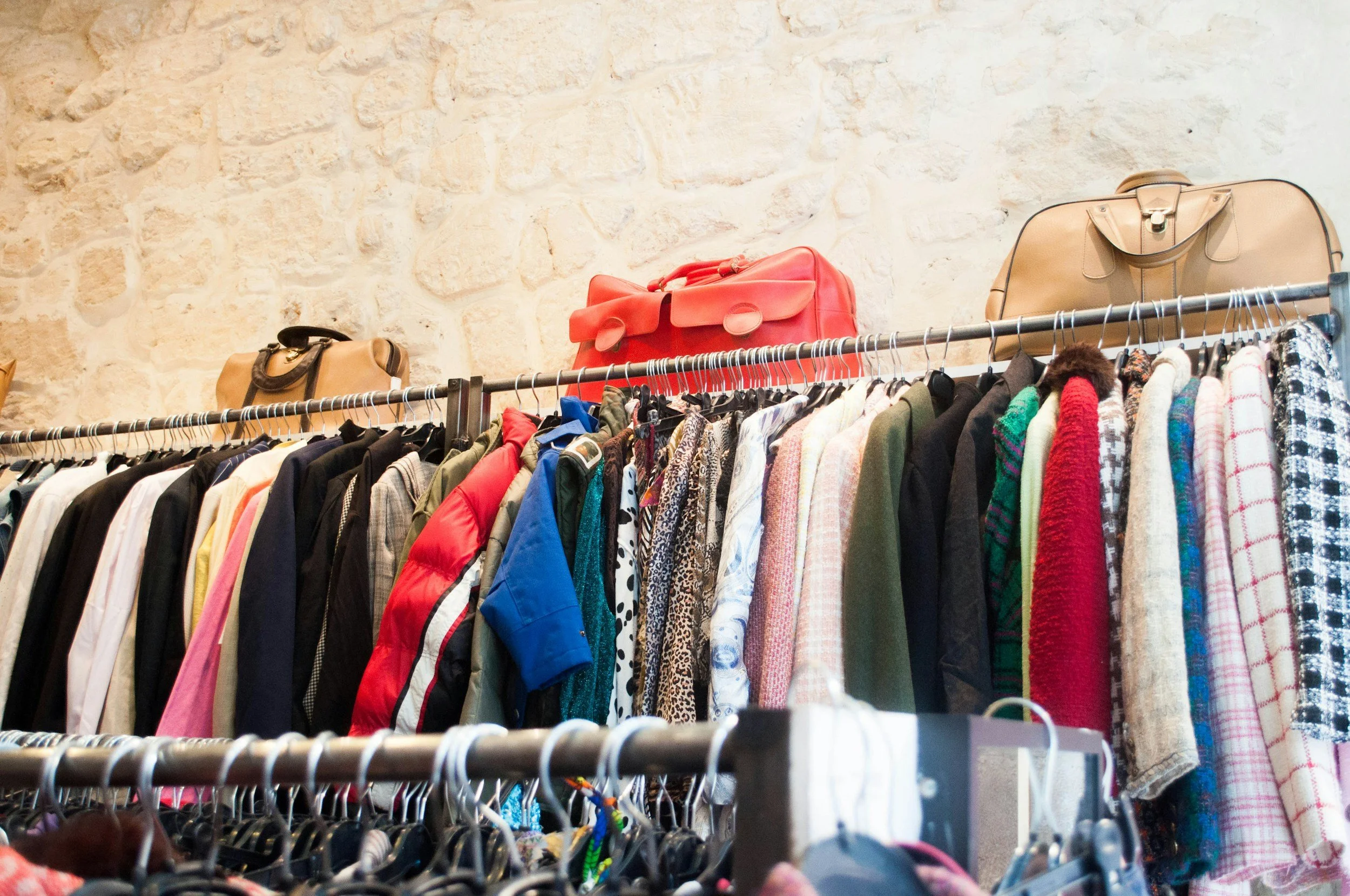
Paris isn’t short on places to buy things, but most of them blur together after a while. The ones that stay with you are usually the ones where you didn’t rush, where you walked a bit further than planned, doubled back once or twice, and ended up noticing something the second time you passed it.
That tends to happen in places like Saint-Ouen, once you’ve moved past the first entrances, or around Marché d’Aligre, when you step away from the main square and into the surrounding streets. The same in the 18th, where the better shops aren’t on the first street you walk down, but one or two turns further out.
What makes these places work isn’t just what’s there. It’s how you move through them. Starting early, before the narrow sections fill up. Taking a break without leaving the area completely. Letting the streets decide where you go next instead of trying to cover everything.
You don’t need to visit all of them, and it doesn’t work well as a checklist. One or two, done properly, is usually enough. Saint-Ouen if you want scale, Marché d’Aligre if you want something more local, or a slower walk around Lamarck–Caulaincourt if you prefer shops over stalls.
If you approach it that way, these places stop feeling like stops on a plan and start feeling like part of the city itself. And that’s usually when Paris becomes easier to understand.
You don’t actually have to stay in the city to get a good market fix. This guide to markets near Paris by train shows places you can reach easily for the day without renting a car.
And if you’re done with Paris, Arles has a completely different mood depending on the season. This piece on Arles in autumn is a good read if you like markets, art, and softer light rather than summer crowds.
FAQ: flea markets and vintage shopping in Paris
What is the best flea market in Paris?
The largest and most consistent is Marché aux Puces de Saint-Ouen, just beyond Porte de Clignancourt. It’s made up of multiple sections, including Marché Vernaison (informal, mixed stalls) and Paul Bert–Serpette (higher-end antiques). The market only really opens up once you move past the first entrances along Rue des Rosiers.
Which Paris flea market is best for antiques vs cheaper finds?
For higher-end antiques, focus on Paul Bert and Serpette at Saint-Ouen, where dealers specialise in furniture, lighting, and design pieces.
For smaller, lower-priced items, Marché d’Aligre is more practical, especially the outdoor brocante area on Place d’Aligre, where items are often sold directly from boxes or tables.
When are flea markets open in Paris?
Most flea markets run on weekends.
Saint-Ouen: usually Friday–Monday (peak days Saturday–Sunday)
Marché d’Aligre: open most days except Monday
Be aware that some vendors close briefly for lunch, typically between 12:30 and 14:00, especially on weekdays.
What time should you visit Paris flea markets?
Between 9:00 and 10:00 is the most useful window. Earlier than that, some stalls are still opening. After 11:30, areas like Vernaison become harder to move through, especially on weekends, as the narrow lanes fill up.
Where can you find vintage clothing in Paris?
The highest concentration is in the Marais (around Rue de la Verrerie and Rue Vieille du Temple) and in the 18th arrondissement near Rue des Martyrs and Lamarck–Caulaincourt. Stores like Kilo Shop, Chinemachine, and Guerrisol are good starting points, but the better finds are often one or two streets away from the busiest areas.
Is vintage shopping in Paris expensive?
It depends heavily on location.
Marais shops → more curated, higher prices
18th arrondissement → less organised, more affordable
Saint-Ouen → wide range, from low-cost brocante to high-end antiques
Price differences often reflect how curated the space is rather than the actual age of the item.
Do Paris flea markets accept cards?
Some do, especially in structured sections like Paul Bert at Saint-Ouen, but many smaller vendors, particularly in Vernaison or at Marché d’Aligre, still prefer cash. Small notes make transactions quicker.
Can you visit Paris flea markets without a car?
Yes.
Saint-Ouen: Metro Line 4 (Porte de Clignancourt) or Line 13 (Garibaldi)
Marché d’Aligre: Metro Line 8 (Ledru-Rollin)
Once you arrive, everything is walkable, but expect uneven ground and narrow passages in older sections.
What is a common mistake when visiting flea markets in Paris?
Stopping too early. At Saint-Ouen, many people stay near the first rows of stalls after exiting Porte de Clignancourt and don’t realise the market continues much further in. It usually takes one full loop before you understand where to focus.
Is Saint-Ouen flea market safe?
Yes, inside the market areas themselves it’s generally safe during the day. The only part that can feel less structured is the walk from Porte de Clignancourt to the main entrances along Avenue de la Porte de Clignancourt. Once you reach the marked market sections, the environment changes noticeably.