The Alsace market towns that feel better in spring than at Christmas
By lunchtime in December, parts of Colmar can feel exhausting before you’ve even sat down somewhere. People stop in the middle of Rue des Marchands to film TikToks, the line outside the gingerbread shops near Place de l’Ancienne Douane stretches into the street, and trying to get a table around Petite Venise without booking ahead usually turns into wandering in circles for half an hour.
Then April comes and the whole region softens.
The covered market in Colmar goes back to selling flowers, asparagus, cheese, and roast chicken instead of mostly Christmas products. In Obernai, people sit outside cafés again around Place du Marché with coffee instead of mulled wine. Vineyard roads outside Ribeauvillé start turning green again, and you can actually hear tractors and church bells instead of Christmas music following you through every square.
A lot of Alsace content online makes it seem like the region only exists for Christmas markets now. But some of these towns are honestly much nicer once winter crowds disappear. Not because they become empty, but because they start feeling normal again.
You notice different things in spring. Which towns are actually practical without a car. Which places feel too small after a few hours. Which villages work better as overnight bases. Which café terraces fill up with locals instead of mostly day-trippers arriving from Strasbourg.
Barr feels completely different from Eguisheim even though they often get grouped into the same Alsace itinerary online. Barr has commuters, school traffic, proper weekly markets, and bakery queues on Saturday mornings. Eguisheim gets very quiet once the buses leave around late afternoon. Obernai works surprisingly good for a few nights without a car because the TER station is actually close to the center, which is not always the case in Alsace wine villages no matter what Google Maps makes it look like.
Spring also makes the region easier to move through in general.
You can book smaller hotels without planning months ahead. Restaurant staff are less stressed. Parking does not eat half the day. The TER trains between Strasbourg, Obernai, Sélestat, and Colmar stop feeling like part of the Christmas market attraction itself.
Alsace starts feeling more like a place people live in again.
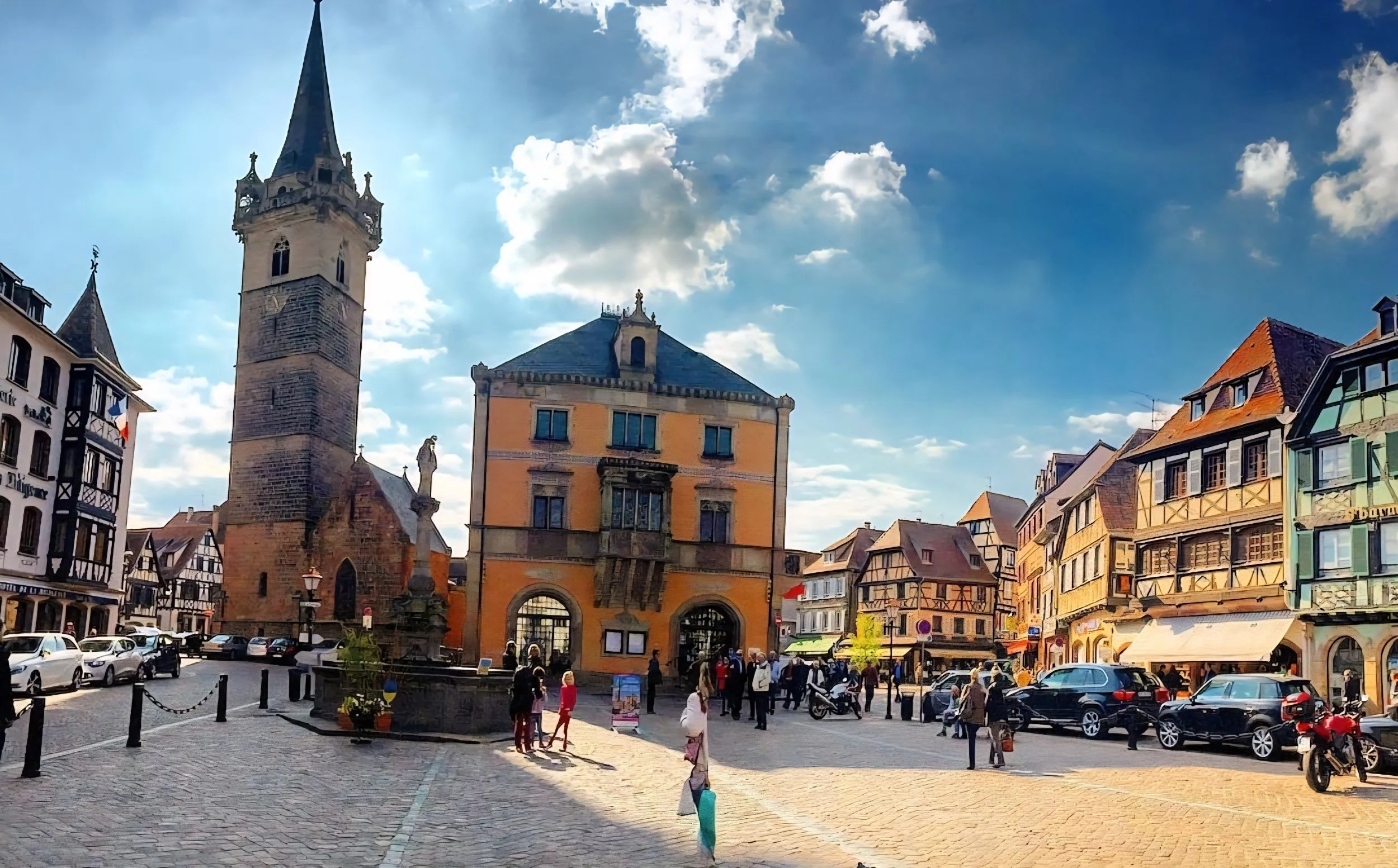
Why Obernai is better in spring than during Christmas market season
Obernai sits about 25 kilometres southwest of Strasbourg on the TER line toward Sélestat, right where the flatter landscape around Strasbourg starts giving way to vineyards, winery roads, and smaller wine-producing villages along the foothills of the Vosges. For anyone travelling around Alsace without a car, Obernai usually ends up feeling much easier than many of the more photographed villages farther south because the logistics are uncomplicated from the moment you arrive. The train station is close enough to the center that you can walk into town with luggage in ten minutes without dragging suitcases uphill through vineyard roads or waiting for a local bus that barely runs outside summer weekends.
You leave the station along Avenue de Gail, pass apartment buildings, pharmacies, tabacs, small everyday cafés filled with commuters drinking espresso before work, and then gradually the old town begins appearing around Porte de l’Europe with its pastel façades, timber-framed buildings, flower boxes, and narrow side streets curling toward Place du Marché. That transition feels important somehow because Obernai still feels connected to ordinary local life before it starts looking picturesque. A lot of Alsace villages feel like tourism begins immediately upon arrival. Obernai still has the feeling of being an actual small town first.
December changes Obernai so much that it almost feels like a different town by mid-afternoon. Around lunchtime, the streets between Place du Marché, Rue du Marché, and Place de l’Étoile start clogging up with day-trippers arriving down from Strasbourg, especially on Fridays and weekends in December when the TER trains are packed with people carrying shopping bags and rolling suitcases before they have even arrived.
By around 14:00, the queue for mulled wine near the Hôtel de Ville usually spills halfway across the square, and people stand shoulder-to-shoulder outside the Christmas stalls eating tarte flambée from paper trays while trying to keep out of the cold. Outside Pâtisserie Gross, the line sometimes stretches onto Rue du Marché because everyone seems to stop there for bredele tins and kougelhopf at the exact same time.
And because Obernai’s center is actually quite small, it starts feeling crowded much faster than somewhere like Strasbourg or even Colmar. You basically end up walking at whatever pace the crowd decides. Someone stops suddenly to photograph the Christmas windows near Rue Sainte-Odile, another group blocks half the street outside the toy shops around Place de l’Étoile, and delivery vans still somehow try squeezing through the middle of everything while people drift around with mulled wine cups and shopping bags.
Even the quieter streets stop feeling quiet in December. Around late afternoon, little lanes near Place du Beffroi and Rue Athic fill with people looking for shortcuts away from the crowds, and by dinner time most of the winstubs near the center already have reservation signs sitting on every table.
Then spring arrives and the whole town loosens up again.
The Wednesday market takes over the square again with actual produce instead of seasonal stalls selling decorations and bredele tins. You start seeing crates of white asparagus from nearby farms, strawberries stacked under striped awnings, tulips, mountain cheeses, roast chickens turning slowly on spits, and local residents wheeling shopping trolleys across the uneven stones before lunchtime. Around 10 in the morning, Rue Dietrich turns into this slightly chaotic mix of delivery vans unloading wine crates, cyclists weaving through pedestrians, market shoppers carrying flowers, and visitors trying to photograph the half-timbered houses while ordinary town life continues around them.
And once the Christmas decorations disappear, smaller details around Obernai start standing out again.
On sunny afternoons in April, it can actually become difficult to get a terrace table at Vintage Cafet' because people linger there for hours once the sunlight reaches the square properly after around 14:30. Near Rue du Général Gouraud, locals drift between boulangeries carrying fruit tarts, kougelhopf boxes, and baguettes before long lunches while cyclists stop for coffee on their way toward the vineyard roads around Bernardswiller and Mittelbergheim. The independent bookshop Librairie Kléber Obernai usually places tables outside in spring with regional cookbooks, Alsace photography books, and novels stacked beside the entrance once the weather becomes warm enough.
Obernai also has more genuinely good restaurants than people expect for a town this size, especially once spring arrives and terrace season begins again. Winstub Le Freiberg still feels relatively local outside weekends, particularly during weekday lunches when residents enjoy a few glasses of Riesling and tarte flambée rather than rushing through meals between sightseeing stops. La Stub des Gourmets works much better in spring too because the terrace softens the whole atmosphere of the restaurant once tables move back outdoors again. Even the more tourist-facing places around Place du Marché become easier to enjoy once staff are no longer dealing with nonstop Christmas crowds and packed reservation lists from morning until night.
Some of the prettiest parts of Obernai are actually outside the busiest streets entirely. Rue Athic and the quieter lanes around Place du Beffroi stay calmer even during spring weekends, with flower boxes beginning to reappear around windowsills by April. If you continue beyond the center toward the vineyard roads leading to Bernardswiller, the atmosphere changes very quickly. Tractors move slowly between vineyard rows in the mornings, vineyard workers are back outside after winter pruning, and the hills around Mont National begin turning green again after months of grey vines and muddy paths.
The walk uphill toward Mont National is steeper than people usually expect, especially after lunch and wine tastings, but the view from above town is worth the climb in late afternoon once the light starts shifting across the rooftops. On clear evenings after rain, you can see far across the Alsace plain toward Strasbourg, and the church tower rising above Obernai becomes much more noticeable from above than from inside the narrow streets below.
The atmosphere changes quickly once the late afternoon trains back to Strasbourg start filling up. Around 17:30, people begin pulling small suitcases back down Avenue de Gail toward the station, terrace tables empty out around Place du Marché, and the streets that felt busy an hour earlier suddenly become much calmer.
By early evening in spring, Obernai starts sounding more like a small town again than a tourist destination.
Restaurant staff drag blankets back inside from the terraces. Wine glasses clink outside places like L'Établi and Le Freiberg while locals settle into longer dinners. Around Rue Sainte-Odile, apartment windows open above the wine bars once the evenings get warmer, and you hear people talking across balconies while church bells from Saints-Pierre-et-Paul carry through the center every quarter hour.
Even on sunny Saturdays in April, the shift feels surprisingly abrupt. Around 16:00, people are still queuing for ice cream near Place de l’Étoile and photographing the timber-framed houses around Rue du Marché. By 19:00, some of those same streets are almost quiet apart from residents walking dogs or heading home with takeaway pizzas and bakery boxes.
The smaller side streets around Rue Athic and Place du Beffroi get especially calm after dark outside weekends. A few restaurant terraces stay busy, but a lot of the shutters close early in spring, particularly on Sundays and Mondays before summer season properly starts. It catches people off guard sometimes because Alsace gets marketed online as this permanently lively café region, when in reality many smaller towns settle down pretty early once day visitors leave.
Outside Fridays and Saturdays, Obernai gets quiet fairly early in spring, especially before May. By around 21:00, shutters are already closed along parts of Rue Athic and Place du Beffroi, and several smaller winstubs stop serving much earlier than visitors expect. Places like Le Freiberg or smaller family-run spots around Rue Sainte-Odile often close Sundays and Mondays entirely outside peak season, while some kitchens stop taking orders after 20:30 even if Google Maps still says “open.”
That catches people out constantly.
It is very easy to spend the afternoon in Strasbourg, take a later TER back to Obernai thinking you will just “find somewhere for dinner,” and then realize half the places saved on your phone have either stopped serving food or are closed for two days. Around March and early April, some terrace cafés do not even reopen properly until Easter depending on the weather.
But once you stop expecting the town to feel busy all the time, Obernai becomes much easier to settle into for a few days.
People fall into routines here quite quickly. Coffee and pastries near Place du Marché in the mornings before the day-trippers arrive from Strasbourg. Picking up cheese, strawberries, or kougelhopf from the Wednesday market before walking back through Rue du Marché while delivery vans are still unloading wine bottles outside the restaurants. Taking the train north for half a day, then coming back before dinner once the square starts emptying again.
And the area around Obernai is good for slower days because you do not have to overplan everything. The vineyard roads toward Ottrott and Bernardswiller start just outside town, and by late April the vines begin turning green again after months of bare branches and muddy paths. The walk toward Ottrott passes small wineries, half-open cellar doors, and storks nesting on rooftops once spring settles in properly.
By evening, the light hits the pastel façades along Rue du Général Gouraud differently once the crowds disappear. Restaurant staff drag chalkboards back inside, locals stop for one last glass of Riesling outside L'Établi, and the center starts feeling less like part of a Christmas market itinerary and more like an actual small wine town again.
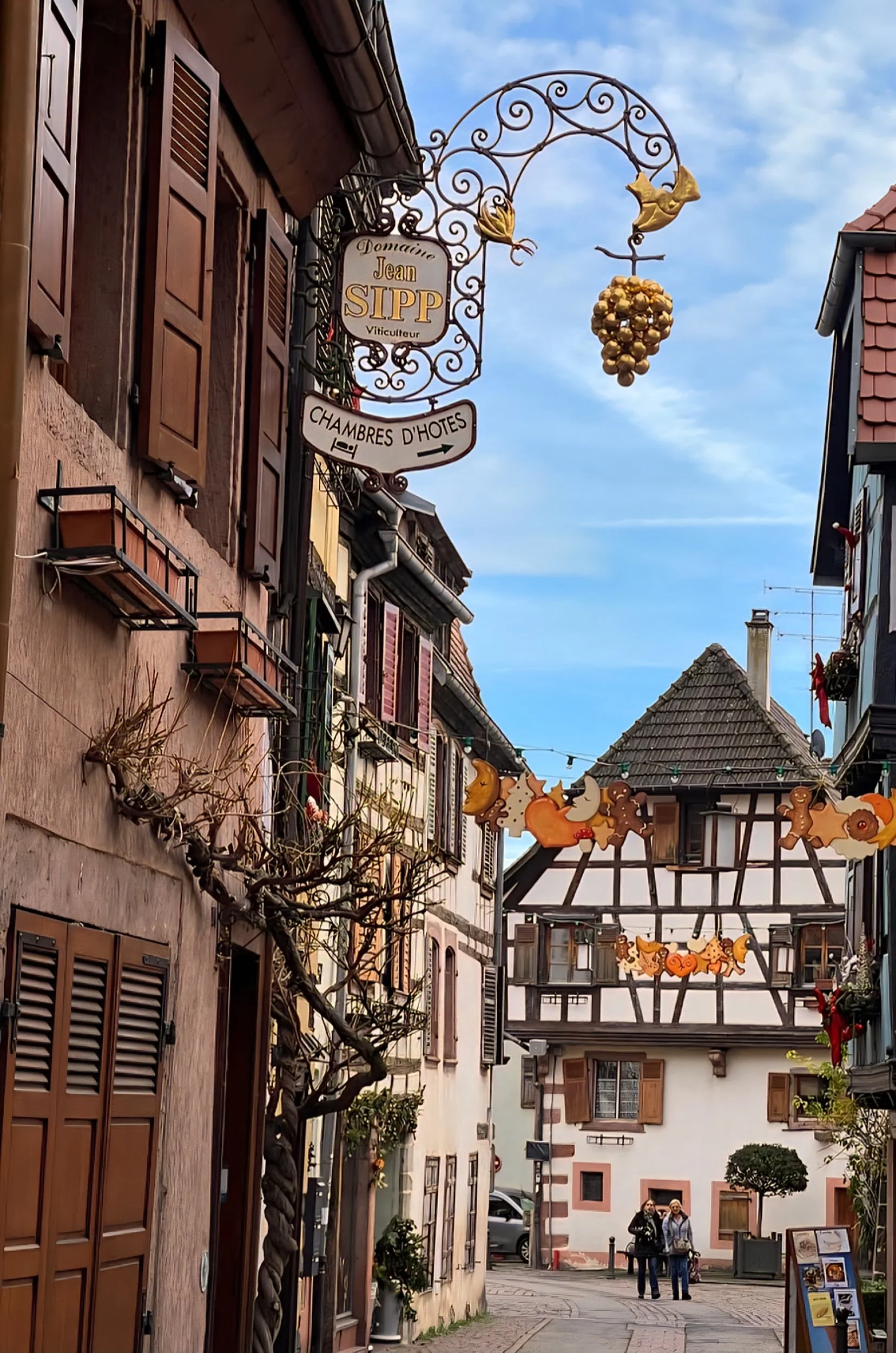
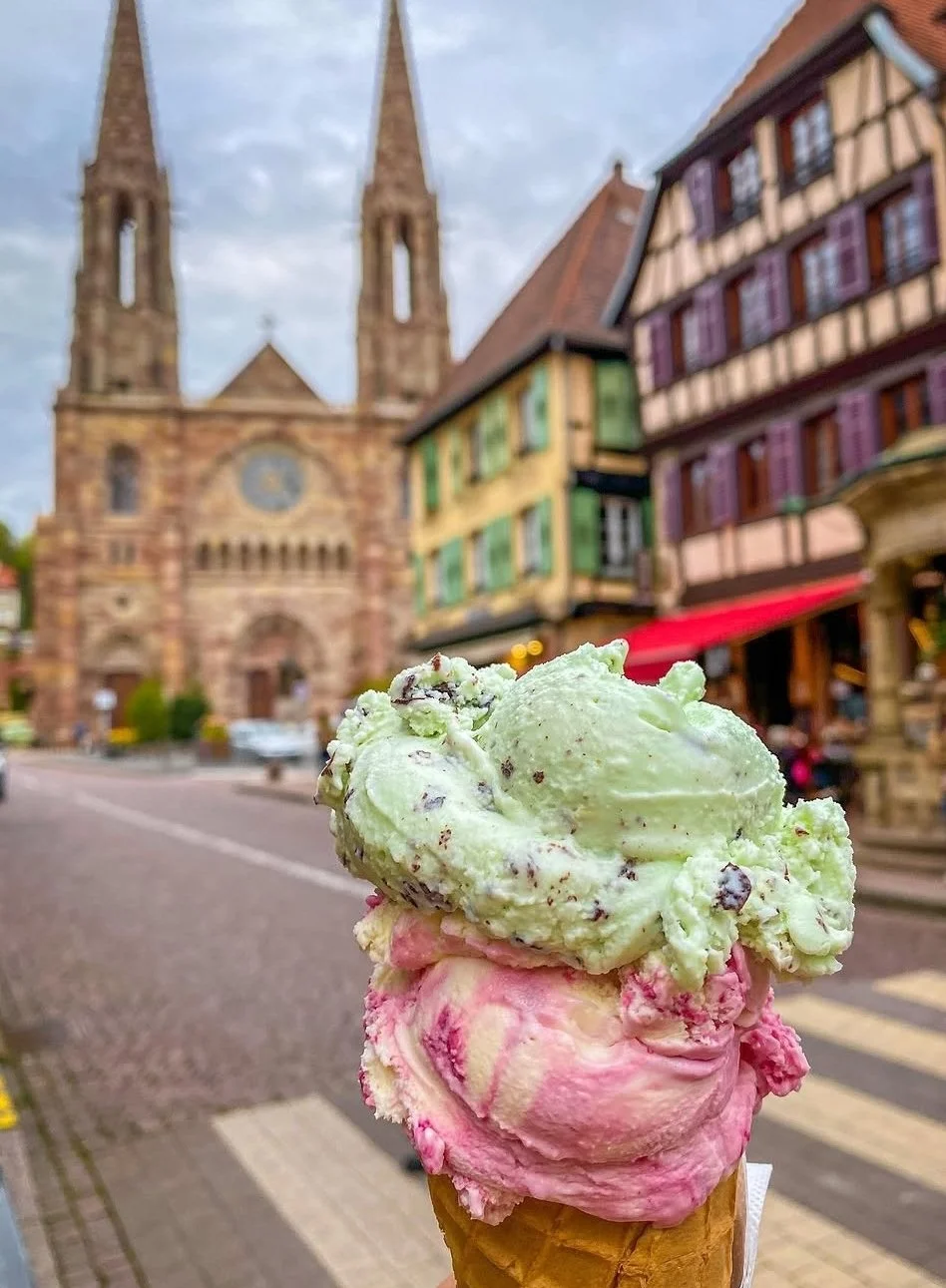
If Barr and Obernai are your favourite parts of Alsace, these quieter Loire towns have a very similar feeling once terrace season starts and the weekly markets move back outdoors.
Eguisheim is nicest before the summer tour buses show up
Eguisheim sits only a few kilometres outside Colmar, wrapped almost completely in vineyards, and most people arrive expecting some impossibly peaceful little village because that is how it gets photographed online. Empty cobbled streets. Flower boxes. Storks perched on rooftops. Maybe one bicycle leaning against a fountain.
That version of Eguisheim mostly exists before 10 in the morning.
By lunchtime in summer, especially once June starts, the parking areas along Route de Wettolsheim and Route de Colmar are already full of buses and rental cars, and the tiny circular streets inside the old town start feeling much narrower than they looked in photographs. Around Place Saint-Léon and Rue du Rempart Sud, people stop every few metres for photos, and because the village loops around itself in circles, you somehow keep ending up behind the same groups over and over again.
Eguisheim feels crowded faster than places like Colmar because the center is genuinely small. The streets narrow unexpectedly near Rue du Bassin, restaurant terraces spill onto the cobblestones, wine barrels sit outside cellar doors, and half the village seems to bottleneck around the fountain near Château Saint-Léon once the buses arrive from Colmar.
Spring changes the atmosphere before that whole cycle starts again.
In April, especially during weekday mornings, the village feels much softer around the edges. Around 08:30, bakery deliveries are still happening near Place de l’Église Saints-Pierre-et-Paul while restaurant staff drag chairs onto terraces and vineyard workers stop for coffee before driving out toward the vines around Husseren-les-Châteaux and Wettolsheim.
You notice sounds again. Storks clattering from the nests above Rue du Rempart Nord. Church bells carrying across the rooftops. Somebody unloading wine crates outside Domaine Bruno Sorg while cyclists ride slowly through the village covered in dust from the vineyard roads above town.
And because there is finally room to move around properly, you start noticing the smaller places that get completely lost during summer.
The tiny courtyard outside La Galinette fills slowly in spring mornings with people drinking espresso instead of rushing through sightseeing stops. A few streets away, the independent pottery and ceramics shops around Rue Monseigneur Stumpf reopen their outdoor displays once the weather warms up properly. There are also several small wine cellars that barely look open from the outside until you notice handwritten tasting signs beside old wooden doors.
The village has a surprisingly good cluster of smaller independent wine producers if you slow down enough to notice them. Domaine Léon Boesch just outside the center stays much calmer in spring before tour season peaks, and tastings there often turn into long conversations once things are quiet. Around Rue du Bassin, smaller producers like Domaine Ginglinger-Fix pour wines much more casually in April compared to July and August when groups cycle through constantly.
The prettier streets are not always the busiest ones either.
Rue du Rempart Sud gets photographed the most because of the flower-covered façades, but some of the quieter little lanes behind Place du Château Saint-Léon feel much nicer early in the morning before the village fills up. Around Rue des Trois Châteaux, shutters open slowly, cats sleep on windowsills above wine shops, and people carry baguettes home from the bakery before the tour buses arrive.
One of the nicest things to do in spring is honestly just leaving the village for an hour.
The vineyard path leading toward Husseren-les-Châteaux starts just outside town and opens up quickly once you climb slightly above the rooftops. By late April, the vines begin turning green again, wildflowers appear along the edges of the paths, and the view back over Eguisheim becomes much better than anything from inside the crowded center streets. If you continue farther uphill toward the Trois Châteaux ruins above Husseren, the view stretches across the vineyards all the way toward Colmar on clear days.
The climb is steeper than people expect after wine tastings, though.
And Eguisheim changes very quickly once late afternoon arrives.
Around 16:30 or 17:00, the buses start thinning out almost all at once and suddenly the village feels quieter again. Restaurant staff stop rushing. People settle onto terraces with wine instead of moving quickly between photo stops. Around Place Saint-Léon, the atmosphere softens completely once the day-trippers head back toward Colmar.
That is usually when the restaurants feel nicest too.
Le Pavillon Gourmand becomes calmer once the lunch rush disappears, and tables outside Caveau Heuhaus stay busy later into the evening with people lingering over Riesling and tarte flambée while the streets empty around them. Even the touristy restaurants feel more relaxed once the daytime crowd pressure disappears.
Transport is still the awkward part here and probably always will be… Eguisheim does not have a train station, so most people come through Colmar first before continuing by bus, bike, taxi, or rental car. The buses work well enough until you miss one. Then suddenly you are standing beside the stop near Place de la Mairie realizing the next departure is not for another hour.
And parking fills earlier than people expect even in spring. On sunny Saturdays in May, the lots near Route de Colmar are already busy before lunch, especially once cycling season starts properly again.
But spring avoids the most exhausting version of Eguisheim entirely. You can still walk through Rue du Rempart without constantly stepping aside for photos. You can actually hear the fountains again. And the village starts feeling less like a backdrop people rush through and more like part of the vineyards surrounding it.
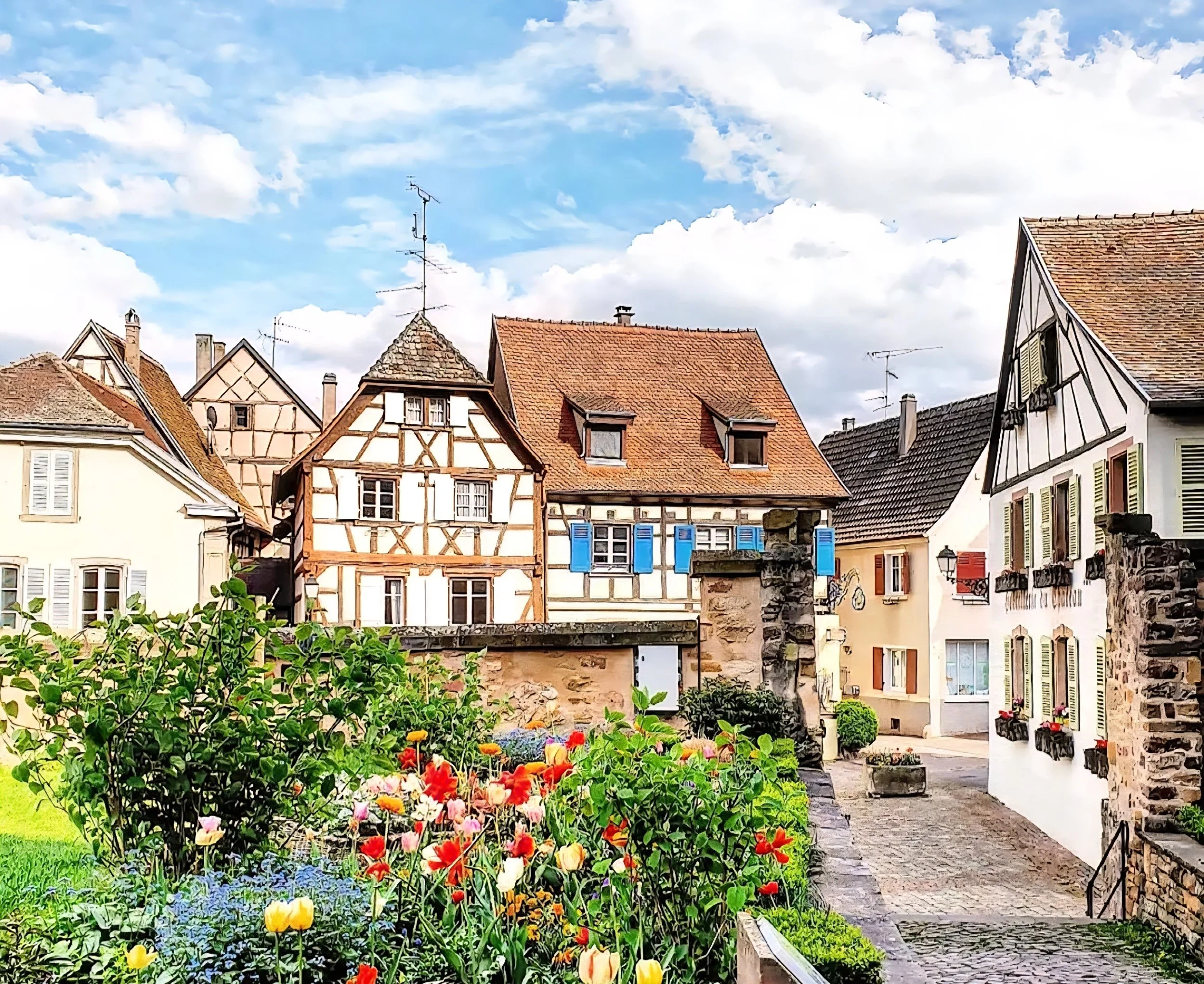
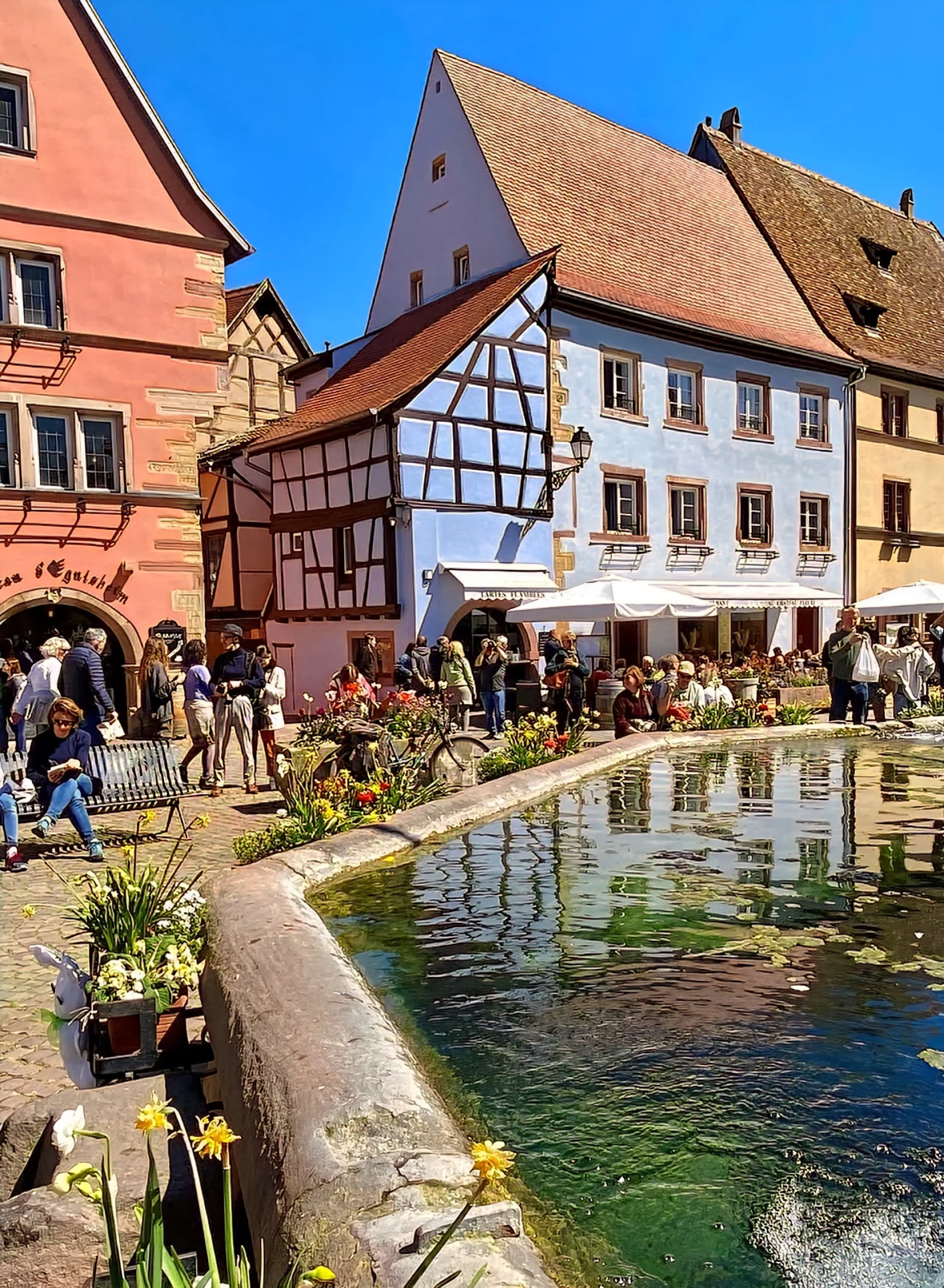
The Wednesday market in Nyons has the same kind of local vibe people often end up looking for in Alsace during spring, and this detailed Nyons guide helps you avoid arriving at completely the wrong time of day.
Ribeauvillé feels less commercial in spring
Ribeauvillé sits right between Sélestat and Colmar along the Alsace wine route, and most people treat it like a quick stop between Riquewihr and Eguisheim. They park somewhere near Avenue du Général de Gaulle, walk one section of Grand’Rue, buy a bottle of Riesling, take photos of the timber-framed houses around Place de l’Hôtel de Ville, then move on again before dinner.
Which means they usually miss the version of Ribeauvillé that actually makes people return.
The town is much longer than visitors expect the first time they arrive. Grand’Rue keeps stretching farther than it looks on maps, and the atmosphere changes block by block depending on where you are. Near the center around the Hôtel de Ville, the streets feel more polished and tourist-heavy once lunchtime starts. A little farther north, near the old Butchers’ Tower and the fountains along the street, things start feeling more residential again. Delivery drivers stop half across the road unloading wine crates while older residents walk home carrying baguettes and flower bouquets from the market.
And Ribeauvillé is one of those places where mornings and evenings are far more interesting than the middle of the afternoon.
Around 07:45 in spring, the town still feels almost completely local. Shutters open one by one along Grand’Rue. The smell of bread drifts out from Boulangerie Pâtisserie Vilmain before the first visitors from Colmar arrive. Restaurant staff drag chalkboards onto the pavement while somebody washes down the terrace outside Au Passage de la Tour with a hose.
Then around 11:00, the cycling groups start arriving.
By lunchtime, the center fills with people biking between Ribeauvillé, Hunawihr, and Riquewihr carrying helmets and wine bottles in baskets. Tour buses pull in near the parking areas outside the old town, and suddenly the narrowest parts of Grand’Rue become this awkward mix of cyclists, strollers, wine tastings, and people stopping in the middle of the street to photograph the same façades.
But Ribeauvillé handles crowds better than a lot of neighboring villages because it has room to absorb them.
You can walk five minutes farther than most people bother to and suddenly the atmosphere changes completely. Around Rue des Juifs and some of the smaller side lanes behind Grand’Rue, the noise drops quickly. Cats sleep in open windows above the wine shops. You hear fountains again instead of crowd noise. In spring, flower boxes start appearing along the upper windows around April, and laundry occasionally hangs across the quieter back streets before summer fully starts.
One thing Ribeauvillé does especially well is cafés that people actually stay in for a while.
Salon de Thé Vilmain gets busy quickly on spring mornings because locals stop there after the market for pastries and coffee before heading home, and once the terrace fills up properly around late morning, people rarely leave quickly. Nearby, Patisserie Schaal usually has queues stretching onto the pavement on weekends once strawberry tart season starts in late spring.
And around aperitif hour, Ribeauvillé becomes much nicer than it is during the middle of the day.
The light shifts properly across Grand’Rue, wine glasses start appearing on terraces, and people settle in for long dinners instead of rushing through sightseeing stops. Tables outside Au Passage de la Tour and Le Goupil stay full late into the evening once spring evenings get warmer, especially on Fridays when locals from nearby villages come into town for dinner.
The restaurants in Ribeauvillé also feel more local than places nearby like Riquewihr, especially once you are outside the busiest summer weekends and Christmas season. Around lunchtime in April, people sit for quite a while outside Au Zahnacker ordering Riesling, baeckeoffe, or tarte flambée while delivery vans still move slowly through Grand’Rue beside the terraces.
A few streets away, La Table du Gourmet is more refined but feels much calmer in spring when you are not competing with packed holiday crowds and reservation lists weeks ahead. And farther north along Grand’Rue, some of the smaller winstubs stay busy well into the evening with locals lingering over wine long after most day visitors have already driven back toward Colmar. Around 21:00, the street outside starts emptying properly while tables inside are still full of people ordering another glass instead of rushing off to the next stop on an itinerary.
Ribeauvillé also has more independent shops than people expect once you stop focusing only on wine tasting rooms.
There are little ceramics stores reopening outdoor displays in spring, old-fashioned linen shops selling heavy Alsace tablecloths, small antique stores with faded wine posters and regional pottery stacked in windows, and a few art galleries tucked into side streets near Place de la Sinne where local landscape painters exhibit vineyard scenes that somehow feel much more grounded than the generic souvenir art sold elsewhere.
Galerie Halter becomes much easier to browse in spring once you are not squeezed in beside tour groups, and a few tiny cellar doors around Rue Klobb still feel almost strangely informal in April. You walk in expecting a quick tasting and suddenly somebody’s grandfather is explaining vineyard plots while a dog sleeps under the table.
And the walks above Ribeauvillé are part of why you should stay longer here. The paths toward Château Saint-Ulrich, Château du Girsberg, and Château du Haut-Ribeaupierre begin almost directly behind the town. From below, the castle ruins look deceptively close. Then fifteen minutes later you are breathing much harder than expected while climbing uphill through vineyards and forest paths.
The best viewpoint is not actually from the castle itself either.
There is a section slightly below Château Saint-Ulrich where the vineyards open up properly and Ribeauvillé spreads out below the hills toward the Alsace plain. Late afternoon is best there once the light starts shifting across the rooftops and vineyards toward Sélestat.
Transport is still annoying without a car and that part never really gets mentioned properly online.
Ribeauvillé does not have a train station, so most people arrive through Sélestat first, then continue by bus or taxi. The buses are manageable until you miss one. Then suddenly you are standing outside the stop near the roundabout realizing the next departure is almost an hour away. Sundays are especially awkward because frequencies drop quite a bit outside summer.
But Ribeauvillé works best once you stop trying to move around constantly anyway. It is the kind of town where people end up buying another bottle of wine, staying longer at dinner than planned, walking slowly back through Grand’Rue once the terraces empty out, and realizing they are much less interested in rushing off to the next village the following morning…
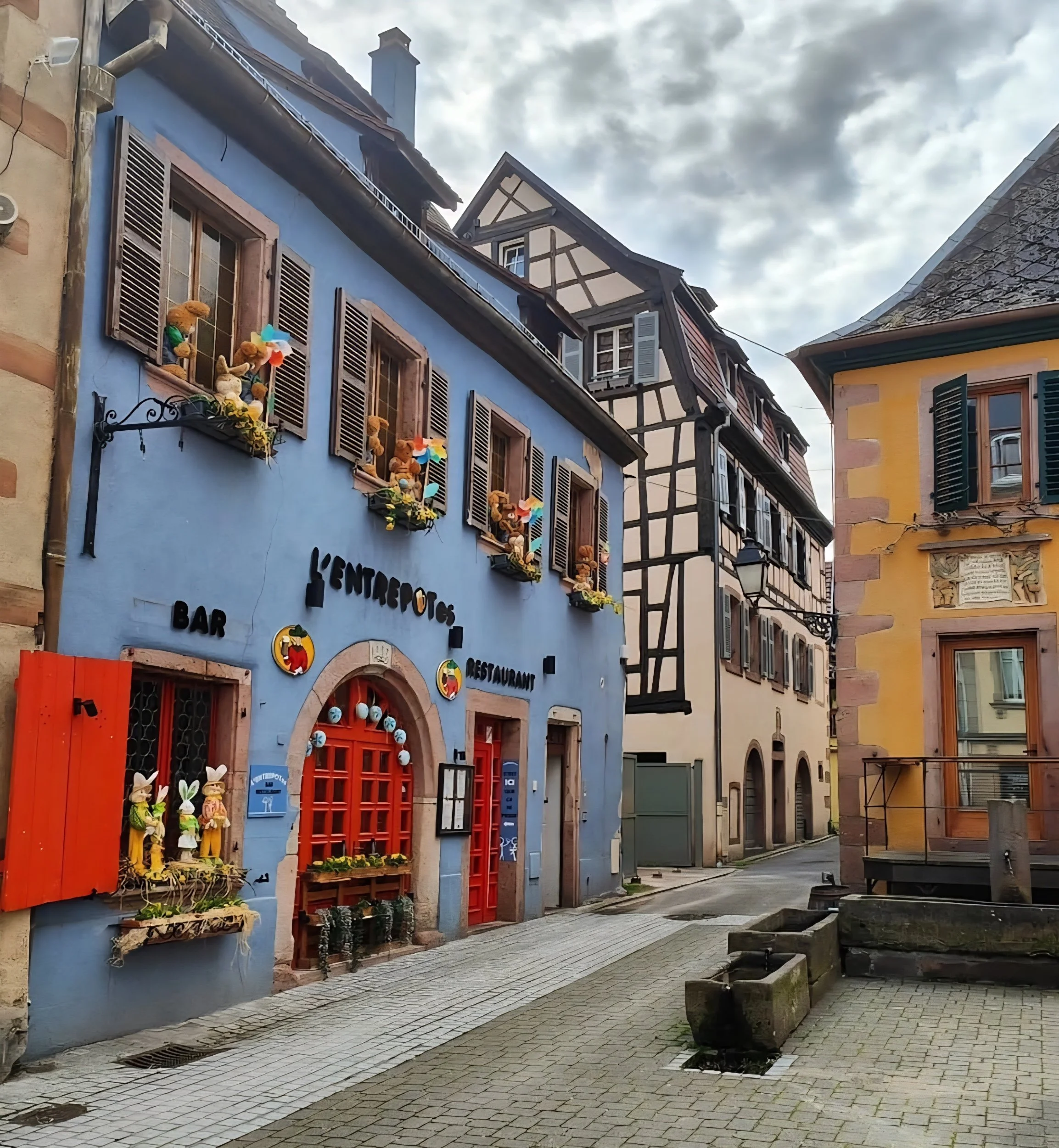
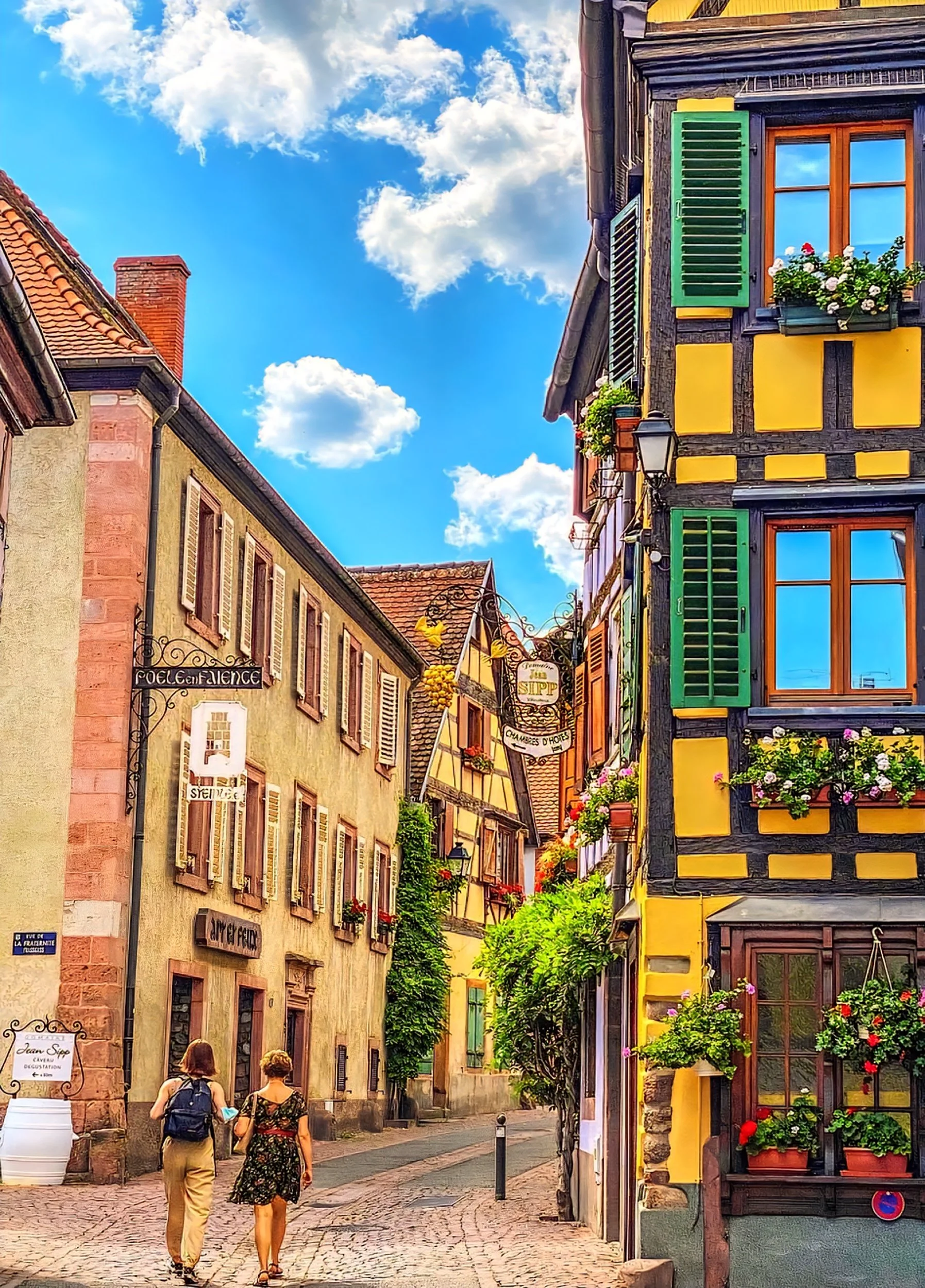
Barr feels more local than most Alsace wine towns
Barr does not really have that polished “arrival moment” that a lot of Alsace villages rely on. You step off the TER from Strasbourg and the first things you pass are apartment buildings, little garages, bakeries opening for the morning, teenagers heading toward school, people carrying grocery bags home from Super U. Then a few minutes later the older streets begin appearing around Place de l’Hôtel de Ville almost by accident.
And Barr is better because of that.
It feels much more connected to everyday life than some of the prettier wine villages farther south where tourism takes over almost immediately once you enter the center. People actually use the town year-round. You notice it in small ways all the time. Delivery vans blocking Rue de la Kirneck while unloading wine crates. Cyclists stopping for coffee before riding uphill toward Mittelbergheim. Older residents carrying flowers and pastries home from the Saturday market while the church bells cut through the noise from the square.
Saturday mornings are probably when Barr feels most like itself.
By around 08:30, Place de l’Hôtel de Ville is already full of asparagus stacked in wooden crates, buckets of tulips, mountain cheese from the Vosges, roast chickens turning slowly beside market stalls, jars of local honey, and people greeting each other while carrying shopping baskets across the square. The queue outside Pâtisserie Oppé usually stretches onto the pavement before lunch because everyone seems to stop there for kougelhopf, fruit tarts, or pastries at exactly the same time.
Nobody seems especially rushed about anything.
At Café Bretelles, people sit outside with tiny coffees while the market is still setting up around them, and once the sunlight reaches the terrace properly later in the morning, tables stay full for hours. Nearby, Salon de Thé Marie Blachère gets busy after the market with people carrying pastry boxes and flowers back through town, and around aperitif hour the wine bars along Rue de la Kirneck slowly start filling up without that sudden wave of tour groups arriving all at once.
Barr also has lots of little places that only really stand out once you stop trying to move through the town quickly.
Librairie Pleine Page near the center feels like an actual neighborhood bookshop where locals stop on the way home from work rather than somewhere designed for tourists buying souvenirs. Inside, there are shelves of Alsace cookbooks, regional photography books, old travel writing, handwritten recommendation cards tucked into novels, and stacks of local magazines near the counter. Around Rue des Bouchers and some of the side streets behind the church, there are little antique shops with faded wine posters in the windows, florists dragging buckets of tulips and peonies onto the pavement once spring arrives properly, and ceramics stores where handmade bowls and pottery sit slightly unevenly stacked in dusty displays.
The quieter streets are usually the nicest ones anyway.
Rue des Bouchers stays calm even on weekends, especially early in the morning before the cafés fill up. Little water channels run beside parts of the street, shutters open slowly above the old façades, and once spring settles in properly you start seeing laundry hanging between upper windows again and cats sleeping on warm stone ledges outside cellar doors.
And one of the nicest things about Barr is how quickly the vineyards begin once you leave the center.
Within maybe fifteen minutes on foot, you are already walking uphill toward Mittelbergheim through vineyard roads with views back across the rooftops and church tower. Around late April, the vines begin turning green again after months of muddy winter rows, and the roads above town fill with cyclists stopping at wineries and vineyard workers moving between the vines.
The climb becomes steeper faster than people expect, especially after lunch and wine tastings.
But the light up there late in the day is beautiful. Around the vineyard roads near Domaine Klipfel, you can look back across Barr while the hills around Andlau and Mittelbergheim soften in the evening light. After rain, the whole plain below the vineyards feels unusually clear, especially toward sunset when the rooftops start catching the last light.
Barr also gets quiet fairly early outside weekends, and that catches people off guard sometimes.
By around 21:00 in March or April, parts of the center are already calm apart from restaurant terraces and the occasional TER arriving at the station. Some kitchens stop serving earlier than visitors expect, especially Sundays and Mondays, and it is very easy to come back from Strasbourg assuming you will just “find somewhere later” only to realize half the restaurants already stopped serving food an hour earlier.
But after a couple of days, that slower lifestyle starts making sense. Morning coffee at Café Bretelles. Market in the square. Vineyard walk toward Mittelbergheim. Long lunch that accidentally stretches into the afternoon. Another glass of Riesling once the terraces start filling again around dinner. Yes pleace!
Barr is very good at that kind of day.
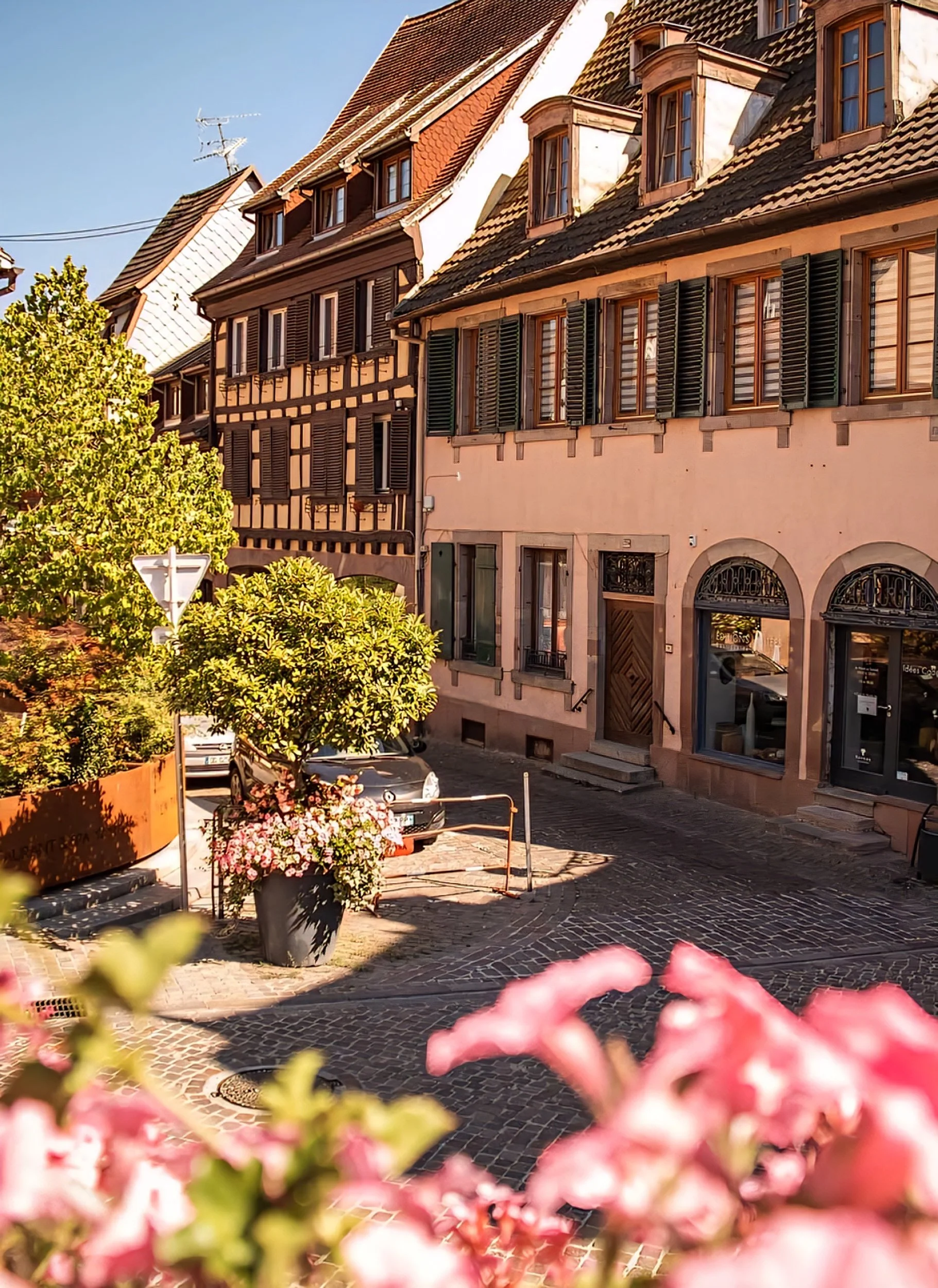
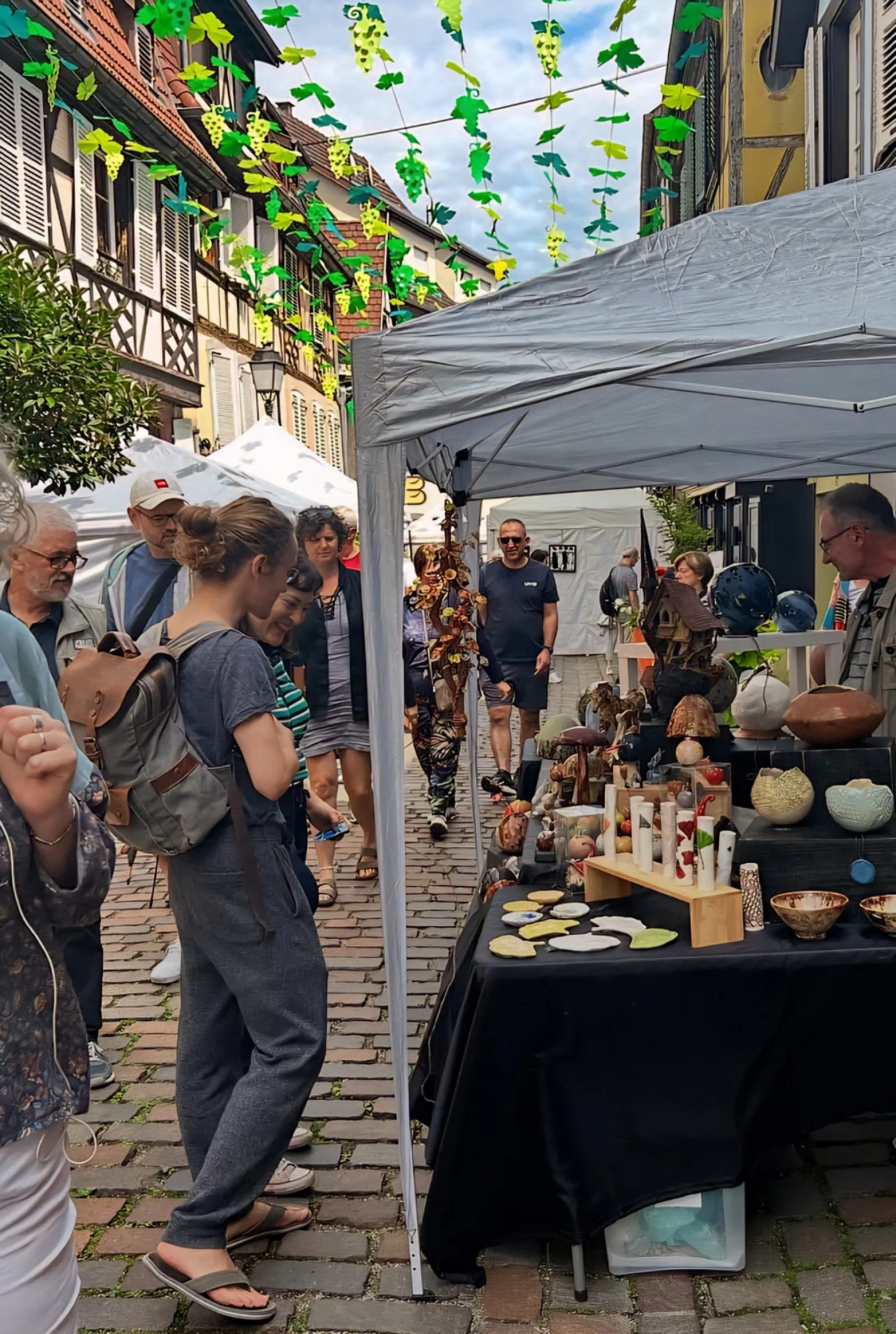
A surprising number of people trying to plan a spring France trip end up debating between eastern wine villages and southern market towns, and this honest Uzès vs Pézenas comparison makes the difference between them very clear very quickly.
If you are continuing south from Alsace toward Lyon, this slower Tournus stop works extremely well for breaking up the train journey without dealing with a rental car.
Most people visit Colmar in December. Spring is when the city relaxes
Colmar in December can feel weirdly stressful for a place that people keep describing as cozy.
By around 13:00, the stretch between Rue des Marchands, Petite Venise, and Place de l’Ancienne Douane is usually so packed that you stop moving naturally without even realizing it. Somebody freezes in the middle of the bridge near Quai de la Poissonnerie to take photos, another group blocks half the street outside the gingerbread shops, and people with shopping bags keep spilling out from the Christmas stalls into the middle of the road because there is nowhere else left to stand.
And the thing is, Colmar outside Christmas season does not actually feel like that most of the time.
In spring, especially from late March into May before the heavier summer traffic properly arrives, the center starts behaving like a normal small city again. Around 08:00 near Marché Couvert, the people crossing the canals are mostly locals buying things for lunch instead of visitors photographing the houses. Fishmongers are setting up ice trays inside the market hall, bakery vans squeeze badly parked deliveries through Quai de la Poissonnerie, and the café terraces slowly start filling one table at a time instead of all at once.
Around 08:00 near Marché Couvert, Colmar sounds completely different from the middle of the day. Restaurant staff are still dragging chairs across the terraces near Quai de la Poissonnerie, bakery deliveries squeeze through the narrow streets behind Rue des Tanneurs, and flower sellers outside the market start lining buckets of tulips and peonies along the pavement while people stop for coffee on the way to work.
You hear little things again once the crowds disappear for a few months. Wine bottles clinking into crates outside the bars near Place des Six Montagnes Noires. Somebody opening shutters above Rue Berthe Molly. The canal water moving under the bridges around Petite Venise before the sightseeing boats start running properly later in the morning.
A lot of people arrive in Colmar with the exact same route already planned before they even leave the station. Petite Venise first, then Rue des Marchands, maybe the Unterlinden Museum, quick photos outside the Koïfhus building, lunch somewhere around Place de l’Ancienne Douane, then back toward Strasbourg before dinner.
Which is probably why so many people leave saying Colmar felt beautiful but strangely exhausting at the same time.
The city feels much better earlier in the day before everybody starts funneling into the same streets at once. Around 08:30, Rue Berthe Molly is still quiet apart from bakery deliveries and people stopping for coffee before work. Tables outside L'Un des Sens fill slowly instead of all at once, and around Rue des Clefs, delivery drivers still block half the road unloading pastry boxes near Pâtisserie Gilg while shop owners open shutters one by one along the old façades.
Behind the Koïfhus building, the little lanes around Rue des Écoles and Rue de la Herse still feel almost sleepy in the mornings. Staff at Le Fer Rouge drag chairs onto the terrace before lunch service, somebody hoses down the cobblestones near Place de l’Ancienne Douane, and smaller shops like Librairie Hartmann and the independent wine stores around Rue des Marchands open gradually while the city is still waking up.
That version of Colmar feels completely different from the middle of the afternoon once the sightseeing boats start moving through Petite Venise and the bridges near Quai de la Poissonnerie fill with people trying to photograph the canals from the exact same angle.
Some of the nicest streets in Colmar are not even the ones everybody photographs constantly.
Rue Berthe Molly is prettier in spring than most of Petite Venise once the flowers start appearing again and the façades catch the softer afternoon light. Around Rue des Écoles and Rue de l’Ours, people wheel shopping trolleys home from the market while cyclists cut carefully through the cobblestones. If you continue farther toward Quartier Sud, the city changes again completely. Bigger apartment buildings. Parks filling with locals once the weather warms up. Almost nobody carrying cameras anymore.
And there are lots of smaller places around Colmar that completely disappear during Christmas season because the crowds flatten everything into the exact same experience.
Librairie Hartmann becomes much calmer once you can actually browse properly without people pushing through looking for souvenirs nearby. Along Rue des Têtes, there are old wine shops with dusty bottles in the windows, little ceramics stores, independent linen boutiques, and galleries showing Alsace landscape photography that somehow feels much more grounded than the mass-produced art around Petite Venise.
The small covered passages near Rue des Clefs are good too and easy to miss entirely if you are moving too fast.
One of the nicest things to do in spring is honestly just spending time around Marché Couvert without turning it into a sightseeing stop. Around late morning, people sit outside with glasses of wine and long lunches while the flower stalls spill tulips and peonies onto the pavement beside the canal. The atmosphere around there feels completely different once the city stops operating in Christmas survival mode.
And Colmar changes quickly once evening arrives.
During December, the center stays loud and crowded late into the night. In spring, things loosen much earlier. Around 18:30, once the day-trippers start catching trains back toward Strasbourg and Basel, the bridges around Petite Venise suddenly empty out again. Restaurant staff stop rushing. The canals quiet down. You can actually hear conversations from apartment windows above the water.
That hour just before dinner is probably when Colmar feels nicest. People sit outside with Riesling near Quai de la Poissonnerie while the reflections from the façades move across the canal. Around Place des Six Montagnes Noires, the wine bars slowly start filling with locals after work instead of tour groups trying to fit in one last stop before leaving.
And the restaurants become far easier to enjoy once Christmas market season ends.
La Soï still gets busy, but spring lunches there stretch longer once people stop rushing around the city. JY’S near Petite Venise finally feels connected to the canal instead of buried under crowds. Even the smaller winstubs around Place de l’Ancienne Douane calm down once staff are no longer trying to survive nonstop December service every night.
Colmar station is only about fifteen minutes from the center on foot, which suddenly feels much shorter once you are not dragging luggage through Christmas market crowds and packed pavements near Avenue de la République.
Underneath all the photographs and postcards, Colmar is still a real city. And Spring is when you can actually feel it.
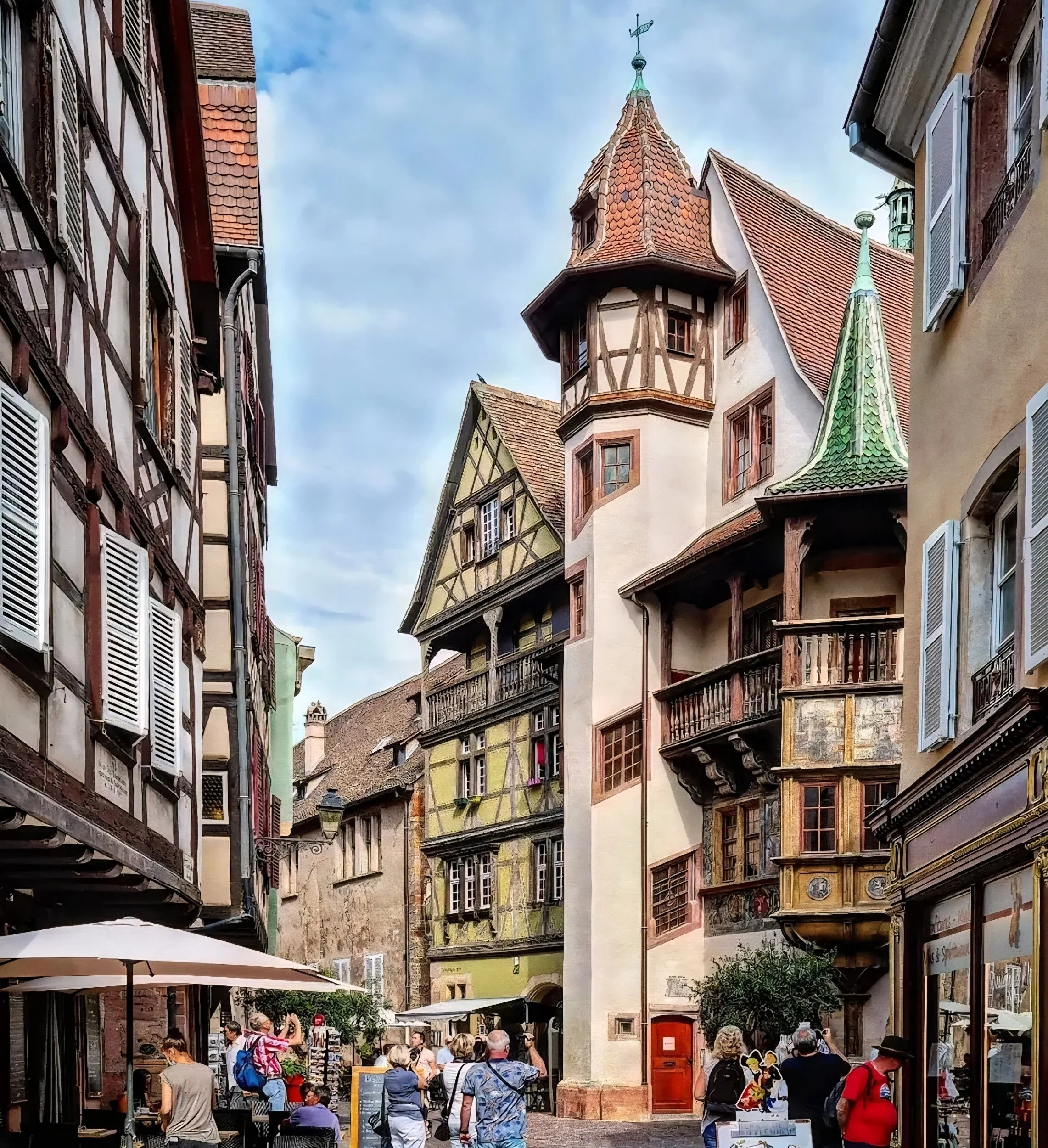
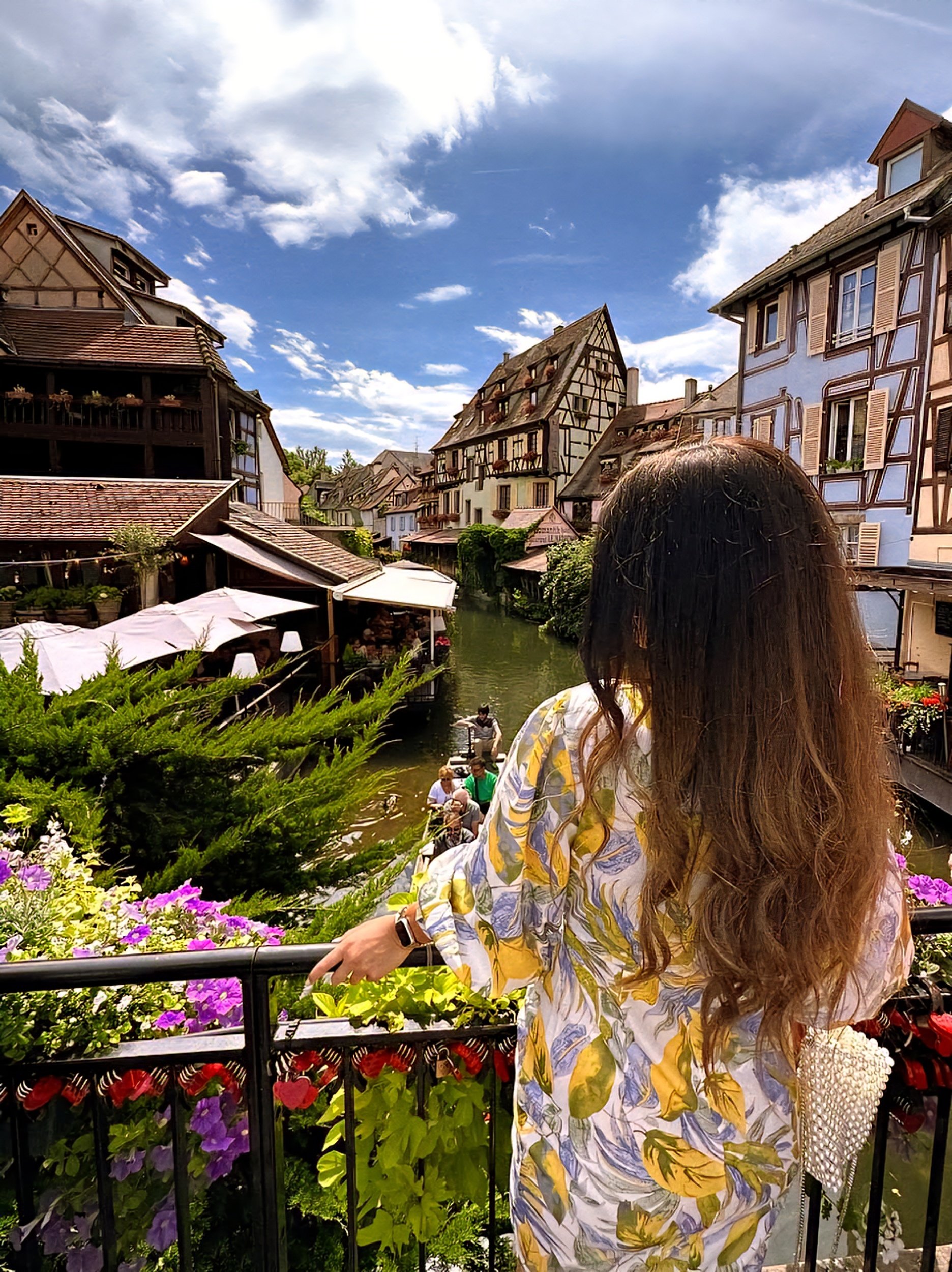
A lot of the same people planning spring trips through Alsace are also searching for food markets and smaller towns farther south, and these spring markets work especially well if your trips revolve more around cafés, market days, and long lunches than sightseeing routes.
Most people never walk beyond the bridge in Kaysersberg
Kaysersberg gets crowded in a very particular way during December, mostly because almost everybody arriving in the village ends up moving through the exact same narrow stretch between the stone bridge, Rue du Général de Gaulle, and Place de la Mairie at the exact same time of day.
By around lunchtime, the stone bridge connecting Rue du Général de Gaulle with Rue du Collège is usually so full of people stopping for photos that everybody else ends up weaving awkwardly around them carrying mulled wine cups, pastry boxes from Pâtisserie L'Enfariné, or shopping bags from the little stores near Place de la Mairie. Somebody pauses suddenly because they noticed a wine cellar tucked below one of the old timber-framed buildings, another group stops in the middle of the bridge trying to photograph the river from the exact same angle as everybody else, and within half an hour the whole center starts moving at the pace of whoever is walking slowest.
The bottleneck usually gets worst between the bridge, Place de la Mairie, and the narrow stretch of Rue du Général de Gaulle where the terraces and Christmas stalls squeeze the street even tighter. Then another shuttle bus arrives from Colmar, people spill out from the parking area near Place Gouraud, and suddenly the village feels much smaller than it looked in photographs online.
Around 08:30 in April, the bridge is still mostly empty apart from a few people stopping for bread before work and bakery deliveries trying to get through Rue du Général de Gaulle before the terraces start filling later in the morning. You hear the river properly again. Somebody drags buckets of tulips onto the pavement outside the florist near the church while delivery drivers unload pastry boxes beside Pâtisserie L'Enfariné, where the queue for kougelhopf and fruit tarts starts forming surprisingly early on weekends once people arrive from nearby villages.
Around 08:30, Kaysersberg still feels fairly local before the buses from Colmar start arriving closer to lunch. Tables outside Art is Show fill slowly with people drinking coffee while delivery vans unload bread and wine along Rue du Général de Gaulle before the street becomes too crowded to drive through easily. Near Rue du Collège, restaurant staff hose down terraces before lunch service, bakery queues begin forming outside Pâtisserie L'Enfariné, and the little lanes behind Église Sainte-Croix stay quiet enough that you mostly hear the river below the bridge and shutters opening above the old houses.
Most people never really move beyond the bridge and the streets closest to the river, which is why Kaysersberg starts feeling much more interesting once you wander a little farther uphill.
Around Rue des Forgerons and the quieter lanes climbing behind the church, the atmosphere changes surprisingly quickly. Laundry hangs between upper windows once spring gets warmer, tiny wine producers leave cellar doors half open without giant tasting signs outside, and some of the ceramics shops near Rue des Potiers still feel slightly chaotic in a good way with handmade bowls, pitchers, and pottery stacked unevenly beside the entrances instead of displayed perfectly for tourists.
Librairie Bisey also becomes much nicer outside Christmas market season because you can actually browse without constantly stepping aside for people carrying shopping bags and waffles through the aisles. Nearby, little independent shops selling old Alsace linen, regional cookbooks, handmade candles, pottery, and wine accessories start reopening outdoor displays once the weather settles properly in April.
And the village changes a lot once you start walking above it instead of through it. The climb toward the castle ruins begins almost immediately behind the center and gets steeper much faster than people expect after lunch and wine tastings, especially once the path narrows under the trees higher up the hill. But the best viewpoint is not actually from the ruins themselves.
There is a stretch slightly below the castle where the whole valley opens properly toward Ammerschwihr and the vineyards surrounding Kaysersberg, and late afternoon is usually the nicest time to walk up there once the light starts dropping across the hills. Around late April, the vineyard rows finally begin turning green again after months of muddy winter vines and bare branches, and from above you can see cyclists moving slowly between wineries below while the rooftops of the village start catching the evening light.
The quieter road leading out toward Kientzheim is worth walking too because almost nobody bothers leaving the center once they finish taking photos near the bridge. Around early evening, people sit outside smaller wineries there with glasses of Riesling before dinner while cyclists head back toward Colmar through the vineyards.
By around 18:30, the buses head back toward Colmar, the bridge finally starts clearing out, and restaurant staff at Flamme & Co stop trying to weave between people standing in the middle of the street taking photos. The river suddenly becomes louder again, conversations drift down from apartment windows above the wine shops, and the terraces settle into dinner service instead of nonstop turnover from sightseeing crowds.
If you start feeling slightly overwhelmed by the crowds around Colmar and Kaysersberg after a couple of days, these quieter market towns are much easier to actually settle into for a long weekend.
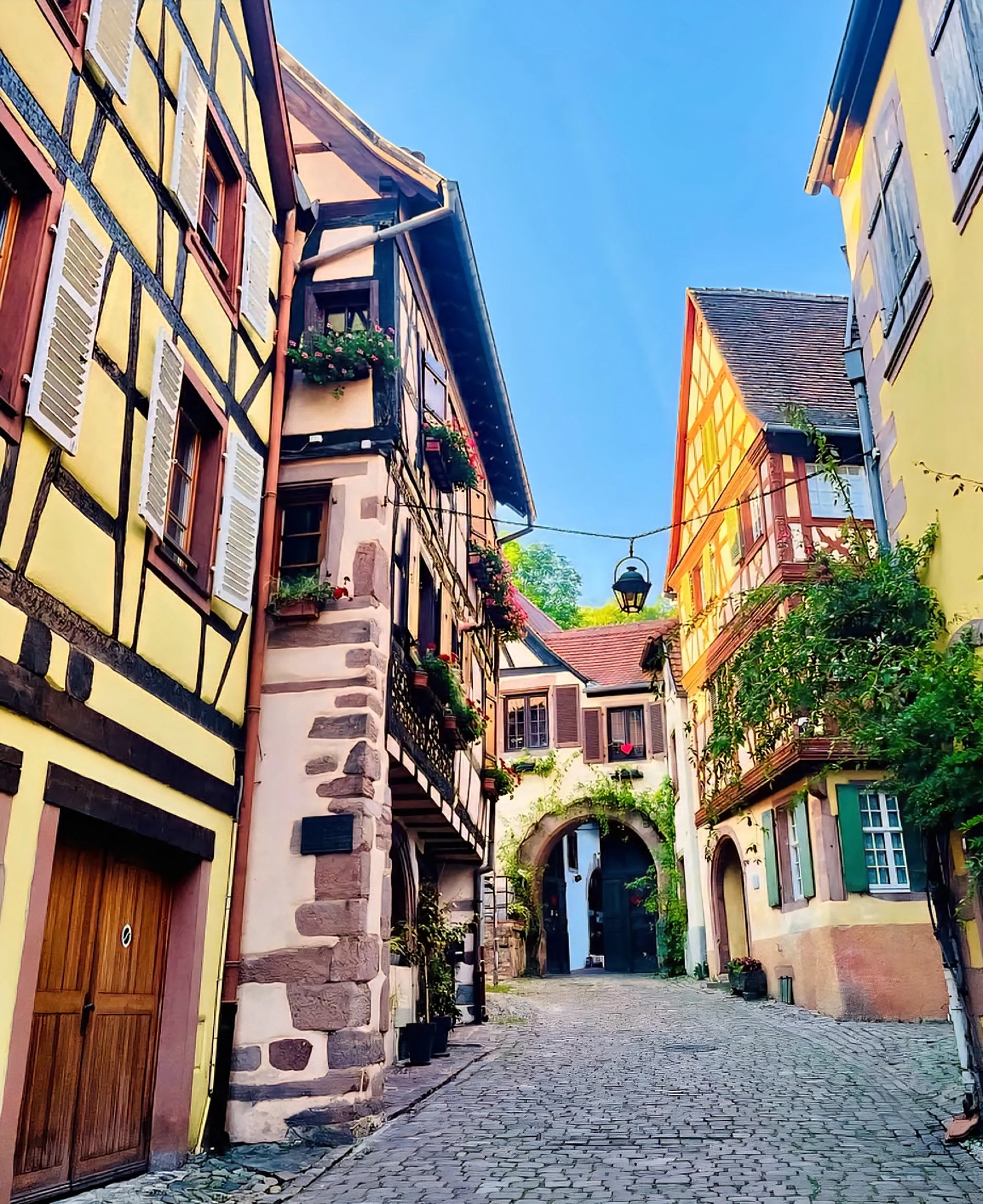
Wissembourg feels very different from the Alsace most people picture
Wissembourg sits so far north that it almost feels separated from the version of Alsace most people come looking for. A lot of visitors never make it beyond Colmar or the wine villages farther south, so Wissembourg ends up feeling much less shaped by tourism even during spring weekends when the weather gets warm and people start crossing over from Germany for lunch.
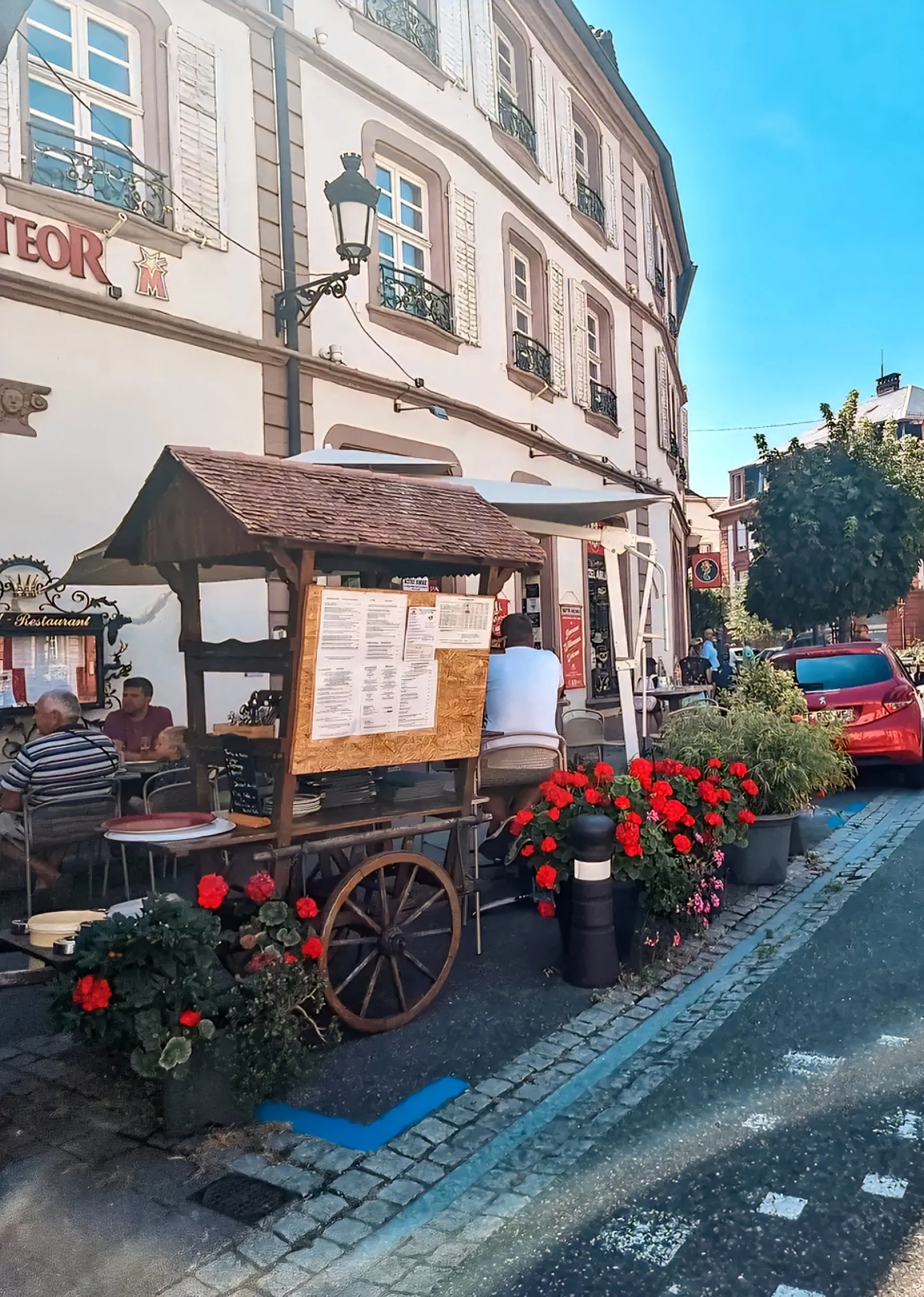
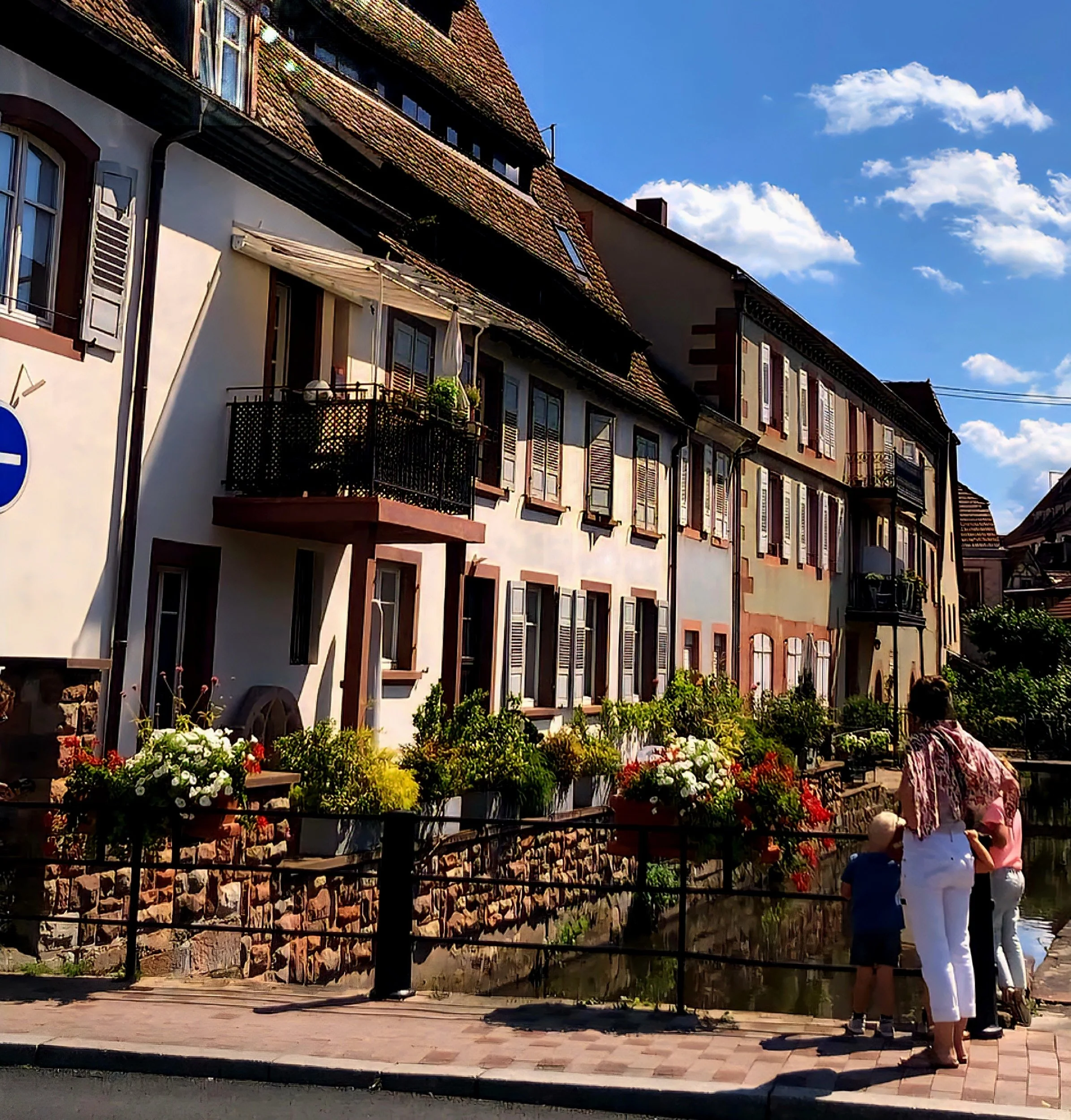
The town feels different straight away after arriving from Strasbourg by TER. The station sits a little outside the old center, and the walk in passes apartment blocks, bakeries, pharmacies, little garages, and normal residential streets before the canals and timber-framed houses start appearing near Rue Nationale. Nothing about the arrival feels staged. People are carrying groceries home, cyclists cut through Place de la République on the way to work, delivery vans stop awkwardly half across the road unloading pastry boxes outside bakeries before the streets narrow closer to the center.
Around 08:30 in spring, Wissembourg still belongs mostly to locals. At Pâtisserie Rebert, people queue for kougelhopf and pastries before work while flower stalls begin appearing around the square once the weather gets warmer properly again. Near Rue du Chapitre, shutters open one by one above the canal while restaurant staff drag terrace tables outside near Quai Anselmann before lunch service starts. You hear the water running through the Lauter much more than traffic in the mornings, especially around the little bridges near Église Saints-Pierre-et-Paul before the lunch crowd arrives from Germany later in the day.
And the area around the abbey church is where the town feels nicest once spring settles in.
The lanes behind Église Saints-Pierre-et-Paul, especially around Rue de l’Ordre Teutonique and Rue du Sel, stay quieter than the center even during weekends. Cats sleep beside cellar doors in the sun, flower boxes start returning to the windows around April, and the little water channels running beside the streets become noticeable again once winter market stalls disappear. Some of the smaller wine shops leave cellar doors half open during the afternoons, and near the canals the smell drifting through the streets is mostly bread, damp stone, flowers, and cellar air instead of waffles and mulled wine.
Wissembourg also has lots of places that still feel like they exist mainly for the people living there rather than visitors passing through for an afternoon. Librairie Clé des Arts feels like an actual neighborhood bookshop where people stop after work instead of somewhere curated around “French village aesthetics,” and around Rue Nationale there are antique shops with old Alsace wine posters fading in the windows, ceramics stores with handmade bowls stacked unevenly beside the entrances, little bakeries selling tarte flambée dough and pastries to locals preparing Sunday lunches.
Around late morning, the atmosphere shifts slightly once people start crossing over from Germany for lunch and the terraces near Quai Anselmann begin filling properly. At Salon de Thé Chez Max, people stay outside for a long time once the weather gets warm enough for terrace season, while cyclists stop briefly along the river after riding through the forest roads and countryside surrounding the border.
One thing people notice quite quickly after staying here a couple of days is how early parts of the town close outside weekends. By around 20:30, several smaller streets near the abbey church already feel almost empty apart from restaurant terraces and the occasional TER arriving from Strasbourg. Some bakeries sell out surprisingly early on Sundays, smaller shops close completely on Mondays during spring, and if you arrive back late expecting to “find somewhere later” for dinner, there is a good chance half the kitchens already stopped serving food.
The paths along the River Lauter are also much nicer in spring than during winter. Around late April, the canal edges and little parks near the old fortification walls turn very green again, cyclists ride slowly back into town covered in dust from the vineyard roads and forest paths, and people sit outside with Riesling near Quai Anselmann while the evening light catches the timber-framed houses above the water.
Wissembourg does not really have that formal “postcard Alsace” atmosphere people expect before arriving. The town feels slightly rougher around the edges than the villages farther south, but also more relaxed because of it. Once the evenings quiet down and the restaurant terraces settle into dinner service beside the canals, the whole place starts feeling much more like a border town people genuinely live in.
People who end up preferring Wissembourg over the more famous Alsace villages usually also like Semur-en-Auxois because it has the same slightly quieter, lived-in feeling once the day visitors disappear in the evening.
People who like Alsace once the vineyard roads turn green again usually end up loving these slower autumn towns once market season and wine harvests start properly later in the year.
Spring reveals how different these towns actually are
One thing that becomes very obvious in Alsace once December is over is how much easier the region is to enjoy when you are not constantly working around crowds, parking problems, and restaurant bookings.
In spring, plans change more naturally. You stay longer somewhere because lunch turned into wine. You stop at a small winery outside Barr because somebody left the door open and there are two people inside instead of twenty. You take the slower road between villages because the vineyard views are good and nobody is in a rush anyway.
And the towns stop feeling interchangeable.
Kaysersberg gets noticeably quieter after around 18:00 once the buses leave for Colmar and suddenly you can actually hear the river below the bridge again. In Obernai, people are still sitting outside the wine bars later into the evening while some of the smaller villages feel almost empty after dinner. Wissembourg stays calmer overall, but Sundays can catch people off guard because bakeries sell out early and several smaller places close completely by afternoon.
A small thing that helps a lot in Alsace during spring is starting earlier than you think you need to. The villages are completely different before lunch. Bakery deliveries are still happening, café terraces are only half full, and the streets around places like Eguisheim and Ribeauvillé still feel connected to everyday life instead of day-trip traffic.
And honestly, these towns work much better once you stop trying to see five villages in one day.
The nicest parts usually happen in between the obvious sightseeing anyway. Sitting outside after the lunch rush when the square starts emptying again. Walking back from dinner while shutters are closing above the canals. Realizing the terrace you almost skipped has the best evening light in the whole town.
If you are wondering whether December in Alsace is genuinely magical or just overcrowded by now, this guide to Montbéliard gives a much more realistic idea of what Christmas market season in eastern France actually feels like on the ground.
FAQ: Alsace in spring vs Christmas season
Is spring better than Christmas market season in Alsace?
For a lot of people, yes.
December is beautiful, but it also changes how the towns function. Parking fills early, restaurant reservations start controlling the day, and places like Kaysersberg, Eguisheim, and parts of Colmar become physically difficult to move through once the afternoon crowds arrive.
Spring keeps the atmosphere of the region without the same level of pressure. The vineyard roads reopen properly, terraces return to the squares, and the towns start behaving more like normal places again instead of seasonal attractions.
Which Alsace villages become too crowded during Christmas market season?
Kaysersberg, Eguisheim, and the old center of Colmar are usually the most difficult around weekends in December because the historic centers are relatively compact and the crowds compress into a few streets very quickly.
In Kaysersberg, the bottleneck usually forms between the bridge, Rue du Général de Gaulle, and Place de la Mairie by lunchtime. In Eguisheim, the circular streets around Place Saint-Léon fill up quickly once the buses arrive from Colmar.
Which Alsace towns feel most local outside Christmas season?
Barr and Wissembourg feel noticeably more local year-round because they are less dependent on tourism traffic than villages farther south.
Barr still functions first as a working wine town with schools, pharmacies, markets, bookstores, and local cafés woven into the center. Wissembourg feels even less tourism-focused because of its location near the German border and the fact that many visitors never travel that far north.
Which Alsace villages are easiest without a car?
Obernai and Barr are two of the easiest because both have TER stations within walking distance of the center.
Colmar also works well as a base without a car because trains connect easily toward Strasbourg, Sélestat, Mulhouse, and Basel.
Villages like Eguisheim and Kaysersberg are more awkward because they rely on buses, taxis, or rental cars once you leave Colmar station.
Which Alsace villages stay lively after dinner?
Ribeauvillé usually keeps the strongest evening atmosphere outside peak summer because the center stretches out more and the wine bars stay busy later into the evening.
Colmar also stays active later around Petite Venise and Place des Six Montagnes Noires, especially Thursdays through Saturdays.
Villages like Eguisheim can feel very quiet after around 20:00 outside weekends once the day visitors leave.
Is Colmar or Obernai better for a spring base?
It depends what kind of trip you want.
Colmar works better if you want stronger train connections, more restaurants, museums, wine bars, and easier day trips across Alsace.
Obernai feels smaller and calmer, and the station sits close enough to the center that arriving with luggage is much easier than in several other Alsace towns.
For slower 3–4 day trips without a car, Obernai is often less stressful operationally.
What time do Alsace villages get busy?
Most villages start filling noticeably between 10:30 and 12:00, especially once buses begin arriving from Strasbourg and Colmar.
The calmest hours are usually before 09:30 and after around 18:00 once the day-trippers leave again. Kaysersberg, Eguisheim, and Riquewihr change very quickly once the afternoon departures start.
Are Alsace villages too quiet at night in spring?
Some are.
Eguisheim and parts of Kaysersberg become very quiet outside Fridays and Saturdays once dinner service finishes.
Ribeauvillé usually stays active later, especially around Grand’Rue where wine bars and restaurant terraces remain busy into the evening.
Which Alsace towns are hardest to park in during December?
Colmar is usually the most frustrating overall because of the volume of visitors arriving for the Christmas markets.
Kaysersberg also becomes difficult surprisingly early in the day because the village is physically small and the parking areas outside the center fill quickly on weekends.
In spring, parking becomes significantly easier across most of the region.
How many days do you need for Alsace in spring?
Around 4–6 days works well if you want time to move slowly between towns instead of rushing through several villages in one day.
A common mistake is trying to fit Colmar, Eguisheim, Ribeauvillé, Riquewihr, Kaysersberg, Strasbourg, and the wine route into a weekend. The region works much better once you leave space for longer lunches, vineyard walks, markets, and slower travel days between villages.
What closes in Alsace on Sundays during spring?
Quite a lot outside the larger towns.
Some bakeries sell out by early afternoon, smaller independent shops often close completely on Sundays and Mondays, and restaurant kitchens in smaller villages may stop serving around 20:00 outside peak tourist periods.
This catches people off guard regularly in places like Wissembourg and Eguisheim where the centers become much quieter after lunch on Sundays.
Which Alsace towns work best for longer stays?
Ribeauvillé works well because the center stays active later and the surrounding vineyard walks are easy to access without constantly moving the car.
Obernai is one of the easiest without a car thanks to the TER station and direct Strasbourg connections.
For a quieter stay, Barr works especially well because it still feels connected to everyday local life outside tourism.