
Ribadeo or Viveiro: which is better for a weekend in northern Galicia?
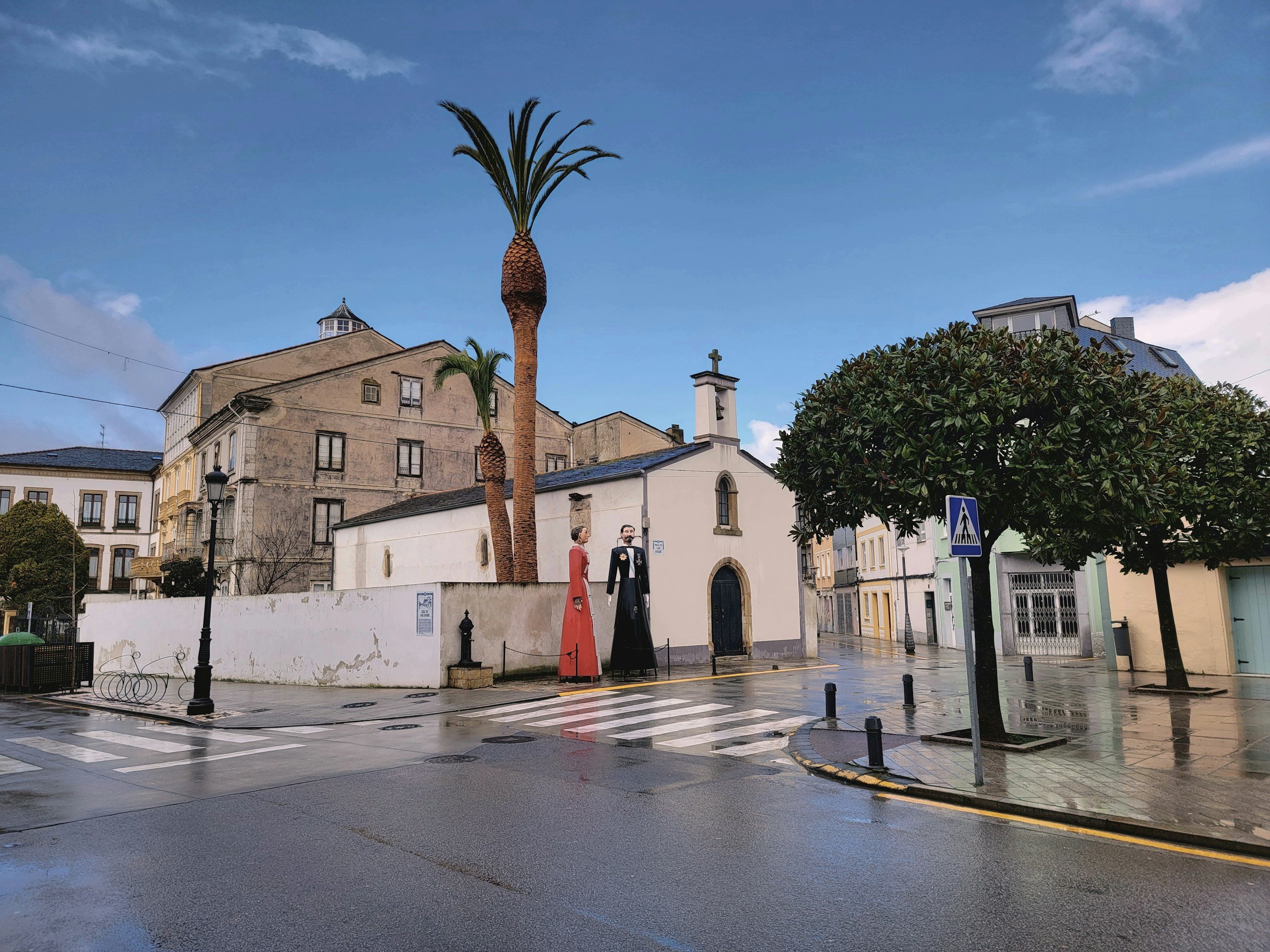
If I only had two nights, I would choose Ribadeo. I could stay somewhere near Praza de España, walk down to Porto de Porcillán, carry on past O Cargadoiro towards Illa Pancha and still have plenty of time for Rúa San Roque, a long lunch and an evening in town. Viveiro is the one I would choose if I had three or four nights, particularly if I wanted to walk to the beach in the afternoon and still have a few different streets to wander when I went out again for dinner.
It is surprisingly difficult to work that out from most guides, because Ribadeo is nearly always shown alongside Praia das Catedrais, while Viveiro is surrounded by photographs of beaches, forests and viewpoints. It makes both places look as though you can simply arrive and start walking to everything. In reality, Praia das Catedrais is around ten kilometres from Ribadeo and needs its own tide and transport plan, while several of the places casually included in Viveiro guides, including Souto da Retorta and Fuciño do Porco, are not easy little outings once you take away the car. Covas is different. You really can walk there from the old centre, which is one of the strongest reasons to choose Viveiro.
I would be more interested in what the weekend looks like once the famous beach or viewpoint has been dealt with. Ribadeo gives you a very easy day without needing to book or organise anything. You can have breakfast around Praza de España, follow the streets downhill to the harbour and continue towards Illa Pancha, then make the much less effortless climb back into town and spend the rest of the afternoon around Rúa San Roque. It does not sound like an ambitious itinerary, but that is rather the point. You are not left trying to find another excursion simply to fill the day.
Viveiro takes a little longer to get to know because its old centre, riverfront and Covas do not all sit in one compact pocket. You might start around Porta de Carlos V and Praza Maior, disappear into the streets behind Rúa Pastor Díaz for a while, then cross the Landro and walk towards the beach later in the day. There is also more going on when you come back out in the evening. Viveiro is hardly a lively resort, but it does not go quite as still as Ribadeo can once the shops close and the daytime visitors have left.
That is why I would not automatically book Ribadeo because Praia das Catedrais is the place I most wanted to see, or choose Viveiro because I liked the look of all the nature nearby. I would think about the less exciting but much more useful questions first: where I could walk after breakfast, whether reaching the beach would involve checking a timetable, what I could do if it rained and whether I would still enjoy being in town once the main outing was over. For a weekend without a car, those details would decide it for me.
Ribadeo or Viveiro? Here’s where I’d stay
If I were booking this as a two-night weekend, I would stay in Ribadeo. I could leave my bag somewhere near Praza de España, walk down to Porto de Porcillán that afternoon and still have the following day for Illa Pancha, Rúa San Roque and a lunch that did not have to be squeezed between several outings. Give me three or four nights, though, and I would choose Viveiro. Its old centre takes longer to explore, Covas is close enough for an unplanned afternoon at the beach, and there is simply more choice when you head back out after dinner.
How long I would stay: Two nights in Ribadeo; three or four in Viveiro. Ribadeo is easier to fit into a short weekend without feeling that you have missed half the town, while Viveiro makes more sense when you have time to divide your days between the old centre, the Landro waterfront and Covas.
Where I would arrive from: Ribadeo fits much more naturally into a journey from Oviedo, Luarca or elsewhere along the Asturian coast. Viveiro is the more sensible choice when approaching from Ferrol or A Coruña. There is a direct narrow-gauge train between Ribadeo and Viveiro, but it runs too infrequently for me to think of the two towns as interchangeable bases.
What the centres are actually like: Ribadeo makes an impression quickly because Praza de España, Torre dos Moreno and the indiano houses along Rúa San Roque sit within a small area. Viveiro is less immediate. Porta de Carlos V leads into Praza Maior, but you need to keep walking towards Rúa Pastor Díaz, Santa María del Campo and the streets behind the square before the old town starts to make sense.
Where I could walk to the beach: Ribadeo has Praia de Os Bloques, a small sheltered beach beside the estuary around one kilometre from the centre, but it is probably not the beach you had in mind when you started looking at Ribadeo. Praia das Catedrais is roughly ten kilometres away and needs a separate plan. From central Viveiro, I could cross the Landro and reach the long beach at Covas in around 20 minutes, without checking a bus timetable or arranging the day around low tide.
Whether I would catch the market: Ribadeo’s main market is on Wednesday and Viveiro’s is on Thursday, so neither fits neatly into a standard Friday-to-Sunday weekend. Ribadeo does also have a Sunday produce market, although it runs weekly during summer and less frequently in winter, so this is one of those details I would check before booking rather than assume it will be there.
What happens in the evening: Ribadeo becomes noticeably quieter once the shops close and the people visiting Praia das Catedrais have moved on. I would not mind that during a two-night stay, but Viveiro gives you more choice around Praza Maior and Rúa Pastor Díaz, as well as the option of walking towards Covas for dinner or a drink. It is not a busy resort town; it just does not feel quite as finished for the day.
Which one works better without excursions: Viveiro, particularly if I had more than two nights. The old town, riverfront and Covas give you three genuinely different parts of the day without requiring another bus journey. Ribadeo still fills a short stay very easily, but by the third full day I would probably want to go farther along the coast.
What I would be careful about: In Ribadeo, the awkward part is Praia das Catedrais. You need to look at the tide, check whether access is being regulated and find out whether the seasonal bus is useful on your dates. Viveiro has the opposite problem: travel guides make places such as Fuciño do Porco, Souto da Retorta and the surrounding beaches sound as though they are all part of town, when several become surprisingly complicated without a car.
Where I would stay: In Ribadeo, I would look around Praza de España or the upper part of Rúa San Roque, where I could reach the centre immediately without committing myself to the climb back from Porcillán every time I went out. In Viveiro, I would stay near Praza Maior, Porta de Carlos V or the central end of Rúa Pastor Díaz. Covas would only be my first choice if waking up close to the beach mattered more than staying among the older streets.
The biggest difference for me is how quickly each town comes together. Ribadeo is quite easy to understand from the moment you arrive. Praza de España gives you the arcaded Pazo de Ibáñez, Torre dos Moreno and the start of Rúa San Roque, while the streets towards the harbour make it obvious where to go next. The walk down to Porcillán is easy enough that you may barely notice the slope until you turn around and have to climb it again, but even that helps the town feel larger than it first appears.
Viveiro is more spread out, and I do not think I would judge it properly after one quick circuit of Praza Maior. The old centre continues beyond the streets you first see through Porta de Carlos V, and crossing Puente de la Misericordia changes the weekend again because the riverfront and Covas begin to feel like another part of town rather than an excursion. That extra space is exactly why I would choose Viveiro for a longer stay, although it also means Ribadeo is the easier place when time is tight.
So my answer is fairly firm. For two nights, I would stay near Praza de España in Ribadeo and leave Praia das Catedrais out if the tide or transport made it awkward. For three or four nights, I would choose Viveiro, stay in the old centre and treat Covas as somewhere I could walk to whenever the weather looked good. The famous attractions would not decide this one for me. The number of nights and the direction I was travelling from would.
Planning the trip for autumn may change the answer completely, and these October alternatives let you compare the Galician coast with stone villages, bookshops and inland food-and-wine stops that make more sense once the weather turns.
Why I’d choose Ribadeo for two nights
One of the reasons I would choose Ribadeo for a two-night weekend is that I can already see how the trip would work. I would spend the first afternoon around Praza de España and Rúa San Roque, walk down to Porcillán the following morning and then continue along the water towards Illa Pancha. That leaves enough time for a long lunch, a few shops and a quiet evening without constantly wondering whether I should be squeezing in another beach or finding a bus somewhere. Even without Praia das Catedrais, the weekend would still feel complete.
I would look for somewhere around Praza de España, Rúa San Francisco or the beginning of Rúa San Roque. Hotel Boutique Loriente and Hotel Mediante are both directly on the square, Hotel Ros Mary is just around the corner beside Santa María do Campo, and Hotel Rolle sits slightly farther downhill on Rúa Enxeñeiro Schulz. None of them would leave me thinking twice about going back to my room before dinner or dropping off something I had bought in town, which matters more on a short trip than a prettier harbour view. Porcillán looks very close when you check the map, but it sits much lower than the centre, and I suspect the novelty of that view would wear off rather quickly on the second climb back uphill in the rain.
On the first afternoon, I would probably start in Praza de España and see where I ended up rather than follow a formal route. Torre dos Moreno is impossible to miss, with its rounded dome and four stone figures holding up the corner tower, but knowing a little of the story makes the rest of Ribadeo easier to understand. The building was commissioned by brothers Juan and Pedro Moreno Ulloa after they made their money in Argentina, and when it was completed in 1915, all that concrete, iron and glass must have looked rather startling beside the older buildings around the square.
I like that the rest of Praza de España is not trying quite so hard to compete with it. Pazo de Ibáñez, now the town hall, runs along one side, Santa María do Campo faces the square from another, and Parque de San Francisco fills the middle with trees and benches. It looks like somewhere I would happily sit with a coffee for half an hour, but it is also a useful place to stay because several of Ribadeo’s main streets begin almost immediately around it.
Before the shops close, I would walk along Rúa Rodríguez Murias and the surrounding commercial streets. This is the part that tends to disappear from shorter Ribadeo guides, which move very quickly from Torre dos Moreno to Praia das Catedrais, but I would want to know what the town is like when nobody is looking at the architecture. There are clothes shops, pharmacies and food businesses beneath many of those grand façades, and during the day Ribadeo still feels like somewhere people from the surrounding area come to shop and get things done. That changes later, particularly once the visitors passing through for Praia das Catedrais have left and the shutters begin to come down, so I would not save this part of town for Sunday afternoon.
Rúa San Roque is where I would slow down and start looking properly at the houses. Ribadeo has an official Indianos route covering a little over two kilometres and fourteen buildings, but I honestly do not think I would spend my first afternoon trying to find every plaque. Walking the main stretch of San Roque would be enough, especially because the houses become much more interesting when you compare them with one another instead of treating them as fourteen stops that have to be completed.
Casa da Ayudantía is set behind iron railings and a small front garden, with a glazed gallery across the upper floor. Nearby, Esperanza Leiras is easier to recognise by the long glass gallery and little octagonal lookout above the roof, while Ascensión Pillado is heavier and more traditional, with granite around the windows and the owner’s initials worked into the ironwork. Casa de los Andes looks different again, with two metal-framed glass galleries, including one that rises into the roofline. These are the details I would remember before going, because “look at the indiano houses” is otherwise the sort of advice that sounds useful until you are standing on San Roque wondering which house you are meant to be looking at.
That would be more than enough for my first afternoon, especially once I had stopped for coffee, wandered into a few shops and inevitably spent longer than planned looking at one of the houses. I would leave Porcillán and Illa Pancha for the following morning, when I could take my time over the waterside walk and deal with the climb back into town before lunch. Ribadeo works over two nights because there is a very easy shape to the weekend, but it never needs to feel like an itinerary you are racing to finish.
If I still felt like walking, I would continue along Rúa San Roque as far as Casa Rosa and Parque dos Indianos before turning back towards the centre. Casa Rosa is not one of the houses you need help identifying, with its two enormous corner domes and a façade that seems to occupy half the street. The park opposite Casa de Sela is much quieter, but it tells another side of the same story. Returning emigrants did not only build elaborate homes for themselves; they also paid for gardens, schools and public spaces, and the mix of Galician and American plants here makes that connection easier to see.
The following morning, I would have breakfast at Mareta on Avenida Rosalía de Castro, particularly if I wanted something more substantial than coffee and a packaged pastry before the coastal walk. It is already in the upper part of town, which saves beginning the day with a climb from the harbour. From there, I would return through Praza de España, pass behind Pazo de Ibáñez and take the older lanes around Rúa Viejo Pancho and Rúa Trinidade towards the Capela da Atalaia.
This is where Ribadeo suddenly becomes much easier to understand. From the Atalaia, you can look across the estuary towards Figueras and Castropol in Asturias, with Porto de Porcillán and the marina directly below. There is a panoramic lift connecting the upper town with the waterfront, and it is certainly useful when it is working, but I would not plan the whole day around it. It has closed for mechanical problems before, so the steps and sloping streets are still worth remembering, especially when you have to make the journey in the opposite direction later.
Down at Porcillán, Ribadeo feels quite different from the streets around Praza de España. The marina is here now, but this was once the town’s commercial port, and the row of waterfront buildings still feels slightly detached from the shops, town hall and grand indiano houses above. I would only stop for lunch here if I wanted to stay beside the water and continue directly towards Illa Pancha afterwards. Going back uphill to eat in the centre and then returning to the harbour would turn one fairly enjoyable climb into two for no good reason.
The walk continues along Avenida Calvo Sotelo and beneath Puente dos Santos, the long road bridge crossing the estuary into Asturias. Shortly afterwards, you reach O Cargadoiro, which is much more interesting once you know why the stone structure is there. Iron ore used to arrive by railway from the mines around Vilaoudriz, now A Pontenova, and was transferred straight into waiting ships from a loading platform above the water. You can walk onto part of that old platform today, while the stone bays behind it show where the railway wagons once arrived. Without that background, it would be easy to see O Cargadoiro as no more than another viewpoint.
The next stop is Forte de San Damián at Punta do Carballo. There has been a defensive position here since the seventeenth century, although the fort was destroyed during an English attack, rebuilt and altered again over the following decades. What matters when planning the walk is that it is not simply an empty ruin you pass from the outside. The restored building contains a small interpretation centre, and admission and guided visits are currently free, although I would check the Forte de San Damián website before leaving because opening days and tour times are limited.
After the fort, Estrada do Faro continues for roughly another 1.5 kilometres towards Illa Pancha. This is the part where the walk begins to feel properly coastal. The estuary widens, the opposite bank slips farther away and the sheltered water around Porcillán gives way to the open Cantabrian Sea. Allow around 40 minutes each way between central Ribadeo and Illa Pancha if you walk fairly steadily, but that is not a realistic estimate for the whole outing once you have stopped at the Atalaia, O Cargadoiro and the fort. I would leave most of the morning free rather than treating the lighthouse as a quick there-and-back walk before lunch.
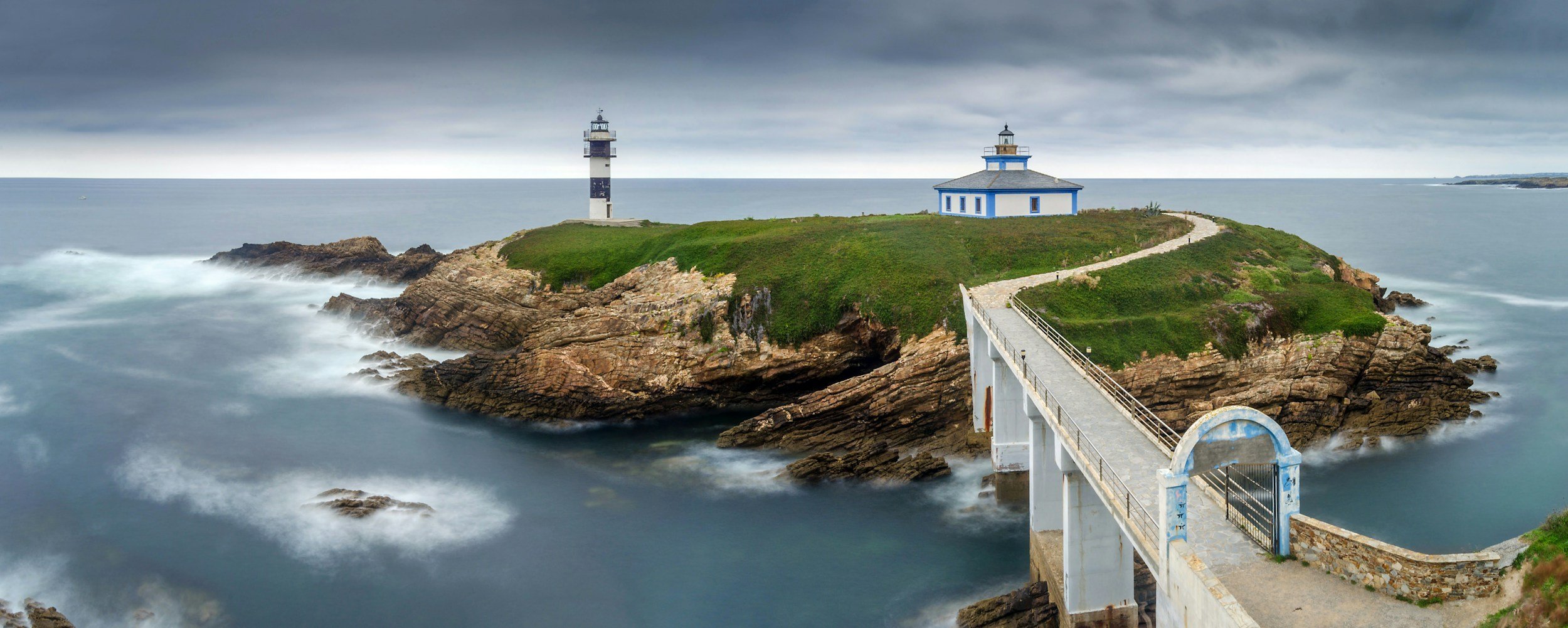
There are two lighthouses on Illa Pancha: the older square building and the much taller cylindrical tower with black and white bands. I would not assume that the bridge onto the island will be open, regardless of what photographs online appear to show. The official Galicia tourism page directs visitors to the viewpoint on the mainland, where you can see both lighthouses and the mouth of the estuary without needing access to the island itself.
The stretch beyond Forte de San Damián is also the most exposed part of the walk, with very little shelter once rain or strong wind comes in from the sea. I would check the forecast before setting off, but a grey or unsettled morning would not necessarily ruin the entire plan. The Atalaia, Porcillán and O Cargadoiro can still be joined into a shorter circuit, and Illa Pancha can be the part you abandon if the weather becomes unpleasant.
The climb back into Ribadeo is where you really notice how far below the centre Porcillán sits. If the panoramic lift is operating, it removes the sharpest section, but otherwise the streets below the Atalaia bring you steadily back towards Praza de España. This is exactly why I would do the waterfront and lighthouse as one complete outing rather than book a hotel at the harbour and repeat the climb every time I wanted coffee, shops or dinner in town.
For dinner that evening, I would stay in the upper centre rather than automatically return to Porcillán because it looks like the obvious place to eat beside the water. A Horta de San Roque, at number 44 on Rúa San Roque, serves Galician and Asturian dishes and has a covered garden terrace. I would book ahead at the weekend, particularly in summer, but its location makes much more sense after a day that has already involved walking down to the harbour and all the way back again.
There is another reason I would choose to sleep in Ribadeo rather than treat it as a quick addition to Praia das Catedrais. The centre tends to become busier from late morning in summer, when beach excursions stop around Praza de España, Torre dos Moreno and the nearest shopping streets. By late afternoon, many of those visitors have gone and Parque de San Francisco and Rúa Rodríguez Murias feel noticeably different. Ribadeo is quieter then, but not in a way that leaves you with nothing to do. You can go back to your room, have dinner close to San Roque and see the town after it has stopped being someone else’s hour-long coach stop.
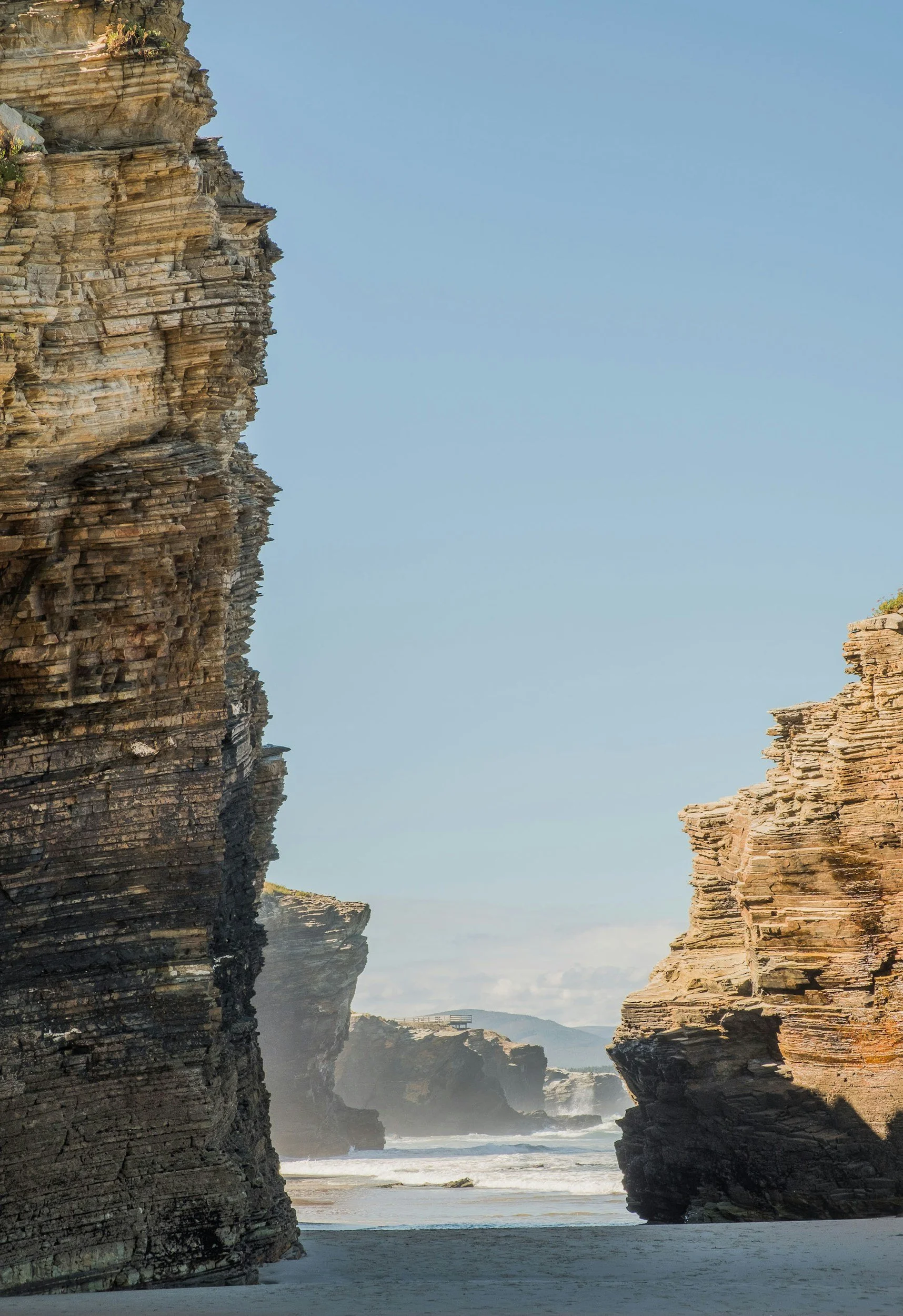
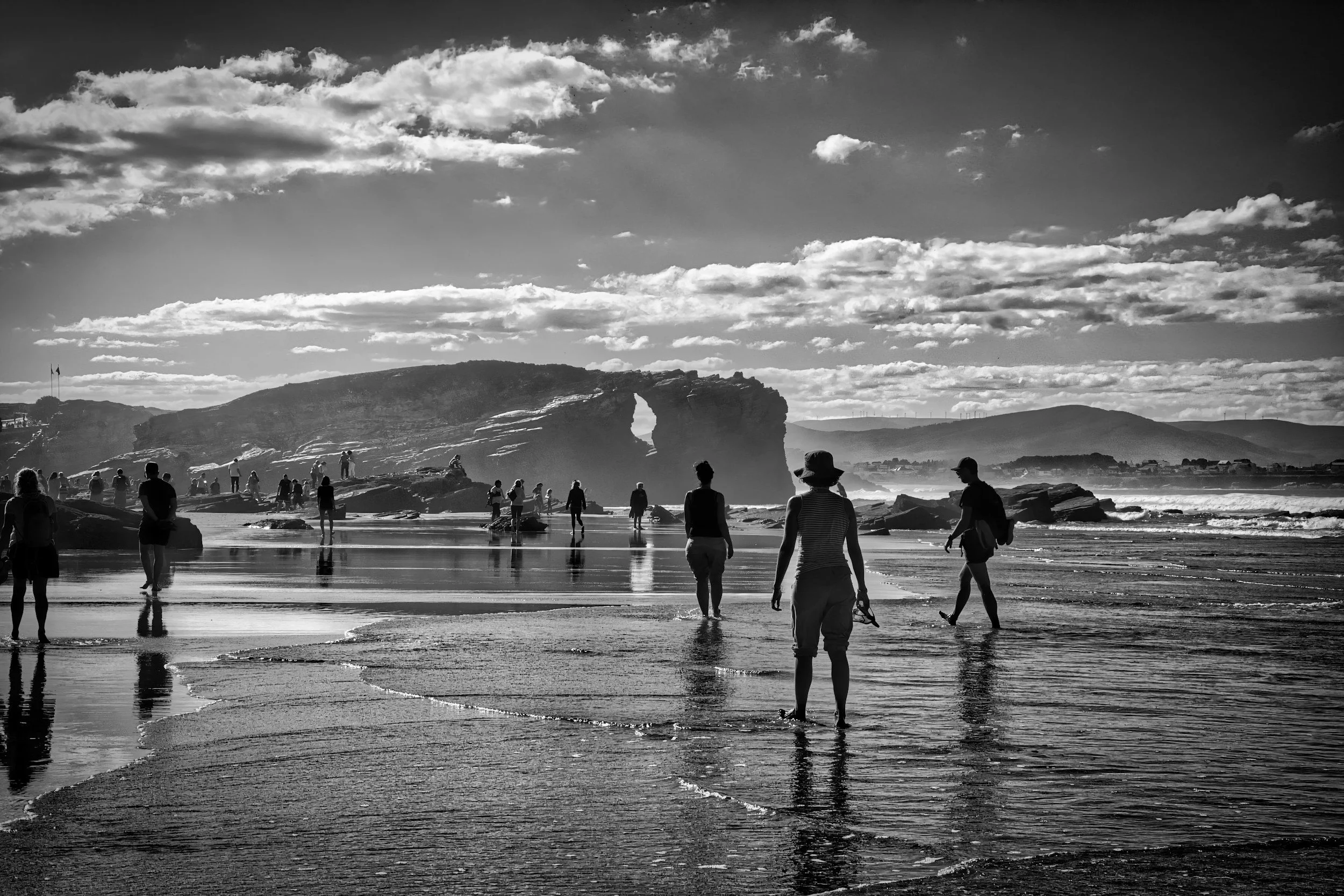
Praia das Catedrais can still be part of the weekend, but I would fit it around Ribadeo rather than build the entire stay around the beach. It sits roughly ten kilometres west of town near A Devesa, low tide decides when you can walk beneath the arches, and advance access rules apply during the busiest periods. Public transport also changes with the season, so a connection that looks straightforward in July may not exist in quite the same way later in the year.
This is why I would not stay beside Praia das Catedrais as a substitute for staying in Ribadeo when travelling without a car. Accommodation around As Catedrais and Arealonga is scattered between the coast, the N-634 and several small settlements. Once the beach visit is over, you do not have Rúa San Roque, Praza de España, the market or a choice of cafés outside the door, and a wet or very windy day leaves you with far fewer easy alternatives. In central Ribadeo, the beach becomes one possible outing. Beside the beach, it risks becoming the whole trip.
If the tide makes Praia das Catedrais impractical or I simply want a slower final morning, I would stay close to the hotel and walk towards the Mercado de Abastos. The market building stands behind the main commercial streets on Rúa José Vicente Pérez Martínez, and its exposed iron structure makes it look quite different from the older buildings around San Roque. Wednesday is the main weekly market day, while the producers’ market runs on Sundays throughout summer and on the second Sunday of the month during winter. I would check the date before getting excited about a Sunday market, though, because on weekends when it is not running this part of town is much quieter.
That gives the two-night stay a very easy shape: Praza de España and the indiano houses on the afternoon you arrive, one full day between the Atalaia, Porcillán and Illa Pancha, then the market area or whichever streets you missed before leaving. I would add a third night if Praia das Catedrais were essential and the low tide fell at an awkward time. For Ribadeo itself, two nights feel right. There is enough to fill the weekend without padding it out, and enough breathing room that lunch, the weather or an unexpectedly long stop somewhere do not throw the whole plan off.
Heading into Asturias after Ribadeo, these walkable northern bases will save you from choosing a town with a convenient station but no useful walks once you arrive.
Why Viveiro works better for town life and a beach on foot
Viveiro is the one I would choose for three or four nights because I would not need to plan an excursion every time I wanted to fill an afternoon. I could spend the morning around Praza Maior and Rúa Pastor Díaz, walk across the river to Covas when the weather improved, then come back for dinner without checking a bus timetable. That combination of an old centre, ordinary shops and a beach you can reach on foot gives Viveiro more variety than Ribadeo once you stay beyond the weekend.
There is one needlessly confusing detail if you arrive by train. Viveiro has two stops, and Viveiro Apeadero is the one closer to the historic centre. Travelling from Ferrol, the train calls first at the station named simply Viveiro, near Avenida da Xunqueira and Rúa Verxeles, then reaches Viveiro Apeadero about three minutes later. It would be very easy to see “Viveiro” on the platform, grab your bag and get off, only to discover that the next stop would have left you in a much more useful part of town.
Viveiro Apeadero is on Camiño Altamira, a short walk from the streets behind the old centre. It is a basic halt rather than somewhere I would arrive half an hour early and expect to find coffee or a comfortable waiting room, and the narrow-gauge trains are too infrequent to be casual about missing one. Adif lists Viveiro Apeadero and Viveiro station separately, so I would double-check which one appears on the ticket before travelling.
Arriving by bus is simpler. The station is on Rúa Ramón Canosa, beside the Mercado Municipal and only a few minutes from Porta de Carlos V. You can walk into the old town with your luggage rather than arranging a taxi from somewhere on the edge of Viveiro. Some booking websites call the stop Viveiro E.A., which simply means estación de autobuses. It is the central bus station, not a third arrival point to worry about.
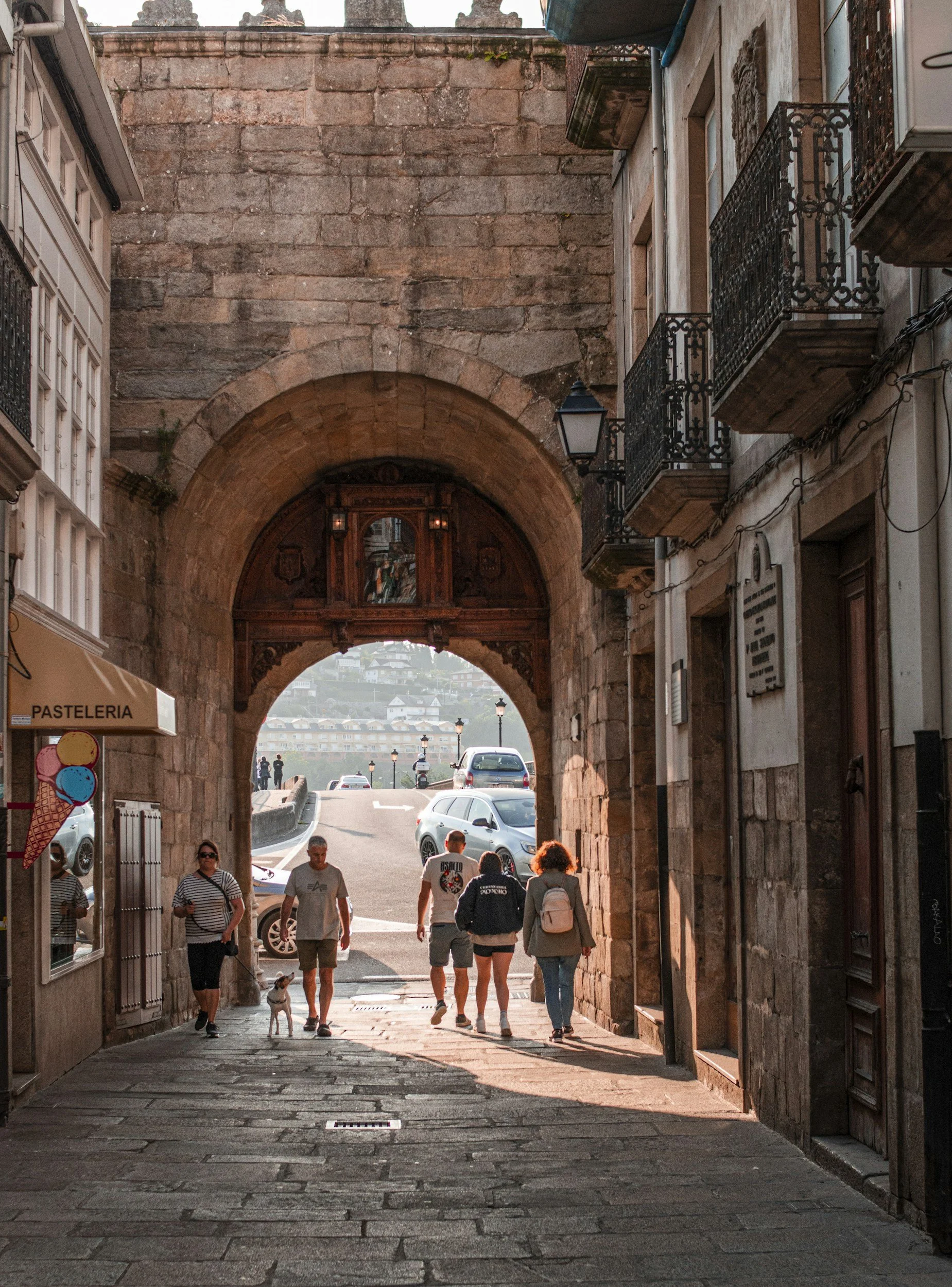
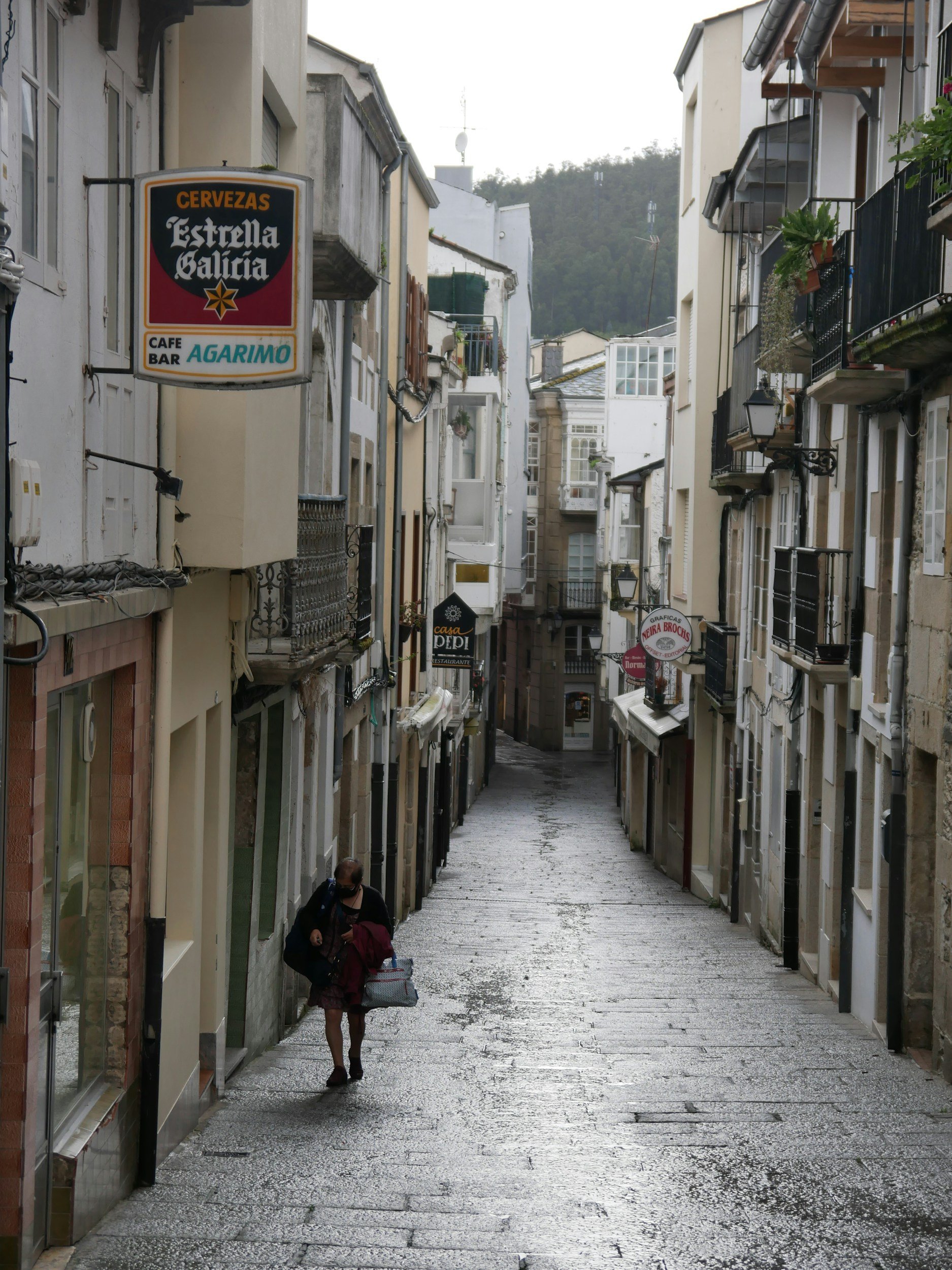
From the station, Porta de Carlos V is the obvious way into the old centre. It appears in almost every photograph of Viveiro, but it does not feel like a monument placed on its own for visitors. People still pass through it on their way between Rúa Ramón Canosa, Puente de la Misericordia and Praza Maior, so you will probably walk beneath it several times without deliberately adding it to the day.
The gate was built after the fire that badly damaged Viveiro in 1540, and the imperial arms and bust of Carlos V are still visible above the arch. I would look up once, but what I like more is where the gate takes you. Within a few minutes, you are among the cafés, bakeries and small shops around Rúa María Sarmiento and Praza Maior, rather than entering one of those old quarters that seems to contain little beyond restaurant menus and souvenir shops.
Praza Maior is smaller than the name suggests, and the buildings around it do not match particularly neatly. Granite fronts, iron balconies, slate roofs and enclosed Galician galleries all share the same compact square. The statue in the middle is Nicomedes Pastor Díaz, the Viveiro-born writer and politician whose name appears again on the main shopping street. On the corner of that street, Casa dos Leóns is easy to spot once you know to look for the two stone lions beside the old family coats of arms. Only the façade survives from the original seventeenth-century house, which is not something I would have guessed simply by walking past it…
Before continuing along Rúa Pastor Díaz, I would make a short detour onto Rúa María Sarmiento. Coffee Urban Roasters is at number 3 and serves speciality coffee, breakfast and homemade sweet and savoury pastries. A few doors farther along, Pastelería Vale has its own bakery and sells cakes, chocolates, Galician empanadas and handmade ice cream during the warmer months!
Rúa Pastor Díaz is where I would probably spend more time than expected. Panadería Mary Carmen is at number 44 if I wanted to pick up bread or something small for later, while Kalea at number 47 sells its own contemporary silver jewellery rather than the usual mass-produced souvenirs. O Recuncho, at number 55, is a possible stop for lunch or dinner, and the shops continue towards Praza de Lugo rather than ending as soon as you leave Praza Maior.
None of these places is a major attraction, but that is exactly the point. Over three or four nights, it matters that you can have coffee at Coffee Urban Roasters, collect an empanada from Pastelería Vale, browse the shops on Pastor Díaz and buy something for a picnic without turning the morning into a formal sightseeing route. Viveiro feels like somewhere people are still buying bread, meeting for coffee and running errands, not a historic centre waiting for visitors to arrive.
I would also walk towards the Mercado Municipal near Rúa Ramón Canosa, where the fish, meat, fruit and vegetable stalls bring another part of the town into the morning. From here, it is easy to continue towards the Igrexa de Santiago and the former Convent of San Francisco, then work back through streets such as Rúa Margarita Pardo de Cela, Rúa do Forno and Rúa da Zapatería. The older centre becomes more interesting once you move away from the short line between Porta de Carlos V and Praza Maior and begin finding these smaller streets for yourself.
The real advantage appears when you have finished with the centre but do not particularly want to arrange a day trip. Puente de la Misericordia takes you across the Landro, and from there you can continue towards the promenade at Covas and Praia de Covas on foot. You could spend the morning around Pastor Díaz, have lunch in town and decide afterwards that the sky looks clear enough for the beach. There is no advance booking, seasonal shuttle or awkward return bus to think about.
That is why Viveiro works so well for a slightly longer stay. I could begin the morning with coffee, wander through a few streets I had not seen the day before, stop at the market and only decide after lunch whether I felt like walking to Covas. The beach gives you another side of the town without taking over the entire trip, and because it is close enough to reach on foot, a sunny afternoon does not require any planning.
For coffee, caféURBANroasters is on Rúa María Sarmiento, just beyond the oldest lanes of the centre. It roasts its own beans and serves espresso, filter coffee and breakfast, so it is somewhere I would actually sit for a while rather than stop only to buy a pastry. A few doors away, Vale Pastelería sells empanadas, bread and slices of Tarta de Viveiro. Both are close enough to Praza Maior to become part of an ordinary morning, although I would still check the opening hours, particularly on Mondays and outside summer.
Behind Rúa Pastor Díaz, Viveiro becomes much easier to lose yourself in. The streets are no longer arranged around one obvious square, and names such as Rúa Zapatería and Rúa Ferreiros still refer to the shoemakers and blacksmiths who once worked here. Rúa Luis Trelles was traditionally associated with fish sellers, while nearby Praza de Fontenova opens unexpectedly between the narrower lanes, with café tables gathered around the fountain.
I prefer this part of Viveiro to repeatedly circling Praza Maior. The streets rise and fall slightly, the façades become narrower and the glass galleries sit above shops people still use. It feels less like a collection of buildings you are supposed to admire and more like a part of town you gradually get to know. I would probably take a different turn each morning and still end up finding my way back to Pastor Díaz or the square.
Farther uphill, Calexa das Monxas follows the garden wall of the Convento das Concepcionistas towards Porta do Valado. Only three of Viveiro’s original six gates remain, and this is where you can also see the best-preserved stretch of the medieval wall. The enclosed convent has been here since the eighteenth century, and pastries can still be ordered from the nuns rather than bought across a normal bakery counter. I would keep some cash with me and check locally whether they are selling that day, rather than assume there will be fixed shop hours.
Santa María do Campo is nearby and worth walking around rather than looking only at the main entrance. It is a small Romanesque church, with carved stone figures beneath the roofline and a later chapel on its northern side. These are easy details to miss when you arrive, take one photograph of the doorway and move on.
From there, Callejón del Muro follows another part of the former defensive line, while Porta da Vila opens onto the old Camino Real. The gate still carries a stone inscription dated 1217, with a small wooden shrine above the arch on the side facing the old town. None of these lanes takes very long to walk, but together they make Viveiro feel larger and more layered than it first appears from Praza Maior.
It would probably take me several walks to connect Porta do Valado, Santa María do Campo, Praza de Fontenova and Porta da Vila without looking at my phone. For me, that is part of the reason to stay for three or four nights. Viveiro is compact, but it does not feel finished after one walk through the main square.
Viveiro also gives you more choice once the afternoon turns into evening. Around Praza Maior, Praza de Fontenova and Rúa Pastor Díaz, cafés, tapas bars and restaurants are spread across several streets, while Covas has another cluster along Avenida de Cantarrana and behind the beach. It is not a town I would expect to stay busy late into the night outside summer, and there is still a noticeable pause during the afternoon, but dinner does not depend on one small harbour strip. I could return after a long walk, see what was open around Fontenova and Pastor Díaz and choose somewhere then, rather than having the evening decided for me before the day had even begun.
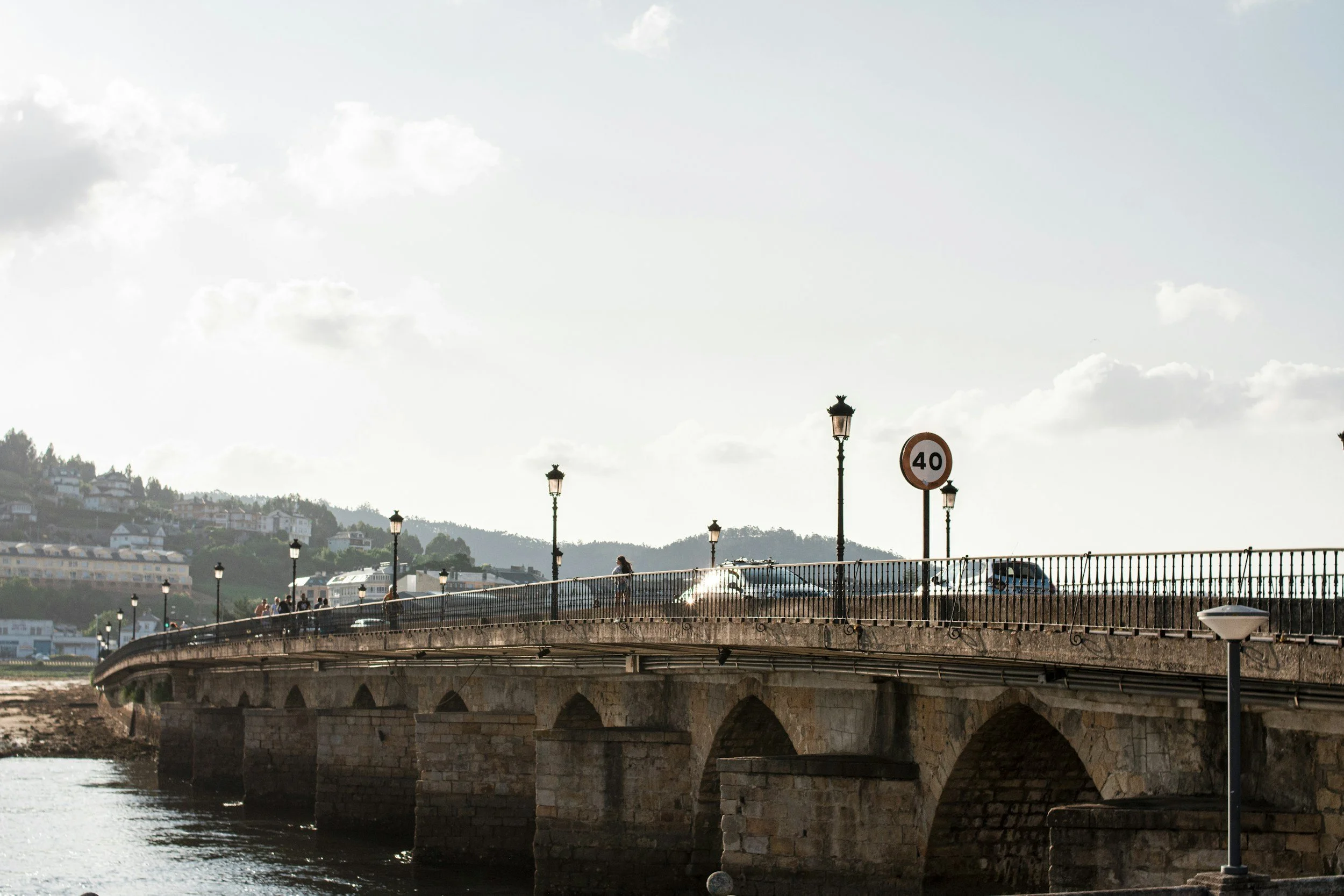
The walk to Covas fits naturally into this part of the stay because it begins almost directly outside Porta de Carlos V. Puente de la Misericordia crosses the Landro in front of the gate, taking you from the enclosed streets of the old centre towards the much more open waterfront. A bridge has stood here since at least the thirteenth century, although it has been rebuilt and altered several times, and nine of its original twelve arches can still be seen. The Cruz do Rollo remains on the bridge, while the small Ecce Homo chapel and Pazo de la Misericordia stand at the Covas end, so the change between the two sides of Viveiro happens gradually rather than beginning with an ordinary road out of town.
After crossing the bridge, the route turns beside the ría and continues past the marina towards Covas. It takes around 20 minutes from Porta de Carlos V to reach the first part of the neighbourhood, but that is only the beginning of the walk. Praia de Covas stretches for almost two kilometres, with a promenade running between the beach and Parque Pernas Peón, so I would not decide in advance exactly how far I needed to go. On a grey afternoon, I could walk to the first stretch of sand and turn back. If the weather improved, I could continue along the whole promenade towards Os Castelos and Seiramar.
Parque Pernas Peón makes that flexibility even more useful. Its trees, picnic tables and public toilets mean I could bring an empanada or something from the market without committing to sitting on an exposed beach, then move across to the sand if the clouds cleared. There is also a pond and a children’s area, with several beach entrances opening from the opposite side of the promenade.
Behind the park, Covas feels more like a residential part of Viveiro than a separate seaside resort. Avenida de Cantarrana and the surrounding streets have supermarkets, cafés, restaurants and apartment buildings that remain in use beyond the busiest summer weeks. I could stop here for coffee, buy something I had forgotten or stay for dinner before walking back, which makes the beach much easier to include in an ordinary day.
If I continued to the western end, I would eventually reach the dark slate rocks known as Os Castelos, which separate the main beach from Seiramar. A memorial near the rocks marks the wrecks of the frigate Magdalena and the brig Palomo, both lost during a storm in the ría on 2 November 1810. Seiramar carries on beyond them as a smaller extension of Covas, while the sixteenth-century Pazo de Grallal stands a little farther back among the later buildings.
This is why a “walk from Viveiro to Covas” can be anything from a quick look at the beach to most of an afternoon beside the water. Crossing the bridge, reaching the first section of sand and returning to the centre can take less than an hour, while walking through Parque Pernas Peón to Os Castelos and Seiramar adds several kilometres before the return. Covas also has its own railway halt, but the trains are too infrequent for me to assume I could simply catch one back when I became tired. I would only use it if a suitable departure already fitted my plans.
What makes the walk particularly worthwhile is how different Covas feels from the old centre, even though the two are so close. Around Praza Maior and Rúa Pastor Díaz, the streets are narrow, the shopfronts sit beneath stone façades and glass galleries, and it is easy to lose sight of the water completely. Cross Puente de la Misericordia and the view opens across the Landro before leading into the marina, park and long sweep of beach. I could spend a wet morning around the market and the lanes behind Praza de Fontenova, then walk all the way to Seiramar when the sky cleared without reorganising the rest of the day.
Monte San Roque is different and should not be treated as another casual extension of that walk. The viewpoint is around four kilometres from central Viveiro and stands 353 metres above sea level, with the signed route beginning along Rúa Antonio Bas before climbing towards the cemetery and continuing uphill to the chapel and recreational area. Although the distance may look manageable on a map, almost all of the height is gained directly from a town close to sea level. I would give it a separate half-day rather than attempt it after already walking the length of Covas.
At the top, the Ermida de San Roque sits among picnic tables and fountains, with views across Viveiro, Covas, the Landro estuary and the ports of Viveiro and Celeiro. The climb is exposed in places, however, and persistent rain can make the steeper sections slippery while also hiding much of the view. I would carry water, wear shoes with a decent grip and follow the marked route instead of relying on a map that shows little more than the road distance. The official Viveiro guide identifies Rúa Antonio Bas as the approach from the centre.
Covas is therefore the walk I could decide on after lunch, perhaps continuing to Seiramar if I still wanted to be outside. Monte San Roque is the one I would choose deliberately that morning and plan the day around. Having both within reach gives Viveiro much more variety over three or four nights than the town first appears to offer.
Covas is easy to fold into the day, but I would be more careful with the other nature spots often listed as things to do from Viveiro. They can look surprisingly close on a map, yet without a car, the distance is rarely the difficult part. The real question is whether I could reach the correct starting point and still have a sensible way back.
Souto da Retorta is a good example. The eucalyptus woodland lies around six kilometres inland at Chavín, and once there, the walk itself is easy. Some buses can take you as far as the village, but the stop is not beside O Avó, the enormous eucalyptus most people come to see, so there is still a walk to reach the woodland. I would only plan it after finding a return bus that genuinely worked, because six kilometres from Viveiro feels very different when the next service is several hours away.
Fuciño do Porco needs even more thought. It is regularly included in Viveiro guides, but the cliff walk is actually at Punta Socastro in neighbouring O Vicedo, beyond Praia da Abrela and close to Suegos. The boardwalk from the car park is only around 2.8 kilometres return, which makes the outing sound much simpler than it is. Getting to that car park is the awkward part.
The train to O Vicedo does not leave you at the beginning of the trail, so I would still need to arrange a taxi or turn it into a considerably longer walk. With so few trains running, I would work out the whole day before leaving Viveiro, including how I was getting back, rather than hope the connections came together once I arrived. Parts of the walkway have also closed for repairs in the past, so I would check the official Fuciño do Porco website before planning the trip around it.
The same applies to beaches that appear temptingly close when browsing accommodation pages. Praia de Area is across the ría, while Abrela, San Román, Xilloi and the smaller coves around Punta Socastro lie farther west along the coast. They may all be described as beaches near Viveiro, but they do not work in the same way as Covas when you are travelling on foot. I could walk to Covas because the sun came out after lunch. Reaching the others would mean finding a suitable bus or train, arranging a taxi or deliberately setting aside most of the day for a much longer walk.
I would not rule them out, but I would choose one and plan around it rather than try to squeeze several coastal places into the same day. For an afternoon when I simply wanted to be beside the water, I would stay with Covas and keep walking towards Os Castelos or Seiramar if the weather held. It gives you plenty of beach without turning the day into a transport puzzle.
Covas also works well in the evening because the walk back feels different once it gets dark. After dinner, I could follow the promenade beside the ría as the lights of the old town began appearing across the water. Puente de la Misericordia brings Porta de Carlos V back into view, and crossing the bridge leaves you almost directly outside the gate, with Praza Maior, Fontenova and the quieter lanes around Rúa Pastor Díaz only a few minutes farther on.
That easy return is one of the reasons I would choose Viveiro without a car. Souto da Retorta, Fuciño do Porco and the more distant beaches are possible when the transport lines up, but Covas never needs to become a carefully organised excursion. I could walk there when the weather suited me, stay for dinner and make my way back beside the Landro without thinking about the last bus.
Cedeira can look like an easy third option until you start comparing harbour apartments with rural guesthouses, and where to stay explains which part works best when every dinner, bus and beach walk needs to be manageable on foot.
Where you are arriving from may decide between Ribadeo and Viveiro
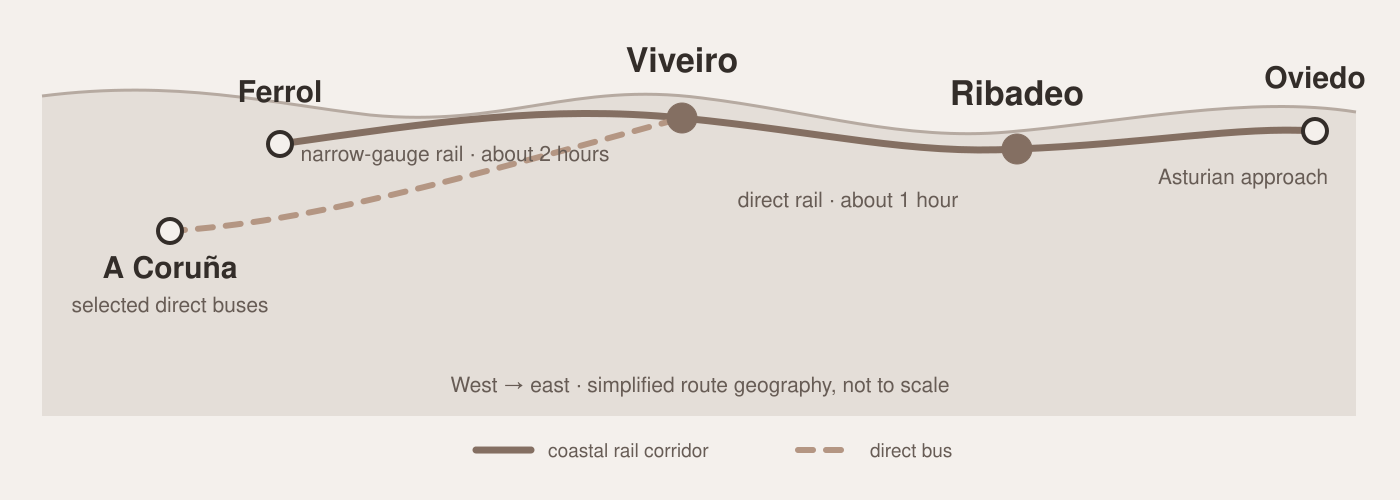
The direction you are already travelling from may make the choice between Ribadeo and Viveiro much easier than comparing everything the two towns offer. Coming from A Coruña or Ferrol, you reach Viveiro first, while a journey along the Asturian coast from Oviedo, Luarca or Navia naturally brings you to Ribadeo. They may sit on the same narrow-gauge railway, with only around an hour between them, but that does not mean either town is equally convenient from both sides.
From Oviedo, I would begin in Ribadeo. The direct bus usually makes better use of the day than the slow coastal train, although the train becomes more appealing if you are already travelling through western Asturias and do not mind taking longer to follow the coast. Starting in Luarca, Navia or Tapia de Casariego makes Ribadeo an even more natural next stop because you can continue west, cross into Galicia and arrive without passing the town only to return to it later.
Ribadeo is also the first sizeable Galician town you reach from this direction, and once you arrive, Praza de España, Rúa San Roque and the upper centre are all close enough to reach on foot. Unless Viveiro is where you actually intend to stay, there is little reason to step off one bus or train and immediately begin waiting for another. The onward journey takes roughly an hour once you are moving, but the service is infrequent enough that a short line on the map can become an awkward gap at the station and a much earlier departure from Asturias than the distance seems to justify.
Coming from Ferrol changes the order completely. The narrow-gauge train travels east through Xuvia, Cerdido and Ortigueira, then continues along the coast through O Barqueiro and O Vicedo before reaching Viveiro in around two hours. It is not a fast journey, but it is direct, and the final stretch passes through several small coastal places that would be difficult to include without a car. After a night in Ferrol, it feels like a natural continuation of the route rather than a day spent making connections.
Ribadeo lies another hour or more beyond Viveiro, after Xove, Burela and Foz, so I would only stay on the train that much longer if I were continuing into Asturias afterwards. For a short break, adding that extra stretch at the beginning of the trip would mean passing through the town that makes the most sense from Ferrol merely to reach the one farther away.
These old FEVE trains now appear on Renfe under Cercanías AM, short for Ancho Métrico, which makes them surprisingly easy to miss when you search only among the usual long-distance services. I would check the official Renfe Cercanías AM timetable using the actual date of travel, because some trains leaving Ferrol stop before Viveiro or Ribadeo rather than continuing along the whole coast. The different Renfe names and booking systems are unnecessarily confusing the first time you encounter them, so I have explained them more clearly in this guide to using trains in Spain.
From A Coruña, Viveiro is again the easier choice, although I would take the bus rather than travel by train to Ferrol and hope the onward departure matched. Some direct buses complete the journey in a little over two hours, with certain services taking around 2 hours 20 minutes, and they arrive at Viveiro’s station on Rúa Ramón Canosa. From there, Porta de Carlos V and Praza Maior are only a few minutes away, so you can leave the bus and walk almost immediately into the part of town where you are likely to be staying.
The one detail I would check carefully is the departure point in A Coruña, as search results can show either the main bus station or Os Castros depending on the service. That distinction matters much more when you are arriving by train or staying on the other side of the city with luggage. The Arriva Galicia journey planner and the official Galicia public transport planner are the places I would check for the date itself, rather than relying on a general route page that confirms a direct bus exists without showing whether it runs on the day you need it.
The train between Viveiro and Ribadeo is where a two-town trip can begin to look deceptively easy. It takes around an hour, passes through Xove, Burela and Foz without requiring a change, and leaves you within walking distance of both centres as long as you use the correct station in Viveiro. On paper, it sounds like the kind of transfer that could be fitted around breakfast or lunch without giving it much thought.
In reality, the hour on the train is not the part that shapes the day. The limited departures are. This is not a line where you can finish breakfast, wander to the station and assume another train will be along shortly, and some services shown around Ferrol do not continue as far as Ribadeo at all. When the only useful train leaves early in the morning or halfway through the afternoon, a journey that lasts barely an hour can still take a much larger piece out of the day.
Sundays and public holidays make that even more important. A direct bus from A Coruña to Viveiro that appears in a weekday search may not run on Sunday, while the remaining bus and rail options can leave at times that are technically possible but not especially useful. The problem is often not a complete lack of transport, but a departure that forces you to leave before breakfast, arrives after hotel reception closes or creates a long wait between two short journeys. I would always search with the exact travel date rather than build the trip around a timetable from another day of the week.
For that reason, I would not split an ordinary two-night weekend between Ribadeo and Viveiro. By the time you have packed, checked out, walked to the station, waited for the train and checked in again, much of the only full day has disappeared. You may technically have slept in both towns, but one becomes little more than an arrival evening and the other does not properly begin until Saturday afternoon.
With two nights, I would let the direction of travel decide. Ribadeo makes the most sense when you are arriving from Oviedo, Luarca or elsewhere along the Asturian coast, while Viveiro is the better choice from Ferrol or A Coruña. The direct train between them is useful, but it works much better as one stage of a longer route than as a reason to squeeze both towns into the same weekend.
Four nights is where dividing the stay begins to feel worthwhile, particularly when you keep travelling in the same direction afterwards. Coming from A Coruña or Ferrol, I would spend two nights in Viveiro, take the direct train to Ribadeo and then continue into Asturias. From Oviedo, I would reverse that order. Five nights is better still and allows the split that suits the towns more naturally, with two nights in Ribadeo and three in Viveiro.
At that point, the train no longer feels as though it has interrupted the trip because it links two stays that each have enough time to feel distinct. On one side are Viveiro’s larger centre, its old lanes and the walk to Covas; on the other are Ribadeo’s harbour, the indiano houses along Rúa San Roque and the route towards Illa Pancha. With fewer than four nights, though, I would not try to force both into the itinerary. I would look at the direction I was already coming from and let that make the decision.
Viveiro
The old FEVE and Cercanías AM names are usually where this journey starts looking more complicated than it is, and my Renfe explainer sorts out the service names, ticket types and regional routes before you end up planning around the wrong train.
Market days, Sundays and the weeks when the towns feel completely different
Market day changes both towns enough that I would plan around it if markets were one of the reasons for coming, although the timing is slightly awkward for an ordinary Friday-to-Sunday break. Ribadeo’s main weekly market takes place on Wednesday and Viveiro’s on Thursday, so arriving a day or two earlier would add far more to the trip than trying to squeeze another attraction into an already full weekend.
In Ribadeo, the Wednesday market gathers around the Praza de Abastos on Rúa José Vicente Pérez Martínez, behind the shops along Rodríguez Murias and Reinante, rather than in Praza de España as you might expect. Stalls spread into the surrounding streets and bring in shoppers from Ribadeo as well as the nearby municipalities, which makes the morning feel like part of the town’s normal week rather than an event arranged to give visitors something to photograph. I would arrive before lunch, when the market is properly underway and there is still time to look around the food hall and outside stalls, because by early afternoon traders are already packing up and the surrounding streets begin returning to their usual mixture of parked cars, shops and local traffic.
There is also a smaller Sunday market, Mercado dos Domingos, which is easy to confuse with the much larger Wednesday one but has a different feel altogether. This is where local producers connected with A Sucadoira sell vegetables, eggs, bread, preserves, honey and whatever else is available that week, so the selection naturally changes with the season. It would be the more convenient market for a weekend stay, but only if the date happens to match, because it runs every Sunday during summer and usually drops back to the second Sunday of the month in winter.
I would therefore check the current calendar before assuming a Sunday morning in Ribadeo would begin at the market. In 2026, the weekly summer edition was advertised from late June, running from 09:00 until 14:00 around the Praza de Abastos and continuing through summer into part of autumn, but those dates can shift from one year to the next. A July weekend is likely to include it, while an ordinary weekend in February or November may not, unless the stay happens to fall on the second Sunday of the month. The Concello de Ribadeo’s market page is the place I would check before choosing the dates.
On the right Sunday, Ribadeo can feel more interesting than Viveiro, particularly if the producers’ market is one of the reasons you have chosen to stay. I would begin around the Praza de Abastos, buy bread, honey or whatever had been brought in that morning, then walk through the upper centre and continue along Rúa San Roque before lunch. The market gives the morning a natural direction, and there are enough people moving between the stalls, cafés and surrounding streets to make this part of town feel properly in use.
The dates do need to line up, though, because Ribadeo can feel very different on a Sunday when the market is not running. Most independent shops are closed, the Mercado de Abastos should not be treated as a guaranteed Sunday stop, and the streets around Rodríguez Murias and Reinante lose much of the everyday activity that comes from deliveries, errands and people shopping during the week. The same walk through the upper centre is still pleasant, but I would plan it as a quiet morning rather than arrive expecting the market and find locked doors instead.
Viveiro’s main market takes place on Thursday morning, when the stalls usually fill Praza Maior and continue around the point where Rúa Pastor Díaz, Margarita Pardo de Cela and the older lanes meet. Because it is held in the centre rather than inside a separate market building, the morning spreads naturally into the surrounding cafés, bakeries and shops, with people moving back and forth between the stalls and the businesses along Pastor Díaz. This is when Viveiro feels most clearly like the commercial centre for the wider A Mariña area, particularly before lunch, when the square and the nearby streets are at their busiest.
I would still check where the market is being held before walking straight to Praza Maior, because festivals, public events and work in the square can move it elsewhere for a few weeks. During March and April 2026, repairs to the paving sent the Thursday stalls down to Jardíns Noriega Varela, and the gardens had also been used in August 2025 when summer events took over the centre. One of those August markets was even brought forward by a day because of the San Roque festivities, so someone relying on the usual Thursday location could easily have assumed it had been cancelled when it had simply moved.
Fortunately, Jardíns Noriega Varela is close to the bus station and only a few minutes from Porta de Carlos V, so finding the alternative site does not require a complicated detour. It does change the feel of the morning, however. In Praza Maior, the stalls sit among the old streets and draw you naturally towards Pastor Díaz for coffee or into the lanes behind the square afterwards. Down in the gardens, the market has more space and feels slightly separate from the shops in the old centre, although it is still easy to walk back through Porta de Carlos V once you have finished.
For a Thursday visit, I would therefore check the latest notice from the Concello rather than trust the permanent marker on a map, then arrive early enough to enjoy the market before traders begin packing away for lunch. Whether it is held in Praza Maior or beside the waterfront, the market is worth arranging the morning around, but the usual setting in the old centre gives you the better sense of how Viveiro works on an ordinary weekday.
The markets also show how much the experience of either town can depend on the day you arrive. On a Thursday or Friday morning, the streets are busy with ordinary errands, deliveries and people moving between shops, bakeries and cafés, whereas Sunday is much quieter once the market has finished or, in Ribadeo, when there is no market at all. Independent shops in both towns often close from around 13:30 or 14:00 until 16:30 or 17:00, although every business keeps slightly different hours, and many remain closed throughout Sunday. There will still be cafés, bars and restaurants open, but walking along Rúa Pastor Díaz or Rodríguez Murias on a Sunday afternoon is not the same as seeing those streets during the week.
I notice the difference more in Ribadeo because its commercial centre is smaller, so once the independent shops close and there is no Mercado dos Domingos to bring people into town, the remaining activity gathers quite quickly around Praza de España and whichever cafés are open nearby. Viveiro gives you a little more room to change plans, with places spread around Praza Maior, Avenida de Cervantes and Covas, although its old centre also becomes noticeably quieter. Rather than wait for the shops along Pastor Díaz to reopen on a Sunday, I would cross Puente de la Misericordia and spend the afternoon walking towards Covas, where the beach and promenade do not depend on opening hours.
Sunday is also the day when I would be most careful about the journey home. The narrow-gauge trains and regional buses do not all run to the same timetable at weekends and on public holidays, so a departure that works perfectly on Friday may disappear on Sunday or move to a time that is far less useful. This becomes particularly frustrating when the journey involves a connection in Ferrol, Ribadeo or A Coruña, because one reduced service can turn two fairly simple journeys into several hours of waiting.
I would check the exact departure date through Renfe Cercanías AM and the Galicia public transport planner before booking the accommodation, rather than leaving the return journey until the weekend itself. The same applies to Easter Sunday, national holidays and local public holidays, when a timetable found for an ordinary weekday tells you very little about whether you can still enjoy the final afternoon before leaving.
The day of the week matters, but there are also certain periods when the usual differences between Ribadeo and Viveiro almost disappear beneath a much larger event. Viveiro during Holy Week, for example, is not the quiet coastal town described through most of this guide. Its Semana Santa is recognised as a Festival of International Tourist Interest, with processions and religious events beginning on the Friday before Palm Sunday and continuing until Easter Sunday. In 2026, the programme ran from 27 March to 5 April, although the dates naturally move with Easter each year.
Many of the processions pass through the same streets I would otherwise use for an unplanned walk, including Avenida de Cervantes, Margarita Pardo de Cela, Praza Maior, Nicomedes Pastor Díaz and Irmáns Vilar Ponte. Good Friday is especially busy, beginning with the Encuentro between Praza Maior and the atrium of Santa María before several later processions, including the Desenclavo, Santo Entierro, Procesión de la Pasión and the late-night procession dos Caladiños. With barriers, spectators and processional routes occupying the centre for much of the day, moving through Viveiro becomes part of the event rather than an ordinary afternoon of wandering between the square and the river.
Semana Santa can be a very good reason to choose Viveiro when the celebration is what you have come to see, but I would not want to book that week accidentally while imagining empty lanes, spontaneous dinners and a quiet evening around Praza Maior. Rooms fill earlier, restaurants are more difficult to leave to chance and the centre remains active much later than it normally would on a spring evening. I would check the official Semana Santa de Viveiro programme before choosing Easter dates, even if I had no intention of watching every procession.
At the beginning of July, Resurrection Fest changes Viveiro even more dramatically. The four-day rock and metal festival is one of the largest events in the area, and in 2026 it ran from 1 to 4 July, bringing temporary facilities, organised transport and a considerable demand for accommodation into and around the town. Some of the official rest areas are in Parque Pernas Peón in Covas and at Monte San Roque, which are the very places I would recommend at another time for a relaxed beach afternoon or a quieter half-day above the town.
During the festival, Covas is no longer simply Viveiro’s residential beach neighbourhood. Supermarkets and cafés become busier, people continue moving between the beach, accommodation and festival facilities late into the night, and places to stay are heavily sought after. That can make Viveiro remarkably convenient for anyone attending Resurrection Fest, since the old centre, Covas and much of the festival infrastructure can be connected on foot, but it is entirely the wrong week for someone hoping to spend three quiet days walking between the old town and the beach. The official Resurrection Fest website publishes the current dates and practical details worth checking out.
Ribadeo has its own July weekend when the town feels completely different, although the event is closely connected to the architecture and history you encounter during an ordinary stay. Ribadeo Indiano celebrates the people who emigrated to Cuba, Argentina and elsewhere in the Americas before returning with new money, ideas and architectural influences. The 2026 edition took place from 10 to 12 July, bringing thousands of visitors into the centre, many dressed in early twentieth-century clothing, while music, period vehicles, exhibitions and cultural activities spread through the streets.
The Mercado de Ultramar forms part of the programme, with antiques, books, clothing, food, traditional crafts and products connected with the relationship between Galicia and the Americas. Rúa San Roque and Torre dos Moreno become particularly important because the indiano houses are no longer simply façades passed during a walk; they become the setting for the story the whole town is telling that weekend. It is a much more locally specific event than a generic summer festival and could easily be the reason for choosing Ribadeo, but it also fills the streets that normally make the town feel manageable over a quiet two-night stay. The Concello’s announcement for the 2026 Ribadeo Indiano anticipated thousands of visitors, so I would not arrive without booking ahead.
Even outside Ribadeo Indiano, July, August and much of September are shaped by the number of people visiting Praia das Catedrais. Free advance authorisation is required during Holy Week and from 1 July to 30 September, while low tide concentrates arrivals into a few useful hours rather than spreading them evenly across the day. When the best low tide falls in the late morning, buses, cars and organised excursions often reach Ribadeo at similar times before or after the beach, and Praza de España, Torre dos Moreno and the nearest section of Rodríguez Murias can become much busier than they were over breakfast.
That increase is not felt equally everywhere. Rúa San Roque becomes quieter as you move away from Praza de España, while the walk through Porcillán towards O Cargadoiro and Forte de San Damián distributes people differently from the central square. Even so, an ordinary July weekend can feel noticeably busier than one in May, with more pressure on accommodation, restaurants serving people who are only passing through and the most useful Praia das Catedrais access times filling in advance.
For the kind of town-based trip described in this guide, I would generally look at May, June, September or early October, while still checking the event calendar before booking. May comes before the main July festivals and usually avoids the Praia das Catedrais reservation period outside Holy Week, although Ribadeo’s Sunday producers’ market may still be following its winter schedule. In other words, choosing a random Sunday in May does not guarantee that the market will be there.
June gives you longer evenings for walking to Illa Pancha or continuing along Covas, while usually avoiding the busiest part of summer, but I would still look closely at the final week. Ribadeo’s weekly summer Sunday market may not have started yet, while preparations for Resurrection Fest can already be changing Covas as July approaches. The month itself is not the problem; the exact dates are what decide whether you find the quieter coastal stay described here or arrive just as one of the year’s largest events is beginning.
September still feels quite summery on this part of the coast, especially around Covas, where the promenade, beach and outdoor café tables remain easy to enjoy on a warm afternoon. The harbour walks in Ribadeo also benefit from the extra daylight, although the town can still be busy when good weather coincides with a useful low tide at Praia das Catedrais. Advance authorisation remains compulsory there until 30 September, so September should not be treated as a quiet alternative to July and August without first checking the tide times and reservation availability.
By early October, much of that beach traffic has eased and accommodation in central Ribadeo is often easier to find, which makes it a good time for a town-based stay rather than a trip planned mainly around Praia das Catedrais. I would not assume that the Sunday producers’ market is still running every week, however, because the summer schedule may already have ended. If the market matters to the trip, I would check the current calendar before choosing a particular weekend rather than arrive on Sunday morning expecting to find it.
The one thing I would not choose either month for is guaranteed sunshine. This is an exposed stretch of Atlantic and Cantabrian coast, and the weather can change quickly even on a morning that begins clear. Rain is entirely possible in May, the walk towards Illa Pancha can become much colder once the wind picks up, and an October front can make the open promenade at Covas somewhere you would rather not spend the afternoon. Ribadeo’s route beyond Forte de San Damián offers very little shelter, while in Viveiro the wind coming up the Landro is particularly noticeable on Puente de la Misericordia and along the more exposed side of Covas.
For me, the appeal of May, June, September and early October is not that they promise beach weather, but that both towns are generally easier to experience as actual towns. There is less pressure on accommodation, weekday shops and cafés are going about their usual business, and the main walks are not competing with the concentrated summer traffic surrounding Praia das Catedrais. I would still pack a proper waterproof jacket and keep one indoor plan in reserve, but I would take that uncertainty over arriving during a major festival or spending the day organising everything around a crowded low-tide slot.
Ribadeo and Viveiro both have the train in their favour, but a weekend in Cedeira is worth considering if you would trade easier connections for a smaller fishing town with a beach, harbour and coastal walk right outside the centre.
So, which one would I actually choose?
For two nights without a car, I would go with Ribadeo. It is small enough that you can arrive, leave your bag and start walking without needing much of a plan, but there is still enough to fill the weekend. You have the harbour, the indiano houses along Rúa San Roque and the walk out towards Illa Pancha, and two nights feels about right rather than slightly rushed.
Give me three or four nights, though, and I would book Viveiro. There is more to wander around, more choice when it comes to dinner, and Covas means you can wake up, see that the weather is good and walk to the beach without organising anything. It is simply easier to spend a few days there without feeling that you need to come up with a new excursion every morning.
What you most want from the trip matters more than which town is prettier. For a proper beach you can walk to, I would stay in Viveiro. For Praia das Catedrais, I would stay in Ribadeo. I would also let the rest of the journey decide: Ribadeo fits much better if you are coming from or continuing into Asturias, while Viveiro makes far more sense from Ferrol or A Coruña. On a short trip, I would not sit on another slow train just because the other town looked a little nicer in photographs.
I would happily spend two quiet evenings in Ribadeo, especially once the day visitors have left and the centre settles down. If I were staying longer and wanted more places to try, I would rather be in Viveiro. The markets would only change my answer if Ribadeo’s Sunday producers’ market happened to be running, as neither town’s main weekly market is much help on a normal Friday-to-Sunday trip.
With four or five nights, I would stop trying to choose and stay in both. Two nights in Ribadeo followed by two or three in Viveiro gives you enough time to properly enjoy each one, and the train between them starts to make sense. Trying to squeeze both into the same weekend would mean spending too much of Saturday checking out, waiting for a train and checking in again.
My honest answer is still this: Ribadeo is better for a weekend. Viveiro is the one I would choose when I had a few more days and wanted to settle in a little.
If Ribadeo and Viveiro still feel quite similar on paper, my northern Galicia breakdown brings Cedeira, Betanzos and Mondoñedo into the decision too, including which town works for two nights, which makes a better base and where Sunday transport becomes a nuisance.
FAQs about choosing between Ribadeo and Viveiro
Is Ribadeo or Viveiro better for a weekend without a car?
For an ordinary two-night weekend, I would choose Ribadeo. It is smaller, easier to explore on foot and gives you enough time for Praza de España, Rúa San Roque, Porcillán and the coastal walk towards Illa Pancha without needing to organise a day trip. Viveiro becomes the better choice when you have three or four nights and want a beach, a larger town centre and more places to walk to directly from your accommodation.
How many nights do you need in Ribadeo?
Two nights is enough to enjoy Ribadeo itself without rushing. That gives you one full day for the centre, the indiano houses along Rúa San Roque, Porcillán harbour and the walk past O Cargadoiro towards Illa Pancha. Stay for three nights if Praia das Catedrais is essential, as the tide and limited public transport may decide which part of the day you can visit.
How many nights do you need in Viveiro?
I would allow three nights for Viveiro, particularly without a car. The old centre and Covas can comfortably fill two days, while a third gives you time for the full beach promenade or the climb to Monte San Roque if the weather is good. Four nights still works if you would rather settle into the town than arrange excursions along the coast.
Can you visit Ribadeo and Viveiro on the same weekend?
You can, but I would not split a two-night weekend between them. The direct narrow-gauge train takes roughly an hour, yet the limited departures mean checking out, waiting for the train and checking in again can take over the middle of your only full day. Staying in both begins to make sense with four or five nights.
Which town is better for beaches?
Viveiro is the clear winner when you want a beach you can reach easily on foot. Covas begins around 20 minutes from the old centre and continues into a long promenade with cafés, supermarkets and Parque Pernas Peón behind it. Ribadeo is the better base for visiting Praia das Catedrais, but the beach lies about ten kilometres outside the town and cannot be treated as a spontaneous walk from your hotel.
Where should you stay in Ribadeo or Viveiro without a car?
In Ribadeo, I would stay close to Praza de España, Rúa Rodríguez Murias or the beginning of Rúa San Roque, rather than choosing accommodation near Praia das Catedrais and becoming dependent on transport. In Viveiro, stay near Porta de Carlos V for the old centre and easiest bus access, or in Covas if walking to the beach matters more than being beside the historic streets.
Are Ribadeo and Viveiro easy to explore on foot?
Both town centres are walkable, but they work differently. Ribadeo is more compact, although the route towards Illa Pancha adds a longer coastal walk, while Viveiro spreads across the river and requires around 20 minutes on foot to reach Covas from the old centre. Neither requires a car for the places that make the town itself worth visiting.
Is Ribadeo or Viveiro better when the weather is bad?
I would choose Viveiro for a longer stay when the forecast looks unsettled. Its larger centre gives you more cafés, shops and streets to move between, while Covas remains useful for a short walk between showers; Ribadeo is still enjoyable in poor weather, but more of its appeal depends on the exposed routes towards Porcillán, O Cargadoiro and Illa Pancha.
Can you reach Praia das Catedrais from Ribadeo without a car?
Yes, although it takes more planning than the short distance suggests. A direct summer bus normally runs from Ribadeo bus station to Praia das Catedrais, while services outside the main season are more limited and may leave you with a walk from the nearest stop or the cost of a taxi. Check the transport, low-tide time and seasonal access requirement together, because finding a bus is little use if you arrive when the famous arches are underwater.
Which town is easier to reach from A Coruña?
Viveiro is considerably easier from A Coruña. Some direct buses complete the journey in a little over two hours and arrive close to Viveiro’s old centre, whereas reaching Ribadeo usually takes longer or involves an additional connection. For a short break from A Coruña, I would choose Viveiro unless Ribadeo is part of a longer journey continuing into Asturias.
Which town is easier to reach from Oviedo?
Ribadeo is the more practical choice from Oviedo, with direct bus connections and a position just across the Galician border from Asturias. It also fits naturally into a route through Luarca, Navia or Tapia de Casariego. Reaching Viveiro means continuing west for roughly another hour on a railway where the departure time matters far more than the distance.