The easiest Champagne villages to visit without a car from Reims
You can have breakfast in Reims, catch an ordinary TER and be standing in a wine village 13 minutes later. In Rilly-la-Montagne, Champagne houses line Rue de Reims and the vineyard paths begin just beyond the last row of homes. There is no tour to join or complicated journey to arrange, which makes it surprising that this option is so rarely mentioned when people talk about exploring Champagne without a car.
The railway between Reims and Épernay is known as La Ligne des Bulles, with stops at Rilly-la-Montagne, Germaine, Avenay-Val-d’Or and Aÿ-Champagne. On the timetable, they can look equally practical, but they work very differently once you start planning a day around tastings, lunch and the gaps between trains. Rilly is the easiest place to combine all three with a vineyard walk, while Aÿ has enough cafés, shops and places to visit to fill an entire day. Germaine and Avenay are far quieter, which may be exactly what you want, but I would only choose either after arranging lunch and deciding how you will spend the time between trains.
Some of Champagne’s best-known villages are actually more difficult to reach. Hautvillers appears in almost every regional guide but has no railway station, while several villages that receive far less attention have direct connections from Reims. Even in those places, however, arriving by train does not mean you can simply walk into the nearest Champagne house and begin a tasting. Most visits must be booked in advance, lunch options can be unexpectedly limited and not every TER stops in every village.
This is not simply a list of Champagne’s prettiest villages. It is an honest guide to the places you can realistically visit from Reims without a car, including what there is to do on foot, where lunch is possible, which tastings make sense and how much time each stop deserves. I have also included the seasonal Grand’R bus from Bezannes, which reaches Verzenay, Verzy and several places missed by the train. Getting into the vineyards can be remarkably straightforward, but choosing the right village matters far more than the timetable initially suggests.
The quick answer: which Champagne village is easiest from Reims?
Rilly-la-Montagne is the easiest Champagne village to visit from Reims without a car. The direct TER takes around 12 minutes, the station is close to the centre and several growers accept individual visitors when booked in advance. With a little planning, you can fit a cellar visit, lunch and a vineyard walk into the same half-day without spending more time travelling than you do in the village.
Rilly will not suit everyone, however. Aÿ-Champagne is more practical for a full day when you want some flexibility, Avenay-Val-d’Or is better for a quiet village walk and picnic, and Germaine makes far more sense for its forest trails than for moving between Champagne houses.
Rilly-la-Montagne for the easiest first trip
Rilly is the village I would choose for a first car-free day in Champagne. The journey from Reims is short, the centre is easy to explore on foot and there are several producers where individual visitors can arrange a proper cellar tour instead of arriving and hoping somebody happens to be available.
It also has something that the two smaller stops struggle with: a realistic chance of combining Champagne with lunch. I would still check opening days and reserve both before leaving Reims, but you are not automatically dependent on whatever you brought in your bag. The five-kilometre walk around Rilly takes roughly one hour and 40 minutes, passing the village church, vineyard views and the entrance to the old railway tunnel, so it fits neatly between a late-morning tasting and the return train.
Four or five hours should be enough, although the timetable may make that decision for you. The only real catch is that Rilly feels easy when the important parts have already been arranged. Turn up without a producer booking or any idea of where to eat and the day could still feel much emptier than expected.
Aÿ-Champagne for a full day
Aÿ is around 27 minutes from Reims and the safest choice when you want more than a tasting and a walk to justify the journey. You can follow the Musardises heritage route through the old centre, walk beside the canal, visit Pressoria and arrange a cellar tour at Champagne Ayala. Pressoria is about 15 minutes from the station on foot, so there is no need to organise a taxi after arriving.
The village also has cafés, restaurants, bakeries and everyday shops, along with a Friday morning market on Place Henri Martin. That gives you far more room to change the day as you go, particularly if the weather turns or a tasting ends earlier than expected.
I would give Aÿ most of the day rather than trying to fit it into a few hours. It may not be the tiny vineyard village some travellers imagine when planning a Champagne trip, but that is exactly why it works so well without a car. If your original plan falls apart, you can still find lunch and enough to do before the next train.
Avenay-Val-d’Or for a quiet walk and picnic
Avenay-Val-d’Or is the one I would choose when the real appeal is walking through a small village and the surrounding vineyards, rather than filling the day with tastings. The train takes around 23 minutes from Reims and arrives beside the River Livre, with the Saint-Trésain church, an old wash house and several walking routes nearby.
The simplest option is the 2.5-kilometre Si Avenay m’était conté trail, which takes around an hour and leads you beyond the short main street. Longer routes continue towards the vineyards and Mont Aigu when the paths are dry, but I would not arrive expecting to find an easy lunch afterwards. Bring something from Reims or confirm exactly what will be open, then use the picnic tables beside the river.
Avenay works best as four or five quiet hours with one grower visit arranged in advance. It is not a village where you can wander between open tasting rooms, but it may be the most appealing choice if your ideal day involves one thoughtful tasting, an unhurried walk and lunch outdoors.
Germaine for forest walks, not an easy tasting day
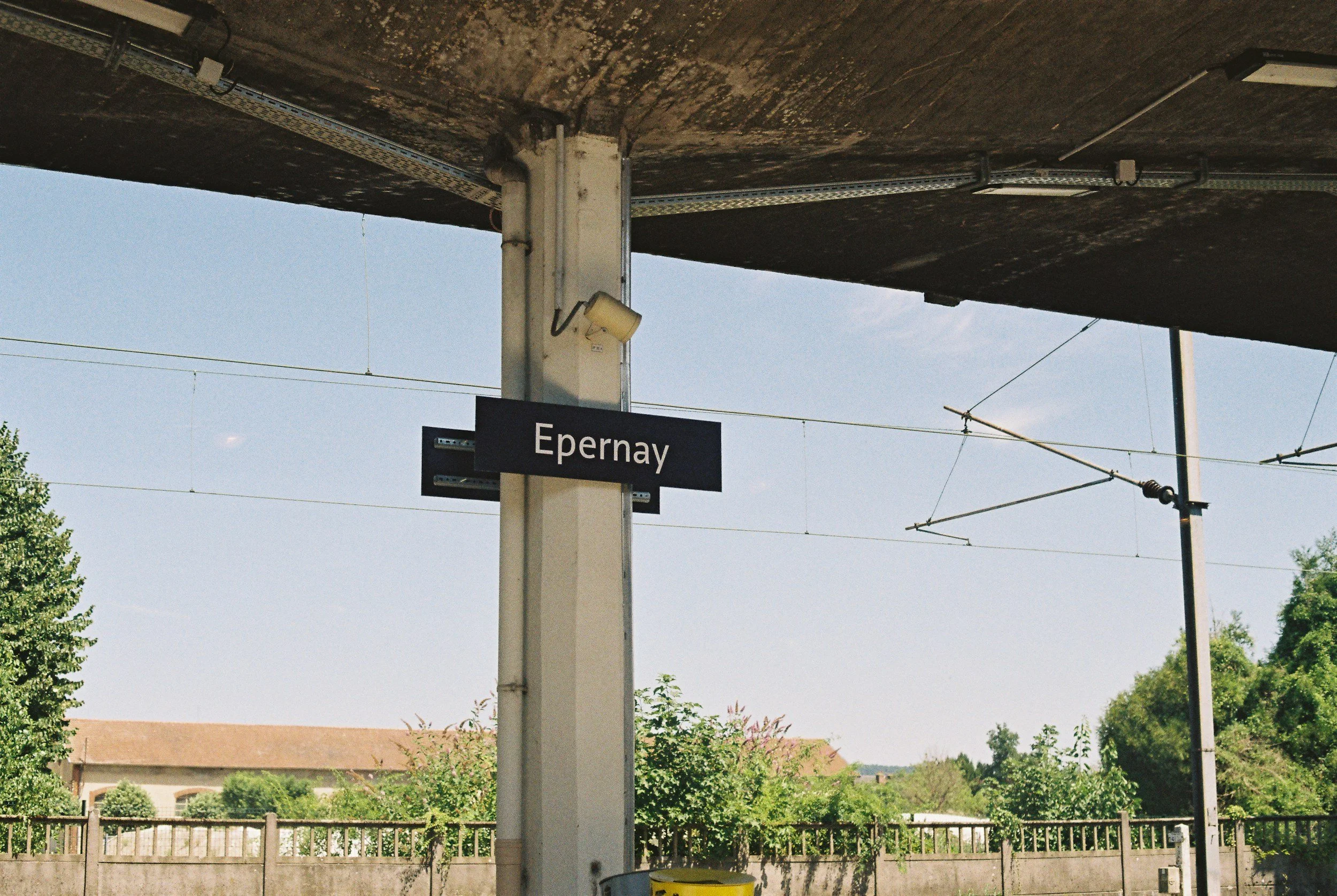
Germaine is only around 16 minutes from Reims, yet it is the least straightforward of these four stops for a typical Champagne day trip. The village developed around the forest rather than wine tourism, and the walking trails remain the strongest reason to get off here. The five-kilometre circuit through woods, meadows and vines takes around an hour and a half, while the shorter Sentier des Lutins stays closer to the village.
There is very little to fall back on if you arrive without food or decide that you no longer want to walk. Daytime eating options are limited, and there are fewer visitor-friendly cellar experiences than in Rilly or Aÿ. Forest tracks can also become muddy after rain, so I would not choose Germaine simply because its departure time happens to suit you.
Three or four hours is enough when you specifically want a woodland walk with vineyard views along the way. If Champagne tasting and a pleasant lunch matter more, I would stay on the train.
All four villages sit on the Reims to Épernay railway known as La Ligne des Bulles, but not every service stops at each one. Germaine is particularly easy to miss in the timetable, and waits for a return train can be much longer on Sundays. Choose your train home before reserving a tasting, then allow enough time to walk back to the station without watching the clock all afternoon.
For the simplest half-day, choose Rilly-la-Montagne. For a full day with cafés, lunch and somewhere to go if it rains, choose Aÿ-Champagne. Avenay-Val-d’Or is the best fit for a picnic and an easy vineyard walk, while Germaine is for the person who reads “forest trails” and immediately knows that matters more than fitting in another cellar.
A village day becomes much easier once you choose the right place to sleep, and I’ve compared Reims, Épernay and the vineyard stays in this stay comparison, including which options become surprisingly awkward when you do not have a car.
Rilly-la-Montagne for a tasting, lunch and vineyard walk
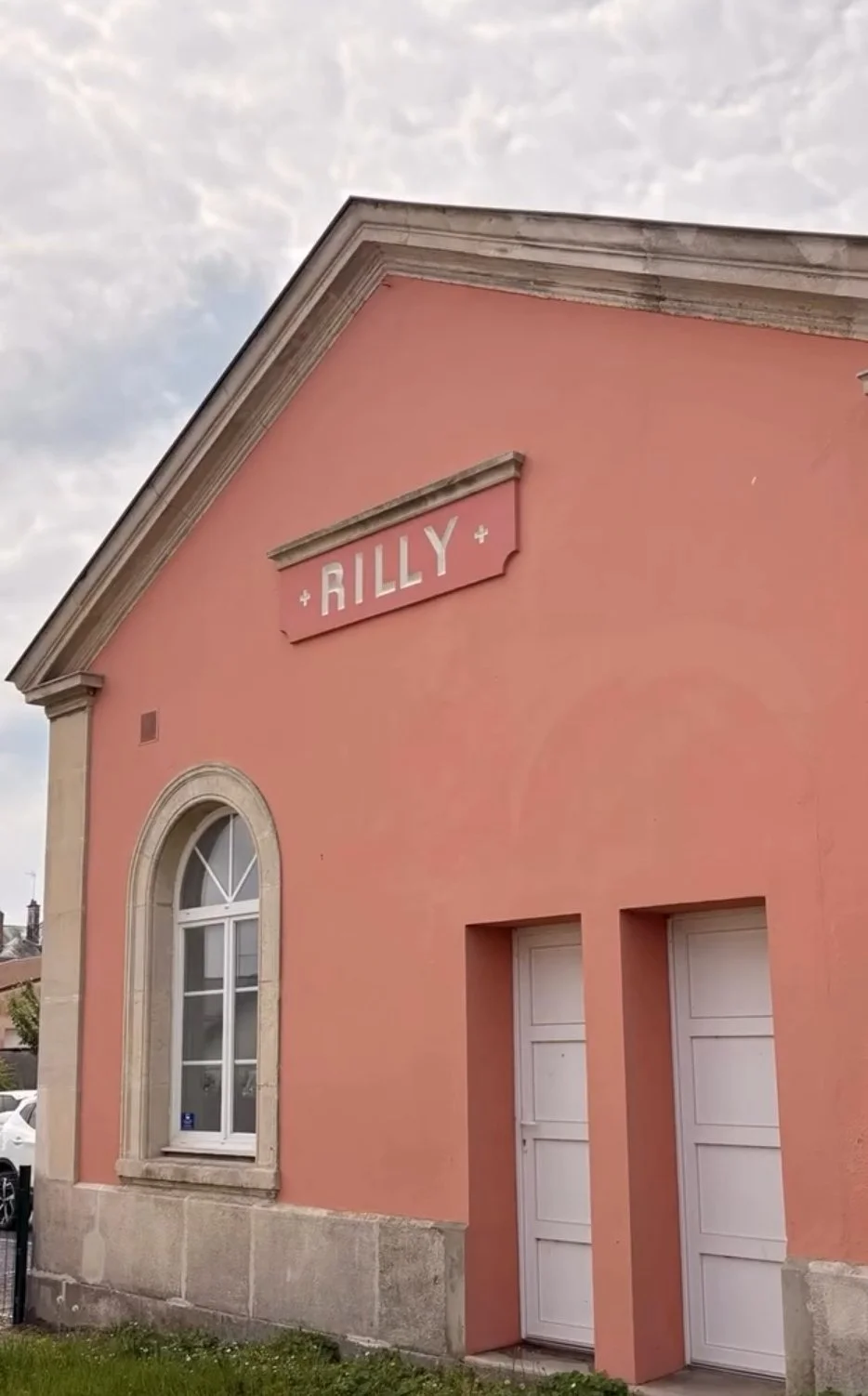
Rilly-la-Montagne is the village I would choose for a first trip from Reims, not because it has the prettiest centre or the longest list of things to see, but because the different parts of the day fit together unusually well without a car. The station is close to several Champagne producers, there is somewhere genuinely good for lunch and an easy circular walk leads beyond the houses and into the vines before the train home.
The first thing to understand is that Rilly is a working wine village, not a miniature version of Reims. There is no grand square surrounded by cafés, and the Champagne houses are mixed among ordinary homes along Rue de Reims, Rue Jean Jaurès and the smaller streets around Saint-Nicolas church. That is part of the appeal. Delivery vans stand outside cellars, handwritten producer signs hang on gates and the vines begin almost as soon as the final houses end.
From the station, follow Rue Jean Jaurès uphill and continue through the village towards Église Saint-Nicolas. Parts of the church date from the 12th century, but the detail to look for is inside, where the carved wooden choir stalls show people carrying out different vineyard trades. Rilly also has two old wash houses, although I would not spend an hour trying to locate every historic feature. The village becomes much more interesting once its streets turn into vineyard tracks.
Which Champagne producer should you visit in Rilly?
Champagne Michel Fagot is the simplest choice when arriving by train. The estate is at 2 Rue Jean Jaurès, almost at the foot of the station, and offers visits in English and French by appointment. Current options range from a one-hour estate tour with one Champagne for €25 to a 90-minute visit with three Champagnes for €42. Sunday visits can also be arranged in advance, which makes this a particularly useful address for a weekend trip.
I would choose Michel Fagot when convenience matters or when you want a structured introduction to a family estate without losing much of the day getting there. Being so close to the railway also solves the slightly awkward question of what to do with any bottles you buy. Ask whether the estate can keep your order until shortly before the return train, rather than carrying it through lunch and around the vineyards.
For a smaller, more traditional cellar visit, Champagne Daniel Dumont is another strong option. Its one-hour tour includes the traditional chalk cellar and costs €19 with two Champagnes or €23 with three. The estate is at 11 Rue Gambetta, around ten minutes from the station on foot, and visits can be arranged directly by email in English or French.
Champagne Didier Herbert on Rue de Reims is useful if you prefer to check availability and book online. The family works six hectares divided among 30 parcels in Rilly, Ludes, Trois-Puits, Mailly-Champagne and Verzenay, so the tasting provides a slightly broader introduction to the northern Montagne de Reims than the village address might suggest.
There are many more producers in Rilly, including well-known names such as Vilmart & Cie, but a sign outside a Champagne house does not necessarily mean visitors can walk in. Some estates mainly receive trade visitors, existing customers or guests with private appointments. I would choose one producer whose visit genuinely suits you and give it the time it deserves, rather than knocking on several doors and hoping somebody is available.
Where to have lunch and drink Champagne by the glass
The most useful lunch address in the village is Restaurant des Coteaux de Rilly, formerly known as Prise de Mousse. It is at 23 Rue de Reims, roughly halfway between the station and the upper part of the village, and combines a relaxed French restaurant with a Champagne bar.
This is not the sort of tasting-menu restaurant that takes over the entire afternoon. The current menu includes pâté en croûte, Jambon de Reims, a croque with Chaource and truffle, slow-cooked beef cheek and sharing boards, with an average meal price of around €25 before Champagne. More importantly, the wine list includes numerous local bottles and several Champagnes by the glass, so you can try something from a producer you passed in the village without booking another full cellar visit.
I would reserve a table, even on a weekday. Rilly has ordinary village services, including a bakery and small food shops, but their opening hours are not reliable enough to build the day around. There is no bookshop, antique shop or group of independent boutiques to fill a long gap between trains. Come for the Champagne, lunch and the walk, and if the restaurant is unavailable, buy a picnic in Reims rather than assuming you will find an easy alternative after arriving.
The walk I would take after lunch
Rilly’s official short circuit covers around four kilometres and takes roughly one hour and 15 minutes. It passes through the village and vineyards before bringing you close to the entrance of the railway tunnel, which was built in the 1850s and runs for more than three kilometres beneath the Montagne de Reims. During the Second World War, the tunnel was used to store German V1 flying bombs and was attacked in 1944, an unexpected piece of history beneath what now appears to be a very quiet railway line. The municipality publishes the route on its Rilly-la-Montagne walking trails page.
The circuit is the right length for a half-day because it gives you proper vineyard views without turning the visit into a full hike. Tracks can become muddy after rain, and there is little shade once you are among the vines, so bring water and wear shoes suitable for an unpaved path. The village also opened a new educational forest trail, En forêt Eau’trement, in May 2026, with restored woodland ponds, benches, tactile displays and audio information. It could work well on a longer visit, but I would not attempt to combine the forest, a complete cellar tour, lunch and the village circuit between two closely timed trains.
A realistic half-day would mean arriving in the middle of the morning, booking a cellar visit for around 10:30 or 11:00, having lunch at 12:30 and setting out on the short walk at about 14:00. That should leave enough time to reach the station for a late-afternoon train without rushing through the final part of the route. I’d check the timetable before reserving anything and keep at least 30 minutes free between the end of your plans and departure.
If you are travelling alone, the village trains are the easy part; I go into tastings, evening meals and where I would feel most comfortable staying in my solo Champagne guide.
Aÿ-Champagne for markets, old streets and a full day
Aÿ is where I would send you if four hours in a tiny wine village sounds a little too quiet. The train arrives close to the old centre, breakfast pastries and picnic food are easy to find, and several Champagne visits can be booked in advance. Once you have had enough cellar talk for one afternoon, there is still Pressoria, the canal and a choice of short walks.
It is bigger and busier than Rilly-la-Montagne, but not in a way that takes away from the experience. The vineyards begin behind the upper streets and rise steeply above the houses, yet Aÿ is also a small working town where people are buying bread, collecting prescriptions and doing their Friday shopping. That everyday life is exactly why it works so well without a car. The entire day does not depend on one producer being open.
The station sits below the centre, between the railway and the canal. From here, it is a short walk uphill to Place Henri Martin, the most useful starting point for exploring Aÿ. The town hall faces the square, Patrick Baillet’s bakery and tearoom is nearby, and a Friday market brings around 25 traders here from 8:00 until 12:00. If your dates are flexible, Friday morning is when I would come.
This is a proper local market so arrive early enough to buy fruit, cheese, bread or lunch from one of the prepared-food stalls before traders begin packing away. There are picnic tables on Place Henri Martin and at several points near the canal, so the market can give the morning some life and solve the question of lunch at the same time!
Start with the old streets rather than heading straight to a cellar
Aÿ makes more sense once you see how closely its Champagne houses, workers’ homes, old presses and vineyards have developed alongside one another. The town’s Musardises Agéennes route has 19 marked stops and loops through the historic centre in roughly an hour. There is no need to follow every marker dutifully, but the trail gives you a reason to turn into the narrow side streets instead of walking directly from the station to a tasting and back again.
Begin near Place Henri Martin, then make your way towards the 15th-century Église Saint-Brice, the old half-timbered houses and the small passages around Rue Roger Sondag, Rue Gambetta and Rue Jules Blondeau. Look out for the Art Nouveau house on Rue Gambetta and the presses connected with Henri IV and François I. The route also leads past houses and courtyards that are easy to overlook when your attention is fixed on the famous Champagne names painted above the gates.
A second trail follows the story of René Lalique, who was born in Aÿ in 1860. Twelve installations around town trace his work as a jeweller and glassmaker, bringing an unexpected design story into a place usually discussed almost entirely in terms of wine. An augmented-reality app provides the full interpretation, but the route is still worth following without it.
You will also pass the entrances to Bollinger, Deutz and Ayala. Their presence helps explain why Aÿ feels more substantial than the smaller villages, but a famous name above the gate does not mean casual tastings are available. Bollinger remains difficult to visit and is not somewhere I would advise an independent day-tripper to try on the chance that somebody lets them in. Admire the historic façades, then spend your time and money on a visit you can actually confirm.
Ayala for a proper Champagne-house visit
Champagne Ayala is the clearest choice if you want to see the polished cellars of an established house without returning to Reims or continuing to Épernay. It is around ten minutes from Aÿ station on foot, with visits available from Tuesday to Saturday by reservation.
The standard Ayala Experience currently begins at €30, which makes it considerably more accessible than some of the private visits offered by Aÿ’s prestige houses. The tour covers where the wines are made and aged before finishing with a guided tasting. Ayala is known for a fresher, lower-dosage style and gives Chardonnay an unusually prominent role for a house based in a Grand Cru village so strongly associated with Pinot Noir.
I would choose Ayala for a first substantial Champagne visit, or when you want to understand how a large historic house differs from the growers found elsewhere in the region. Allow around 90 minutes and bring something warm, even during summer. The cellars remain cool, the visit involves numerous stairs and guests are asked to arrive ten minutes before the tour begins.
Pierre Leboeuf for a smaller family cellar
For something more personal and less formal, Champagne Pierre Leboeuf is at 11 Rue Saint-Vincent in the old centre. The family provides cellar visits and tastings by appointment, with current prices beginning at €15 for three cuvées or €22 for a visit followed by a tasting.
This is the nicer choice if you have already toured one of the large houses in Reims and would rather talk to a grower about the vineyards around Aÿ. It is a working family estate, so arrange a time directly rather than assuming that published opening hours mean somebody will always be free to receive visitors. Harvest, bottling and vineyard work can all affect what is possible.
Another straightforward option is Champagne Collery at 7 Rue Jules Lobet. Its 45-minute tasting of three Champagnes currently starts at €25 and takes place at Villa Collery, where the garden creates a more relaxed setting than a technical cellar tour. It works particularly well if you want a proper tasting while keeping more of the day free for the town and Pressoria.
Henri Giraud also receives visitors in Aÿ, but its introductory experience currently begins at around €115. I would treat that as a deliberate splurge for somebody already interested in the house, not the default choice simply because it appears on a list of local producers.
Where to have lunch in Aÿ
Aÿ has several places where lunch can become an enjoyable part of the day rather than an emergency sandwich beside the station. I would still reserve, particularly from Friday to Sunday. There is more choice than in the smaller villages, but the dining rooms are small and one unexpected closure can completely change the afternoon.
Avarum, at 18 Rue Roger Sondag, is the most interesting option when you want a proper meal and the chance to try several Champagnes without booking another cellar visit. Its menu is small and seasonal, the presentation is thoughtful without becoming overly formal, and the wine list gives plenty of space to producers from the surrounding villages. This is where I would book lunch after a morning spent walking through the old centre.
For something simpler, Le 19cent60 at 38 Rue Roger Sondag is a small brasserie with around 20 seats, homemade dishes and a more relaxed lunchtime feel. It is useful when you want lunch to take an hour rather than occupy most of the afternoon. Service is currently limited to particular lunch and evening sittings, so check the opening day and reserve instead of crossing town on the assumption that it will be serving.
A good casual alternative is L’Atelier by Patrick Baillet on Place Henri Martin. It combines a bakery, chocolate shop and tearoom, with homemade dishes served in glass jars to eat there or take away. It is particularly convenient when you arrive for the Friday market, want coffee and something sweet, or need a picnic more appealing than whatever remained at Reims station.
The same family bakery is known for its bread and pastries, making it a sensible place to buy breakfast before beginning the Musardises route. Nearby, Charcuterie de la Place at 1 Rue Jules Blondeau sells meat, prepared dishes and picnic food. Between the bakery, butcher, market and ordinary grocery shops, Aÿ is the one village on this railway where forgetting to pack lunch does not immediately become a problem.
Aÿ has a municipal library, but it is a local service rather than somewhere I would recommend to a traveller hoping to browse a beautiful bookshop. Pressoria’s shop is more interesting for visitors, with a selection focused on Champagne, regional food, locally made objects and work by independent makers.
Pressoria is worth more than a rainy-day backup
Pressoria occupies a former Pommery pressing centre at 11 Boulevard Pierre Cheval, directly below the UNESCO-listed vineyard slopes. Calling it a Champagne museum makes it sound much drier than it is. The exhibition uses scent, sound, touch and large installations to explain how the vineyards change through the year, what lies beneath the vines and how grapes eventually become Champagne.
Allow between 90 minutes and two hours. The visit ends with two Champagnes on the terrace, or grape juice for children, looking directly towards the vineyards. Adult admission currently costs €18. Pressoria opens from 9:30 to 18:30 on most days but closes on Thursdays, with the last recommended entry at 16:30. Those hours make it especially useful on a Sunday or when the weather turns, but check them before arranging the rest of the day.
I would not automatically combine Pressoria with a long Champagne-house tour unless you are genuinely interested in the production process, as there will be some overlap. A better full day could pair Pressoria with a shorter grower tasting at Collery or Pierre Leboeuf, while Ayala fits more naturally with the heritage walk and a longer lunch.
Finish beside the canal or climb into the vineyards
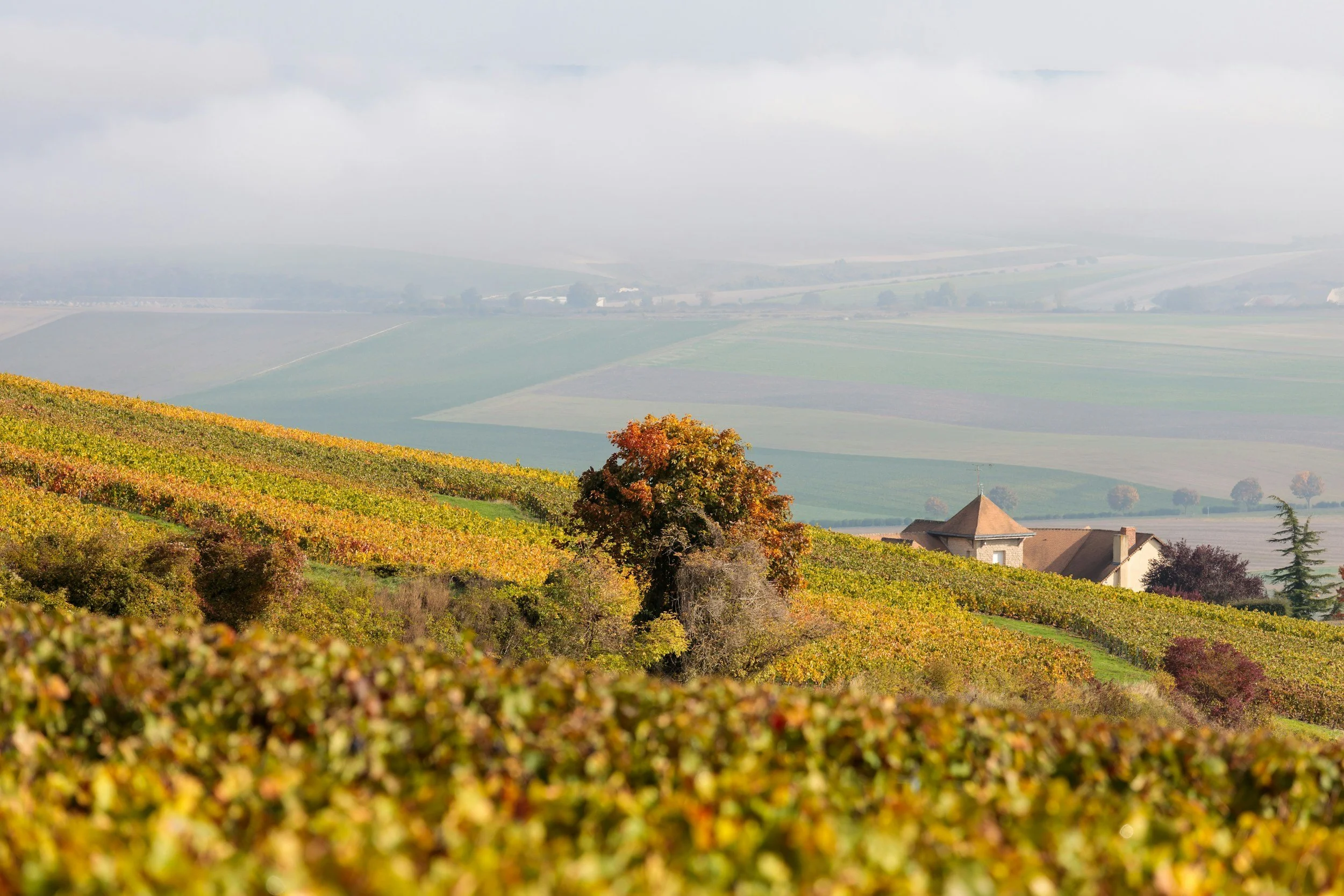
After several hours of tastings and exhibits, the simplest final walk is down by the canal. Aÿ lies between the historic vineyard slopes and the Marne-Rhine Canal, and its towpath shows the town from a completely different angle. The ground is flat, there are picnic tables near Boulevard Charles de Gaulle and Chemin des Mayeurs, and you can walk for as long as the train timetable permits without committing to a complete circular route.
If you still have energy, head uphill instead. The three-kilometre Si Aÿ m’était conté circuit begins near the station and takes around one hour and 15 minutes, passing through the historic centre and towards the vines. There is also a 2.8-kilometre route focused on the history of Champagne production, while the 9.5-kilometre Cubray circuit takes closer to three hours and is better kept for a day without a long lunch or cellar tour.
For most people, the short heritage trail followed by twenty or thirty minutes beside the canal will be enough. Aÿ already fills a day once you include the market, lunch and one substantial Champagne experience. Adding a three-hour vineyard hike usually means rushing the things that made you choose the town in the first place.
A full day in Aÿ that actually fits together
On a Friday, I would arrive early enough to see the market on Place Henri Martin, buy something from Patrick Baillet and spend the rest of the morning following the Musardises route through the old centre. Reserve lunch at Avarum or Le 19cent60 for around 12:30, then choose between Ayala for a traditional house visit and Pressoria for a broader explanation of Champagne’s landscape and production.
Finish beside the canal, allowing enough time to collect any bottles and walk back to the station without hurrying. If you choose Pierre Leboeuf or Collery instead, the shorter tasting may leave enough time for Pressoria as well.
A Sunday needs a slightly different plan. The Friday market is gone, several shops and restaurants may be closed, and grower visits are more difficult to arrange. Pressoria usually opens, making it the safest anchor for the day, but I would reserve lunch and confirm every tasting before leaving Reims.
Aÿ is not the village to choose if you want silence and empty vineyard tracks from the moment you step off the train. It is the better choice when you want some flexibility: old streets in the morning, a local lunch, one excellent Champagne visit and enough everyday town life that a single closed door does not send you straight back to Reims.
Avenay-Val-d’Or for a quieter village day
Avenay-Val-d’Or is the village I would choose when the day I have in mind is one good Champagne tasting, a picnic beside the river and a walk that takes me properly out into the vineyards. It is much smaller than Aÿ and there is no restaurant-filled centre waiting beyond the station, but you are not arriving somewhere completely empty either. There is a very good butcher and delicatessen, a new grocery shop, a local bar on Place Carnot, picnic tables beside the River Livre and three walking routes that let you decide how outdoorsy you actually feel once lunch and six glasses of Champagne are involved.
The village sits in a narrow valley between the vineyards and the wooded edge of the Montagne de Reims. The Livre runs through it in several small channels, vines appear behind the houses and everything becomes noticeably quieter once you leave Place Carnot. I would not come expecting enough shops, museums and open cellar doors to fill an unplanned day. Avenay works much better when you book one tasting, sort out lunch before the shops close and choose a walk that fits the train times.
Start beside the River Livre and follow it through the village
From Avenay station, I would walk towards Place Carnot first rather than immediately setting off for the vineyards. This is not one of those villages where everything has been arranged around a beautiful central square, and the places worth seeing are scattered between Place Carnot, Rue Gambetta, Rue de l’Église, Rue Chanzy and the little channels of the Livre that keep appearing between the houses.
Place Carnot is the practical centre rather than a place full of café terraces. Le Champenois, at number 10, is the village bar, tobacconist and newsagent, and it feels much more like somewhere residents stop for a drink than a Champagne bar created for visitors. I would happily call in if it were open, but I would not rely on it for a full lunch or arrive expecting a long list of local growers by the glass. Avenay becomes far easier to enjoy once you accept that lunch will probably be something you collect from the village shops and eat beside the river.
From the square, continue along Rue Gambetta towards Église Saint-Trésain. The church is surprisingly large for a village this size, which makes more sense once you know that Avenay once had an important Benedictine abbey founded by Sainte Berthe in the seventh century. The abbey has disappeared, but the present Gothic church, built and altered between the 12th and 16th centuries, still gives you some idea of the village’s much wealthier religious past. Go inside if it is open, particularly for the west portal, old paintings and 18th-century organ.
The river comes with its own local story. According to the legend of Sainte Berthe, she bought a spring for one livre and then traced the route the water should take towards the abbey with the tip of her staff. The more believable version is that a channel was dug, which would still have been an impressive project at the time. That channel, known locally as the bief, continues towards the old wash house before disappearing near Saint-Trésain. The village’s own account of Avenay’s history explains the story in more detail, and it is useful to know before walking around because the Livre does not follow one neat, visible course. It keeps vanishing behind walls and gardens, then reappearing between the houses.
Look for the covered wash house on Rue Chanzy, where the water runs beneath the tiled roof, as well as the fountain associated with Sainte Berthe. Neither is something I would cross Champagne specifically to see, but together with the church, narrow water channels and old stone walls, they make the village feel very different from the drier, more obviously vineyard-focused stops along the same railway.
William Saintot is the tasting I would book first
Champagne William Saintot is the easiest producer around which to build the day. The family has been based in Avenay since 1918, and the estate is now run by Morgann Saintot, William’s grandson. Its vineyards are not limited to one hillside around the village either. The family works parcels in the Premier Cru villages of Avenay-Val-d’Or, Mutigny and Bisseuil, as well as Champignol-lez-Mondeville in the Aube, so the tasting gives you a broader comparison than you might expect from one small family estate.
Visits are normally available by appointment from Tuesday to Saturday, generally between 10:00 and 17:00, and can be given in English. The shorter experience currently costs €14 and lasts around an hour, with six Champagnes included. That is a generous tasting for the price and still leaves enough of the day for lunch and a decent walk afterwards. The one detail solo travellers need to know is that bookings require at least two adults, so I would contact the estate directly before making plans around it if travelling alone.
The two-hour visit, currently €28, would be my choice if this were my only grower visit during the trip. It includes the press, vat room and cellars before the same six-wine tasting, so you get to see how the estate works rather than simply arriving to try the finished bottles. The family also has its own vine nursery and a 600-square-metre cellar museum arranged over two floors, with old equipment alongside slightly less expected features including a transparent barrel and lighting installations. You can compare the current William Saintot visits and prices here.
Sustainability is an important part of how the family works, but the visit does not appear to be aimed only at wine collectors who already understand every technical term. I would choose William Saintot if I wanted time to ask questions, see what running a small Champagne estate actually involves and taste several different wines without paying for an elaborate “experience” around them.
For something much less conventional, Champagne Augustin is on Route de Germaine. Marc Augustin and his family work biodynamically, with a very individual philosophy built around soil life, natural energy and what they call cœurviculture. The current 90-minute visit costs €50 and includes the press, winery, cellar and four Champagnes.
Augustin makes more sense if you are already curious about biodynamic wine and genuinely want to hear this particular family’s way of thinking about it. For most first-time visitors, I would still begin with William Saintot. It costs considerably less and gives a more straightforward introduction to Avenay as a working Premier Cru village.
Whichever estate you prefer, arrange the visit before travelling. These are family businesses where the same people receiving visitors may also be working in the vineyard, bottling or dealing with everything else happening behind the cellar door. Published opening times do not necessarily mean you can arrive from the train and expect somebody to stop what they are doing for an unplanned tasting.
Buy lunch before the village closes for midday
Avenay does not currently have the kind of restaurant I would plan the whole day around. That is its clearest disadvantage compared with Aÿ, but it does not mean you need to bring a disappointing supermarket sandwich from Reims either.
Maison Claudon, at 11 Rue Gambetta, is the address I would try first. It is an artisan butcher, charcuterie, delicatessen and traiteur selling meat, pâtés, prepared dishes and cheese. Rather than deciding in advance exactly what lunch should be, I would go in and see what has been made that morning, whether that turns out to be pâté en croûte, sliced charcuterie, a salad or one of the cooked dishes. The important part is going before lunch, as the shop normally closes in the middle of the day. Do not finish a late-morning tasting at 14:00 and assume you can buy everything afterwards.
Once lunch is sorted, take it to the picnic table on Rue des Quatre Maisons beside the Livre. There is another table on Rue Gambetta towards the D9, but the riverside one is the nicer choice and fits naturally into the short village walk. It is not a developed picnic area with a café, toilets and carefully arranged views. It is simply a table beside the water in a residential part of the village, which is probably the most honest picture of what a quiet afternoon in Avenay looks like.
There are a couple of evening options if you happen to be staying later. Croq’Panda serves Asian dishes from a food truck on Place Carnot on Wednesday evenings from around 17:30, and the village currently lists O’Turtles Pizza on selected Friday evenings. I would see those as a useful bonus if the train times suit, not as a reliable answer to lunch.
There is also no bakery, independent bookshop, antique shop or line of small boutiques to browse when you have an unexpected hour before the train. Le Champenois has newspapers and magazines, but it is not a destination for anyone hoping to spend the afternoon in a beautiful village bookshop. Bring a book with you, collect food while the shops are open and use the spare time beside the river or out in the vineyards.
Choose the walk according to how much Champagne you have just tasted
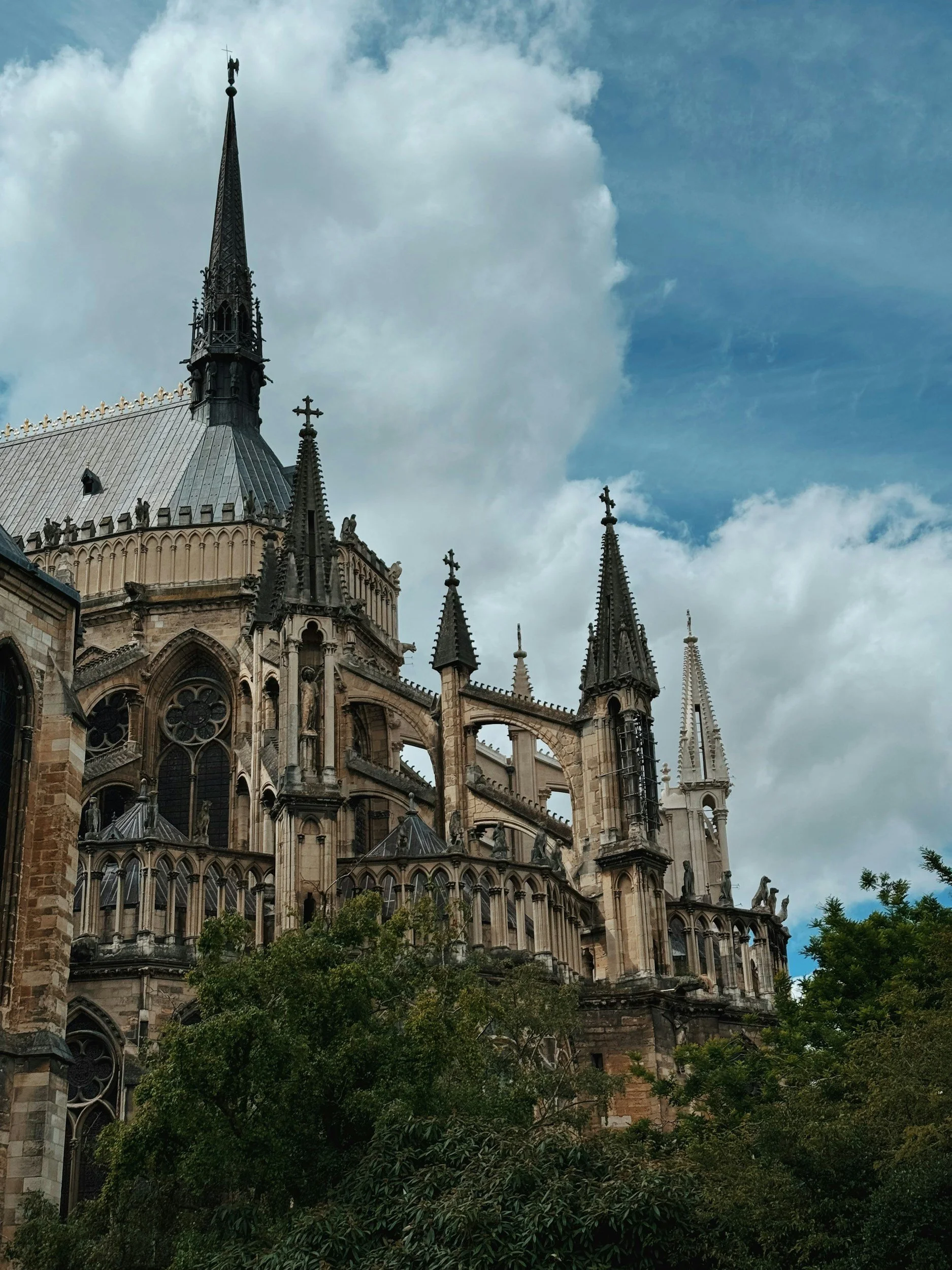
Avenay has three official routes, and they are usefully different rather than being the same walk offered in three lengths. The shortest stays within the village and explains its history, the middle route follows the valley into the vineyards and lower woodland, and the longest climbs towards Mont Aigu.
The Si Avenay m’était conté discovery trail is 2.5 kilometres and takes roughly an hour. I would choose this after the full two-hour William Saintot visit, on a day when the ground is wet or whenever several kilometres of muddy vineyard tracks no longer sound especially appealing. It connects the church, wash house, fountain, river channels and older streets while adding more context to Sainte Berthe, the former abbey and the way the village developed around the water.
Although it is short, I would not rush around it in 30 minutes simply to say it had been completed. The most interesting part is noticing where the bief slips between buildings, taking time inside Saint-Trésain and following the quieter streets beyond Place Carnot. This is the route to choose if you enjoy small historic details more than the idea of doing a proper hike.
The Au Pays de la Livre circuit is the one I would probably choose myself. It covers five kilometres in around one hour and 20 minutes, beginning in Avenay before moving between the river valley, vineyards and the lower edge of the woods. You pass the church and wash house first, then leave the compact centre behind as the views begin to open over the vines.
I would allow closer to two hours if you tend to stop for photographs or do not want to spend the first section worrying about whether you have taken the correct turn out of the village. The official time assumes fairly continuous walking, and the route becomes easier to follow once you are on the country paths. Expect mud after rain and very little shade on the exposed vineyard sections.
The Circuit du Mont Aigu is for the day when the walk matters at least as much as the Champagne. The tourism office describes it as a ten-kilometre route taking around three hours, while the French hiking federation’s more detailed version measures approximately 11.2 kilometres and suggests three and a half hours. I would plan around the longer figure, especially when the next train after yours may be two hours away.
The route begins near Rue de l’Église, continues along Rue Chanzy and passes the wash house before climbing gradually through the vineyards towards the woods. Mont Aigu is only 196 metres high, so this is not a serious mountain hike, although the ascent may feel more ambitious after lunch and a tasting of six Champagnes. From the upper parts of the route, you can look back across Avenay’s vineyards towards the chalk plain and the wooded slopes of the Montagne de Reims.
East of the village, areas of dry grassland and pine support several species of wild orchid, making late spring and early summer particularly interesting. Stay on the path and leave the flowers where they are. There is nowhere to buy water once you are on the longer route, and no obvious shortcut that quickly returns you to the station, so carry everything you need from the village.
I would not squeeze Mont Aigu around the two-hour estate tour unless the timetable gives you a genuinely long day. The shorter William Saintot tasting, an early picnic and the three-hour walk fit together much more comfortably.
How I would plan the day
For the easiest version of Avenay, I would arrive during the middle of the morning and collect lunch from Maison Claudon and L’Épicerie du Centre before the shops close for midday. I would then walk through Place Carnot and past Saint-Trésain before arriving at William Saintot for a tasting booked at around 11:00.
Afterwards, I would take lunch to Rue des Quatre Maisons beside the Livre and then spend the early afternoon on the five-kilometre Au Pays de la Livre circuit. If Le Champenois were open on the way back, I would stop for a drink before walking down to the station, but I would still leave enough time that finishing the day does not turn into a rushed search for the correct platform.
If you choose the full two-hour estate visit, replace the five-kilometre walk with Si Avenay m’était conté. If Mont Aigu is the main reason you are coming, book the shorter tasting as early as possible, eat before starting the climb and choose a return train that leaves comfortably later than the official finishing time.
Avenay is not the village to choose when you want a restaurant reservation, a Champagne bar and a few shops to browse between tastings. I would come here for one family cellar, lunch beside the narrow River Livre and a walk that begins among old wash houses and village streets before heading properly into the vines.
Germaine when you need a break from Champagne tastings
Germaine is the village I would choose when I had already visited a few cellars and honestly wanted to spend the afternoon in the forest instead. There are vineyards here, including some unusual experimental vines around Vaurémont, but they do not dominate everything in quite the same way as they do in Rilly-la-Montagne or Avenay-Val-d’Or. Germaine has always been closely tied to the forest, and the village still has old woodcutters’ houses, three wash houses and several paths that lead directly from the houses into the trees.
It feels surprisingly remote for somewhere you can reach by train from Reims. Part of that is because the station is not actually in the centre. It sits near the small hamlet of Les Haies, and from there you need around 30 minutes to reach the main village, or closer to 40 if you take the prettier route through the forest. I would definitely allow for that when choosing a return train. This is not a place where you step off the train and immediately find the church, restaurant and village shop waiting across the road.
I do quite like that about Germaine, though. The walk from the station feels like the beginning of the day rather than an annoying transfer you need to get through. The Si Germaine m’était conté heritage route also starts at the station, so you can follow that into the village instead of walking along the most direct road with Google Maps open.
Walk in through the forest and old village streets
Germaine sits in a wide clearing surrounded by the Montagne de Reims forest. Before the railway arrived, many families here made their living from forestry, particularly woodcutting, and some of their old houses still stand along Rue du Pré Michaux. The buildings now occupied by Le Cerf à 3 Pattes and Chez L were both once woodcutters’ homes.
The village centre is spread between Rue du Pré Michaux, Rue de Courtagnon, Rue du Moulin, Rue de l’Orme and the streets around Église Sainte-Croix. Parts of the church date from the 12th century, but Germaine is not really a village where you walk to one obvious landmark, photograph it and feel that you have seen everything. The more interesting details are scattered around: old villas beside much simpler workers’ houses, water running from the surrounding springs and wash houses tucked along streets you could easily pass without noticing.
The one I would make sure to find is the Lavoir de Thérèse on Rue du Moulin, named after the last woman known to have used it. Several of the village walks pass it anyway, so it does not require a separate detour. There are two more wash houses around Rue de l’Orme, including one near Rue de Courtagnon. They are small and fairly plain, but I actually prefer that to wash houses that have been restored until they look like decorative features. These still resemble places people once came to because washing needed to be done, not because somebody had added them to a visitor route.
The cemetery contains one of Germaine’s more easily missed stories. During the 19th century, workers came from the Creuse to help build the railway tunnel beneath the Montagne de Reims, and several died in an accident during the work. Their grave can still be seen in the cemetery wall. I doubt I would have known to look for it without the heritage trail, which is why it is worth downloading the route from the Germaine village page before leaving Reims.
The complete Si Germaine m’était conté route is five kilometres and takes around an hour and a half. It uses old photographs, maps and clues to explain what you are looking at, but its biggest advantage is that it begins at the station and leads you towards the centre. If you are going to spend half an hour walking into Germaine anyway, you may as well take the route that gives that walk some purpose.
Le Cerf à 3 Pattes is the kind of village shop I would hope to find
Once you reach Rue du Pré Michaux, look for Le Cerf à 3 Pattes at number 3. It is difficult to describe it neatly because it is a village grocery shop, local produce store, bar and cultural venue all at once. One week there might be a small producers’ market or concert; another could bring theatre, a night walk or one of its philosophical café evenings.
The shop stocks food from more than 30 producers in the Marne, Ardennes and Aisne, so it is a much better place to put together lunch than I expected to find in a village of this size. The selection changes, but you may find local cheese, eggs, fruit, vegetables, meat, preserves and regional drinks, as well as bread and pastries.
The opening hours do require some planning. The shop is currently open from 8:30 to 12:00 and 16:00 to 19:00 from Tuesday to Friday, then from 9:00 to 12:00 at weekends. It closes on Mondays. If your train gets you into the centre at 12:10, there is a good chance you will have missed your opportunity to buy lunch, so I would check the train arrival and add the walk from the station before deciding that the timing works.
There is also a small bistrot in another of the former woodcutters’ houses, serving local drinks and simple food such as charcuterie, cheese, soup and desserts. In summer, you can sit outside on the terrace. The only problem is that the bistrot does not necessarily open whenever the shop does. It is more closely tied to Friday evenings and the concerts or community events happening that week, so I would look at the current programme rather than assuming it will be open when you return from the forest.
The events are worth checking even if you are only considering Germaine as a day trip. A brocante is normally held on the final Sunday in August, while October brings Lire, perché dans l’arbre, a small festival combining books, storytelling, performances and activities in the forest. Germaine does not have an ordinary bookshop, but I can imagine the village being particularly lovely during a festival where books and the woods are the entire point of coming.
Chez L makes lunch much easier, but I would still reserve
Germaine does have a proper restaurant, which immediately makes the village easier to plan than several of the smaller stops on this railway. Chez L is next to Le Cerf à 3 Pattes on Rue du Pré Michaux and currently serves lunch from 12:00 to 15:00 from Friday through Wednesday. It closes on Thursdays.
The dining room has mismatched vintage plates and old tableware rather than identical white restaurant crockery, which is exactly the sort of unnecessary detail that would make me want to eat there. There is also a large terrace, and after walking in from the station I would probably book an outside table if the weather looked reliable.
Even though it is a relaxed village restaurant, it is also the only dependable sit-down lunch option in Germaine. I would reserve rather than arrive after the train journey and hope for the best, particularly at weekends. The current listing for Chez L is the easiest place to check the latest opening days and contact details.
If the restaurant is closed, Le Cerf à 3 Pattes should have everything needed for a good picnic, provided you reach it before noon. There are picnic tables opposite the church beside the play area, near the level crossing on the road towards Ville-en-Selve and beside the sports ground on the way to Vaurémont. They are basic village picnic tables rather than pretty visitor areas with cafés and toilets, but they give you somewhere to eat before walking into the forest.
A pizza truck normally comes to Place de l’Église on Monday evenings, and an Asian food truck has also been listed for Sundays. Those could be useful if you are staying until a later train, but I would not build the day around either without checking that week’s schedule.
This is also worth saying clearly: there is no separate bakery, wine bar, bookshop or row of small shops to save the afternoon if it starts raining. Germaine is a much better choice when you actively want to walk. On a wet Monday, when Le Cerf à 3 Pattes is closed and most of the reason for coming involves paths through the woods, the day could feel very long.
The five-kilometre walk I would choose
The Circuit des Bois, prairies et vignes de Germaine would be my first choice after lunch. It is a five-kilometre loop taking around one hour and 25 minutes, although I would allow longer if I were stopping for photographs or had just eaten a full meal at Chez L. The route moves between forest, fields and the small vineyards around Vaurémont, so the scenery keeps changing rather than feeling like one long walk beneath identical trees.
Vaurémont itself is little more than two streets and a handful of houses, but the vines around it are quite different from the neat, narrow rows you see in most of Champagne. Some have been trained into a lyre shape, which divides and opens the canopy rather than keeping it in one upright line. The vines are experimental parcels belonging to Champagne producers, yet they still feel like one small part of the countryside here rather than the feature around which the whole village has been arranged.
The Calvaire de Vaurémont has the clearest view across the Marne Valley. It is not a dramatic viewpoint that requires a difficult climb, but the landscape suddenly opening after the more enclosed forest sections makes it one of the nicest parts of the walk. Nearby, the Verger du Champ Pansé has been planted with old local fruit varieties, which gives you another small reason to stop instead of walking straight back into Germaine.
I would save the official map of the Germaine circuit to my phone before setting out. The walk is not especially long, but I would rather have the route already downloaded than stand at the edge of the woods trying to work out which path the description means.
Another option is La Balade de la Fée Lucie, which is also five kilometres and takes around 90 minutes. It begins beside Le Cerf à 3 Pattes, passes the Lavoir de Thérèse and continues through Vaurémont and the vineyard parcels before returning to the village.
It was designed partly for families and comes with questions and clues, but that does not mean it is only worth doing with children. The questions point out details around the wash house, cemetery, church and unusual vines that would otherwise be very easy to walk past. It also starts and finishes beside the shop and Chez L, so it is the simplest route to fit around a lunch reservation. The Fée Lucie route and question sheet can be downloaded before the trip.
I would choose the Circuit des Bois, prairies et vignes for the changing scenery and the view from Vaurémont. I would choose the Fée Lucie walk if I wanted more of the village history or preferred having questions that told me what to notice along the way.
The Sentier des Lutins is better for a shorter forest walk
The Sentier des Lutins begins at the Aire du Bûcheron on Rue de Courtagnon and covers a little over two kilometres. Red signs and small woodland figures guide the way between land-art creatures hidden among the trees. It is clearly aimed at families with younger children, and the suggested 90-minute walking time allows for children stopping to look for all the figures.
Without children, you could complete it much faster. I would choose this route if I wanted an easy hour in the forest after lunch, had less time before the return train or simply did not feel like another five-kilometre circuit. It does not give you the village streets, vines and wider views of the longer routes, but it is the easiest way to spend some time beneath the trees without turning the afternoon into a full hike.
The Aire du Bûcheron was improved in 2025 and is now the clearest entrance from Germaine into the Forêt domaniale du Chêne à la Vierge. You can read more about the new paths and visitor facilities on the Montagne de Reims regional park website.
The forest shares France’s Forêt d’Exception label with the state forests around Hautvillers and Verzy, but Germaine feels very different from the much better-known Faux de Verzy. There is no single natural attraction that everyone has come to photograph. It is a mixed forest of oak, beech and other broadleaf trees that has been used by the surrounding villages for generations, and I would come here for the walk itself rather than one famous thing waiting at the end.
The paths can stay muddy even when Germaine’s streets are completely dry, so proper shoes are useful. During autumn and winter, I would also check local hunting information and pay attention to temporary signs at the entrances. This is still a working forest, and a route being marked on a tourist map does not mean every path will be available every day of the year.
Can you arrange a Champagne tasting in Germaine?
There are Champagne growers around Germaine, although this is not somewhere I would visit expecting to walk between several tasting rooms. Champagne Gérard-Guichon, at 8 Rue de Rilly, is listed by the Comité Champagne as welcoming visitors in French or English by request.
There are no regular visitor hours or neat online menu of tasting options, so you would need to contact Eric and Laurence directly and ask what they can arrange on your chosen date. I would see this as an interesting addition if I particularly wanted to meet a small local producer, not something to assume will be available after arriving in the village.
For a structured cellar visit with several Champagnes and dependable booking times, Rilly-la-Montagne or Avenay-Val-d’Or is easier. I would choose Germaine because it gives you a different sort of day. You can still see the vines, buy a local bottle and possibly arrange a grower visit, but you are not spending another afternoon underground hearing the same explanation of riddling and dosage.
The Germaine day I would actually plan
I would take a morning train and follow the Si Germaine m’était conté route from the station through Les Haies and into the village. Once in the centre, I would visit Le Cerf à 3 Pattes before it closes at noon, even if I already had lunch booked, because this is exactly the sort of small local shop I would regret walking past.
I would then look around Sainte-Croix, Rue de l’Orme and the Lavoir de Thérèse before having lunch at Chez L at around 12:30. After lunch, I would walk the Circuit des Bois, prairies et vignes, mainly because I like the mixture of forest, small vineyard parcels and the view from Vaurémont. If I wanted more local history and slightly less route-finding, I would take the Fée Lucie walk instead.
I would keep the Sentier des Lutins for a shorter visit or for a day when the train timetable did not leave enough time for the full circuit. If Gérard-Guichon could arrange a tasting, I would probably replace part of the morning heritage walk with that rather than trying to fit a tasting, a long lunch and two forest routes into one day.
The day of the week matters here more than it first appears. Sunday can work quite well because Le Cerf à 3 Pattes opens in the morning and Chez L currently serves lunch, although the train service is less frequent and the bistrot may still be closed. Monday is trickier because the shop does not open at all, even though Chez L should be serving lunch. Thursday gives you the reverse problem: the shop opens, but the restaurant does not.
Germaine is not the village I would choose for Champagne bars, wine shops and several cafés to move between. I would come after a few days of tastings, when lunch served on mismatched vintage plates, a local shop inside an old woodcutter’s house and an afternoon in the forest all sound much better than another cellar tour.
If you have not completely decided on Champagne, I’ve compared France’s train-friendly wine regions by village access, tasting logistics and how much planning each one really needs without a car.
Verzenay and Verzy using the seasonal Grand’R bus
Verzenay and Verzy are two of the most interesting places on the Montagne de Reims for anyone travelling without a car, but until recently they were also two of the most awkward. Verzenay has its lighthouse rising improbably from the vines, while Verzy has the largest concentration of twisted beech trees in the world, yet neither village has a railway station and the forest sits well above the ordinary bus routes.
The seasonal Grand’R bus changes that. It runs from Champagne-Ardenne TGV station through the wine villages before stopping in Verzenay, directly outside the lighthouse, in the centre of Verzy and finally beside the Faux de Verzy forest. This is not merely a shuttle to one attraction. Used carefully, it gives you enough time to eat in Verzenay, visit the lighthouse and museum, walk beneath the twisted beeches and still return to Reims that evening.
The timetable is limited enough that you need to plan the day around it. In 2026, scheduled services run at weekends and on selected public holidays from 2 May to 14 June, then every day from 15 June until 13 September. There are only three buses in each direction, using a 20-seat vehicle, so missing one is not a minor delay. Outside those dates, the route changes to advance-booked transport through the MyMobi system rather than operating as the same straightforward visitor service.
Begin in Verzenay village, not at the lighthouse
The first Grand’R bus leaves Gare Champagne TGV at 10:20 and reaches the centre of Verzenay at 11:26. It continues to the lighthouse five minutes later, but I would get off in the village. The lighthouse will still be there later, and starting below it gives you time to see Verzenay itself before walking gradually uphill through the vines.
One detail that could easily cause confusion is that Champagne-Ardenne TGV is not Reims’ central station. The bus leaves from Bezannes, south of the city, which you can reach from central Reims by tram or local train. I would leave a comfortable connection rather than choosing one that arrives two minutes before the Grand’R departs. The bus only has 20 seats, and it is not going to wait because your tram was late.
Verzenay is home to around a thousand people and still feels very much like a working Champagne village. The centre spreads out around Place Carnot, Rue Chanzy, Rue Thiers and Place des Carrières, rather than one particularly beautiful square where everything has been arranged for visitors. You will see delivery vans outside Champagne houses, handwritten notes on cellar doors and tractors passing through the same streets you are using to find lunch.
I would begin around Église Saint-Pierre, then follow Rue Chanzy and wander through the smaller streets around Place Carnot. Most of the church dates from the 18th century, although plenty of what you see elsewhere in Verzenay is newer than it first appears. The village was close to the front during the First World War and badly damaged. Both the lighthouse and the windmill above the village were used as observation posts, so the two sights that now look rather cheerful on postcards have a much more complicated history behind them.
There are Champagne names everywhere, but that does not mean you can walk through every open gate and ask for a tasting. Many of these are small family estates where the office, cellar and family home all share the same courtyard. Most receive visitors by appointment, and even a simple late-morning tasting can easily take up all the time before the next bus.
One you can book in advance is Champagne Godmé Sabine, at 1 Rue du Phare near the top of the village. The current €18 tasting includes three cuvées and lasts around 90 minutes, while the €25 full visit takes two hours. There is also a terrace overlooking the vines towards the lighthouse, which makes this a good option if meeting a grower sounds more interesting than spending that time in the museum.
I would not try to fit the full Godmé visit, lunch, the lighthouse museum and the Faux de Verzy into one Grand’R day. It looks possible when you first see the timetable, but 90-minute tastings have a habit of becoming longer once people start talking and you decide to buy a bottle. I would either choose the grower tasting instead of the museum or save it for a slower day spent entirely in Verzenay.
Sort out lunch before heading up to the lighthouse
The easiest place for lunch in central Verzenay is La Grappe à Pizza, a tiny pizzeria on Place des Carrières with only around 14 seats. It serves pizzas, pasta, salads and a few other simple dishes, and you can also order takeaway if you would rather eat outside. Lunch is currently served from Tuesday to Saturday, usually between 12:00 and 14:00, while Sunday and Monday are closed. With so few tables, I would reserve or order ahead rather than arrive hungry and discover that every seat has gone.
For something you probably would not expect to find in a Champagne village, try A La Table Tropicale at 2 Rue de Verzy. The food is homemade and Caribbean, with dishes such as colombo and menus based around Antillean cooking. Its opening days and serving times seem to change, though, so this is somewhere I would contact directly before planning lunch around it.
The lighthouse has a tasting area, shop and garden, but it does not have a proper restaurant. Finishing the museum visit with a glass of Champagne and a view across the vines sounds lovely; arriving there after the morning bus and expecting to find lunch does not. Eat in the village first, then walk up to the lighthouse without spending the entire museum visit thinking about food.
Walk uphill through the vines to the lighthouse
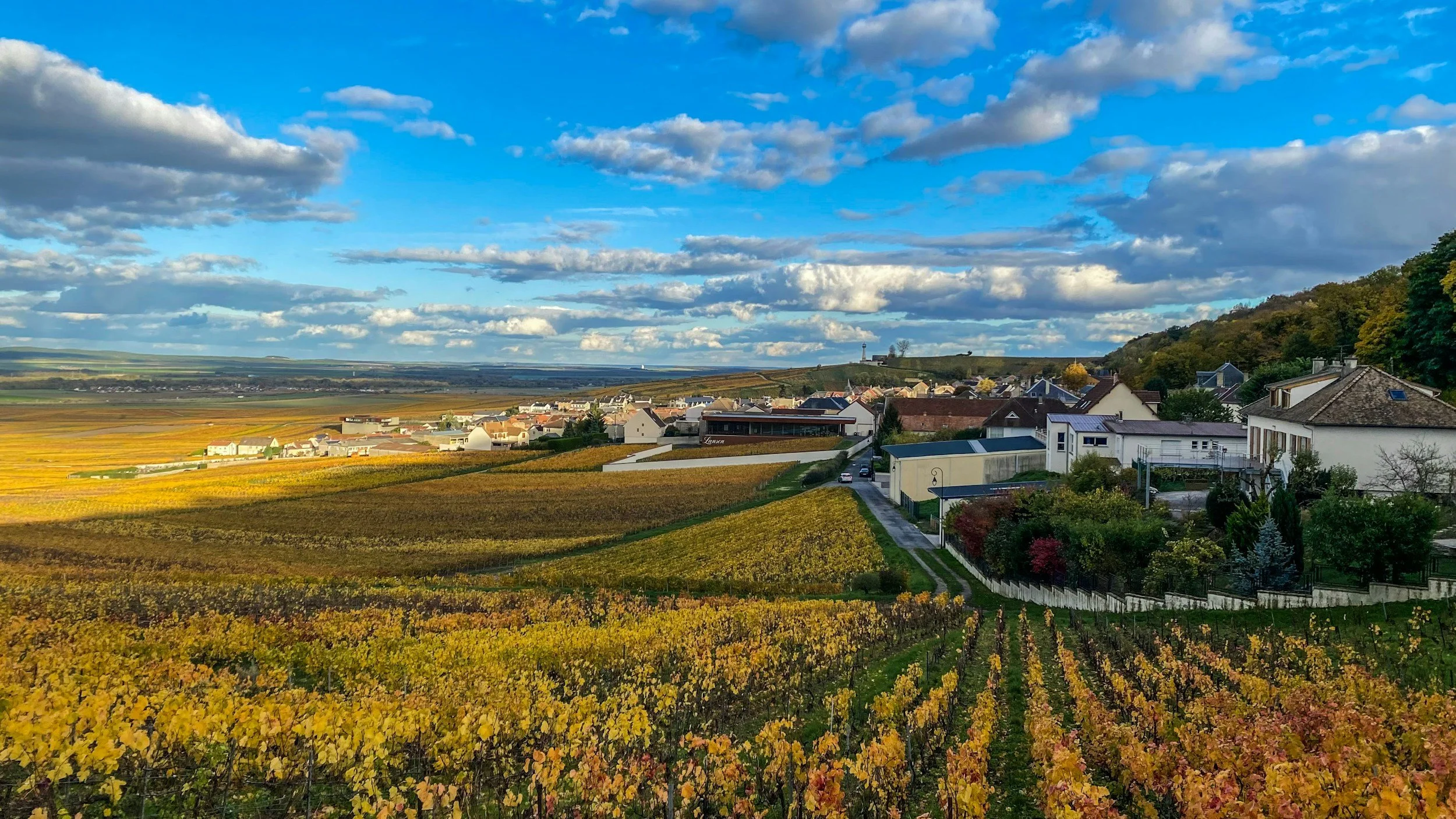
From the centre of Verzenay, it takes around 20 to 25 minutes to walk up to the lighthouse. It is not far, but the last part is uphill with very little shade, so it can feel longer than expected on a hot afternoon. Follow Rue du Phare out of the village and the houses gradually give way to rows of Pinot Noir vines, with the view opening a little more as you climb.
The lighthouse itself looks wonderfully out of place, as though somebody picked it up from the French coast and dropped it in the middle of Champagne. It was never built to guide ships, though. Champagne producer Joseph Goulet had it constructed on Mont Rizan in 1909 as a very extravagant advertisement, with the Goulet name running down all six sides and a light that could be seen across the surrounding vineyards. There was even a restaurant and guinguette here, so people came for food, drinks and the view until the First World War brought everything to an end.
The building later belonged to Heidsieck and then Mumm before it was eventually bought for public use and turned into the Musée de la Vigne. I find that history far more interesting than the idea of it simply being a pretty viewpoint. The lighthouse began as an enormous Champagne advert, was used as a wartime observation post and then stood unused for decades before becoming the museum you can visit today.
The museum explains what you have been looking at all week
The museum is most useful when you have already passed through several wine villages and begun wondering why one slope grows mostly Pinot Noir, what workers are doing between the rows and why every producer keeps talking about exposure, chalk and parcels.
The displays follow the vineyard through the year, covering pruning, tying, flowering, harvest and the first stages of winemaking. Audio, models, old tools and filmed interviews put more emphasis on the people working outside than on bottles arranged in glass cases. It is a better introduction to Champagne’s vineyard culture than another cellar tour that spends most of its time discussing riddling and disgorgement…
An individual visit takes around 90 minutes and is available with audio guidance in English as well as French, German, Spanish and Dutch. Adult admission is currently €9 for the museum, garden and lighthouse, or €3 if you only want the tower and garden. From April through September, the site opens daily from 10:00 until 18:30.
There are 101 steps to the viewing platform, which sits 25 metres above the ground. From the top, Verzenay is laid out beneath you, with the village pressed against the lower slope and the vineyards spreading towards the plain. You can also pick out the 1818 windmill on Mont-Bœuf, now owned by Mumm and generally not open for ordinary visits.
The view is not only there for photographs. It lets you see how abruptly the forest begins above the vineyards and how close Verzenay and Verzy are despite feeling like separate stops on the route. On a clear day, this is the moment when the geography of the Montagne de Reims finally becomes understandable.
Afterwards, the tasting space pours Champagnes from a changing selection of local growers, with more producers represented in the shop. This is useful if you have no time for a separate cellar appointment. Ask what is currently open rather than choosing the most familiar label, then take the glass into the garden if the weather is good.
In summer, the lighthouse also holds outdoor concerts and picnic events in the panoramic garden, particularly on Sundays and public holidays. These are worth checking when choosing your date, although an afternoon concert may require you to give up the Verzy part of the day.
Be back at the Phare de Verzenay bus stop before 15:11. I would finish the museum by 14:50, even if that means leaving a half-full glass behind. The next Grand’R is also the final useful outbound service for the forest.
Decide whether Verzy village or the forest matters more
From the lighthouse, the bus reaches Verzy Centre at 15:17 and the Faux de Verzy at 15:25. This creates two possible options of the afternoon.
The easiest is to remain on the bus until the final stop. You arrive directly beside the forest trail, avoiding the uphill walk from Verzy village. This gives you four hours before the last return bus leaves at 19:25, enough for the main Faux circuit, the Mont Sinaï viewpoint and a picnic without watching the time every ten minutes.
The alternative is to get off in Verzy Centre, look around the village and walk up towards the forest. This gives the day more local detail, but it adds a sustained climb and requires a proper walking route rather than simply following the traffic on the D34. I would only choose it with an offline map and enough energy after the lighthouse stairs.
Most of what you might need is clustered around Rue Chanzy, Rue Gambetta and the church, so Verzy is an easy place to pick up food and water before walking uphill. Case à Pain, at 2 Rue Gambetta, sells bread, pastries and savoury food from early morning until 19:00 and currently closes on Wednesdays. The village grocery, Bien Hêtre, is at 1 Rue Chanzy and usually opens again from 16:00 to 19:00 after its lunch break. It closes on Sundays.
There is also a proper restaurant, Du Cep à l’Assiette, at 2 Rue Chanzy, serving from Tuesday lunchtime through Sunday lunchtime. Unfortunately, its opening hours do not fit this particular Grand’R day very well because the bus does not reach Verzy until after 15:00. I would still keep the address in mind if I were planning a separate trip to the village, though. Having somewhere dependable for lunch makes Verzy much easier to visit on its own, especially if I wanted time for a tasting before walking up to the forest.
I would not try to turn the village itself into a long sightseeing route. Walk around the church, mairie and the older streets nearby, pick up anything you need for the afternoon and then begin the climb. That short walk through Verzy is still worth doing because you see how the landscape changes as you go, from Champagne houses and working courtyards in the village to vineyards higher up the slope, followed by beech forest at the top.
If I only had one afternoon and wanted as much time as possible among the Faux, however, I would stay on the bus until the forest stop. Getting off in Verzy gives you a better feel for the village and the landscape around it, but it also adds an uphill walk and leaves less room for missed turns or a slower-than-expected visit before the return bus.
The Faux are stranger than the photographs suggest
A fau is a naturally occurring twisted beech tree whose trunk and branches grow sideways, downwards and into themselves. Some form low green domes, while others appear to have tied their branches into knots. Verzy has close to 800 specimens, the largest concentration anywhere in the world.
For centuries, people tried to explain them through the soil, disease and local legends. Stories connected the trees to the monks of the former Saint-Basle Abbey, witches, curses and even Joan of Arc. The current scientific explanation is a rare genetic mutation, although seeing a straight branch suddenly growing from the middle of a twisted crown still makes the old stories understandable.
The forest changes their appearance completely through the year. In summer, foliage covers many of the trunks and turns the trees into low, enclosed rooms of green. Early autumn brings colour, while the bare months reveal every loop and contortion in the wood. The scheduled Grand’R season ends in mid-September, unfortunately just before the shapes become clearest, although the advance-booked MyMobi service continues outside the summer timetable.
The main Balade des Faux is a three-kilometre loop beginning near the bus stop and Faux car park. It is easy, mostly level and laid out with a surfaced route, information panels and protective barriers around the most sensitive trees. Four audio points and Braille information have been installed along the trail, and the route itself is suitable for wheelchairs and pushchairs. The frustrating detail for a car-free visitor is that the 20-seat Grand’R vehicle is not currently accessible to passengers with reduced mobility, despite the forest trail being designed for them.
Allow at least 90 minutes. You could physically walk the loop faster, but the individual trees are named and marked, and their shapes take a moment to understand. Look out for the Fau de Saint-Basle, the Fau de la Mariée and the rarer twisted oak and chestnut forms among the beeches.
Stay behind the wooden barriers even when a branch seems close enough to touch. The root systems sit near the surface and repeated footsteps compact the soil around them. The barriers are not there to make photographs inconvenient; they are part of the reason hundreds of these slow-growing trees still survive in one forest.
Add Mont Sinaï when you have the later bus
With four hours between buses, I would add the Observatoire du Mont Sinaï rather than stretching the Faux loop into a much longer hike. The path begins from the parking area opposite the Faux entrance and leads towards the highest point in the Marne, at 286 metres.
The height sounds modest, but the location mattered during the First World War. French forces used the ridge as an observation post overlooking the plain, and the surviving concrete position is now protected as a historic monument. The view explains immediately why the site was chosen. The land drops away northwards towards Reims, while the wooded ridge hides the vineyards you crossed earlier in the day.
Allow another 30 to 45 minutes for the detour, depending on the path you take and how long you stop at the viewpoint. It adds historical context without requiring the commitment of the longer PR 63 Entre vignes et Faux circuit, which is better saved for a day when hiking, rather than the lighthouse, is the main reason for coming.
The forest has shaded picnic areas but no permanent café beside the bus stop. Bring water and something to eat, even if you had lunch in Verzenay. The final bus is late enough that a snack bought at Case à Pain or in Reims will be welcome by 18:00.
The paths can remain damp after rain and fallen beech leaves become slippery, so shoes with some grip make a noticeable difference. In warmer weather, the forest is considerably cooler than the exposed slopes around the lighthouse. In autumn, pay attention to hunting notices and any temporary route closures.
The day I would actually plan
Take the 10:20 Grand’R from Champagne-Ardenne TGV and get off in central Verzenay at 11:26. Walk around Place Carnot, Rue Chanzy and the streets near Saint-Pierre before having an early lunch at La Grappe à Pizza. If it is Sunday, Monday or the restaurant is closed, bring a picnic and spend that extra time in the village.
Begin walking towards the lighthouse by around 12:45 and arrive shortly after 13:00. That leaves close to two hours for the museum, the 101-step climb, the garden and perhaps one local Champagne before the 15:11 bus.
Stay on the bus to the Faux de Verzy, arriving at 15:25. Walk the three-kilometre Faux circuit first, then cross towards the Mont Sinaï observatory if the weather and your energy allow. Eat your picnic in the forest and be back beside the bus stop well before the final departure at 19:25. The bus reaches Champagne-Ardenne TGV at 20:50.
If Verzy village matters more to you than Mont Sinaï, get off at Verzy Centre at 15:17, collect something from the bakery or grocery and spend a short time around Rue Chanzy before walking to the forest. Return from the Faux stop at 19:25 rather than trying to walk back down and catch the bus in the village.
A shorter version is possible by taking the 15:30 return from the Faux, but that only gives you five minutes in the forest after the afternoon outbound arrives. In practice, the last bus is the one that turns this into a worthwhile two-village day.
The limitations are mostly in the timetable
The Grand’R is one of the most useful additions to car-free travel around Reims, but three daily departures do not give you much room for improvisation. The first bus does not reach Verzenay until late morning, the middle outbound service is essential for reaching the forest, and the final return is your only sensible way home after walking the Faux.
The bus also begins at Champagne-Ardenne TGV rather than Reims Centre, has only 20 seats and is not accessible to passengers with reduced mobility. Up to four bicycles can be carried on the rear rack, provided each weighs no more than 15 kilograms, but I would not build a cycling day around getting one of those spaces without confirming how boarding is handled.
Restaurant closures are the other weak point…! Verzenay has two places to eat, but neither covers every day of the week, and the shops shown on older maps are not always dependable. The forest has toilets and picnic facilities but nowhere to buy lunch. Bring food whenever one closed door would otherwise ruin the afternoon.
Even with those restrictions, this is one of the most varied days you can take from Reims without a car. You begin among Champagne growers and ordinary village streets, climb a lighthouse that started life as an enormous advertising stunt, finally see the vineyard landscape from above and spend the second half of the day beneath trees that look as though they have been growing according to entirely different rules.
If Burgundy is next, the decision usually comes down to Beaune or Chablis; I’ve compared transport, wine, markets and the feel of both in this side-by-side guide, so you can choose without opening another ten tabs.
Why famous Hautvillers is harder without a car
Hautvillers is one of those Champagne villages that appears in almost every itinerary, usually between a photograph of Dom Pérignon’s tomb and a sweeping view across the vines. What those itineraries rarely mention is that nearly everyone in them has arrived by car, minibus or private tour.
The village has no railway station, and the regular buses from Épernay stop below the hill in Dizy. Hautvillers itself sits much higher, with the vineyards rising between the valley and the first houses. The awkward part is simple: public transport gets you close, but not all the way there.
That does not make Hautvillers impossible without a car. A taxi from Épernay is quick, an e-bike turns the climb into a nice part of the day, and a bus followed by a walk works for anyone happy to earn their first glass of Champagne. It does mean that Hautvillers needs to offer something you cannot get more easily in Aÿ, Avenay-Val-d’Or or Rilly-la-Montagne.
For me, it does, but not for the reason usually advertised. I would not come expecting a grand Dom Pérignon attraction or a cellar tour - I would come for the abbey church, the strange collection of wrought-iron signs, the view across the Marne Valley and the chance to compare several local growers in one place without booking a full cellar visit at each.
There is no ordinary bus into the village
Mouvéo’s regular line 3 runs from Épernay to Dizy Porte du Vignoble, but it does not continue up to Hautvillers. From the final stop, you still have roughly 3.5 kilometres to walk, with most estimates allowing around 40 to 50 minutes.
The distance is not the difficult part. Hautvillers sits close to 200 metres above sea level, while much of Dizy lies near the bottom of the Marne Valley. The road and vineyard lanes therefore climb steadily, with some a lot steeper sections towards the village. It is manageable in normal walking shoes, but it is not a level stroll between two neighbouring places.
A single Mouvéo journey currently costs €1.20, and tickets can be bought from the driver or paid for using a bank card on board. The network normally runs from Monday to Saturday, excluding public holidays, so this route is not a dependable Sunday solution. Check the current line 3 timetable before leaving, particularly if you are planning to walk back to Dizy for the final bus.
I would download an offline walking route as well. The most direct road route is not necessarily the walk you will enjoy most, and there is no single, beautifully marked visitor path leading from the bus stop to Dom Pérignon’s tomb. Some sections use quiet lanes or vineyard tracks, while others bring you close to local roads. After heavy rain, the more rural options can be muddy.
There is now a zonal transport-on-demand service covering Hautvillers, which can make online journey planners look more helpful than they really are. The TAD Z2 connects villages in the Grande Vallée de la Marne with Dizy, Aÿ and Aÿ-Champagne station, but the local authority describes it as a service for residents, requiring prior registration and advance telephone booking. It is not a sightseeing shuttle that visitors can assume they will be able to use. You could contact Mouvéo and ask whether a temporary visitor registration is possible, but I would have another plan ready.
A taxi is the simplest answer, especially for two people
From Épernay station, the drive to Hautvillers takes around ten minutes. A’Gil Taxi currently lists a basic Épernay to Hautvillers fare of approximately €17 to €23, although the final price can vary with the time, day and number of passengers.
Split between two people, that is not wildly expensive compared with the cost of a Champagne tasting or guided tour. It also gives you more freedom to book lunch and a cellar visit at sensible times rather than arranging the entire day around a bus that still leaves you at the bottom of the hill.
The important part is arranging the return. Hautvillers is busy with tour vehicles, but that does not mean an empty taxi will be waiting beside the church when you decide to leave. Book the outward and return journeys together, or ask the driver how much notice they need for collection.
One reasonable compromise is to take a taxi uphill in the morning and walk down to Dizy afterwards. That removes the harder climb while still letting you use the €1.20 bus back to Épernay. I would only do this in daylight, with the route saved offline and before a long tasting rather than after several generous pours.
An e-bike makes Hautvillers part of a better day
An electric bike is probably the most enjoyable car-free option when the weather is dry. You can leave Épernay along the Marne and its canal, use sections of the V52 cycle route through the valley and then climb through Dizy or Cumières towards Hautvillers.
The valley section is easy. The final approach is not, which is why I would choose an e-bike rather than an ordinary city bike unless you genuinely enjoy climbing. The road from Dizy gains roughly 80 to 100 metres over a relatively short distance, and some sections are steep enough to make electric assistance feel very worthwhile.
Facil-e-Bike rents electric bikes from 7 Avenue de Champagne in Épernay between May and September, while De la Selle au Guidon operates close to Épernay station and has bikes with ranges of up to 100 kilometres. Pedal ’n’ Pop in Aÿ also offers e-bikes with strong motors and suggested routes, with delivery available around Aÿ and Épernay.
A bike also makes it easier to include Cumières or Dizy instead of travelling directly up and down the same road. I would cycle from Épernay along the water, stop in Cumières, climb to Hautvillers for lunch and a tasting, then descend towards Dizy before returning to Épernay. That gives the journey a purpose beyond solving a transport problem.
Bring a lock and confirm where bikes can be secured before beginning a cellar visit. Champagne and cycling also need a sensible agreement with each other. A tasting of two small pours at lunch is one thing; a full afternoon of cellar visits followed by a steep descent is not.
The famous abbey is not actually open to visitors
The first thing to understand once you reach Hautvillers is that the abbey and the abbey church are not the same visitor experience.
The former Benedictine Abbaye Saint-Pierre d’Hautvillers is privately owned by Maison Dom Pérignon and is not open for ordinary visits. You cannot walk through the monastic buildings, tour a Dom Pérignon cellar or book a standard tasting with the brand simply because you have reached the village.
What you can visit is Église Saint-Sindulphe, the abbey church. It is normally open to the public throughout the year, and Dom Pierre Pérignon’s black marble tombstone lies inside near the choir. Entry is free unless you join a guided visit.
The church is quieter and more restrained than the fame surrounding it might suggest. There is no large exhibition explaining the life of Dom Pérignon, and the tomb itself can be seen in a few minutes. The interest comes from understanding what happened here rather than expecting a major attraction.
Pierre Pérignon arrived at Hautvillers Abbey in 1668 and spent 47 years managing its estates, vineyards and wine production. He did not suddenly invent sparkling Champagne after tasting a miraculous batch of bubbles, despite the version of the story repeated in advertising. His work improved grape selection, blending, pressing and the quality of the abbey’s wines at a time when controlled sparkling wine was still developing. The village tourism office describes him more accurately as Champagne’s “spiritual father” rather than its sole inventor.
This distinction is worth making before travelling. If your whole reason for coming is to tour the place where Dom Pérignon is produced, Hautvillers may disappoint you. If you are interested in the village where the historical figure lived and worked, the church, abbey exterior and surrounding vineyard landscape still make sense together.
The village is more interesting when you look above the doors
From the church, walk into the streets around Rue de l’Abbaye, Rue Dom Pérignon, Rue Henri Martin, Rue de Bacchus and Place de la République. Hautvillers is compact enough that you will not get seriously lost, but the village does not reveal itself from one square alone.
Its most distinctive details are the wrought-iron signs attached to the houses. The tourism office counts around 140 of them, showing trades, family names, animals, wine tools and parts of village history. Some depict coopers, blacksmiths or vineyard workers, while others have been designed for more recent residents and businesses.
The tradition was revived during the 20th century, so these are not 140 untouched medieval signs. That does not make them less enjoyable. They turn an ordinary walk through the village into something more observant, particularly along the smaller lanes where a bunch of grapes, pair of scissors or iron figure appears above a doorway without an explanation beside it.
The old wash house is another small detail worth finding, particularly if you are following the village map from the tourist office. It dates from the 19th century and fits naturally into the shorter walking route through the centre. Like the signs, it does not need to be treated as a separate attraction. It is simply part of what makes Hautvillers feel like a village rather than a collection of Champagne addresses.
The Dom Pérignon belvedere near the abbey is the view most people have come to see. From here, the land drops towards the Marne, with Épernay, Dizy, Cumières and the river bends visible beyond the vineyards. The viewpoint makes the village’s position much easier to understand, including why the final walk from the bus feels steeper than the map suggested.
Nearby Parc Pierre Cheval contains the large bronze statue of Dom Pérignon. It is not especially subtle, but the park provides another open view and somewhere to sit before lunch. The Croix Joseph viewpoint, on the road towards Saint-Imoges, is quieter and more exposed, though it requires a longer walk away from the compact centre.
Hautvillers is better for comparing Champagne than touring another cellar
The village’s strongest advantage over some easier train stops is the number of places where you can taste local Champagne without committing to another 90-minute production tour.
Au 36, at 36 Rue Dom Pérignon, is the most useful address for a first visit. Instead of pouring one producer’s range, it offers changing selections from growers around Hautvillers and the wider region. Current tasting choices begin at €14 for two glasses and €18 for three, while a larger comparison of six pours is available for two people. It also sells a glass of Dom Pérignon, currently priced at around €35 to €38, for anyone curious to try it without booking one of the expensive experiences offered elsewhere.
The food is designed to work alongside the tasting rather than compete with it. Regional plates include cheese, charcuterie and duck, while the hot dishes include lentils, chicken, potée and ratatouille. Prices are currently around €19 to €26 for most plates and casseroles.
This is where I would eat if I wanted lunch and a useful Champagne comparison in the same booking. The garden is particularly pleasant in good weather, but Hautvillers receives plenty of tour groups and weekend visitors, so reserve rather than arriving at 13:00 and hoping for a table.
For a grower visit, Champagne G. Tribaut is one of the easiest estates to place into the day. It stands at 88 Rue d’Eguisheim and receives visitors for cellar visits and tastings, with the official Champagne directory currently listing daily hours from 09:00 to 17:30. The estate has a press, vat room, cellars and riddling area, but its best feature may be the garden overlooking the Marne Valley.
I would contact the family before travelling even though broad opening hours are published. The Comité Champagne currently lists French as the visitor language, while the regional park also mentions English and German, so confirm who will be available if an English-language visit matters.
Other bookable growers include Champagne Jean-Philippe Bosser, with tastings currently starting at €13, and Champagne Fernand Lemaire, starting at €18. Champagne Joseph Desruets is the more involved choice if you are interested in production history. Its 45-minute cellar visit includes the family’s old Darcq Flamain press and barrel cellar, while a separate 90-minute vineyard walk is available by reservation.
I would choose one grower or Au 36, not both plus a large lunch and another formal tasting. Hautvillers is enjoyable because it lets you connect the wine to the village and the view. Filling every hour with appointments removes most of what justified making the extra journey.
Lunch is considerably easier here than in the quieter villages
Unlike Avenay or Germaine, Hautvillers gives you several realistic lunch choices. The difficulty is not finding food but matching your visit to opening days and securing a table when the village is busy.
L’Atelier des Moines, at 34 Rue Henri Martin, is a relaxed wine bar and restaurant serving homemade dishes, sharing plates and Champagne from independent growers. Its published kitchen hours currently cover lunch from Thursday to Sunday, with Wednesday also opening between May and September. Friday and Saturday include dinner, while Sunday is lunch only.
This is a better choice than Au 36 if you want a more recognisable lunch followed by Champagne, rather than a tasting flight surrounded by regional plates. It is still informal enough for walking clothes and does not require turning the middle of the day into a lengthy restaurant occasion.
Clotaire, at 29 Rue de la Croix de Fer, is the more polished option. The current set menu costs €42 and uses seasonal produce, with Champagne from Hautvillers growers on the wine list. An old village press has been incorporated into the bar, which gives the modern dining room a link to the building’s earlier use. Clotaire currently opens from Wednesday to Saturday for lunch and dinner, then Sunday lunch.
I would choose Clotaire when lunch is one of the reasons for making the trip and allow enough time to enjoy it. I would not book it at 12:30, arrange a grower visit at 14:00 and assume the village is small enough to make the timing work.
Clos des Arches, at 80 Rue de la Porte d’en Bas, combines a Champagne bar with a tea room, serving drinks, snacks and sharing plates. It is useful when you want something lighter or when one person wants Champagne and another would rather have tea. Its days have changed since opening, so check the current announcement rather than relying on an older directory.
The village also has a bakery on Place de la République and a small Thursday-morning market at the Jard Kiedrich car park. The market is currently described as a fruit-and-vegetable stall and a butcher rather than a large weekly event. I would use it if the date happens to suit, but I would not change an itinerary for it.
Add one short vineyard walk, not the longest route on the map
The Circuit du Piédestal de Dom Pérignon is the best walk for a first visit. It covers three kilometres and takes roughly 50 minutes, linking the village with the surrounding vineyard landscape and viewpoints.
The distance is short enough to fit after lunch, but I would allow closer to 75 minutes if you stop at the signs, church and belvedere. The path is exposed in warm weather, and vineyard tracks can become muddy after rain.
The Rinsillons loop is another good option, covering 2.5 kilometres in around an hour, while the botanical version extends to 4.2 kilometres. These routes make more sense when you have arrived by taxi or e-bike and still want time outdoors without committing to most of the afternoon.
The eight-kilometre Bellevue loop and 11-kilometre Saint-Marc circuit are proper half-day walks. They give wider views of the valley and surrounding forest, but I would not add either to a day that already includes the climb from Dizy, a cellar visit and lunch.
If you walk up from the bus stop, that approach is already your vineyard walk. Spend the rest of the day in the centre and around the Dom Pérignon belvedere rather than feeling that you also need to complete an official circuit.
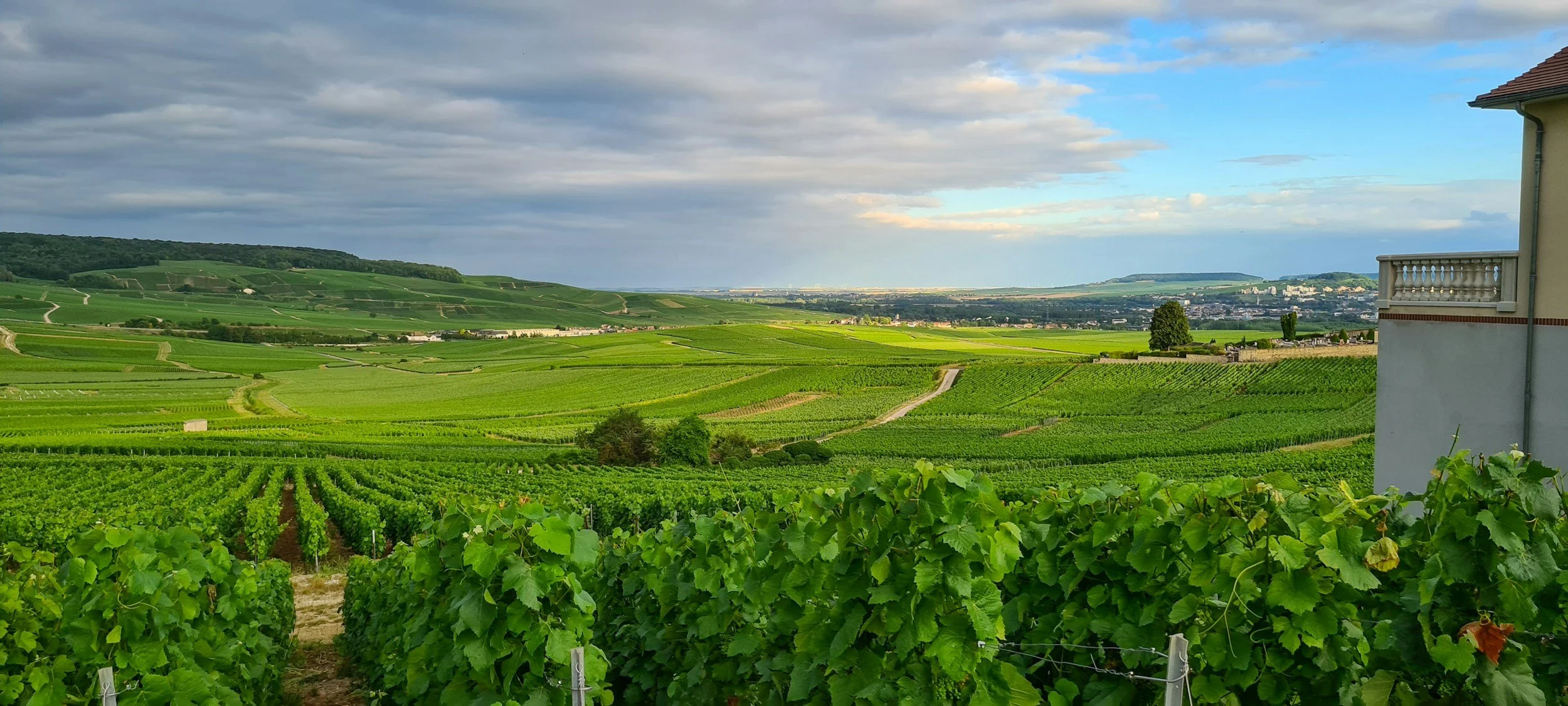
The Hautvillers day I would actually plan
For the easiest version, I would book a taxi from Épernay station for around 10:00 and arrange collection from Hautvillers at approximately 16:30.
Begin at Saint-Sindulphe church before the tour groups become more noticeable, then walk around Rue de l’Abbaye, Rue Dom Pérignon and the smaller lanes looking for the iron signs. Continue to the Dom Pérignon belvedere and Parc Pierre Cheval, which together take around an hour without rushing.
Book Champagne G. Tribaut for late morning if you want a cellar visit, or go straight to Au 36 for a tasting and lunch at around 12:30. Trying to do both is possible, but it gives the day a much more organised feel and leaves less time for the village itself.
After lunch, walk the three-kilometre Piédestal circuit or the shorter Rinsillons loop. Return through the centre for tea or one final glass at Clos des Arches before meeting the taxi.
For the less expensive version, take line 3 from Épernay to Dizy Porte du Vignoble and begin the climb in the morning. Allow a full hour even if the route planner claims 40 minutes, particularly when the ground is wet. Visit the church and viewpoint, reserve lunch at Au 36 or L’Atelier des Moines, then spend the afternoon following the iron signs rather than adding another long walk.
Leave enough daylight for the return to Dizy and choose the bus you intend to catch before beginning the descent. The buses are frequent enough to be useful, but not frequent enough that I would arrive at the stop without checking.
Sunday is the hardest day for a completely public-transport-based visit because the ordinary Mouvéo network does not run. A taxi or e-bike solves that, and several Hautvillers food and tasting addresses do open on Sundays, but every booking needs to be confirmed individually.
When Aÿ is the better choice
Choose Aÿ instead when you want the simplest full day without a car. The TER stops in the town, the centre begins within walking distance of the station, and you have cafés, bakeries, Pressoria, several Champagne houses and the Musardises heritage route without paying for a taxi or beginning with an uphill walk.
Aÿ also works better in uncertain weather. There are more indoor options and more places to wait for the train if a tasting finishes early. Hautvillers is much more dependent on walking, views and being outside between appointments.
Choose Avenay-Val-d’Or when you want one approachable grower visit, a picnic beside the Livre and a proper country walk. It is quieter, much less famous and easier to reach by TER, though it has fewer food choices and almost no shopping.
Germaine is the better alternative once you have had enough cellar tours and would rather spend the day in the forest. It has a railway station, lunch at Chez L and several walks through woodland, fields and the small vineyard parcels around Vaurémont.
Hautvillers makes most sense when the Dom Pérignon history, iron signs and Marne Valley view are specifically important to you. It is not automatically the best village simply because it is the most famous.
Is Hautvillers worth the extra effort?
Yes, once.
The view is genuinely one of the clearest ways to understand the Marne Valley, the church gives useful context to a name seen everywhere in Champagne, and the village has enough grower tastings, food and small architectural details to fill a good half-day. Au 36 also gives independent travellers something particularly useful: the chance to compare local Champagnes without arranging several separate estate visits.
I would not make the journey solely to photograph Dom Pérignon’s tomb. The abbey is private, the church visit is brief and there is no large Dom Pérignon attraction waiting behind the gates. Someone expecting a prestigious branded experience may wonder why they spent €40 on return taxis.
I would also avoid placing Hautvillers in an already crowded day with Épernay, Aÿ and two cellar tours. The transport effort only feels worthwhile when you give the village enough time for the streets, lunch and viewpoint, rather than arriving in a van for 25 minutes and leaving with the same photograph as everyone else.
Hautvillers is harder without a car, but it is not inaccessible. The best solution is either to accept the taxi as part of the cost, or turn the journey itself into the day by walking or cycling up from the valley. What does not work particularly well is pretending it is as easy as one of the Champagne villages with a train platform in the centre.
September is not simply a quieter version of the same trip, particularly once the harvest begins, so I’ve broken down Burgundy in September by weather, prices, harvest activity and the towns that still work well without a car.
Three village days I would actually plan from Reims
The villages along the Reims to Épernay railway line are close enough together that it is tempting to visit several in one day. I would resist that. Trains are not frequent enough for effortless hopping, most Champagne growers expect visitors at a fixed time, and lunch becomes unnecessarily complicated once you are trying to leave one village before the restaurant closes in another.
I would instead choose the village according to the kind of day I wanted. Rilly-la-Montagne is the strongest choice for a grower tasting followed by lunch, Avenay-Val-d’Or makes more sense when walking and a picnic matter more than cellar visits, while Aÿ has enough food, heritage and indoor interest to fill the most complete day.
All three have TER stations on the railway between Reims and Épernay, but that is almost where the similarity ends. Rilly feels organised around Champagne production, Avenay opens gradually into fields, vines and the Livre valley, and Aÿ is large enough to have a market, restaurants, major Champagne houses and an actual museum. I would not judge them by which name is most famous. I would choose the one that fits the day.
A tasting-and-lunch day in Rilly-la-Montagne
Rilly is the easiest place to plan when meeting a grower is the priority. The train journey from Reims is short, the station is close to the village and there are enough producers within walking distance that you can choose an estate according to the sort of visit you want rather than simply booking the only place available.
I would take a morning train from Reims and allow at least 30 minutes between arriving and the tasting. That gives you time to walk up from the station, find the correct courtyard and avoid appearing at someone’s working winery the moment the train pulls in. Addresses in Rilly can look close together on a map, but entrances are not always obvious and the village rises gently towards the vineyards.
For a first visit, I would book one of the growers that offers a proper look at the production spaces rather than a tasting alone. Champagne Daniel Dumont, at 11 Rue Gambetta, receives visitors in English and French by reservation and combines its vaulted chalk cellars with a tasting. It is a practical choice if you want someone to explain how a smaller family estate works without turning the morning into a large organised tour.
Champagne J. & H. Fagot, on Rue Jean Jaurès, is another useful option because the family offers several different visits, including walks connected to the vineyards around Rilly. Its shorter cellar experience fits more easily into this particular day, while the longer vineyard formats are better when you are prepared to make the estate the main event.
I would arrange the tasting for around 10:30 or 11:00. One appointment is enough. Visiting a second grower immediately afterwards rarely tells you twice as much, particularly once every discussion begins with pressing, fermentation and ageing. The more interesting comparison comes from tasting several cuvées with one producer and asking why they differ.
Afterwards, walk through the older streets around Rue de Reims, Rue Gambetta and the mairie before lunch. Rilly is not built around one immaculate historic centre. Its interest comes from the mixture of substantial winegrowers’ houses, working courtyards, old walls and narrow streets climbing towards the vines. You will probably pass delivery vehicles and people moving equipment between buildings, which makes more sense after you have seen what is happening behind one of the doors.
For lunch, I would book Prise de Mousse, at 23 Rue de Reims. It operates as a small Champagne bar and bistrot rather than a formal restaurant, serving food alongside a selection of bottles and glasses. That suits this itinerary because lunch can still feel connected to the village without becoming another long tasting appointment. Its opening days and service hours need to be checked before choosing the train, particularly outside the main visitor season.
Le Bacchus, at 3 Rue de Chigny, is the more everyday alternative. It is a village bar, tabac and local meeting place rather than somewhere designed around wine tourism. Published hours currently cover weekdays, Saturday morning and a short Sunday opening, but the food offered can vary, so I would call before depending on it for a complete lunch.
If neither place is serving on your chosen day, bring food from Reims instead of assuming another restaurant will appear when you arrive. Rilly has useful local businesses, but not the number of backup choices you would find in Aÿ or Épernay.
After lunch, I would take one of the shorter local walks rather than arranging another cellar. The village’s floral and heritage route passes through the centre and gives you a reason to explore the streets above the mairie, while the short vineyard paths show how closely the houses sit beneath the cultivated slopes. Champagne J. & H. Fagot also lists the Five Lords trail, flower walk and romantic walk among the routes around the village.
How far you go should depend on the next train rather than the route name. I would save the longer forest paths for a day without a morning tasting, particularly after wet weather when the tracks above the village can be muddy. A 60 to 90-minute walk, followed by a coffee or final glass if Prise de Mousse is open, is enough before returning to the station.
This is the day I would choose from Tuesday to Saturday, when grower appointments and lunch are easier to arrange. Sunday can work with careful planning, but the combination becomes much weaker if the only available visit is in the morning and neither lunch address is serving properly. Monday may be possible with an appointment, although it would not be my first choice for an enjoyable village day.
Rilly works because the pieces are close together. You can step off the train, meet a producer, eat in the village and still spend part of the afternoon outside without arranging a taxi. It is the most straightforward answer for someone who wants a Champagne village day rather than a walking day that happens to pass through the vineyards.
A quieter picnic-and-walk day in Avenay-Val-d’Or
I would plan Avenay very differently. The village does have Champagne growers, but its stronger case is the landscape around it: the Livre running through the valley, the church and wash house in the centre, vineyard slopes above the houses and several marked walks beginning close enough to the station to use without a car.
I would take a train that reaches Avenay in the morning, then begin with the one-hour Si Avenay m’était conté discovery route. It covers approximately 2.5 kilometres and connects the main pieces of village history without using the best walking hours on a long circuit immediately after breakfast.
The most substantial building is the 13th-century Église Saint-Trésain, whose unusually elaborate portal survived the destruction and rebuilding that affected much of the village. From there, the route brings you towards the wash house, fountain, smaller streets and the places connected to Saint Berthe, the religious figure traditionally associated with Avenay’s former abbey.
The abbey itself no longer provides a large monument to visit. It was destroyed after the French Revolution, so the village’s history has to be read through the church, surviving street pattern and fragments rather than one obvious attraction. That is partly why Avenay feels so different from Hautvillers. Nobody arrives in a tour van, photographs a famous tomb and leaves 20 minutes later.
For the main walk, choose between two routes rather than automatically selecting the longest.
The Au Pays de la Livre circuit covers five kilometres and takes roughly 80 minutes. It is the better choice when you want a relaxed village day, the weather is uncertain or you would like enough time for a pre-arranged grower tasting later. The route follows the small valley landscape around Avenay without requiring the longer climb towards Mont Aigu.
The Circuit du Mont Aigu covers around ten kilometres and takes approximately three hours. It begins near Rue de l’Église, passes through Avenay and Fontaine-sur-Aÿ and climbs to the 196-metre Mont Aigu viewpoint. From the higher ground, you can see the Livre valley on one side and the eastern edge of the Montagne de Reims opening towards the wider Champagne plain on the other. The official route is described as easy, but there is still a distinct climb and exposed vineyard terrain.
I would begin the Mont Aigu circuit before noon and carry the picnic rather than eating first. That lets you stop once you have left the village and reached a place where the view opens, instead of sitting beside the station because lunch happens to fall at 12:30. Bring enough water, especially in summer, because the vineyard sections have little shade and there is no dependable café halfway around the route.
The landscape changes more than the photographs of Champagne slopes suggest. You pass vineyards, fields, the wooded edge of the regional park and sections of the Livre valley, while the eastern side of the commune includes grassland, pines and areas known for wild orchids. You are not walking through unbroken rows of grapes for three hours.
Download the route before leaving Reims. Mobile coverage may be perfectly adequate, but vineyard junctions can look almost identical and the yellow markings are easier to miss when agricultural vehicles, vegetation or temporary work interrupt the path. After rain, the tracks may be muddy even when the streets around the station are dry.
If you prefer to include Champagne, book one grower for the late afternoon and take the five-kilometre walk rather than Mont Aigu. Avenay producers generally work by appointment, and you should not expect to find several public tasting rooms open when you return. Champagne Pierre Morlet, Champagne Jean Marniquet and Champagne Crucifix are among the local names, but confirm the visit language, duration and exact number of tastings directly before choosing your train.
Personally, I would leave this day without a formal tasting. After visits in Reims or Rilly, spending several hours walking through the landscape where the grapes are grown adds more to the trip than hearing the production process explained again. Return to the centre, look around Saint-Trésain properly and take an afternoon train back to Reims.
Avenay is best on a dry weekday or Saturday, particularly when you want a full outdoor day and do not mind carrying lunch. It is a poor choice in heavy rain, very hot weather or on a day when the train gaps leave you waiting for several hours after the walk. Check the return options before deciding between the five and ten-kilometre circuits.
This is the least expensive of the three days, and it is simply the one that places Champagne in its wider rural setting. The station, village and marked paths allow you to spend a day among the vines without making drinking the only activity.
A fuller food-and-culture day in Aÿ
Aÿ is the right choice when you want the day to continue working even if a tasting is cancelled or the weather changes. It is larger than Rilly or Avenay, with a proper centre, several places to eat, everyday shops, major Champagne names and Pressoria, the region’s most useful museum for understanding how the landscape, grapes and production process fit together.
Friday is the strongest day because the weekly market occupies Place Henri Martin from approximately 08:00 until 12:00, with around 25 traders. It is not a tourist market arranged around bottles and souvenirs. Expect food, produce and the ordinary purchases of a small French town, which gives you a better introduction to Aÿ than walking directly from the station to a Champagne appointment.
Take a morning train from Reims and walk towards Place Henri Martin first. On Fridays, look around the market and buy something small for later before beginning the Musardises Agéennes heritage route. The circuit is marked by 19 interpretation panels explaining how the wine trade shaped Aÿ, from its cellars and presses to the houses built by merchants, workers and vineyard owners.
This is not a preserved wine village where every façade belongs to the same period. Streets such as Boulevard Charles de Gaulle, Rue Roger Sondag and Rue Jules Lobet mix Champagne premises with schools, shops, houses and municipal buildings. The Musardises route helps make sense of that mixture rather than pretending the only relevant buildings are the grandest ones.
You will pass the entrances of major houses including Bollinger, Deutz and Ayala, but seeing a name above a gate does not mean you can walk in for a tasting. Their visitor arrangements differ, and some experiences are limited or require advance contact. Unless a particular house is essential to you, I would avoid placing a formal cellar tour into this day. Pressoria already gives you the production background, and the streets show how closely Champagne is tied to the town.
Book lunch for around 12:30. Rôtisserie Henri IV, at 46 Boulevard Charles de Gaulle, is the dependable traditional choice, serving substantial French dishes in a room that feels more like a local restaurant than a branded Champagne experience. Its opening pattern includes several lunch services but changes across the week, so confirm the current schedule and reserve.
For something more contemporary, check the current restaurant at Maison Calsis, beside Pressoria on Boulevard Pierre Cheval. This is the more convenient option when you want lunch and the museum in the same part of town, although I would still leave a proper gap between the reservation and your entry time rather than assuming lunch will finish in exactly an hour.
Afterwards, walk to Pressoria, housed in the former Pommery pressing centre at the foot of the vineyard slope. The permanent exhibition moves through ten themed spaces covering the geology of Champagne, vines through the seasons, grape varieties, pressing, fermentation, blending and the sensory differences between wines.
It is interactive without feeling designed only for children. Smell, touch, sound, projected landscapes and practical explanations are used to answer the questions that cellar tours sometimes pass over quickly, particularly how chalk, slope direction, weather and grape variety alter what eventually reaches the glass.
Allow around 90 minutes to two hours. The visit ends with a commented tasting of two Champagnes, or grape juices for anyone not drinking, on a terrace overlooking the vines. That tasting is enough for this particular day and removes the need to fit a separate producer into the afternoon. Pressoria currently opens from 09:30 until 18:30 every day except Thursday, with the final recommended entry well before closing.
The Thursday closure matters. Aÿ still has enough streets, houses and walking routes to visit without Pressoria, but it no longer delivers the same complete food-and-culture day. If Thursday is your only available date, I would book a producer or follow the longer Cubray vineyard circuit instead.
After Pressoria, walk towards the canal and Marne Valley cycle route if there is time before the train. The low, open landscape beside the water is a useful contrast to the enclosed streets and vineyard slope above the town. You do not need to complete another official route. A short walk beside the canal is enough after several hours in the centre and museum.
If your train leaves later, return towards Place Henri Martin for coffee or a glass rather than booking an additional tasting. Aÿ has enough cafés, bars and food businesses to make this possible, although individual opening hours still need checking. This is one of the few rail-served Champagne villages where finishing an activity early does not leave you standing beside a closed mairie with nowhere to go.
I would plan Aÿ on Friday for the market, or on Monday, Tuesday, Wednesday or the weekend when Pressoria is open. It is particularly useful in spring and autumn, when a day depending entirely on vineyard paths can be spoiled by rain. Most of the centre can be explored in short sections, and the museum gives you a substantial indoor part without sending you underground for another cellar tour.
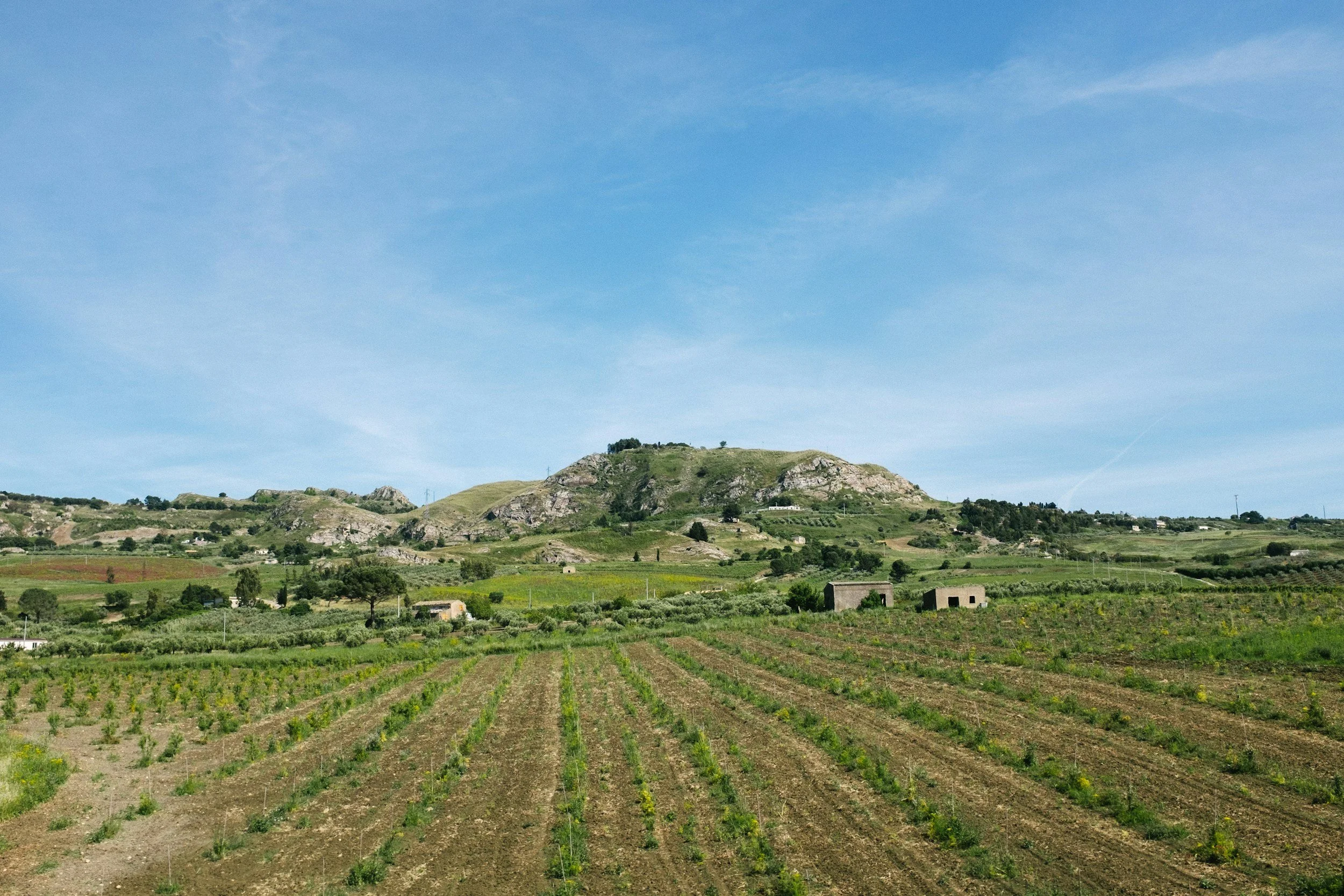
Which of the three would I choose?
For a first independent Champagne village, I would choose Rilly-la-Montagne. It gives you the clearest version of the experience most people have in mind: a short train from Reims, a personal appointment with a grower, lunch in the village and time to walk beneath the vines before returning.
I would choose Avenay-Val-d’Or after one or two cellar visits elsewhere. It is the better day when you are ready to see where Champagne comes from without spending most of the afternoon discussing bottles. The ten-kilometre Mont Aigu circuit makes it a genuine walking destination, while the shorter Livre route still leaves space for the church, village and an optional appointment.
I would choose Aÿ when travelling with someone who does not want the entire day to revolve around tasting, or when the forecast makes a countryside walk uncertain. The market, Musardises route, restaurants, Pressoria and canal give the day more variety than any of the smaller stops.
I would not try to combine all three. Even two creates compromises unless the only goal is to say you have seen them. Rilly needs its booked grower and lunch, Avenay needs enough daylight for the walk, and Aÿ can easily fill the day on its own. Staying in one place is what turns each of them from a railway stop into a village you have actually understood.
FAQs about visiting Champagne villages from Reims
Can you visit the Champagne region without a car?
Yes, Champagne is surprisingly manageable without a car if you stay in Reims or Épernay and choose villages around the railway. Rilly-la-Montagne, Germaine, Avenay-Val-d’Or and Aÿ-Champagne all have TER stations, so you can reach vineyards, walking routes and family-run Champagne producers without joining a tour.
The part that requires planning is what happens after you leave the train. Small growers usually expect you at an agreed time, village restaurants may only serve lunch for a couple of hours, and some stations have long gaps between departures. I would choose one village for the day, arrange the tasting first and then build everything else around the trains that actually stop there.
French regional trains are straightforward once you understand how the timetables and tickets work. This guide explains how I plan car-free trips in France using TER trains.
Which Champagne villages can you reach by direct train from Reims?
The most useful Champagne villages with direct TER trains from Reims are Rilly-la-Montagne, Germaine, Avenay-Val-d’Or and Aÿ-Champagne. The same railway continues to Épernay, which gives you another easy day trip and a much larger choice of Champagne houses, restaurants and shops.
The villages are not interchangeable. Rilly has the best combination of growers, lunch and a short vineyard walk. Germaine is the one I would choose for forest paths rather than a full day of tastings. Avenay is better for a picnic and a longer country walk, while Aÿ has enough food, history and indoor interest to fill a day even when the weather turns.
Not every TER stops at every village, particularly at weekends, so search for the precise station and date through TER Grand Est. A timetable showing plenty of trains between Reims and Épernay does not necessarily mean they all stop in Avenay or Germaine.
What is the best Champagne village to visit from Reims without a car?
For a first Champagne village day from Reims, I would choose Rilly-la-Montagne. The journey is short, the village begins close to the station and several family producers offer bookable cellar visits and tastings within walking distance. It is possible to arrive in the morning, meet one grower, have lunch and still spend part of the afternoon walking below the vineyard slopes.
I would choose Aÿ instead if I wanted a fuller day rather than the most traditional village experience. Aÿ has restaurants, a Friday market, the Musardises heritage route and Pressoria, where the exhibition explains the landscape and production process before finishing with a tasting. It is also the better choice in uncertain weather because the entire day does not depend on vineyard paths being dry.
Avenay and Germaine are stronger once you have already visited a cellar or two elsewhere. Their appeal is being able to leave the train and spend several hours walking through the wider landscape, without finding another tasting to fill the afternoon.
Can you walk from the train station to Champagne vineyards and producers?
Yes, but you should check the producer’s exact address before assuming everything will be beside the station. In Rilly-la-Montagne, Germaine, Avenay-Val-d’Or and Aÿ, you can walk from the platform into the village and continue towards vineyards or marked walking routes. You do not need a taxi simply to see the landscape.
What you will not find is a neat row of tasting rooms waiting outside every station. These are working villages, and many grower addresses look like private houses or courtyards until you find the correct entrance. Some sit higher up the slope than the railway, so allow more time than the distance alone suggests.
I would leave at least 30 minutes between the train arriving and a booked visit, even when the map claims the walk takes 12 minutes. That gives you time to find the address without beginning the tasting flustered because you have been searching for an unsigned courtyard.
Do you need to book Champagne tastings in advance?
Yes, book tastings with independent Champagne growers before travelling to the village. Many family producers do not keep a public tasting room open all day. The person receiving visitors may also be working in the vineyard, bottling wine or preparing an order, so an online listing that says “open” does not always mean you can arrive without warning.
Before confirming, ask what the visit includes. A short tasting at the property is different from a cellar tour, vineyard walk or longer explanation of production, and the prices can differ accordingly. I would also confirm the language, duration and number of Champagnes being poured.
Tell the producer that you are arriving by train. It gives them a clear reason for choosing a particular time and avoids an appointment ending three minutes after the only useful afternoon train has left.
Is Reims or Épernay better as a base without a car?
Reims is the better base for a first trip that combines Champagne villages with restaurants, history and several days of sightseeing. It has direct trains from Paris, a much broader choice of places to eat in the evening and TER connections towards Rilly-la-Montagne, Germaine, Avenay-Val-d’Or, Aÿ and Épernay.
Épernay is better when the trip is mainly about Champagne. The Avenue de Champagne begins within walking distance of the station, the centre is more compact, and Épernay is the easier starting point for Aÿ and a taxi to Hautvillers.
I would stay in Reims if I wanted to visit one or two villages but still have a proper city around me when I returned. I would choose Épernay if most of my plans were in the Marne Valley and I wanted several Champagne houses within an easy walk of the hotel. This comparison of where to stay in Champagne goes into the practical differences between the two bases.
Can you visit Hautvillers from Reims without a car?
Yes, but Hautvillers is not one of the villages you can reach directly by train. It has no railway station, and the simplest route is to take the train to Épernay and arrange a taxi from there. The drive from Épernay takes around ten minutes, but I would book the return at the same time rather than expecting to find an available taxi in the village later.
The less expensive option is Mouvéo line 3 from Épernay to Dizy, followed by an uphill walk of roughly three to four kilometres. That is a realistic route in dry weather if you enjoy walking, but it is not a flat stroll between two neighbouring centres. You also need to plan the return around the bus timetable, which normally excludes Sundays and public holidays.
Hautvillers is worth the extra effort when you specifically want the Marne Valley view, the wrought-iron signs and the church containing Dom Pérignon’s tomb. The former abbey is privately owned and cannot be toured, so I would not pay for return taxis expecting a large Dom Pérignon attraction. The Hautvillers tourism office lists the current rail, taxi and local bus options.
Can you visit Champagne vineyards without booking an organised tour?
Yes, you can visit Champagne independently by combining TER trains with one pre-booked grower appointment. This is the option I would choose if I wanted time for lunch, walking and the village itself instead of spending most of the day being driven between three producers.
A tour becomes useful when the places you care about do not have railway stations. Villages such as Bouzy, Ambonnay and several addresses in the Côte des Blancs are considerably harder to combine by public transport. A tour also saves time if your priority is comparing several producers in different parts of Champagne during one day.
Independent travel and a guided tour are really two different kinds of day. The train is better for understanding one place properly. A tour is better for covering more ground and reaching cellars that would otherwise require several taxis.
How many Champagne villages can you visit in one day?
One village is usually enough for a day that does not feel rushed. A grower visit may take 60 to 90 minutes, lunch has to fit the village’s service hours, and the trains are not frequent enough for spontaneous hopping between every station on the line.
Two villages are possible, but I would only combine them when one has a very specific purpose. You could visit a grower in Rilly during the morning and continue to Aÿ later, but you would lose most of the walking and unplanned time that makes either village enjoyable.
The easiest pairing is Aÿ and Épernay. They are close together by train, both have several food options, and Épernay gives you somewhere useful to spend an hour if the connection is longer than expected. I would not try to include Reims, Épernay, Hautvillers and a railway village in the same day simply because the distances look short on a map.
Can you visit Champagne villages on a Sunday?
You can, but Sunday requires more preparation than any other day of the week. TER trains still run, although there may be fewer departures, while growers, bakeries and restaurants are more likely to close or operate shorter hours.
Aÿ is generally the safest Sunday choice because there is more to do if one appointment changes. Pressoria normally opens on Sundays during its main April to October season, except for its regular Thursday closure, and the town has more food options than the smaller villages. Check the current Pressoria opening information before relying on it.
Rilly can still make a good Sunday trip when both the grower and lunch have been confirmed. I would not take a train to Avenay or Germaine on a Sunday expecting to find an open café, an available tasting and an easy lunch without arranging any of them first.
Can you take a day trip from Paris to a Champagne village without a car?
Yes, but choose either a village day or a Reims city day rather than trying to fit the whole region into one visit. Take an early train from Paris-Est to Reims, then change to a TER for Rilly-la-Montagne or Aÿ-Champagne.
Rilly is the better choice if meeting an independent grower is the main reason for the trip. Aÿ is easier when you want lunch, Champagne history and Pressoria as well as a walk through the town. In either case, reserve the tasting or museum entry before buying a regional connection that only leaves a few minutes to reach it.
Trying to see Reims Cathedral, tour a major Champagne house, visit Épernay and squeeze in Hautvillers produces a day spent watching the time. With one day from Paris, I would either stay in Reims or choose one railway village and treat Reims as the connection rather than another stop.
How do you reach Verzenay and the Faux de Verzy from Reims without a car?
The seasonal Grand’R bus connects Champagne-Ardenne TGV station in Bezannes with villages and sights across the Montagne de Reims, including Rilly-la-Montagne, Mailly-Champagne, Verzenay, the Phare de Verzenay, Verzy and the Faux de Verzy.
The important detail is that the bus leaves from Champagne-Ardenne TGV, not the main Reims Centre station. You need to allow time to reach Bezannes before the Grand’R departure. The service only has three return journeys per day, so decide which return you intend to use before setting off on a forest walk.
For the 2026 summer season, the bus runs daily until 13 September. Outside the main season, it changes to an advance-booked transport-on-demand service through MyMobi. Dates and operating arrangements can change from year to year, so use the official Grand’R timetable rather than copying a departure time from an older article.
The Grand’R is the best public-transport option when you want to combine the Verzenay lighthouse with the twisted beech trees at the Faux de Verzy. It is much less flexible than the TER, but it opens up a part of the Montagne de Reims that is otherwise awkward to reach without driving.