
Where to stay on Sifnos without a car: Kamares, Apollonia or Artemonas?
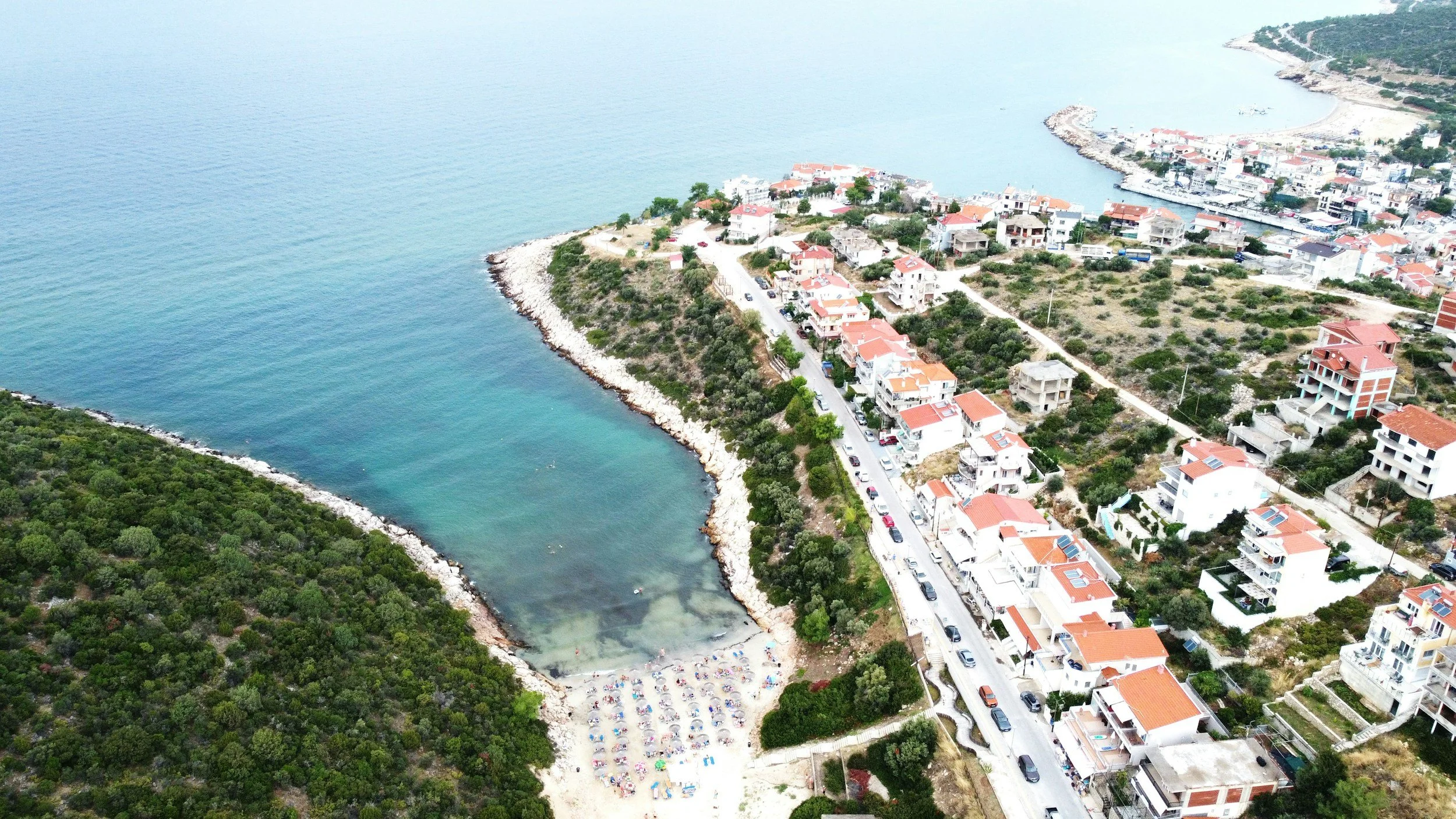
For most people visiting Sifnos without a car, Apollonia is the safest choice, especially on a first trip of three to five nights when you want to see more than one part of the island and don’t yet know which beach, village or dinner plan you’ll end up liking most. It sits in the most useful position for the buses, gives you the easiest evenings, and makes everyday decisions simpler in a way that starts to matter quite quickly once you are there. After a day in Kastro, Faros or Platis Gialos, you can come back, shower, head out for dinner and not spend the evening thinking about one more journey home.
That does not mean Kamares and Artemonas are weaker versions of the same idea. They suit different trips, and in the right circumstances either one can be the better booking.
Kamares makes the strongest case when the ferry and the beach are a big part of why you chose Sifnos in the first place. You arrive there anyway, the beach runs along the bay, and if your room is down near the waterfront, you can get off the ferry and settle in with very little effort. On a two- or three-night trip, especially with a late arrival or an early departure, that can be more valuable than being in the middle of the island. You lose some flexibility, but you gain an easy start, an easy finish and a base where swimming fits naturally into the day.
Artemonas is the one people tend to underestimate. It is quieter and a little more residential than Apollonia, but it is not some cut-off compromise for people who dislike nightlife. The municipality describes it as the terminus for the island’s bus routes, and many services run through Apollonia towards the port and the beaches, so a well-located room here can be just as practical as plenty of rooms sold under an Apollonia address. You still get the freedom to move around the island during the day, but you come back to something calmer in the evening, and Apollonia is close enough to walk to for dinner when you want more choice. In July and August especially, that balance can be very appealing.
The more important catch, though, is that the village name is only the first filter. On Sifnos, the exact accommodation pin matters much more than it seems when you are scrolling booking sites at home. A hotel labelled Apollonia can sit beyond the compact centre and leave you walking along a road whenever you want a bus. A Kamares room can be wonderfully flat and five minutes from the ferry, or halfway up the hillside with a climb you notice every time you come back from dinner. Artemonas spreads out too, so there is a real difference between staying close to the bus terminus and staying on the edge of the village because the listing still says “Artemonas”.
So for a typical first trip, Apollonia would still be my starting point, but not as some rigid rule. I’d choose Kamares when the trip is short and built around easy swims, straightforward ferry days and relaxed evenings by the bay, and I’d choose Artemonas when I wanted the same central part of the island, just with quieter nights. And if the choice came down to a really well-located room in Artemonas or a beautiful but awkward hotel somewhere outside central Apollonia, I’d take Artemonas without much hesitation.
Sifnos is easy without a car, but the bus timetable decides how free it feels
Sifnos is a very manageable island without a car, but it is not the kind of place where you can ignore transport completely and assume everything will work itself out on the day. In July and August, the main routes are usually strong enough that you can wake up, change your mind, go somewhere else and still keep the day feeling fairly open. In May, late September or October, you can still get to many of the same places, but the timetable starts shaping the day much more. You might end up planning lunch around a departure time, or leaving the beach a little earlier than you wanted because missing one bus suddenly matters.
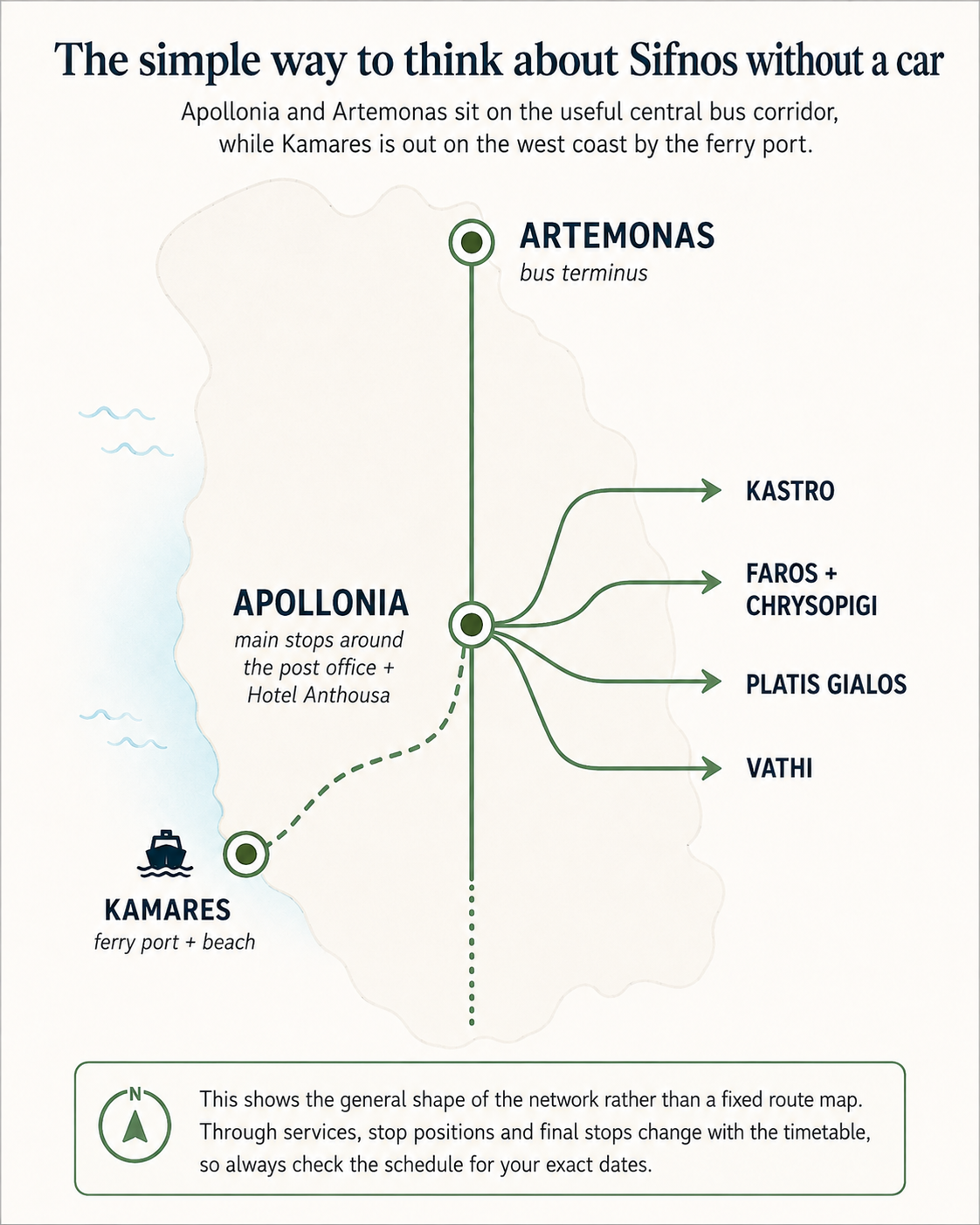
The helpful way to picture the network is not as buses running all over the island in every direction, but as a central spine through Artemonas and Apollonia, with other routes branching out from there. That matters because Artemonas is often spoken about as though it sits slightly outside the useful part of the island, when in reality the municipality describes it as the terminus for the bus routes. Many services start there, pass through Apollonia and continue on towards Kamares, Kastro or the southern beaches. So Artemonas is not some inconvenient add-on to Apollonia. It sits on the same useful corridor. The only thing to keep in mind is that not every individual service runs the full route, which is why the little timetable footnotes matter more than they first appear.
Apollonia is still the easiest place to use as a base, but not because it has one neat central terminal where everything departs. In practice, the official stops are spread around the Hellenic Post Office and Hotel Anthousa, and where you stand depends on where you are going. One day that might mean heading towards the post office for Kamares, and the next it might mean using the Anthousa side for Faros, Chrysopigi or Platis Gialos. It sounds slightly fiddly when written down, but once you are in the middle of the village it is manageable enough. The main thing is simply not assuming that “close to the bus stop” tells you much unless you know which stop the hotel means.
That small detail becomes more important than it sounds because on a no-car trip you repeat the same little walks constantly. A distance that seems tiny on a map can feel much less tiny when it includes steps, a steep lane or a roadside stretch in the heat. So if a property in Apollonia is better placed for the post-office stop than the Anthousa one, or vice versa, that is not just trivia. It affects how easy the stay feels every single day.
Kamares gets oversimplified in the opposite direction. You will often read that staying there means changing buses in Apollonia every time you want to go anywhere else, but that is not automatically true either. Some services continue through the centre and onwards, while others do not, depending on the timetable. So I would not dismiss Kamares on the assumption that every outing involves a connection, but I also would not choose it expecting the same freedom you get from sleeping in the middle of the island. The bigger difference is that, from Kamares, most exploring days begin by heading inland first, which makes you more dependent on the timetable continuing to suit whatever kind of day you want to have.
That is easiest to notice when a plan slips in a nice direction. Say you go to Platis Gialos, stay longer than intended because the water is lovely and lunch turns into a slower afternoon than you meant it to. In peak summer, that may not matter much. On a thinner autumn timetable, the very same decision can suddenly mean a long wait, an earlier-than-planned departure or the expense of a taxi home. The destination has not changed, but the freedom around it has.
The evening is where I’d pay the closest attention. Getting somewhere during the day is usually the easy part. The more useful question is how relaxed you can be about getting back after dinner. If you are staying in Kamares and go to Apollonia for the evening, the final return shapes how long you stay, whether you order another drink and whether the evening can drift naturally or has to end on schedule. In high summer that may be barely an issue. Outside peak season, it can be the difference between a simple night out and a mildly annoying one.
So the timetable does not need to become a whole project before you travel. I’d just check four things: the date range it covers, the right stop, any footnote attached to the route, and the final useful return. That last one matters much more than the first bus out in the morning. And the date range matters more than many people realise, especially around September, when the schedule can change partway through the month.
Once you understand those basics, Sifnos feels far less complicated than it may sound when everything is written out like this. The island is compact, the key places are linked, and you do not need to plan every day in advance. You just have a much better trip when you know which parts of the timetable are flexible and which missed bus is going to be a bit more annoying than it looked on paper.
If you’re still at the stage of comparing islands rather than rooms, I’ve also looked at whether Tinos or Sifnos better fits the trip you want, because the two work quite differently once you remove the car.
Apollonia is the best all-round place for a first car-free trip
Apollonia is the base I’d choose when I wanted to see a good amount of Sifnos without organising the whole trip in advance, because you can head towards Kamares one day, Kastro the next and Faros, Chrysopigi, Platis Gialos or Vathi after that without first having to travel into the middle of the island. That leaves much more room for the sort of decisions you tend to make once you are there anyway, whether the wind changes your beach plans, you sleep later than intended or you simply decide over breakfast that somewhere else sounds better.
The bigger advantage comes when the bus journey is over
The stops around the post office and Hotel Anthousa are all close enough together that, once you understand which one you need, using the buses from central Apollonia is fairly straightforward. There is also a taxi rank by the post office, which gives you a useful backup when the timetable is not lining up particularly well with whatever you have decided to do.
But the part I think you notice more over several nights is what happens when you come back.
After a day in Faros or Kastro, you can return to the room, shower, change and head out again without looking at another departure time. That sounds like such a small advantage when you are sitting at home comparing hotels, but I know I’d get tired surprisingly quickly of every nice dinner ending with somebody checking the time and saying, “We should probably get going.”
It also means a day does not have to become an excursion just because you are on Sifnos. You can have breakfast, wander towards Artemonas, come back for a few hours and decide later whether you feel like going anywhere else, because there is enough around central Apollonia that an unplanned afternoon there does not leave you stranded waiting for the next bus.
Stay near To Steno, not necessarily on top of it
Central Apollonia becomes noticeably livelier later in the day, with To Steno and Plateia Iroon pulling much of the evening activity into one compact part of the village. Staying nearby is extremely convenient because dinner and drinks are minutes from the room, but in July and August I would think twice before booking directly above the busiest stretch if early mornings are also part of the plan.
You can see both sides of Apollonia along the same lane. Drakakis has tables spilling into Steno for food and meze earlier in the evening, while places such as Botzi 93 carry things on much later. That mix is part of the appeal of staying here, but I’d rather be able to walk into it in two minutes than have it directly underneath the bedroom window.
A side lane or somewhere towards the edge of the pedestrian centre would be my preference. You still get the freedom to walk out, change your mind about where to eat and come home whenever you have had enough, but there is at least a little distance between your bed and everyone else’s final drink.
I also wouldn’t take the search for quiet too far. Once a property starts moving well beyond the pedestrian centre because it has a pool, more space or a better view, you can end up giving away the convenience that made Apollonia worth choosing in the first place.
The part of Apollonia I’d book
My first search would be around the post office, Hotel Anthousa and the lanes leading towards To Steno and Plateia Iroon. I wouldn’t need to be directly beside the bus stops, but I’d want them close enough that catching a bus in the morning feels effortless, while dinner remains an easy walk in the other direction.
The area towards Ano Petali can be tempting too, particularly when the rooms become quieter and the views open up, but this is where I’d stop judging distance by the booking map alone. Stone lanes, steps and the exact route back after dark can turn what looks like a very short distance into something you notice every day.
One question I’d ask before booking any property in or around Apollonia is where a taxi or transfer can physically drop you with your luggage. In a pedestrian village, “200 metres from the centre” can mean a pleasant couple of minutes once you have checked in, or it can mean carrying a suitcase up steps before you have even reached the front door.
I’d be even more careful with listings using an Apollonia address but sitting towards Kato Petali, Katavati, Exambela or one of the connecting roads. They may be lovely places to stay, but the village name on the listing is not enough. If dinner involves an exposed roadside walk and getting to the useful bus stops adds another fifteen minutes every morning, you have booked a very different version of Apollonia from the one people mean when they recommend it as the easiest car-free base.
For a first stay, I’d happily trade a little hotel space or a wider view for a room where the buses are easy in the morning and transport disappears from the conversation once I’m home for the evening. That is the version of Apollonia I think is worth paying for.
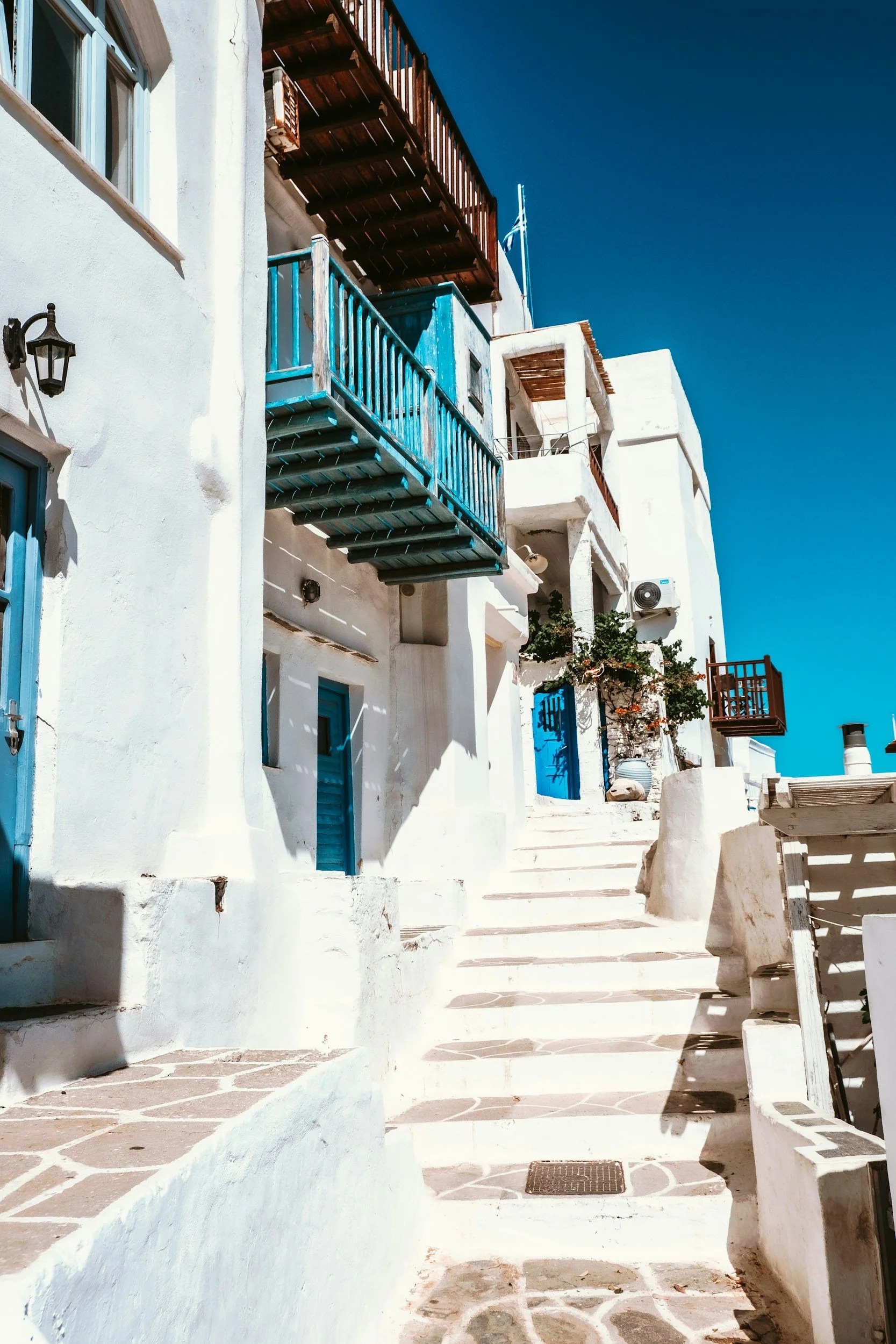
Kamares is better when the beach and ferry days matter most
Kamares becomes much more appealing when the ferry and the beach are part of the trip rather than just things you need to deal with. Every ferry arrives here, so if you stay in the lower part of the village, you can collect your bag, walk to the room and be settled without adding another bus or taxi to the day. On a week-long trip I wouldn’t choose a base purely to save one transfer, but over two or three nights, or with a late arrival or early departure, that simplicity starts to matter a lot more.
Late ferries are a good example. Everything looks beautifully organised when you are planning from home, but once a boat is delayed and you arrive after dark, being able to stay in the same bay feels very different from still having to work out how to get inland. If the room is across the bay or above Kamares, I’d arrange a pickup in advance, but at least you are dealing with a short local transfer rather than trying to rescue the whole arrival plan.
Staying here makes ferry days pleasantly uneventful
For a short trip, being able to leave the luggage, go for a swim and get on with the day is a real advantage. The same applies on departure morning, when you can have breakfast, spend a little longer by the water and collect your bag when you genuinely need to leave rather than spending the last few hours mentally counting backwards from the ferry.
It is not the glamorous part of choosing where to stay, but it is the sort of convenience you notice once the trip is underway. On a two-night stay, I’d rather spend those hours on the beach than moving between the port and a hotel simply because the inland villages look more central on the map.
Kamares is somewhere you can stay put for the day
The port label undersells Kamares a little. The sandy beach curves around the bay towards Agia Marina, so staying near the water gives you something none of the inland bases can offer: the option to swim without turning it into a planned outing.
That changes the day more than the map suggests. A beach that requires a bus is still somewhere you have to decide to go. In Kamares, you can walk down in a swimsuit before breakfast, come back to the room, and only then decide whether you feel like going anywhere else.
There is enough around the bay for the days when you don’t. Restaurants, bakeries, groceries and pottery workshops mean you can stay local without feeling that you are simply waiting for the next bus, and the west-facing bay gives the evening its own reason to remain by the coast.
Ferry arrivals bring short bursts of activity around the quay, but they are exactly that: bursts. A boat comes in, luggage and taxis appear, and things settle again. I wouldn’t reject the lower village because of port noise unless the room sat directly beside the busiest part of the quay or I knew I was an exceptionally light sleeper.
The three parts of Kamares are not equally convenient without a car
This is where the exact accommodation pin starts to matter.
Near the quay and main village is the easiest version of Kamares. You are close to the ferry, buses, shops and places to eat, and luggage is unlikely to become an issue. You will notice more of the ferry traffic, but on a short stay I think that is a fair exchange for being able to walk almost everywhere you need.
Further around the bay towards Agia Marina, the trip becomes more beach-focused and a little calmer. That is the area I’d look at if swimming mattered more than being first onto the bus, but I would check the real route back to the quay with luggage. Twenty minutes along the bay in sandals can be lovely; twenty minutes with a suitcase while your ferry is boarding is a completely different walk.
Then there are the rooms above Kamares, which often have the photographs that are hardest to resist. The views can be beautiful, but this is the point where you can accidentally remove the main advantage of staying here. If every coffee, swim, bus ride and dinner ends with a steep climb back to the hotel, Kamares stops being quite so effortless.
For a no-car trip, I’d take the slightly less spectacular room that lets me walk easily between the beach, ferry and dinner over the terrace I have to earn several times a day.
Leaving Kamares is easy enough, but you feel the timetable more
The compromise shows up on the days you want to explore elsewhere. Most of Sifnos opens up once you travel inland, so staying in Kamares means starting many of those days with a bus rather than simply walking out into the central villages.
As covered earlier, that does not mean every journey requires changing in Apollonia. Some services continue through and others do not, depending on the timetable. The practical difference is simply that Kamares gives you less room for changing the plan halfway through the day.
The same is true in the evening. Dinner in Apollonia is easy enough to arrange, but at some point you have to remember that your bed is back on the coast. In July or August that may barely matter because later buses can still be useful; outside peak season, I’d know the return before getting too comfortable at the table.
One nice way to avoid taking the bus both ways is Trail 10 from Apollonia down to Kamares, a 5.7-kilometre official route that is better tackled in the downhill direction towards the coast. Taking the bus inland, spending some time around Apollonia and then walking back to the bay gives you a very different day from simply commuting between the two.
I’d treat it as a walk to enjoy once, not a transport solution. It is not a sensible luggage route and definitely not something I’d save for the hottest part of a July afternoon.
Kamares is strongest when you genuinely want to spend time in Kamares itself. If swimming before breakfast, staying around the bay some evenings and making the ferry days ridiculously easy all sound appealing, the trade-off in centrality is completely reasonable. If you already know you’ll spend most days inland and most evenings back in Apollonia, I’d skip the repeated bus journey and stay there instead.
Artemonas is the calmer alternative I’d seriously consider
Artemonas is the place I would look at properly before defaulting to Apollonia, because on paper it can seem like you are moving away from the convenient part of Sifnos when in reality you are only moving a little further along the same central corridor. You still have buses, you can still walk into Apollonia for dinner, and you are not giving up the freedom to spend one day in Kastro and the next at the beach. The difference is that you come home to a village where evenings are less concentrated around bars and people staying out late.
For someone who likes being up early, wants to step straight out into village lanes in the morning and would rather visit the busier part of Sifnos than sleep in the middle of it, that is a pretty convincing trade. In July and August especially, when Apollonia is at its liveliest, I would take a central room in Artemonas very seriously.
It is also the option I’d look at most closely when travelling alone and wanting somewhere calm to come back to at night; I’ve included Sifnos among the islands that are particularly easy to enjoy alone for much the same reason.
Artemonas is far better connected than it gets credit for
The biggest misconception is that Artemonas becomes inconvenient the moment you give up a car. The Municipality of Sifnos describes it as the terminus for all of the island’s bus routes, and many services begin here before passing through Apollonia and continuing towards Kamares, the beaches or other villages.
That means a room close to the terminus can be just as useful in the morning as plenty of rooms carrying an Apollonia address. You can walk out, get on the bus and be on your way rather than first needing to reach Apollonia just to start the journey, which is quite different from the way Artemonas is sometimes presented as the quieter village sitting “near” the transport hub.
The only caveat is the timetable itself. Some individual services begin or finish in Apollonia rather than covering the whole Artemonas section, and that matters more outside the busiest part of summer when you have fewer departures to play with. But that is a route-specific issue, not a reason to write Artemonas off as a base.
A room beside the Artemonas terminus would beat an outlying Apollonia hotel for me quite easily. The latter may technically have the more convenient village name, but if you are walking fifteen minutes down a road every morning to reach the useful bus stops, you have not gained much from being “in Apollonia” at all.
Evenings are calmer, but you are not going home to nothing
Artemonas also gives you a nicer middle ground than the usual “lively Apollonia versus quiet Artemonas” description suggests. Restaurants, bakeries and cafés are spread through the village among old houses, courtyards and pedestrian lanes rather than concentrated along one obvious nightlife strip, so evenings feel calmer without the village shutting down around you.
That matters because you do not have to head into Apollonia every time you want breakfast, coffee or dinner. Mosaico, beside Panagia Kochi church, is one example of an evening restaurant and café in Artemonas itself, and the village also has traditional bakeries, pastry shops and pottery workshops dotted through the lanes.
I would still expect a broader choice of restaurants and bars in Apollonia, especially if you like deciding at ten o’clock that the evening should carry on a little longer, but I do not think that automatically makes Artemonas the less interesting place to stay. The appeal is having enough around you for an easy evening, while knowing Apollonia is close whenever you want more.
And I would not describe Artemonas as silent. It is a lived-in village, and summer events can bring plenty of activity of their own. The difference is simply that nightlife is not concentrated underneath your bedroom window in quite the same way.
That distinction matters more to me than the usual “quiet versus lively” shorthand. I like being able to walk somewhere busier when I want it; I just do not necessarily want other people’s night out continuing below the window after I have decided mine is over.
Walking into Apollonia is easy enough, but the exact route matters
One of the reasons Artemonas works so well is that Apollonia is close enough to become part of everyday life rather than a separate outing. The municipality places the villages roughly one mile apart, and depending on your exact start and finish, you are generally looking at around 15 to 25 minutes between the useful central parts.
That is close enough to walk into Apollonia for dinner or drinks and head home afterwards without organising the evening around a bus. For most reasonably mobile travellers, the two villages feel connected in practice rather than like separate bases.
I would still ignore anyone promising a universal ten-minute stroll, because the direction matters and so does the hotel. The walk back towards Artemonas is uphill, and depending on where you are staying, the route can involve stone lanes, steps or a section closer to the road. Fifteen or twenty minutes after dinner in comfortable shoes is one thing; doing the same route with a suitcase at two in the afternoon in August is another.
This is also why accommodation advertised as being “between Apollonia and Artemonas” deserves a closer look. In the right spot, it can be an excellent compromise, with an easy village route in both directions. In the wrong one, “between” can mean beside a road with no proper pavement and a final stretch that feels much less appealing once it is dark.
I would check the route from the exact property pin to central Apollonia after dark, not just the distance shown on the booking page. If several reviews mention a torch, roadside walking or relying on taxis at night, I would pay far more attention to that than to another photo of the view.
Stay central before you start chasing the view
For a no-car stay, I would start around the central square, the bus terminus and the main village lanes. That is where Artemonas gives you the best balance: buses close by, bakeries and places to eat within the village, and Apollonia still easy enough to reach on foot when you want something busier.
You do not need to sleep directly beside the terminus for it to work. A ten-minute morning walk along pedestrian lanes is very different from ten minutes beside a road, so I would happily stay a little further into the village if the route itself was pleasant.
I’d become more cautious towards Bella Vista, Agia Anna and the outer edges of Artemonas, where the rooms often start selling you on views, peace and extra space. Those may all be good reasons to stay there with a car, but without one, the question is whether the room still lets you use Artemonas in the way that made you choose it. Once every bus, dinner or coffee ends with an uphill walk along an awkward route, the trip changes quite a lot.
A complimentary ferry transfer would not persuade me otherwise. It solves the suitcase problem once, on arrival. It does nothing for the following morning when you want the bus, that evening when you want dinner in Apollonia, or the next night when you get home later than planned and still have the final walk to the room.
So I would choose central Artemonas, not just an accommodation carrying the village name. Give me a smaller room near the terminus and the village lanes over a gorgeous suite on the outskirts that quietly turns every day into a transport problem.
That is why I think Artemonas deserves more than being treated as the fallback for people who find Apollonia too noisy. For the right traveller, it may simply be the nicer base: you keep the buses, have enough around you that every meal does not require a plan, walk into Apollonia whenever you want more going on, and head back uphill when you have had enough of it.
Before you book, check the pin and think about how long you’re staying
Once you have narrowed things down to Apollonia, Kamares or Artemonas, I wouldn’t assume the difficult part is over. On Sifnos, the exact accommodation pin can change the trip surprisingly quickly, and a property that appears only a few hundred metres from the centre can involve steep steps, a roadside stretch or a final climb that looks insignificant on Google Maps and becomes much less insignificant by the fourth evening.
The village name is therefore only the first filter. A central room in Artemonas can be easier without a car than an Apollonia hotel sitting well outside the pedestrian centre, and a simple lower-level room in Kamares may suit a no-car trip far better than the suite with the huge bay view halfway up the hillside. The prettier booking photo is not always attached to the easier holiday.
Check the walk you will repeat, not just the distance
Before paying, put the exact property pin into Google Maps and look at the journeys you will make again and again.
In Apollonia, check the walk to the relevant bus stops as well as To Steno and Plateia Iroon. In Artemonas, look at the route to the terminus and how you would walk towards Apollonia in the evening. In Kamares, trace the route from the ferry to the room with a suitcase in mind, rather than simply noticing that the hotel appears close to the water.
Then zoom in properly. Is the route steep? Are there steps? Are you following pedestrian village lanes or spending part of the walk beside a road? Where can a taxi physically stop? And, perhaps most importantly, would you still be happy doing the final stretch at eleven at night?
Those questions sound mundane compared with a sea-view terrace or a beautifully tiled room, but they are the details you will live with every day.
I’d also ask the property where guests are normally dropped with luggage. In the pedestrian parts of Sifnos, the answer is not necessarily “outside reception”. A short walk through stone lanes may be completely pleasant once you have checked in and are carrying nothing more than a beach bag, but considerably less fun when you arrive in the afternoon heat with a suitcase.
The same goes for hotel transfers. If the listing says a ferry transfer is available, check whether it runs for your particular arrival and whether it needs to be arranged in advance. “Transfer available” is not quite the same thing as somebody automatically waiting for you at Kamares.
Reviews are useful here too, but I would search them rather than simply reading the newest five. Try steep, steps, road, dark, bus stop, luggage, transfer, walk to town and noise. One guest complaining about a hill may tell you more about their fitness than the hotel, but several reviews mentioning the same staircase or roadside walk are giving you information the property photographs probably are not.
And pay particular attention to the route after dark. A ten-minute walk at nine in the morning can feel completely different at eleven at night, especially if part of it leaves the village lanes and follows a road.
The number of nights changes the decision more than you might expect
For two nights, I would keep everything extremely simple. Kamares becomes much more attractive because you can step off the ferry, stay beside the beach and avoid spending part of a very short trip moving between the port and your accommodation. If the whole point of the stay is the central villages and evenings in Apollonia, stay there instead, but I definitely would not split two nights between hotels. You would spend far too much of the trip packing, checking out and checking in again.
With three to five nights, Apollonia is still the easiest default because this is long enough for the convenience to start adding up over several days. Artemonas becomes a very good alternative if you have found somewhere genuinely central and would rather walk into Apollonia for selected evenings than sleep beside its busiest part every night.
Kamares can work beautifully for four or five nights too, but only when the bay itself is part of the reason you want to stay there. If swimming before breakfast, returning to the beach later in the afternoon and eating by the water several nights in a row sounds like the trip you want, then the location is doing something useful for you every day. If the main attraction is simply avoiding one transfer when you arrive, I don’t think that is enough reason to spend the rest of the stay starting so many outings from the western coast.
I also wouldn’t split Apollonia and Artemonas. They are close enough to walk between, so choose the one whose evenings suit you better and use the other as part of everyday life rather than turning it into a second hotel stay.
Even with six or seven nights, there is no need to move simply because you have enough time to do it. A week in Apollonia or Artemonas still gives you plenty of freedom to see the island, and there is something very nice about unpacking once, learning where your morning bus and bakery are, and leaving the suitcase alone until it is time to go home.
The one split that can add something genuinely different is finishing with a couple of nights in Kamares, particularly if you want the last part of the trip to become more beach-focused or you have an early ferry anyway. Then the move changes the feel of the trip rather than simply changing the hotel.
That is the test I would use for any split stay: does moving give you something meaningfully different, or are you just moving because it sounds like better planning?
Once you have chosen the village, check that the room still gives you the version of that village you wanted in the first place. A beautiful hotel can still be the wrong booking if every morning begins and every evening ends with a walk you already know you won’t enjoy.
Why I’d choose differently in August than October
The choice between Apollonia, Artemonas and Kamares shifts a little with the season, because the things that make one base more appealing in August are not necessarily the things I would care about most a couple of months later. When buses are running frequently and Apollonia is busy well into the evening, moving slightly further out can feel like a luxury; once the island gets quieter and the timetable thins out, being right in the middle becomes much more useful again.
In July and August, I would give Artemonas a particularly serious look. Apollonia is at its liveliest then, so there is more to gain from sleeping somewhere calmer, especially if you like early mornings and already know you are unlikely to be the person ordering another drink at midnight. You can still walk down to Apollonia when you want dinner or a busier evening, and summer bus service is generally at its strongest, so being one village further along the central corridor does not cost you much during the day.
Come May and June, that trade feels less convincing to me. Apollonia is not dealing with the same level of late-summer nightlife, while the buses may not yet be running with peak-season frequency, so I would rather have the extra flexibility of being right where the different directions are easiest to use. This is the time of year when waking up and changing your mind about the day can be slightly harder if there are only a few useful departures, and being central gives you more ways to work around that.
September is the month I would pay the most attention to before booking, because early and late September can work quite differently. The beginning of the month may still have much of the flexibility of summer, while later on the timetable can already have changed, sometimes during the month itself. Finding something online labelled “September timetable” is therefore not quite enough; check the actual date range printed on it before assuming a late bus or through service will still be running during your stay.
September can also change Artemonas for another reason. The Nikolaos Tselementes Cycladic Gastronomy Festival is traditionally held here, and for a few days the village can be much busier than the calm base you may have pictured when booking it. That could be a very good reason to stay in Artemonas if you want to be close to the festival, but if quiet evenings were the whole reason you chose it over Apollonia, check the dates first.
By October, I would move back towards Apollonia quite decisively. Sifnos itself is calmer by then, so avoiding Apollonia’s summer nightlife matters much less, while having restaurants, everyday services and the most useful bus connections close together becomes more valuable. Artemonas can still be a lovely base, particularly if you find somewhere central and plan to walk a lot, but I would be much less willing to choose a beautiful room on its outskirts and assume the transport will sort itself out.
Kamares becomes a more deliberate choice later in the season too. I would still happily stay there for an awkward ferry, or because I genuinely wanted the bay outside my door, but I would not choose it expecting the same freedom to move around Sifnos that you might have in August. Once the buses become less frequent, repeated journeys inland start taking up more of the day.
If you are travelling later in the year, I’ve gone much further into what Sifnos is actually like in September and October, including the changes to buses, ferries, beaches and what stays open. For this particular decision, though, the shift is fairly simple: Artemonas becomes especially attractive when summer is at its busiest, while Apollonia becomes harder to beat once the island begins winding down.
And if Sifnos has made you realise that smaller Greek islands are more your thing, I’ve gathered a few other Greek islands I’d consider for a quieter trip here.
If I were booking Sifnos for the first time, this is where I’d stay
For a first trip of three to five nights, I’d book Apollonia and then be almost as picky about the room as I had been about the village. I’d want the post office and Hotel Anthousa stops close enough that catching a bus never becomes an extra journey in itself, while still being near the pedestrian centre so I could come back from the beach, change and walk out for dinner without thinking about transport again.
I wouldn’t stay directly on the busiest stretch of To Steno if early nights mattered, particularly in July and August. One or two lanes back would suit me much better: close enough to Plateia Iroon, restaurants and bars that I could decide where to eat once I was already out, but far enough away that somebody else’s late night wasn’t happening underneath the bedroom window. And however beautiful the hotel looked, an unlit roadside walk home would be enough for me to keep searching.
I’d change that choice for two fairly clear reasons. For a short trip built around swimming and easy ferry days, especially with a late arrival or early departure, I’d stay low down in Kamares where I could walk between the room, beach and port. And I’d happily choose central Artemonas instead if I found a room close to the terminus, with an easy route into Apollonia, and knew I would appreciate quieter evenings more than having the busiest part of the island outside the door.
What I wouldn’t do is start moving hotels for the sake of feeling organised. Apollonia and Artemonas are too close to justify splitting a short stay, and I’d only move to Kamares at the end of a longer trip if I genuinely wanted a couple of beach-focused days there or the ferry timing made it useful. Unpacking once and knowing exactly where your morning bus, bakery and dinner options are has a lot going for it.
Then, before paying for the room, I’d do one final check of the official Sifnos bus timetable for my exact dates, open the accommodation pin again and trace the walk home after dinner rather than only looking at it in daylight. If all of that still looks easy, I’d book Apollonia and stop second-guessing it.
If you are still deciding whether Sifnos is the right island in the first place, I’ve compared whether Sifnos or Tinos better fits the trip you want separately. And if you’re travelling later in the year, the more useful next read is what Sifnos is actually like in September and October, because by then the bus timetable and what stays open matter much more than they do in August.
FAQ about staying on Sifnos without a car
Do Sifnos buses meet the ferries in Kamares?
Sometimes the timing lines up well, particularly during the busier summer months, but I wouldn’t plan the arrival around that assumption. Ferry delays and seasonal timetable changes can easily throw the connection off, and there is no guarantee that a bus will be waiting for every ferry.
If I were arriving late and staying in Apollonia or Artemonas, I’d check the bus for that exact date and ask the accommodation about a transfer before travelling. It is much nicer to have that sorted than arrive in Kamares at night and start working out Plan B with a suitcase beside you.
Do Sifnos buses run late enough to go out for dinner?
In high summer, often yes on the main routes, but this is one of those questions where the answer changes quite a lot with the season. I wouldn’t assume an August timetable will tell you anything useful about late September or October.
This is also one of the reasons Apollonia is such an easy base. Once you are back for the evening, you can forget about transport. If you stay in Kamares and want dinner in Apollonia, check the final useful bus home before you go out rather than discovering halfway through dinner that the evening now has a deadline.
Can you stay between Apollonia and Artemonas without a car?
Yes, and it can be a really good location, but I would check the exact pin very carefully before booking. “Between Apollonia and Artemonas” can mean a pleasant village path where you can comfortably walk in either direction, or a property beside a road that looks equally convenient on Google Maps and feels completely different when you are walking home after dinner.
I’d want to know how far the room is from a useful bus stop, whether the route towards Apollonia is lit and whether there are steps or roadside sections. A genuinely well-located property between the two villages can be one of the smartest car-free options on Sifnos; the locality name alone doesn’t prove that it is.
Do you need to book taxis in advance on Sifnos?
I would for anything important. A taxi is a useful backup for a late ferry, an early departure or an evening when the buses have finished, but I wouldn’t build the trip around being able to find one immediately whenever I feel like it.
If you know you will need a taxi at a particular time, especially late at night or for a ferry connection, ask the accommodation to arrange it or save the local taxi numbers beforehand. For an ordinary daytime journey you may have more flexibility, but ferry mornings are not when I would test my luck.
Can you get to Sifnos beaches easily without a car?
Yes, several of the main beach areas are served by bus, including Faros, Platis Gialos, Vathi and the Chrysopigi area, although the number of useful departures depends on the timetable covering your dates.
Apollonia gives you the most flexibility because you are already close to the stops for the different beach directions. From Kamares, some services may continue through while others require you to work around the central routes, so I would check the particular journey rather than assume every beach works equally well from the port.
The important difference is not usually whether a beach is reachable, but whether the return time lets you stay as long as you want.
Is Sifnos still easy without a car in September or October?
Yes, but I would plan the base more carefully than I would in August. Bus schedules can become noticeably thinner later in the season, and September timetables can even change partway through the month, so the exact dates matter.
By October I would lean strongly towards Apollonia because having buses, restaurants and everyday services close together becomes more useful once the summer frequency starts dropping. I’ve covered what Sifnos is actually like in September and October separately, including the transport and opening-hour changes that matter later in the year.