
These towns make antique hunting feel like a weekend away
Antique markets in Europe don’t follow one format, and that becomes clear pretty quickly once you’ve visited more than one. In L’Isle-sur-la-Sorgue, everything runs along the canals around Place de la Liberté, and you end up crossing the same bridges more than once without planning to. In Arezzo, it all centres on Piazza Grande, and you keep coming back to the square between the smaller streets. In Tongeren, the market sits along Leopoldwal and stretches outward rather than pulling you into the middle of the town.
Then there are places where it’s less obvious. In Pézenas, the market builds out from Place Gambetta but breaks up into smaller sections along streets like Rue Conti, so it never feels like one continuous route. On Anglesey, it’s even more contained. You’re walking into a hall in Beaumaris or Menai Bridge, seeing everything in one pass, and then stepping back out toward the coast again.
That difference is what matters in summer. The layout doesn’t change, but how people move through it does. Some places slow down quickly once the main streets fill. Others stay easy to walk but only for a short stretch. In a few, like Anglesey, nothing really changes at all.
This guide focuses on places where the structure still makes sense in summer, and where knowing where to start and when to stop makes more difference than trying to see everything.
L’Isle-sur-la-Sorgue’s antique markets along the canal loop
L’Isle-sur-la-Sorgue is built around a tight network of canals, and the antique market follows that structure rather than forming a single square. The main loop sits around Place de la Liberté and continues along Quai Rouget de Lisle, Avenue des Quatre Otages, and the smaller streets that connect across the bridges in the centre.
If you arrive by car, most people park just outside the centre near Avenue des Quatre Otages or along the outer roads and walk in toward Place de la Liberté. On Sundays, the inner streets close early, and by the time you reach the centre, the layout has already split into several directions along the canal edges. There isn’t a single entry point once you’re inside. You step into the loop and then choose a direction.
The main market runs on Sundays, with a smaller version on Thursdays. By around 8:30, many of the established dealers are already in place, and by 9:30 the full circuit is active. Earlier in the morning, you’ll notice that some stalls are still being arranged while the permanent shops are already open, which creates a different pace depending on where you are in the loop.
The most consistent section sits around Place de la Liberté and along Quai Rouget de Lisle, where permanent antique shops open directly onto the street and extend outward with tables positioned close to the canal edge. From there, the market continues across the bridges into the surrounding streets, including Rue Carnot and the smaller lanes that reconnect back toward the square.
What makes this different from smaller antique markets is how the permanent and temporary setups overlap. The street stalls are not separate from the shops. In many cases, they act as an extension of them. This is most visible along the canal edges, where items are placed right up to the water, leaving a narrow walking path between the stalls and the railing.
The types of items shift as you move through the loop. Around Place de la Liberté and along the canals, you’ll see smaller objects (ceramics, glassware, prints, and table pieces) laid out on tables that are easy to scan quickly. As you move out toward areas like Avenue de la Libération and into Le Village des Antiquaires, the scale changes. Furniture, larger decorative pieces, and more structured displays take over, and the pace slows.
Movement through the market is rarely linear. Most people start near Place de la Liberté, follow one side of the canal, cross one of the smaller bridges, and return along the opposite side. It’s common to realise you’ve come back to the same section from a different angle, especially where the bridges connect near the central square.
The busiest point is usually between 10:30 and 13:00, particularly along the narrow canal paths where the stalls are closest together and the walking space tightens. Earlier in the morning, it’s easier to step into the shops and move between sections without stopping.
There are no separate food areas within the antique sections. Instead, the activity overlaps with the cafés along the canals. Along Quai Rouget de Lisle and near Place de la Liberté, tables begin to fill from mid-morning, and many people move between browsing and short stops rather than staying in one place.
One detail that becomes clear once you’ve walked the full loop is how the layout encourages repetition. You don’t cover it in one pass. You move through one section, cross a bridge, and then return to the same area from a different direction. That’s when it’s easier to notice what you missed earlier.
If you plan to visit, it works best to start near Place de la Liberté before 9:30, walk one side of the canal loop, cross toward Rue Carnot, and return along the opposite side before continuing out toward Avenue de la Libération and the antique village. Trying to move through it in a single direction usually means missing entire sections that sit just off the main path.
If you want to see one of Europe’s most iconic antique markets in action, this expanded guide to L’Isle-sur-la-Sorgue’s flea market helps you plan your visit without missing the best corners.
Before you go, it helps to know how markets actually work in France, and this guide to French brocantes and vide-greniers clears up what to expect.
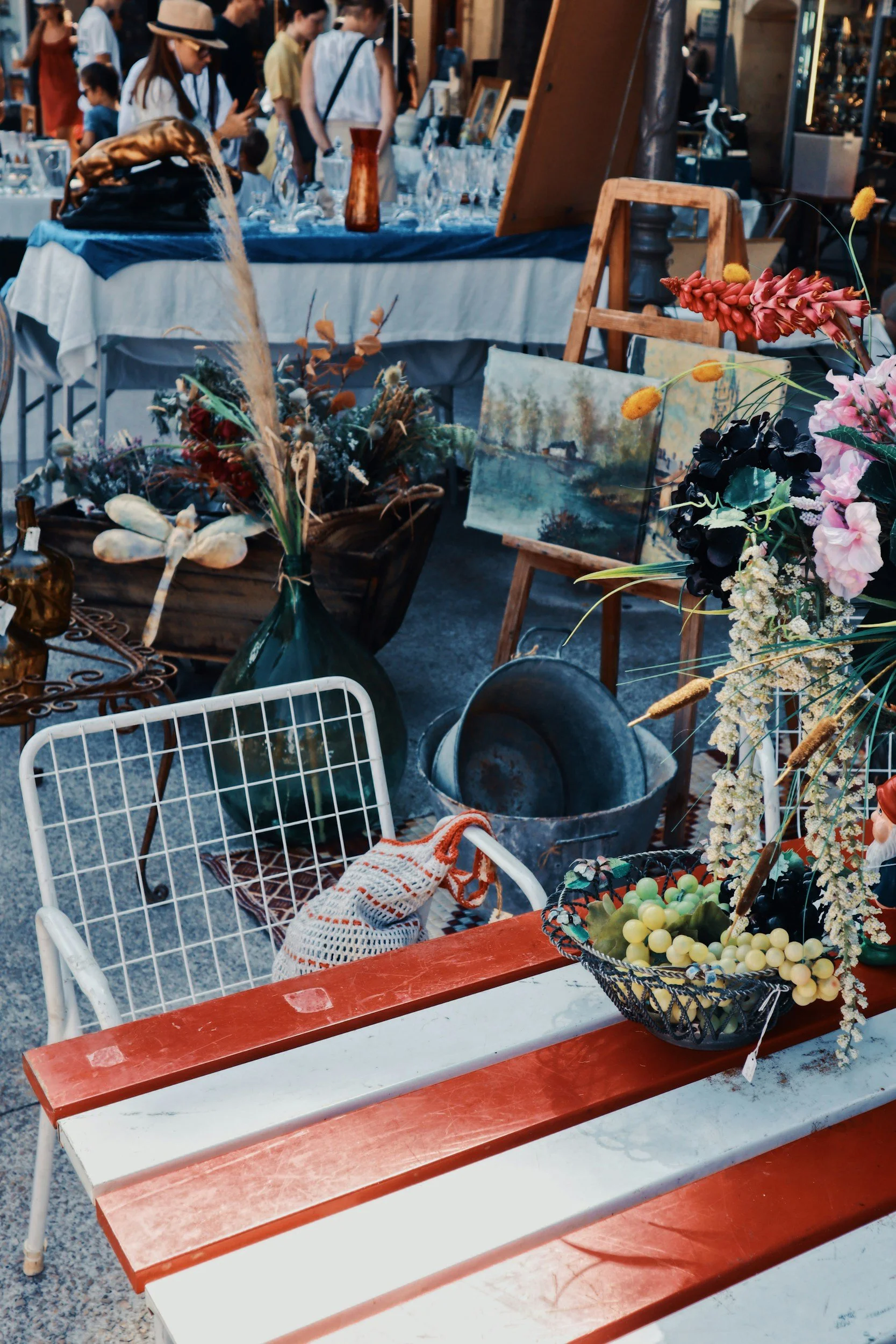
Planning a peaceful French escape this year?
We’ve put together a full 3-day itinerary for Uzès - one of the most charming market towns in southern France. It’s packed with cozy cafés, scenic walks, market-day tips, and relaxed local spots you’ll love.
Pézenas’ antique market around Place Gambetta and Cours Jean Jaurès
Pézenas’ antique activity sits directly within the historic centre rather than forming a separate market area, and the structure spreads out from Place Gambetta into the surrounding streets. The main concentration is around the square itself, with additional dealers extending into Rue Conti, Rue de la Foire, and the lanes that reconnect toward Cours Jean Jaurès, which acts as the main edge of the old town.
If you arrive by car, most people park along Cours Jean Jaurès or in the nearby parking areas and walk in from there. On market days, the transition is immediate once you leave the wider road and step into the narrower streets leading toward Place Gambetta. The first antique shops appear before you reach the square, and the layout builds gradually rather than starting at a single point.
The larger antique days usually take place on Saturdays during the warmer months, with additional events at certain times of year. By around 9:00, Place Gambetta is already active, and by mid-morning the surrounding streets have filled in. Unlike L’Isle-sur-la-Sorgue, there’s no continuous loop. The layout appears in segments, with active streets followed by quieter sections before picking up again.
Around Place Gambetta, the market is at its most concentrated. Temporary stalls line the edges of the square, positioned in front of the permanent antique shops, and the walking space tightens quickly once the central area fills. From there, the activity extends into Rue Conti and Rue de la Foire, where smaller dealers set up along the street or just outside shop entrances.
One detail that stands out is how often the market shifts between inside and outside. You move from a table set up in the street into a shop, then back out again within a few steps. The antique trade here is not separated into stalls and shops. It overlaps constantly, and that changes how you move through it.
The types of items follow that same pattern. Around the square and along the main streets, you’ll see smaller objects—ceramics, glassware, books, and decorative pieces—laid out on tables that are easy to scan quickly. In the shops and in the quieter side streets, the displays are more structured, with furniture and larger items positioned just inside the entrance or deeper inside the space.
Movement is not directional. Most people start at Place Gambetta, move into one street, then return to the square before choosing another. It’s common to enter Rue Conti, realise it thins out, and then come back toward the square where the density is higher.
The busiest point is usually between 10:30 and 13:00, especially around Place Gambetta where several streets meet and the space tightens. Earlier in the morning, it’s easier to step into the shops and move between sections without stopping.
There are no separate food areas within the antique sections. Instead, the activity blends into the cafés around the square and along Cours Jean Jaurès. By mid-morning, tables begin to fill, and people move between browsing and short stops rather than staying within the market itself.
One detail that becomes clear after walking through a few sections is how uneven the layout is. Some streets feel active for a short stretch and then quiet again, which makes it easy to miss parts if you only follow the busiest areas.
If you plan to include it, it works best to start at Place Gambetta before 9:30, move into Rue Conti first while it’s still open, and then return to the square before exploring the other connecting streets. Trying to follow a single route through the entire market usually means missing the smaller clusters that sit just beyond the main flow.
If you like mixing antique hunting with independent boutiques and small vintage shops, these thrift stores and flea markets to visit this spring are worth adding to your route.
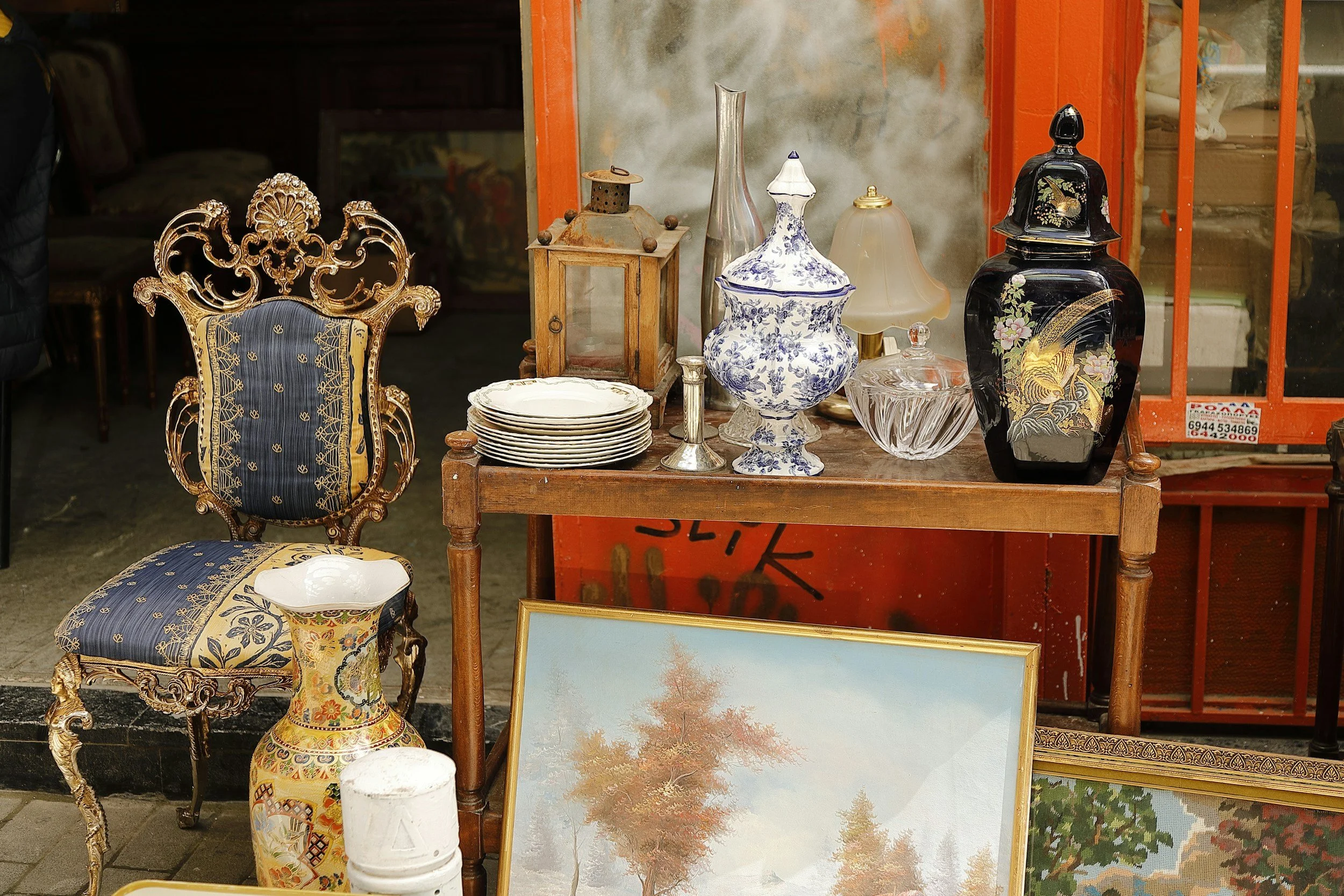
Tongeren’s Sunday antiques along Leopoldwal and Veemarkt
Tongeren’s antique market sits around the edge of the historic centre rather than inside it, following the line of the old town walls. The main stretch runs along Leopoldwal, with additional sections spreading into Veemarkt and the streets that connect back toward the centre near the Basilica area.
If you arrive by train, the station is a straightforward 10–15 minute walk. Most people follow the route toward the old town and meet the market along Leopoldwal before reaching the centre itself. If you’re driving, parking is usually easiest just outside the ring road, then walking in toward the same edge. On Sundays, the first stalls appear before you fully enter the historic centre, and the market builds from there.
The market runs every Sunday morning and starts earlier than most others in this guide. By around 8:00, many dealers are already set up, and by 9:00 the main stretches are active. The structure doesn’t form a loop you can easily follow. Instead, it stretches along Leopoldwal and branches off into sections that feel separate from each other.
Along Leopoldwal, the setup is more continuous. Stalls run in a long line, with larger pieces (furniture, framed items, and more structured displays) set out with space between them. As you move into Veemarkt, the layout changes. The stalls are closer together, the setup becomes less uniform, and the items are more mixed, often arranged on tables or directly from boxes.
Travelling alone can actually make market browsing easier, and this piece on solo secondhand shopping in Europe explains why it’s such a good fit.
One detail that becomes clear as you move between these sections is how uneven the density is. Some stretches of Leopoldwal feel open and easy to walk, then suddenly tighten where the stalls are closer together or where a side street feeds into the main line. In Veemarkt, the opposite happens. It can feel busy at first, then open up again as the stalls thin out.
Movement is not based on a single route. Most people start along Leopoldwal, walk a section, and then turn into Veemarkt or one of the connecting streets rather than continuing in a straight line. It’s common to leave the main stretch without realising you’ve stepped out of the market and then re-enter it a few streets later.
The busiest period is usually between 10:00 and 13:00, especially along the sections of Leopoldwal closest to the main access points into the old town. Earlier in the morning, the layout is easier to read, and it’s possible to move between the larger pieces without stopping.
There are no dedicated food sections within the antique areas. Instead, activity shifts naturally toward the centre of town. As you move away from Leopoldwal and toward the Basilica and nearby squares, cafés begin to fill, and people step out of the market rather than staying within it.
What sets Tongeren apart is how clearly the market follows the outline of the town. It doesn’t pull you into the centre in one movement. Instead, it keeps you moving along the edge, with the option to step in and out at different points.
If you plan to include it, it works best to start along Leopoldwal early, walk one of the longer stretches before the density builds, and then move into Veemarkt before returning toward the centre. Trying to follow the entire market in one direction usually means missing sections that sit just off the main line.
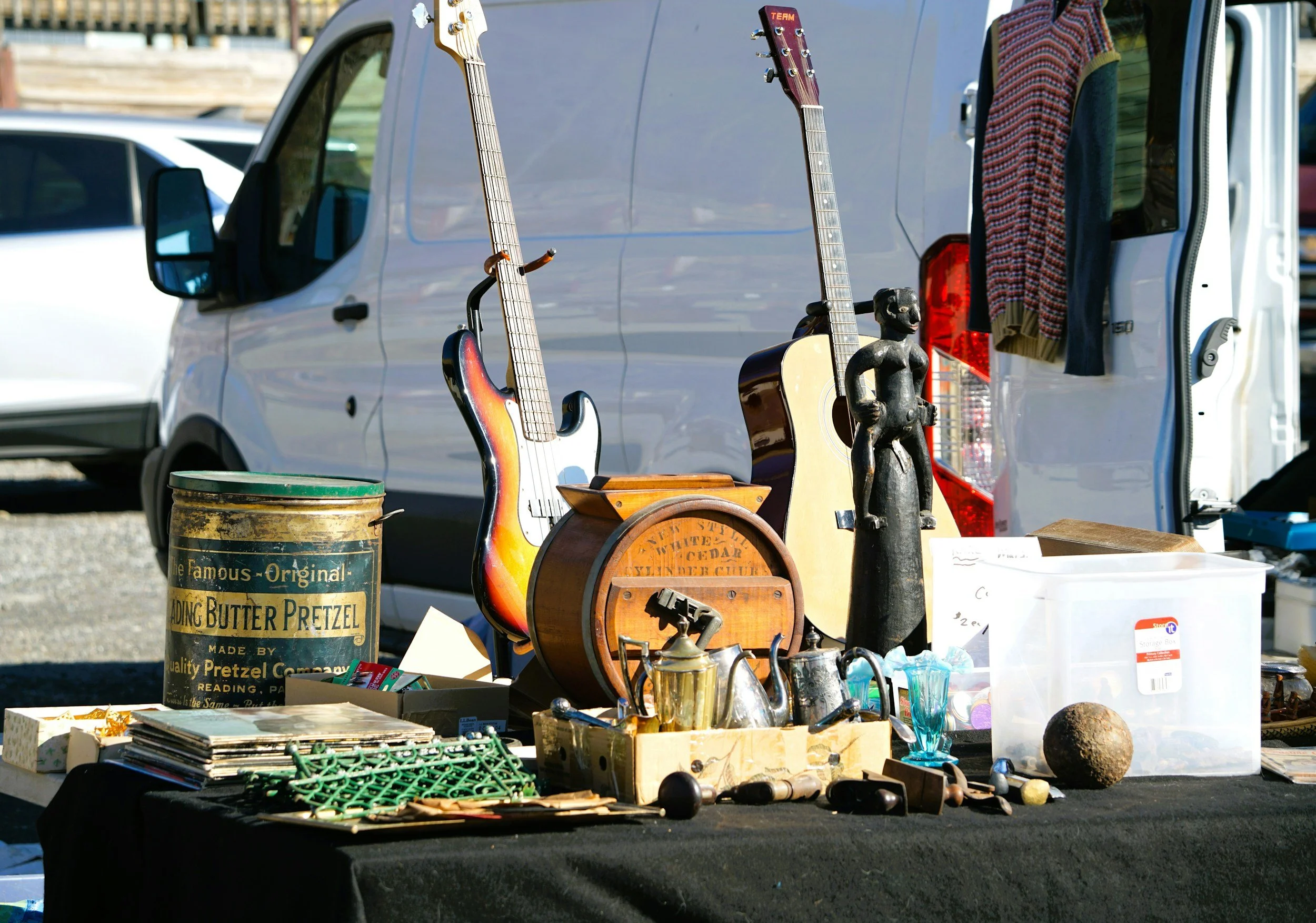
Arezzo’s antique market across Piazza Grande and the upper streets
Arezzo’s antique market is anchored in the upper town and centred on Piazza Grande, with the rest of the layout spreading outward into the surrounding streets rather than forming separate sections. The square sits on a steep incline, and that slope shapes both how the stalls are positioned and how people move through it.
If you arrive by train, the most direct route is uphill along Corso Italia, passing Piazza San Francesco before the street narrows and opens suddenly into Piazza Grande. On market weekends, the first antique stalls appear along the upper stretch of Corso Italia and the streets just before the square, but the main concentration only becomes clear once you step into Piazza Grande itself.
If you’re driving, most people park below the old town near Via Pietri or along the outer roads and walk up through the same route. There isn’t a practical way to enter directly into the market. You always arrive from below and move upward into it.
The market takes place on the first weekend of each month, on both Saturday and Sunday. By around 8:30, many of the established dealers are already in place in Piazza Grande, and by 9:30 the surrounding streets have filled in. Earlier in the morning, the square feels more open, and it’s easier to cross it before the central area tightens.
In Piazza Grande, the stalls are arranged across the slope rather than in straight lines. Larger pieces such as furniture, frames, and heavier objects, are usually positioned lower down where the surface is flatter, while smaller items cluster closer to the edges near the buildings and arcades. The incline means you’re always either moving slightly uphill or downhill as you browse, which slows the pace in the central section.
From the square, the market extends into streets like Via Borgunto, Via dei Pileati, and the smaller lanes that reconnect toward Corso Italia. These sections feel tighter and more uneven. You move from a wide, open square into narrow streets where the stalls sit closer together and the walking space narrows quickly.
One detail that stands out is how often the layout pulls you back toward Piazza Grande. You step into a side street, follow it for a short distance, and then find yourself returning to the square from a different angle. Very few people move through all the streets in one direction. Most use the square as a reference point and come back to it repeatedly.
The busiest period is usually between 10:30 and 13:00. In Piazza Grande, the slope and the density of stalls make movement slower, especially across the middle section. In the surrounding streets, the bottlenecks form where the streets narrow or where multiple routes reconnect.
There are no dedicated food areas within the antique sections. Instead, activity shifts just outside the market. Along Corso Italia and near Piazza San Francesco, cafés begin to fill from mid-morning, and people step out of the market for short stops before returning.
One detail that becomes clear after a full pass is how the slope affects what you notice. It’s easier to scan the lower part of the square quickly, while the upper edges near the buildings hold more compact displays that are easier to miss if you don’t move slowly.
If you plan to include it, it works best to start at the lower edge of Piazza Grande before 9:30, cross the square once to understand how the stalls are positioned, and then move into Via Borgunto or Via dei Pileati before returning to the square. Trying to cover all streets in one continuous route usually means missing sections that sit just off the main paths.
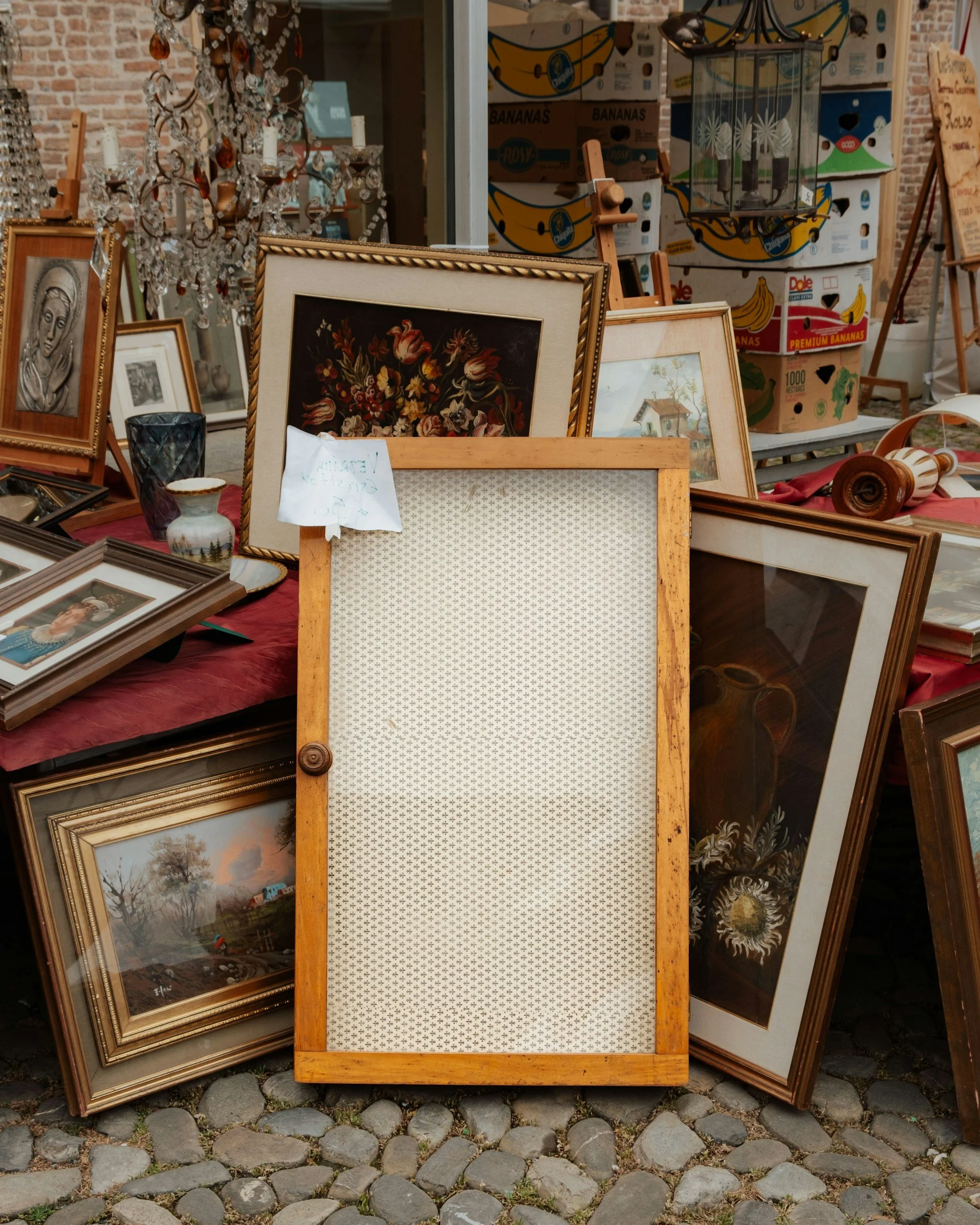
Anglesey’s small antique fairs across Beaumaris, Menai Bridge and Llangefni
Anglesey doesn’t have a single antique market to plan around. Instead, the activity is spread across a few towns, with small fairs held in fixed venues rather than outdoors. The most consistent locations are Beaumaris, Menai Bridge, and Llangefni, and each one follows its own setup depending on the building rather than the town layout.
In Beaumaris, the fairs are usually held close to the seafront, often in venues just off Castle Street, within a short walk of the castle and the waterfront. If you arrive by car, you’ll typically park along the seafront or in the nearby public car parks and walk a few minutes inland. There’s no gradual approach. You move from the open space by the water into a contained indoor setting within a couple of streets.
In Menai Bridge, the setup is similar but more compact. The fairs are usually positioned near the high street and the strait, within walking distance of the bridge itself. Parking is spread along the main road, and the entry is direct. You step inside and see the full layout immediately.
Llangefni works differently again. As the administrative centre of the island, the fairs here tend to be slightly more practical in feel, usually held in community halls near the town centre. There’s no coastal element, and the layout reflects that. You arrive, park nearby, and enter straight into the space without any build-up.
Most fairs run on selected weekends rather than fixed weekly days, so the structure depends on timing rather than location. They typically open around 9:00 or 10:00 and continue into the early afternoon. By late morning, the full setup is already visible, and nothing changes significantly after that.
Inside, the layout is contained within one room or a connected set of smaller rooms. Stalls are arranged in rows or clusters depending on the space, with tables placed close together and larger items positioned along the walls. The scale is small, often with a limited number of dealers, and you can walk the entire fair in a single circuit within a few minutes.
Smaller antiques (ceramics, glassware, books, and mixed items) are laid out on tables, while larger pieces appear less frequently and are usually placed at the edges. The variation depends more on the individual dealers than on the town itself.
What stands out is how contained everything is. There’s no overlap with the street, no extension into surrounding areas, and no need to plan a route. You enter, walk the space once, and that’s the full experience.
The coastal setting still shapes the visit, but only outside the fair itself. In Beaumaris, people tend to move back toward the seafront or along Castle Street after leaving. In Menai Bridge, the activity shifts toward the water and nearby cafés along the strait. The market doesn’t connect to those spaces. It sits separately from them.
The busiest period is usually between 10:30 and 12:30. Outside that window, the pace is steady, and the space remains easy to move through.
Anglesey works differently from the other places in this guide. There isn’t a central market or a defined route through a town. Instead, it’s a series of small, contained fairs, each tied to a specific venue and day.
If you plan to include it, it works best to check which town is hosting a fair during your visit, arrive mid-morning, and combine it with time along the coast or in the town afterwards rather than treating it as the main focus.
How these antique markets actually work once you’re there
One thing that becomes easier to notice once you’ve seen a few of these antique markets is how early people decide where they’re actually going to stop. In L’Isle-sur-la-Sorgue, many walk one side of the canal loop past Quai Rouget de Lisle and then return to a specific stretch near one of the bridges rather than continuing outward. In Arezzo, the same pattern shows up across Piazza Grande, where people cross the slope once and then stay closer to the edges near the arcades on the second pass. In Tongeren, it’s common to leave the main line along Leopoldwal earlier than expected and not continue all the way toward Veemarkt.
That matters because the layout rarely rewards trying to cover everything. In Pézenas, you can pass the entrance to Rue Conti without noticing how active it is just a few metres in, especially if you stay around Place Gambetta. In Anglesey’s indoor fairs, the centre tables tend to draw attention first, but the edges of the room (along the walls) are where the less obvious pieces are usually placed.
Another detail that doesn’t show up in most guides is how fixed the positions are. In places like Arezzo or L’Isle-sur-la-Sorgue, many dealers return to the same spot each time, especially along the canal edges or in the lower part of Piazza Grande. Once you’ve seen the layout once, it becomes easier to recognise where to go back to, rather than starting from the beginning again.
If you approach these markets expecting each street to offer something new, they can feel uneven. If you treat them as a set of repeated positions within a fixed layout, they become easier to read and easier to include without stretching your time.
Planning a spring trip? These spring markets across Europe help you decide where to go and when.
FAQs about antique markets in European towns (summer)
What are the best antique markets in Europe to visit in summer?
Some of the most consistent antique markets in summer are L’Isle-sur-la-Sorgue (canal loop around Place de la Liberté and Quai Rouget de Lisle), Arezzo (Piazza Grande and streets like Via Borgunto), Tongeren (Leopoldwal and Veemarkt), and Pézenas (Place Gambetta and Rue Conti). Smaller setups, like the indoor fairs in Beaumaris or Menai Bridge on Anglesey, work differently but follow a fixed structure.
When is the best time to go to antique markets in Europe?
The most useful time is early morning, usually between 8:30 and 11:00. In L’Isle-sur-la-Sorgue, the canal paths are still easy to walk before they narrow. In Arezzo, Piazza Grande is easier to cross before the central slope fills. After that, the layout stays the same, but movement slows.
Where exactly are the antique markets in Arezzo and L’Isle-sur-la-Sorgue?
In Arezzo, the market is centred on Piazza Grande and spreads into Via Borgunto, Via dei Pileati, and nearby streets leading back toward Corso Italia. In L’Isle-sur-la-Sorgue, it follows the canal loop around Place de la Liberté, Quai Rouget de Lisle, and the connecting bridges in the centre of town.
Are antique markets in Europe crowded in summer?
Certain sections become slow to move through rather than the entire market being crowded. In L’Isle-sur-la-Sorgue, the narrow canal paths fill first. In Arezzo, the middle of Piazza Grande becomes the tightest area. Other sections remain easier to walk.
What can you actually find at these antique markets?
Most markets are made up of smaller objects (ceramics, glassware, prints, books, and decorative items) alongside occasional furniture and larger pieces. In Arezzo, larger items tend to sit in the lower part of Piazza Grande, while in L’Isle-sur-la-Sorgue they appear more often in the antique village along Avenue de la Libération.
Are antique markets worth visiting in summer or better in other seasons?
They work well in summer if you adjust your timing. The layout doesn’t change, but arriving early makes it easier to move through key areas like the canal loop in L’Isle-sur-la-Sorgue or the square in Arezzo.
How long do you need at an antique market in Europe?
In most cases, 45 minutes to 1.5 hours is enough to cover the main sections. L’Isle-sur-la-Sorgue can take longer if you include the antique village, while indoor fairs on Anglesey are usually much shorter.
Do antique dealers stay in the same place each time?
Yes, in many established markets. In Arezzo, dealers often return to the same areas of Piazza Grande. In L’Isle-sur-la-Sorgue, positions along the canal edges and near Place de la Liberté are often repeated.
Are there food stalls inside antique markets?
Usually not. The antique sections are separate. In L’Isle-sur-la-Sorgue, people step out toward cafés along Quai Rouget de Lisle. In Arezzo, activity shifts toward Corso Italia and Piazza San Francesco.
Do you need a car to visit these antique markets?
Not always. Arezzo and Tongeren are accessible by train, with markets within walking distance. Anglesey is easier to explore by car, especially if you’re visiting fairs in different towns like Beaumaris or Llangefni.
Not everyone wants to rent a car, and these European market towns without a car make planning a lot simpler.
Are antique markets in Europe open every week?
It depends on the town. Tongeren runs every Sunday. L’Isle-sur-la-Sorgue has a main market on Sundays and a smaller one on Thursdays. Arezzo takes place on the first weekend of each month. On Anglesey, fairs are held on selected weekends rather than a fixed weekly schedule.