
Why I'd choose May for a first trip to Lofoten
Lofoten isn’t quiet in summer anymore, and that becomes pretty clear as soon as you start looking into it or try to plan a trip in July, because places like Reine, Hamnøy and Henningsvær all get busy at the same time, with cars lining the roads and people stopping at the same viewpoints. May still feels different, and that difference shows up in small, practical ways once you’re there rather than anything dramatic.
It’s not fully “season” yet, which changes how you move through the islands. You can drive along the E10 between Svolvær and Reine without constant traffic, pull over near places like Uttakleiv or Ramberg Beach without competing for space, and stop in Henningsvær without needing to think about where you’ll leave the car. Even in more popular spots like Nusfjord or the bridge crossings in Hamnøy, it’s possible to pause for a few minutes without feeling like you’re in the way.
The landscape sits somewhere in between seasons, which is part of what makes it work. You’ll still see snow sitting on peaks like Volandstinden or the mountains behind Reine, while the lower areas around Leknes, Kabelvåg and along the coast are mostly clear. Roads are easy to drive, including the narrower sections heading toward villages, and you don’t need to plan around weather conditions in the same way you would in winter. Some trails, like the path up to Ryten or sections around Offersøykammen, can still be wet or soft underfoot, especially after rain, so it’s more about adjusting when you get there than planning everything in advance.
What stands out more than anything is how the days actually feel once you’re there. You’re not trying to connect a long list of stops, and you don’t need to structure your route around timing. You might start the morning with a walk near Haukland Beach, drive slowly toward Reine with a few unplanned stops along the way, pick up something simple to eat in Leknes or a small café in Kabelvåg, and then head back without feeling like you’ve missed anything.
There’s also more space than you expect, especially compared to how Lofoten is usually shown. You can walk stretches of coastline without passing many people, sit by the water near places like Eggum or Unstad without noise around you, and spend time in smaller villages without feeling like you need to move on quickly. It’s not empty, but it’s quiet enough that you stop noticing other people after a while.
May isn’t the easiest month if you want everything to be predictable, because the weather shifts quickly and some places are only just opening again after winter. A café might be open in Henningsvær but closed the next day, and some restaurants in Reine or Sørvågen won’t be fully operating yet. But that’s also why it works. You don’t need a fixed plan, and you’re not trying to follow one, which makes it easier to move through the islands without adjusting your day around everything else.
Trips like this usually start with a broader plan, and once you’ve seen how it can come together in this Scandinavia guide, it’s easier to shape the route around places like Lofoten.

How to get to Lofoten, Norway
Getting to Lofoten takes a bit more planning than most places in Europe, but once you understand the main routes, it’s fairly straightforward. The choice usually comes down to whether you want the fastest option or something that gives you more flexibility once you arrive.
The quickest way is to fly. Most people fly from Oslo to either Leknes (LKN) or Svolvær (SVJ), both of which are inside the Lofoten Islands. Flights take around 1–1.5 hours, often with a short connection in Bodø, and run several times a day. Leknes works well if you’re staying around Ramberg, Reine, or Flakstad, while Svolvær is better for Kabelvåg, Henningsvær, and the eastern side of Lofoten. From either airport, you’ll still need a car or bus to reach your final stop, but distances are manageable.
Another common option is to fly to Bodø and continue from there. From Bodø, you can take a ferry to Moskenes, which is on the western side of Lofoten near Reine. The crossing takes around 3–4 hours, and ferries run daily, although schedules vary depending on the season. This route works well if you want to arrive directly into the most scenic part of Lofoten without driving the full distance.
If you prefer to drive, you can reach Lofoten via the E10, which connects the islands to mainland Norway. From Narvik, the drive to Svolvær takes around 3–4 hours, passing through places like Lødingen and across a series of bridges that connect the islands. This route is reliable year-round and gives you full flexibility once you’re in Lofoten, especially if you plan to move between different villages.
There’s also the option of taking the train from Oslo to Bodø, which takes around 10 hours, and then continuing by ferry or short flight into Lofoten. It’s slower, but it breaks up the journey and avoids multiple flights if that’s something you’re trying to limit.
Once you’re in Lofoten, distances between places are longer than they look on a map. Driving from Svolvær to Reine, for example, takes around 2.5 hours without long stops, and you’ll likely take longer once you factor in viewpoints, short walks, and breaks along the way. That’s why most people base themselves in one or two areas rather than trying to cover the entire region quickly.
If you’re deciding between options, flying into Leknes or Svolvær is the easiest overall. Flying to Bodø and taking the ferry is a good alternative if you want a more gradual arrival, and driving works best if you’re already planning a longer trip through northern Norway.

Where to stay in Lofoten in May: choosing the right base
Where you stay in Lofoten matters more than you might expect, especially in May when you’re not working around crowds and can be more flexible with location. Distances between places are longer than they look on a map, and driving between Svolvær and Reine takes around 2.5 hours without stops, so picking one or two bases instead of moving every night usually makes the trip easier.
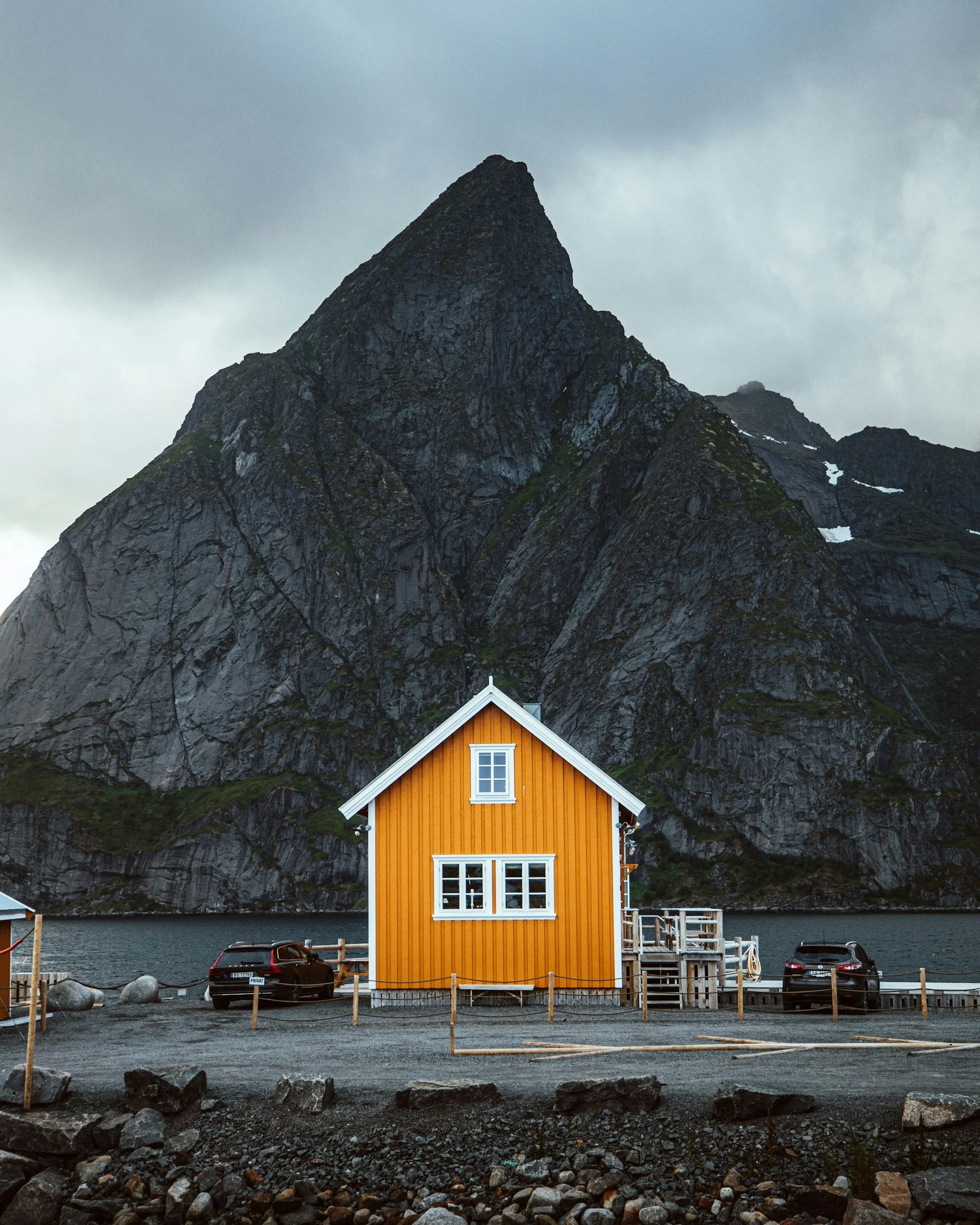
Reine and Nusfjord are the most common choices if you want to stay in a traditional fishing village setting. Both sit on the western side of Lofoten, where the landscape feels more dramatic, with steep mountains rising straight out of the water. In May, these villages are still quiet, especially in the mornings and evenings, and you can walk along the harbour without much activity around you.
Rorbuer cabins are the main type of accommodation here. These are former fishermen’s cabins built close to the water, now converted into small apartments with basic kitchens and living space. Eliassen Rorbuer is located just outside Reine on Hamnøy, right along the E10, which makes it easy to reach and move around from. The cabins are simple, with wooden interiors and direct views toward Reinefjorden, and you can walk between them and nearby viewpoints without needing to drive.
Nusfjord is slightly more contained, with accommodation set within the harbour area itself. It’s a smaller setup, and once you’re there, you tend to stay local in the evenings rather than driving out again. There’s a café and a few shared spaces, but fewer options compared to Reine, which makes it quieter overall.
Ballstad sits further east, about 30–40 minutes from Reine, and works well if you want a base that feels less like a destination and more like a working village. Lofoten Basecamp is located right by the harbour, with cabin-style units facing the water. From here, you can reach places like Ramberg Beach, Uttakleiv, or Haukland within 20–40 minutes by car, which makes it a practical base if you’re planning to explore different parts of the islands during the day.
If you prefer more space, areas like Fredvang and Ramberg are easier to settle into. These are smaller, more spread-out locations with fewer services, but they give you direct access to beaches and open coastline. Staying here usually means booking a private cabin or small guesthouse rather than a hotel. You’ll need a car for most things, including groceries, which are easiest to find in Leknes, about 20 minutes from Ramberg.
In May, most accommodation is open, but availability is still good compared to summer, so you don’t need to lock everything in far in advance. At the same time, not every café or restaurant will be operating full hours yet, especially in smaller villages, so it’s worth thinking about where you’ll eat in the evening when choosing your base.
Mornings in Lofoten: where to go and how the day starts
Mornings are the easiest part of the day to work with in Lofoten, especially in May when the light comes early and most places are still quiet. You don’t need to rush, but getting outside before 08:00–09:00 usually gives you the most stable conditions before the wind picks up or the weather shifts, which it often does later in the day.
If you’re staying in Reine or Hamnøy, you can start without using the car at all. From Eliassen Rorbuer, it takes just a couple of minutes to reach the water, and you can walk along the shoreline toward the bridge that looks back over Reine. This area fills up quickly later in the day, but early in the morning you’ll usually have it to yourself. If you continue past the bridge, there are small side roads and paths where you can walk for another 20–30 minutes without seeing much traffic.
In Reine itself, walking through the harbour area before anything opens gives you a clearer sense of how small the village actually is. You’ll pass drying racks, boats tied up along the docks, and a few houses tucked close together along the water. It’s not about covering distance here, it’s more about using that first hour when everything is still.
In Ballstad, mornings are more practical than scenic, but that’s part of the appeal. From Lofoten Basecamp, you can walk toward the harbour and fishing docks in about 5–10 minutes, where you’ll see boats coming in and people starting work. It’s not a viewpoint, but it gives you a better sense of how the village functions outside of tourism, especially since Ballstad is still an active fishing base.
If you’re willing to drive a short distance, beaches are easiest in the morning. Ramberg Beach is directly off the E10, so you can park right next to the sand and walk straight out. Uttakleiv is about 10–15 minutes off the main road, with a narrower final section, but parking is straightforward early in the day. From Uttakleiv, you can follow the path toward Haukland Beach for 20–30 minutes without needing to commit to a full hike. The ground can still be damp in places, but it’s manageable with normal walking shoes.
Coffee is the one thing that takes a bit of planning, because cafés don’t open early. In Henningsvær, Trevarefabrikken is one of the more reliable stops, but it usually opens around 10:00, so it works better as a mid-morning break rather than a starting point. If you arrive earlier, you’ll likely end up waiting.
A more practical approach is to pick something up on the way. In Leknes, places like Coop Prix Leknes open earlier and have basic options like coffee, pastries, and sandwiches. Petrol stations in the same area are also reliable and often have fresh baked goods in the morning, which is common across Norway. It’s not a destination stop, but it works well when you’re already moving between places.
Driving in the morning is noticeably easier than later in the day. The E10 between Leknes, Ramberg, and Reine is quiet early on, which makes it easier to stop at viewpoints without pulling into a full lay-by or skipping stops altogether. Even short pauses along the road, especially near bridges or open stretches of coastline, are easier to manage before more cars are out.
A simple way to structure the morning is to stay local first, then move. Spend the first hour near where you’re staying, take a short walk or just get outside, then head out around 09:00–10:00 toward your next stop and pick up coffee along the way instead of trying to build your morning around a café.

Best hikes in Lofoten for spring: quiet trails and coastal views
Hiking in Lofoten in May is less about ticking off the well-known peaks and more about choosing routes that actually work with the conditions. Higher trails still hold snow, and anything steep or shaded can stay wet for most of the day, so it’s easier to focus on lower hikes, coastal paths, and shorter climbs where you don’t need perfect conditions.
Offersøykammen is one of the most reliable options early in the season. It sits right off the E10 between Leknes and Henningsvær, with a small gravel parking area just before the bridge when coming from Leknes. The path starts immediately and climbs steadily, taking around 30–45 minutes to reach the top. The ground can be soft in sections, especially after rain, but it’s usually manageable. From the summit, you’re looking out over Vestvågøy, with the E10 cutting through the landscape below and the coastline stretching toward both Henningsvær and Leknes.
The Uttakleiv and Haukland area gives you more flexibility if you don’t want a single defined hike. From Uttakleiv Beach, you can follow the coastal path toward Haukland, which takes about 30–60 minutes depending on how far you go. The trail is uneven but not steep, and because it’s exposed to wind and sun, it tends to dry out earlier than inland routes. There’s parking directly at both beaches, but Uttakleiv is usually quieter in the morning, especially before 10:00.
Eggum is another place that works well in spring without needing to think about trail conditions too much. You can park near the old radar station and walk out along the coastline on a relatively flat path. It’s more of a long walk than a hike, but it gives you uninterrupted views toward the open sea, and you can stay out as long or as short as you like. This is also one of the better spots if you want to be outside without dealing with elevation or muddy climbs.

Mountain tops on Lofoten are stunning and sharp
Around Ballstad, there are smaller local paths that don’t show up clearly on maps but are easy to access once you’re there. From the harbour area, you can walk up toward the hills behind the village on narrow tracks used by locals, with short climbs that give you views back over the fishing docks. These aren’t marked routes, but they’re useful if you want a quick walk without driving anywhere.
In the Reine and Hamnøy area, most of the well-known hikes like Reinebringen are still not ideal in May, especially early in the month. The stone steps hold moisture, and higher sections can still have snow or ice. Instead of forcing those routes, it’s easier to stay lower. You can walk along the shoreline in Reine, follow the road toward Sakrisøy for 20–30 minutes, or explore the smaller roads between Hamnøy and Reine where you still get clear views of the peaks without needing to climb them.
If you’re looking for something slightly longer but still manageable, the area around Fredvang offers access to trails leading toward Ryten, but in May this depends heavily on conditions. The lower sections are usually fine, but higher parts can still be wet or snow-covered, so it’s worth turning back earlier rather than committing to the full route.
Parking and timing make a bigger difference than the hike itself. Even in May, places like Haukland and Uttakleiv start to fill up later in the day, so going early means you can park close to the trail and walk without interruption. By midday, even shorter routes feel busier, especially if the weather is good.
The simplest way to approach hiking here in spring is to choose one area per day rather than trying to move across the islands. Start with something accessible like Offersøykammen or Uttakleiv, see how the ground conditions feel, and adjust from there. That way you don’t lose time driving long distances only to turn back because a trail isn’t workable.
If you’re drawn to coastal landscapes like this, it’s interesting to compare it with somewhere like the North Sea islands.
And if you’re staying later into the darker months, the atmosphere starts to overlap with places like this Danish dark sky island.
Where to eat in Lofoten: simple places that work in May
Food in Lofoten in May isn’t something you map out in advance in the same way you might in a city, because opening hours are still a bit uneven and not every place is running at full capacity yet. You’ll eat well, but it usually comes down to knowing what’s open that day and adjusting as you go, rather than aiming for specific restaurants at fixed times.
If you’re staying around Reine, Hamnøy, or Sørvågen, it helps to check in the morning what’s actually open that evening, because options are limited and not always consistent. Maren Anna is one of the more reliable places when it’s operating, with a small menu focused on fish and seasonal dishes, and it sits right by the harbour so it’s easy to reach without needing to plan much. It’s not somewhere you leave until late, though, so it works better if you plan dinner a bit earlier, usually around 18:00–19:00.
Closer to Reine, Gammelbua is another option that’s easy to include if it’s open during your stay, especially if you’ve spent the day nearby and don’t want to drive further in the evening. It’s set in an old warehouse building by the water, and the menu tends to stay simple, with dishes built around cod, stockfish, or meat, depending on what’s available. It’s the kind of place you go because it’s there and open, rather than something you plan your whole day around.
If you’re based in Hamnøy, staying at Eliassen Rorbuer makes things a bit easier in the evenings, since there’s usually a restaurant on-site or nearby options within a short drive, which means you don’t have to think too much about where to go once the day winds down.
Henningsvær is one of the easiest places to rely on for food, mainly because there are several places within walking distance of each other and opening hours tend to be more stable. Fiskekrogen sits right on the harbour and focuses on fish and shellfish, while Klatrekaféen is more casual, with soups, sandwiches, and simple hot dishes that work well earlier in the day. If you’re already there in the morning or early afternoon, Trevarefabrikken is a good stop for coffee, pastries, or something light to eat, although it’s better to treat it as a daytime place rather than relying on it for dinner in May.
In Ballstad, Hattvika Lodge Restaurant is one of the more dependable options if you want a proper sit-down dinner without driving far, especially if you’re staying nearby. It’s a bit more structured than most places in the area, which means it’s one of the few where it can make sense to book ahead, particularly if you don’t want to think about it later in the evening.
Svolvær is the most practical place if you want a bit more choice or flexibility, since there are more restaurants, cafés, and bakeries concentrated in one area. Børsen Spiseri is one of the more established places, set in an old warehouse by the harbour, while the centre of town has smaller cafés that open earlier and are easier to rely on for breakfast or lunch.
Leknes, on the other hand, is where you go when you just need something simple and consistent rather than somewhere you plan to spend time. Supermarkets like Coop Prix Leknes and nearby petrol stations are often the most reliable places for coffee, sandwiches, or something quick to eat, especially in the morning or late afternoon when other places might still be closed or already shutting.
A typical day tends to fall into place without much effort. You might pick up coffee and something small in Leknes or Henningsvær mid-morning, stop somewhere along your route for a simple lunch, and then either eat early near where you’re staying or cook something yourself if your accommodation has a kitchen. Trying to leave dinner too late usually makes things harder, since many places close earlier than you might expect.
Some of the best moments here happen around meals with a view, something you’ll recognize straight away in these Scandinaviarestaurants with stunning views…!
Is May the best time to visit Lofoten?
After a few days in Lofoten in May, what stands out is how little you need to lock in ahead of time. You can wake up in Ballstad, check the weather, and decide within 10 minutes whether you’re driving toward Uttakleiv, heading east to Henningsvær, or staying local. That kind of last-minute decision-making is much harder later in the summer when parking, ferries, and even short stops start to fill up.
Driving also works differently. A route like Svolvær to Reine along the E10 normally turns into a full-day plan in peak season, with multiple fixed stops and timing around traffic. In May, you can treat it as a shorter outing. You might drive from Leknes to Ramberg, stop at the beach for 20 minutes, continue toward Flakstad, and then turn back without feeling like you’ve missed anything. The same goes for places like Eggum or Unstad, where you can take a small detour off the main road, spend an hour there, and leave without needing to plan the rest of your day around it.
Evenings are simpler, but in a practical way. Most restaurants in smaller places like Reine or Sørvågen stop serving earlier, often around 20:00 or shortly after, so you end up eating at a normal time and staying local rather than driving again later. If you’re staying somewhere like Hamnøy or Ramberg, it often makes more sense to pick up groceries in Leknes during the day and cook in the evening instead of relying on finding somewhere open. That shift changes the pace of the trip more than expected.
You also notice how much you use places that aren’t really “stops.” Small pull-offs along the E10 between Flakstad and Moskenes, the roadside near Fredvang bridges, or the stretch just before entering Henningsvær are all places where you can park for a few minutes without thinking about space or timing. In summer, these same spots are often full, but in May you can use them freely, which changes how you move through the landscape.
Another practical difference is accommodation. In May, you can still find cabins in places like Reine, Ballstad, or Fredvang without booking weeks ahead, and you can adjust your route if you decide to stay longer somewhere. That flexibility makes it easier to base yourself in one area and explore from there rather than moving every night.
If you’re deciding when to go, May works well if you want to keep your days simple and adjustable. You don’t need to plan every stop, you don’t need to time everything carefully, and you don’t lose time to small things like parking or availability.

FAQ about visiting Lofoten in May
Is May a good time to visit Lofoten?
Yes, May is one of the easiest months to visit Lofoten if you want access without peak-season pressure. Roads are clear, flights are running normally, and most accommodation is open, but you don’t have to deal with full car parks or busy viewpoints.
Is May too early for Lofoten?
No, but it depends on expectations. You’ll have full access to the islands, but some hikes are still wet or partially covered in snow, and not every café or restaurant is open every day yet.
The experience shifts a lot depending on when you go, which becomes clearer after a quick look at this Scandinavia in autumn.
What is the weather like in Lofoten in May?
Temperatures are usually between 6°C and 12°C during the day, but it can feel colder with wind, especially near the coast. Weather can change quickly, so you should expect a mix of sun, rain, and cloud within the same day.
Can you see the midnight sun in Lofoten in May?
Yes, the midnight sun begins in late May. Earlier in the month, you still get very long days with light stretching late into the evening, which makes it easier to stay outside without planning around daylight.
Where do you fly into for Lofoten in May?
Most people fly into Leknes (LKN) or Svolvær (SVJ), usually with a connection in Bodø. Leknes works best if you’re staying around Reine, Ramberg, or Fredvang, while Svolvær is more practical for Henningsvær and the eastern side of Lofoten.
Do you need a car in Lofoten in May?
Yes, in most cases. Public transport is limited, and distances between places like Reine, Leknes, and Henningsvær are too long to rely on buses if you want flexibility. Renting a car makes it much easier to adjust your plans during the day.
How long does it take to drive through Lofoten?
Driving from Svolvær to Reine takes around 2.5 hours without stops, but in reality you’ll need most of a day once you factor in viewpoints, short walks, and breaks along the E10.
Are all roads open in Lofoten in May?
Yes, including the E10, which connects the islands from Svolvær to Å. You don’t need winter driving experience in May, and road conditions are generally straightforward.
Is Lofoten crowded in May?
No, May is still considered shoulder season. You’ll see some visitors, especially on weekends, but it’s much quieter than June, July, and August.
Are hikes open in Lofoten in May?
Some are, especially lower hikes like Offersøykammen or coastal walks around Uttakleiv and Eggum. Higher or steeper hikes can still be wet, muddy, or partially covered in snow, depending on recent weather.
Can you hike Reinebringen in May?
It depends on conditions. The stone steps can be wet and slippery, and there may still be snow higher up, especially early in the month. It’s often better to choose lower hikes unless conditions are clearly dry.
What are the best easy hikes in Lofoten in May?
Offersøykammen, coastal paths around Uttakleiv and Haukland, and walks near Eggum are some of the most reliable options, as they are lower and tend to dry out earlier than mountain hikes.
Where should you stay in Lofoten in May?
Reine and Hamnøy are good if you want classic fishing village views, while Ballstad or Ramberg work better as quieter bases with easier access to different parts of the islands. Staying in one or two places instead of moving every night is usually more practical.
What is the best base in Lofoten without a car?
Svolvær is the easiest base without a car because it has more consistent transport connections, restaurants, and services. Other areas are much harder to navigate without driving.
Are restaurants open in Lofoten in May?
Yes, but not all restaurants are open every day, and many close earlier than in summer. It’s best to check opening hours the same day and plan dinner earlier, usually around 18:00–19:00.
What should you wear in Lofoten in May?
Layers are essential. A windproof jacket, a warm mid-layer, and waterproof shoes are usually enough. Even on sunny days, wind near the coast makes it feel colder than the temperature suggests.
Is Lofoten expensive in May?
Yes, Lofoten is generally expensive, but May is slightly more affordable than peak summer. Accommodation is easier to find, and prices are usually lower than in July and August.
How many days do you need in Lofoten in May?
Three to five days works well. This gives you enough time to base yourself in one or two places and explore without needing to rush between locations.
Can you visit Lofoten without a car in May?
It’s possible but limiting. You can reach places like Svolvær by plane or bus, but getting to areas like Reine, Ramberg, or Uttakleiv without a car takes time and reduces flexibility.
Is Lofoten good for solo travel in May?
Yes, especially if you prefer quieter trips. It’s easy to move around by car, and May gives you space to explore without needing to plan around other people.
What is a typical day in Lofoten in May?
Most days involve a mix of short walks, driving between villages, and stopping along the coast. You might start with a walk near your accommodation, drive a section of the E10, stop at places like Ramberg or Uttakleiv, and return in the evening without needing a fixed plan.