These Swedish stays are made for switching your phone off
Most people don’t struggle to fall asleep at home because they don’t know how. They struggle because their surroundings never fully switch off. Street noise continues late into the night, light leaks through curtains that don’t quite close, and mornings start earlier than intended. A short trip doesn’t usually fix that unless the place you stay is set up differently from the start.
In Sweden, that difference is easy to find once you know where to look. Outside the cities, accommodation is often built around space rather than proximity. Cabins are set apart from each other, not stacked side by side. Windows face forest, water, or open land instead of streets. In many regions, especially in the north and in rural Småland or Värmland, you’re dealing with almost no light pollution and very little background noise after 22:00. During parts of the year, darkness lasts long enough that you don’t wake up early unless you choose to.
The places in this guide are selected for how they actually function at night and in the early morning. That includes practical details like distance between buildings, window orientation, how close you are to roads, and whether you can step outside without hearing anything beyond wind or water. Some are small hotels, others are standalone cabins, but all of them make it possible to keep a steady routine without interruptions.
If the goal is to sleep properly for a few nights and reset your schedule without needing to plan activities around it, these are places where that works in practice.
Arthotel Tornedalen, Swedish Lapland
Where sleep meets stillness in Sweden’s far north
Arthotel Tornedalen sits just outside Svanstein, right by the Torne River where Sweden meets Finland. The closest place you’ll recognise on a map is Övertorneå, about 25 minutes away, and most people arrive via Luleå Airport, which is roughly a two-hour drive south. The last part of the journey follows Route 99 along the river. After Hedenäset, it gets noticeably quieter. There are long stretches without houses, shops, or streetlights, and in winter you’ll want to plan your arrival before it gets dark simply because there’s very little to orient yourself by once the light drops.
The property isn’t one main building. It’s a group of cabins and small structures spread out across the land, with enough distance between them that you don’t hear other guests. You step outside and you’re in open space straight away, not onto a shared terrace or corridor. The ground slopes gently toward the river, with trees and patches of open land in between, so even if the place is fully booked it still feels quiet.
Inside, things are kept simple. Wood, neutral colours, soft lighting that doesn’t stay on longer than you need it. Nothing is overdesigned or trying to stand out. The windows face outward toward the landscape rather than paths or entrances, which makes a difference at night. In winter, it gets properly dark and stays that way. In summer, it’s the opposite, with light late into the night and early in the morning, so it’s worth checking that your cabin has good blackout curtains if you’re visiting between May and July.
Evenings are structured without feeling rigid. Dinner is usually served at a set time, and there’s nowhere else nearby to go, so most people stay on-site. Once you’re back in your cabin, the night settles quickly. By around 21:00, there’s very little movement outside. No passing cars, no background noise from other buildings. If you step out, you’ll hear the river or the wind, but that’s about it.
Mornings tend to start on their own terms. There’s nothing outside waking you up, and depending on the season, light either comes in slowly or not at all until later. Breakfast follows a set window, which helps keep a simple routine without needing to plan anything. If you go out early, you’ll notice how still the area is. Even the road nearby stays quiet, especially outside the winter season.
If you do want to leave during the day, you’ll need a car. Driving along the river toward Svanstein or up toward Pajala takes you through small communities with limited opening hours. You’ll find basic grocery stores and the occasional café, but not much that pulls you away for long. Most of the time, people stay close to the property.
What makes this place work is how little interrupts you once you’re there. No light coming through from outside buildings, no late-night noise, no pressure to fill your day. After a couple of nights, your sleep starts to follow a more natural pattern simply because nothing is pushing against it.
Where: Vitsaniemi, Swedish Lapland
Getting there: Fly to Luleå, then 2.5-hour scenic drive north through forests and wide open spaces
If you’re deciding between something grounded and something more designed, tree hotels show how a more architectural stay changes the whole experience of being in nature.
Kolarbyn Eco-Lodge, Skinnskatteberg
Sweden’s “most primitive hotel” - and that’s the whole point
Kolarbyn sits outside Skinnskatteberg in Västmanland, about two hours from Stockholm by car. You can also reach it by train to Skinnskatteberg station and then a short taxi ride of around 10 minutes, but most people arrive by car since there’s no public transport that takes you all the way in. The last stretch is a gravel road through forest, and once you park, you carry your things the final few hundred meters along a path into the site.
This isn’t a hotel setup. The cabins are small charcoal huts spread out in the forest, each with space between them so you don’t see or hear other guests unless you go looking for them. There’s no electricity in the huts, no running water, and no central building where everything happens. You’re given what you need on arrival, including lanterns and access to shared areas, and then you manage your stay yourself.
Inside the huts, the layout is simple. A wooden platform for sleeping, basic insulation, and a wood-burning stove. The beds are set up so you’re slightly raised from the ground, and the walls are thick enough to block out outside noise. At night, once the fire dies down and the lanterns are off, it gets completely dark. There’s no light spill from nearby buildings, and no background noise beyond the forest. You don’t get that kind of silence in most places, even outside cities.
Evenings depend on how you plan them. There’s a shared outdoor kitchen area where you can cook over open fire or basic equipment, and most people prepare something simple before it gets too late. After that, the site quiets down quickly. There are no activities running into the night, and no one moving between cabins once it gets dark. If you step outside, you’ll hear small sounds from the forest, but nothing consistent or mechanical.
Mornings are unstructured. There’s no set breakfast time unless you’ve arranged something in advance, so you wake up when you wake up. Light comes in gradually through the trees, and because there’s no external noise, it’s usually natural daylight that wakes you rather than anything else. If you want coffee or food, you prepare it yourself in the shared area, which is a short walk from the huts.
The surrounding area is forest and lakes. A few minutes’ walk from the cabins, you’ll reach Skärsjön, where there’s a simple spot for swimming and sitting by the water. There are also marked trails starting nearby, but they’re not heavily signposted in the way national parks are, so it helps to have a rough idea of where you’re heading before you set out.
This kind of stay only works if you’re comfortable handling basic things yourself. There’s no reception desk, no late check-in support, and no nearby shop once you’ve arrived. But if the goal is to remove as much external input as possible, this setup does exactly that. After a night or two, your sleep adjusts simply because there’s nothing around you interrupting it.
Where: Skinnskatteberg, Västmanland
Getting there: 2 h from Stockholm by train + taxi
If what you’re really after is that feeling of falling asleep with no distractions at all, sleep under stars helps you see which stays are actually set up for that kind of night.
Treehotel, Harads
Sleep above the trees in a design-forward cocoon
Treehotel is set just outside the village of Harads in northern Sweden, about an hour’s drive inland from Luleå. You turn off the main road at Edeforsvägen, pass through the village itself, and then follow a smaller forest road where signs for each cabin appear gradually rather than all at once. Most arrivals check in at Britta’s Pensionat in Harads before being driven or directed the final short distance to the forest site, which avoids having people moving back and forth between cabins.
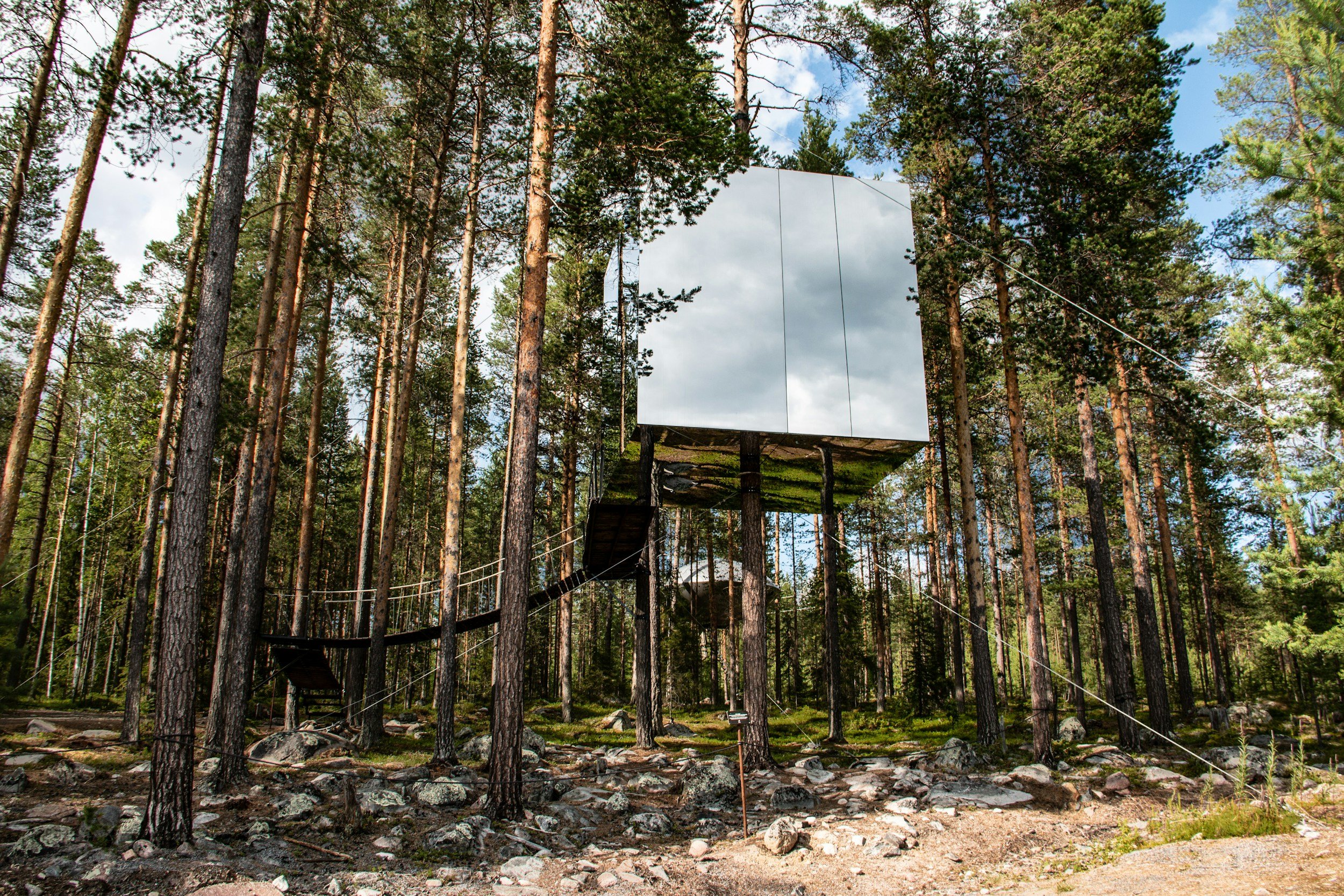
The rooms are individual structures placed in the trees rather than on the ground, and they’re spaced far enough apart that you don’t see other guests once you’re inside. Each one is accessed slightly differently. Some have a ramp, others a staircase, and a few use a steeper ladder-style entry, so it’s worth checking that detail before booking if you’re arriving with luggage or prefer easier access. The cabins are positioned at different heights and angles, which means your view is either straight into the forest canopy or out across the Lule River valley depending on which one you choose.
Inside, everything is controlled and quiet. Insulation is good, windows are large but sealed, and once the door is closed, there’s no outside noise. Lighting is soft and limited to what you actually need, and there are no external light sources nearby. In winter, it gets fully dark by late afternoon and stays that way through the night. In summer, light remains late into the evening, but blackout solutions are in place so you’re not waking up at 03:00 unless you want to.
Dinner is served back at Britta’s Pensionat at a set time, and most guests follow that routine. The walk or short transfer back and forth helps mark the shift between day and evening without needing to think about it. After dinner, the forest area settles quickly. There’s no foot traffic between cabins, and once you’re back inside, it’s completely still. If you step out, you’ll notice how little you hear, even compared to other rural stays. The only consistent sound tends to be wind moving through the trees.
Mornings are structured but not rushed. Breakfast is again served at the pensionat, and getting there involves a short walk or transfer through the same forest path you arrived on. Early in the day, the area around the cabins remains quiet, with very little movement beyond other guests heading in the same direction. Depending on the season, light either comes in slowly through the trees or arrives early and stays steady, but the cabins themselves keep it controlled.
During the day, most movement is simple. You can walk around the forest paths near the cabins or head down toward the river for a longer route, but there isn’t a built-up network of activities unless you’ve booked something in advance. Harads itself is small, with limited services, so most of your time is spent between the cabin and the pensionat rather than moving through the village.
What makes this stay different is how separated everything is. You’re not sharing walls, not hearing other rooms, and not dealing with background noise from a central building. Once you’re inside your cabin, the environment stays stable from evening through morning, which is what allows sleep to settle into a more regular pattern without interruptions.
Where: Harads, near the Lule River
Getting there: Fly to Luleå, then 1-hour transfer
For a wider sense of how these Swedish stays compare to the rest of the region, scandinavia guide gives useful context before you choose where to base yourself.
Inforest Cabins, near Hjo
Minimalist design, forest air, and nothing but stillness
Inforest Cabins are set outside the small town of Hjo on the western side of Lake Vättern, in an area where farmland gradually shifts into forest. From Hjo centre, the drive takes about 10–15 minutes depending on the exact cabin, usually along smaller local roads rather than main routes. If you’re arriving by public transport, the closest practical stop is Skövde, about 25 minutes away by car, and from there you’ll need a taxi for the final stretch. The last part of the journey feels slightly removed from the lakefront town, which is exactly what changes the atmosphere once you arrive.
The cabins are placed individually in the forest rather than grouped together. You don’t walk between units or pass other guests unless you go looking for them. Each cabin has its own small clearing, often with trees directly around it on three sides, and an open view in one direction. That layout matters more than it sounds, because it removes most of the background movement you normally get from nearby buildings, paths, or shared outdoor spaces.
Inside, the setup is minimal but practical. A main room with a bed positioned toward the window, a small kitchenette, and a seating area that doesn’t take up more space than necessary. Materials are simple, mostly wood and neutral tones, with lighting kept low in the evenings. Large windows face out toward the trees rather than toward access paths, so you’re not dealing with passing light or movement. At night, once indoor lights are off, it gets properly dark. There’s no spill from streetlights or neighboring properties.
Evenings here are quiet without needing to plan for it. There are no restaurants within walking distance, so most people either bring groceries from Hjo or stop at one of the larger supermarkets in Skövde on the way in. After dinner, the area settles quickly. You don’t hear cars, and there’s no activity outside your cabin once it gets late. If you step out, you’ll hear wind in the trees or occasional wildlife, but nothing consistent.
Mornings depend on the season. In summer, light comes in early through the trees, but it’s softer than in open areas because of the forest cover. In autumn and winter, mornings start later and stay quiet for longer. There’s no scheduled breakfast unless you’ve arranged it, so you control your own timing. Most people end up keeping a slower routine simply because there’s nothing around pushing the day forward.
If you want to leave the cabin during the day, Hjo is the closest place to go. The town sits directly on Lake Vättern and has a small harbour area with cafés and basic services, but opening hours can be limited outside summer. Walking along the wooden pier or the lakeside path works well for a short outing before heading back. There are also forest tracks near the cabins, but they’re not heavily marked, so they’re better for short walks rather than longer routes.
This kind of stay works when you want separation without being completely remote. You’re close enough to a town to pick up what you need, but far enough out that once you’re back at the cabin, nothing carries through from outside.
Where: Near Hjo, Västra Götaland
Getting there: 2.5 hours from Gothenburg or 3.5 from Stockholm
Island Lodge, Stockholm Archipelago
Luxury tented sleep with sea air and silence
Island Lodge sits on a small island in the outer Stockholm archipelago, reached by boat rather than road. Most guests depart from the mainland north of Stockholm, often from Kapellskär or nearby jetties depending on the season, and the final approach takes you through narrower channels where houses become less frequent and boat traffic drops off. The last part of the journey is quiet, with no large ferries passing, and you arrive directly at the lodge’s small dock rather than a public harbour.
The accommodation is spread out across the shoreline and slightly inland, with cabins and rooms placed so you’re not facing other guests. You move between buildings on gravel paths or wooden walkways rather than corridors, and once you’re inside your cabin, there’s no shared wall or overhead noise. The layout follows the natural shape of the island, which means some cabins sit closer to the water while others are tucked into trees a few minutes’ walk back.
Inside, the design is simple and consistent with the setting. Wood, neutral fabrics, and large windows facing either the sea or the surrounding forest. There’s no external light source nearby, so once indoor lights are off, it gets completely dark. At night, the only consistent sound tends to be water moving against the rocks or light wind through the trees. You don’t hear traffic, and there’s no background noise from neighbouring buildings.
Meals are handled on-site and usually follow a set schedule rather than being open throughout the day. Dinner is served at a fixed time, often in a shared dining space overlooking the water, and after that, the island becomes still quite quickly. There are no shops, cafés, or alternative places to go once the evening settles, so most people return to their cabins early without needing to think about it.
Mornings start gradually. Depending on the season, light comes in over the water or through the trees, but there’s nothing outside that forces you awake. Breakfast is served within a defined window, and outside of that, the island stays quiet with very little movement. Even during peak summer, you won’t see people passing by your cabin unless they’re heading to the same area.
During the day, movement is limited to what’s on the island. You can walk around the shoreline, swim from the rocks or small jetties, and sit in different parts of the property without crossing into busy areas. There are no marked trails in the formal sense, but paths connect the main points of the island, and you quickly get a sense of the layout after one walk around.
Getting here requires planning because departures are tied to boat schedules or arranged transfers. Once you’ve arrived, leaving isn’t immediate, which changes how you use your time. There’s no option to step out for errands or meals, and that separation removes the small decisions that usually shape a day.
This kind of stay works when you want a complete break from movement and noise. The combination of distance from the mainland, the way cabins are placed, and the lack of external activity means nights stay consistent and uninterrupted.
Where: Bergholmen Island, near Vaxholm
Getting there: 45 min boat transfer from Stockholm
What to consider before booking a quiet stay in Sweden
One thing that rarely gets mentioned clearly is how different these places feel depending on the time of year. In northern Sweden, the same cabin can give you completely opposite conditions. In winter, darkness settles early and stays consistent through the night, which helps if your goal is to sleep longer without interruption. In summer, light stays late and returns early, and even with curtains, the overall brightness changes how you wind down. If sleep is the priority, the timing of your trip matters just as much as the location.
Another detail is how isolated you actually want to be. Some stays look remote on a map but still sit close to a road or a cluster of buildings. Others require a final walk, a boat transfer, or a longer drive on smaller roads, and that changes the experience once you arrive. It’s not about distance in kilometres, but about what surrounds the property. A cabin near a lake with no through road nearby will feel very different from one that sits just off a main route, even if both are technically “in nature.”
It’s also worth thinking about how much structure you want during your stay. Places with fixed meal times and organised check-in tend to create a more consistent routine without you needing to plan anything. More independent cabins give you flexibility, but also require you to think about food, timing, and small practical details. Neither is better, but they lead to different kinds of days.
Finally, pay attention to how the space is arranged, not just how it looks. Distance between cabins, window placement, and whether there are shared walls or walkways all affect how quiet it actually feels at night. These are small details that don’t always show up in photos, but they make the difference between sleeping slightly better and properly switching off for a few days.
Choosing the right place here is less about finding the most remote option and more about understanding how the setting works once you’re there.
If you’re leaning towards something more rural and low-key, especially in the south, småland villages makes it easier to picture what a slower stay there actually looks like.
And if you’re considering heading further north for a more dramatic landscape, high coast gives a clearer sense of how different that experience feels compared to the forests and lakes further south.
FAQs about quiet stays in Sweden for rest and sleep
Where are the quietest places to stay in Sweden for rest and sleep?
The quietest stays are found in Swedish Lapland (Harads, Svanstein, Pajala), inland forest areas like Skinnskatteberg, and smaller islands in the Stockholm archipelago. These locations are set away from main roads and built with distance between cabins, which removes most night-time noise and light.
What are the best quiet cabins in Sweden surrounded by forest?
Look for standalone cabins rather than grouped holiday parks. Areas around Skinnskatteberg and near Hjo offer cabins placed directly in forest clearings, where you don’t share walls and there are no nearby paths or traffic. This setup makes a noticeable difference for uninterrupted sleep.
Are there quiet hotels in Sweden that are not in cities?
Yes, especially in northern Sweden and remote coastal or archipelago areas. Places like small lodges near Harads or island stays in the outer Stockholm archipelago are designed with separate buildings and minimal lighting, which keeps evenings and nights consistently quiet.
Is Swedish Lapland good for improving sleep?
Yes, particularly from late autumn to early spring. In areas along the Torne River and inland forests near Harads, darkness lasts most of the night and there is almost no background noise after evening hours. Staying outside villages rather than in them makes the biggest difference.
When is the best time to visit Sweden for deep sleep and rest?
November to March is the most effective period for longer, uninterrupted sleep, especially in the north where daylight hours are short. In summer, light stays late and returns early, which can affect sleep unless your accommodation has proper blackout curtains.
Do you need a car to reach quiet cabins and lodges in Sweden?
In most cases, yes. Many of the quietest stays are located outside towns, with the final stretch on smaller roads or by boat. Some locations can be reached by train to nearby towns like Skövde or Luleå followed by a taxi, but having a car makes arrival and daily logistics easier.
Is the Stockholm archipelago good for a quiet stay?
Yes, especially on smaller islands that require a scheduled or private boat transfer. Once you arrive, there are no roads, no traffic noise, and very little movement between buildings, particularly in the evening.
What should you check before booking a quiet stay in Sweden?
Focus on layout and surroundings rather than just photos. Check how far cabins are spaced, whether there are nearby roads, how windows are positioned, and if there are shared walls. Also confirm if meals are provided or if you need to bring your own food, as shops are often not nearby.
Are off-grid cabins in Sweden comfortable during winter?
They can be, but comfort depends on how heating is managed. In places like forest huts near Skinnskatteberg, you may need to maintain a wood stove yourself. Cabins with proper insulation and fixed heating systems are easier if you prefer a more stable indoor temperature overnight.
How far are quiet stays in Sweden from major cities like Stockholm?
Some options, like Skinnskatteberg, are within two to three hours of Stockholm by car or train plus taxi. Others, such as Harads or Svanstein in Swedish Lapland, require a flight to Luleå followed by a one to two hour drive.
Want more quiet, cozy travel ideas like this?
Join the newsletter and get our favorite peaceful places sent straight to your inbox.