Small Christmas markets near Strasbourg you can reach by train
Strasbourg is wonderful at Christmas, but I'd definitely make time to visit at least one of the smaller market towns nearby. There are quite a few you can reach by train, and I love the idea of spending an afternoon somewhere with a pretty old town, a few Christmas stalls and a good excuse to stop for something warm to eat before heading back.
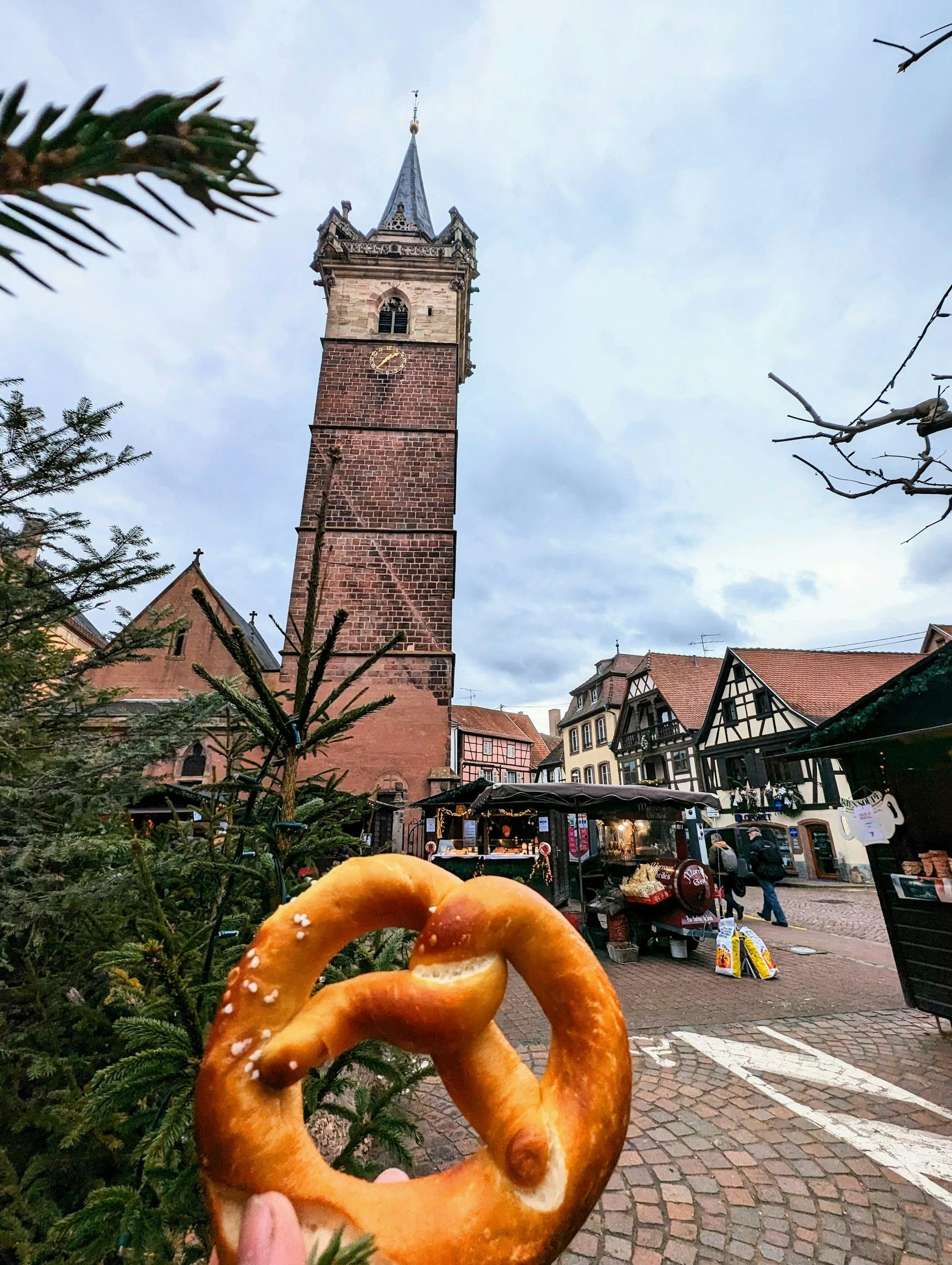
If I were choosing just one, I'd probably go with Obernai. It's only around 30–45 minutes from Strasbourg by direct train, and you can walk straight into the old town from the station. The market is spread across several squares, with plenty of local food and crafts, and the winegrowers serve their own white mulled wine. I'd be quite happy spending a few hours here, wandering between the stalls, exploring the little streets and finding somewhere nice to sit down for a while.
Sélestat is another one I'd seriously consider, although for a completely different reason. The town has a Christmas-tree tradition documented as far back as 1521, and there are exhibitions connected to that history alongside the markets. Then there are places like Molsheim and Barr, which have Christmas markets on selected weekends, and Wissembourg further north, where the town itself is worth making more time for.
Just be a little careful with the dates, because some of these markets only open on certain weekends in December. And I wouldn't assume the smaller ones will necessarily be less busy, especially when they're only held a few times each year. Personally, I think one good afternoon in a town you really want to visit sounds much nicer than trying to fit several markets into the same day.
When to visit the smaller Christmas markets around Strasbourg
There's quite a difference between visiting Alsace on a Tuesday in December and arriving for an Advent weekend. Some of the smaller towns only hold their Christmas markets a few times each year, and those are often the ones I'd be tempted to plan a whole afternoon around.
If you're in Strasbourg during the week, Obernai and Sélestat are easy choices, with markets open daily throughout most of the Christmas season. But if you happen to be visiting on 5–6 or 12–13 December 2026, I'd give Barr some serious consideration. Its Christmas market takes over parts of the old town for just two weekends, with more than 70 artisans and traders gathering around the Hôtel de Ville, Rue du Dr Sultzer and Musée de la Folie Marco. It's a lovely opportunity to see a town that you might otherwise overlook when planning a Christmas trip to Alsace.
Molsheim is another lovely option for a weekend, with its Christmas market taking place over four weekends between late November and 20 December. The stalls usually open at 2 pm, so you can enjoy a slow morning in Strasbourg, have a nice breakfast and catch a train around lunchtime. That leaves you the afternoon to explore the market around Place de l'Hôtel de Ville and have a look around the old town.
And if you're visiting Alsace after Christmas, you're not too late for some of the markets. Strasbourg's main market finishes on 24 December, but Sélestat stays open until 27 December, Turckheim until the 30th and Obernai right through to New Year's Eve. They're all closed on Christmas Day, though, and some have shorter opening hours towards the end of the season.
If you haven't decided where to stay yet, I've also compared the best bases in Alsace when you're travelling without a car, including which towns make it easier to explore the region by train.
Obernai is the easiest place to start
Obernai has quite a lot going for it at Christmas, and I think part of its appeal is that you can make as much or as little of the visit as you like. You could come for a couple of hours, browse the market and head back to Strasbourg, but I'd be tempted to give it a whole afternoon. The old town is worth exploring in its own right, and the Christmas market is spread across several of its central squares rather than being squeezed into one small corner.
Place du Marché is a good place to begin, with its colourful Alsatian buildings and traditional town-centre setting. From there, you can wander between the stalls and make your way towards Cour Athic, where local crafts are part of the Christmas programme. I particularly like that Obernai puts so much emphasis on regional food and craftsmanship. The local winegrowers serve their own white mulled wine, which is something a little different from the usual red version you'll find at most Christmas markets. Even if mulled wine isn't your thing, it's a nice reminder that you're in one of Alsace's wine-growing towns, where local traditions are still a big part of the celebrations.
I wouldn't spend the entire visit moving between stalls, though. Obernai has the sort of old centre that's worth exploring beyond the Christmas decorations, with narrow streets, half-timbered houses and plenty of places to stop for a coffee or something to eat. I'd leave some time to walk around without a particular destination in mind, especially if you've already spent a day exploring Strasbourg's much larger Christmas market.
Getting here is straightforward, too. Direct regional trains from Strasbourg take around 30–45 minutes, and the walk from Obernai station into the centre takes roughly 7 minutes, although I'd allow a little longer to reach the market squares. For Christmas 2026, the market runs from 27 November until 31 December, excluding Christmas Day. It generally opens from 10 am, with later closing on Fridays and Saturdays and an earlier finish on Christmas Eve and New Year's Eve.
Obernai can get quite busy at Christmas, especially on weekends, but I'd still make time for a wander around the old town beyond the market stalls. And when you're ready to sit down for a while, there are some lovely places to stop. Salon de thé Gross, on Rue du Général Gouraud, is worth a look for its Alsatian pastries, while Pâtisserie Schaeffer is another tempting spot for coffee and cake. There's also Au Fond de la Cour, a little tea room tucked inside an old building, which sounds like just the sort of place I'd enjoy finding on a December afternoon. I'd aim to arrive while it's still light, take my time exploring and, if the return train works out, stay long enough to see the Christmas lights before heading back to Strasbourg.
How to get to Obernai from Strasbourg
Take a direct TER train from Strasbourg station to Obernai, which takes around 30–45 minutes depending on the service. From Obernai station, it's roughly a 7-minute walk into the centre, so allow about 10–15 minutes to reach the Christmas market squares.
Sélestat gives the day a little more Christmas history
Sélestat has a rather wonderful connection to Christmas, and it's one of the reasons I'd be tempted to choose it over some of the more famous Alsatian market towns. Back in 1521, someone recorded a payment for guarding the town's forest around the traditional Christmas-tree cutting period. That little entry in an old account book is now recognised as the earliest known written reference associated with the Christmas-tree tradition. I love that something we take so much for granted today has a connection to an ordinary piece of town administration from more than 500 years ago.
And Sélestat makes quite a lovely occasion of that history. During Advent, the Christmas markets are spread across Place d'Armes, Place de la Victoire and Place du Dr Maurice Kubler, with the Bibliothèque Humaniste close by. It's worth stepping inside if you have time, particularly for the seasonal displays exploring the town's Christmas-tree heritage. There's also an exhibition featuring glass Christmas ornaments from Meisenthal, a village in northern Lorraine with a long glassmaking tradition. These aren't simply decorations to admire; they're part of a regional craft tradition that has become closely associated with Christmas in this part of France.
I'd probably make Sélestat a late-morning outing and give myself a good part of the afternoon here. There's something quite appealing about browsing the market, taking a break from the cold to see the exhibitions and then going back out into the old town. The historical buildings and squares are worth enjoying beyond the Christmas stalls, too, so I wouldn't plan the visit around shopping alone.
If you're interested in local traditions, I think Sélestat is one of the most interesting choices on this list. You come for a Christmas market, but there's a much older story woven into the visit, and it's one that feels particularly fitting at this time of year. Just check the Bibliothèque Humaniste's exhibition opening days before travelling, as the indoor programme doesn't necessarily follow the market's daily schedule.
How to get to Sélestat from Strasbourg
Take a direct train from Strasbourg to Sélestat. The faster services take around 20 minutes, although some direct regional trains follow a longer route, so it's worth checking the journey time rather than simply choosing the first direct departure. From Sélestat station, allow around 15–20 minutes to walk into the centre and reach the Christmas market squares.
If you enjoy these smaller Christmas markets, I've put together a few more European Christmas markets I'd choose over the biggest ones, including some lovely places beyond Alsace.
Molsheim is perfect for a shorter weekend outing
Molsheim is one of those towns I'd happily spend an afternoon exploring, especially when the Christmas market is on. It's only a short train ride from Strasbourg, and the old town has some beautiful historic buildings that make it worth visiting even if you're not planning to do much Christmas shopping. You could easily spend a few hours here and still be back in Strasbourg for dinner.
The Christmas market is centred around Place de l'Hôtel de Ville, where you'll find one of Molsheim's most recognisable buildings, La Metzig. Built in 1583 for the local butchers' guild, it's a beautiful example of Alsatian Renaissance architecture, with an ornate façade and distinctive roof. I think it's quite nice that a building once connected to the town's everyday trading life is still such an important part of its centre.
The Christmas celebrations aren't limited to the square, either. The market traditionally includes chalets around the Hôtel de Ville, with additional stalls at La Metzig and Espace Saint-Joseph. You'll find artisans and Christmas gifts alongside seasonal food, although I'd leave some time to explore the streets beyond the stalls as well.
Molsheim has an interesting history that isn't immediately obvious from its Christmas market. During the Reformation, religious communities fleeing Strasbourg found refuge in the fortified town, leaving behind some impressive buildings. The Jesuit Church is one of the places worth seeing, and if you enjoy exploring historic towns on foot, the local tourist office has a lovely little walking route of around 1.9 km that takes in several of Molsheim's historic sights, including the old fortifications.
I'd particularly consider visiting on 12 or 13 December 2026, when Molsheim celebrates Noël d'Antan, its traditional Christmas event inspired by the town's medieval past. The festivities include historical costumes and a procession, giving that weekend something a little different from the usual Christmas stalls. Sunday 13 December is also the one market day that begins at 10 am rather than 2 pm.
Otherwise, the market takes place over four weekends: 28–29 November, 5–6 December, 12–13 December and 19–20 December. Saturdays run from 2 pm until 8 pm, while Sundays usually finish at 7 pm. I'd probably choose a Saturday, have a relaxed morning in Strasbourg and arrive in Molsheim for the market opening. There's enough here to enjoy an afternoon without trying to fill every hour, and you can always stay a little longer to see the town's Christmas illuminations before heading back.
How to get to Molsheim from Strasbourg
Take a direct TER train from Strasbourg to Molsheim, which takes around 15–30 minutes depending on the service. From Molsheim station, allow about 15–20 minutes to walk into the historic centre and reach Place de l'Hôtel de Ville. The market is easy to explore on foot once you're there, with the main Christmas locations all around the town centre.
Barr is worth visiting on the right December weekend
Barr is one I'd be very tempted to visit if my trip happened to fall on 5–6 or 12–13 December 2026. Those are the only two weekends when the town holds its Noël Authentique Christmas market, and I think the setting is a big part of its appeal. Rather than gathering everything into one square, the stalls are spread through parts of the old centre, giving you a good excuse to explore the town as you go.
Barr sits along the Alsace Wine Route, surrounded by vineyards at the foot of the Vosges. It's a proper little wine town, with half-timbered houses, narrow streets and old buildings that tell you quite a bit about its history. I wouldn't come here just to browse Christmas decorations. I'd want to see a little of Barr itself, especially around Place de l'Hôtel de Ville, where the Renaissance town hall overlooks one of the prettiest parts of the centre.
During the Christmas market, more than 70 artisans and traders gather around the Hôtel de Ville, along Rue du Dr Sultzer and towards Musée de la Folie Marco. The latter is an elegant 18th-century residence associated with the town's wine-growing heritage, and its surroundings add another interesting setting to the market. I like the idea of moving between these different parts of town rather than spending the entire afternoon in front of the same row of chalets.
If you enjoy Alsatian wines, Barr is also an interesting place to visit because of its connection to the nearby vineyards, particularly the Grand Cru Kirchberg de Barr. You don't need to arrange a wine tasting to appreciate that side of the town, although I'd certainly consider stopping somewhere for a glass of local wine or a proper Alsatian lunch if the opening hours work with your visit.
There's a slightly different feel to the two market days as well. Saturdays begin at 2 pm, which makes them well suited to an afternoon visit followed by the Christmas lights. Sundays start at 11 am, giving you more time if you'd rather arrive earlier, explore the streets and stop for lunch before browsing the stalls.
Barr wouldn't be my choice for a quick market visit on an ordinary December weekday, but on one of those four dates, I'd happily give it most of the afternoon. There's enough history and local character here to enjoy the town alongside the Christmas market, and the vineyards surrounding it make it feel quite different from Strasbourg.
How to get to Barr from Strasbourg
You can take a direct TER train from Strasbourg to Barr, with journeys generally taking around 40–55 minutes depending on the service. Barr station is approximately 1 km from the Christmas market area, so allow another 15–20 minutes to walk into the old centre. It's worth including that walk when planning your return, particularly if you're staying until the market closes in the evening.
Some of these Alsatian towns are just as interesting outside the Christmas season. I've written about the Alsace market towns I'd actually prefer visiting in spring, when you can enjoy a very different side of the region.
Wissembourg makes a different sort of day out
Wissembourg is a little further from Strasbourg than the other towns on this list, but I think it's one of the most interesting choices if you have a whole day to spare. It's right up in northern Alsace, close to the German border, and has a beautiful old town that deserves more than a quick visit to the Christmas stalls. There's a river running through the historic centre, an enormous Gothic abbey church and some lovely old neighbourhoods to explore. I'd definitely want to arrive while it's still light and see a bit of the town before heading to the market.
One area I'd make time for is Le Bruch, the old neighbourhood along the River Lauter. It's known for its half-timbered houses, little bridges and buildings overlooking the water, including the 16th-century Maison de l'Ami Fritz. It's quite a different setting from the main shopping streets, and a lovely part of Wissembourg to include in a walk around the old centre. You can also look out for the Maison du Sel, a substantial historic building dating back to the 15th century, and sections of the old town walls that once protected Wissembourg.
If you enjoy exploring historic towns, there's actually a 3.1 km walking route through the old centre, starting at Place du Saumon near the tourist office. It takes around an hour and a half and passes many of the town's notable buildings. I wouldn't necessarily follow every part of it on a cold December afternoon, but it's a useful way to find some of the streets and corners you might otherwise miss. You can pick up information at the tourist office, which occupies the old Grange aux Dîmes, a former tithe barn beside the abbey.
The Christmas market itself is held around the Abbey Church of Saints-Pierre-et-Paul, and this is where I'd plan to spend the later part of the afternoon. The church is one of the largest Gothic buildings in Alsace, with a beautiful medieval cloister and some remarkable stained glass. Its history stretches back to the abbey that once dominated the town, and there's even a Romanesque chapel containing a reproduction of the famous Christ of Wissembourg, an extraordinary piece of early medieval stained-glass art. If the church is open during your visit, I'd definitely make time to step inside rather than just admire it from the market.
There's also a rather unusual side to Christmas in Wissembourg that I find fascinating. The town has a strong connection to Hans Trapp, a frightening character from Alsatian folklore who was used to warn children about bad behaviour. The legend is linked to Hans von Trotha, a 15th-century nobleman whose reputation in the region was far from friendly. Alongside Hans Trapp is Christkindel, the traditional Christmas gift-bringer, and the two figures are part of the area's Christmas customs. Wissembourg has a tradition of celebrating this folklore with a procession, although I'd check the current programme before planning a visit specifically around it.
I think a Saturday would make a particularly nice day here. Wissembourg has its regular weekly market on Place de la République on Saturday mornings, so you could arrive earlier, explore the town and then make your way towards the Christmas market when it opens at 11:30 am. I'd leave time for lunch somewhere in the old centre, too, rather than relying entirely on food from the Christmas stalls. With the river, old buildings and abbey quarter, there's enough to keep you interested for several hours without having to add another destination.
The 2026 Christmas market runs on Fridays, Saturdays and Sundays from 27 November to 20 December. Fridays are evening-only, from 5 pm, while Saturdays run from 11:30 am to 8 pm and Sundays until 7:30 pm. I'd choose a weekend daytime visit, partly because there's so much worth seeing around town and partly because it gives you the option of enjoying the market around the illuminated abbey before returning to Strasbourg.
Wissembourg is a little more of a commitment than Obernai or Molsheim, but I think that's part of why I'd save it for a day when I wasn't in a hurry. Between the riverside streets, the old fortifications, the abbey and the local Christmas traditions, the market becomes one part of a really interesting visit to northern Alsace.
How to get to Wissembourg from Strasbourg
There are direct regional trains from Strasbourg to Wissembourg, generally taking around 50–65 minutes, although some departures involve a change. From Wissembourg station, allow about 20 minutes to reach the historic centre and the Christmas market around the abbey. For a weekend visit, I'd check the return journey before leaving Strasbourg, especially if you'd like to stay until the abbey and market are illuminated.
For another French Christmas market with plenty of local character, Montbéliard's Christmas market is worth knowing about, particularly for its traditional Christmas illuminations.
Turckheim is worth the extra train connection
Turckheim is one of the Christmas markets I'd be particularly interested in visiting, even though getting there from Strasbourg involves changing trains in Colmar. It's a small wine town with medieval gateways, beautiful half-timbered houses and a Christmas tradition that's quite different from the usual market stalls. If you're visiting Alsace in December, I think it's worth considering, especially if you enjoy the little local traditions that make Christmas feel different from one town to the next.
The Christmas market is called Marché des Lutins, or Elves' Market, and takes place on Place de l'Hôtel de Ville. Instead of the usual rows of identical wooden chalets, the stalls are housed in quirky little buildings with crooked roofs and unusual shapes. Local artisans sell their creations here, and there's even a wishing well and an elf-themed activity around the town. It's a playful market, but I think the historic setting gives it plenty of appeal for adults, too.
I'd arrive early enough to explore Turckheim before spending time at the market. The town still has three medieval gateways, including the Porte de France, which once controlled trade entering the town and dates partly from 1330. There's also the more imposing Porte du Brand, built with a much more defensive purpose, and the Porte de Munster. These are wonderful reminders that Turckheim was once a fortified town, long before its Christmas celebrations became a reason to visit.
The old centre is fairly compact, so you can easily wander between the historic gates, the colourful buildings around the town hall and the Christmas stalls. Turckheim is also surrounded by vineyards, including the well-known Brand Grand Cru vineyard, which rises above the town. That connection to wine is part of its identity throughout the year, and something I'd keep in mind if I wanted to bring home a bottle of Alsatian wine rather than another Christmas decoration.
But the part of Turckheim's Christmas celebrations I'd most want to see is the Advent-calendar opening at 5 pm. Every evening from 1 to 24 December, the Petits Porteurs de Lumières, or Little Bearers of Light, take part in a small ceremony to reveal another illuminated window of the town's large Advent calendar. The tradition draws on local history, customs and figures associated with the Christmas season. I particularly like that the town has made something of the simple tradition of opening an Advent-calendar window. It's such an ordinary part of December at home, but here it becomes something people gather to enjoy together.
If you fancy getting out of the cold for a while, Wiehnacht's Stewala is worth popping into. It's Turckheim's little Christmas café, tucked inside the town hall complex, where you can sit down with a hot chocolate, coffee or mulled wine. There are also displays by local artists and craftspeople to have a look at. I'd probably stop here before the 5 pm Advent-calendar opening, especially after spending a few hours exploring the town.
Something else I find really interesting about Turckheim is its night-watchman tradition, which goes back centuries. The watchman used to walk through the streets at night, keeping an eye out for fires and reminding people to put out their candles. The tradition was brought back in the 1950s, and you can still see the watchman making his rounds on certain December evenings. They usually take place at 9 pm, though, so unless you're staying nearby or have checked a late connection back to Strasbourg, I'd probably save that experience for another visit.
The Marché des Lutins is open from 27 November to 30 December in 2026, apart from Christmas Day. Most days, the stalls open from 10 am to 7 pm, with a little longer on Saturdays and earlier closing on 24 and 30 December. Personally, I'd try to visit sometime between 1 and 24 December, when you can catch the Advent-calendar opening at 5 pm. That would be the highlight of the trip for me, with plenty of time beforehand to enjoy the market and wander around Turckheim.
How to get to Turckheim from Strasbourg
Getting to Turckheim is fairly easy, although you'll need to change trains in Colmar. The whole journey from Strasbourg can take around an hour if the trains line up nicely, but it might take a little longer depending on the connection. Once you arrive in Turckheim, it's only a 5–10-minute walk into the old town and the Christmas market.
Just keep an eye on the train schedule, as there are some planned works on the line, including 27 November and 11 December 2026, when part of the journey may be by replacement bus. And if you're planning to stay for the Advent-calendar opening at 5 pm, I'd check the trains back through Colmar beforehand so you can enjoy it without worrying about getting home.
Make the journey home part of the plan
Before heading off to any of these markets, I'd have a quick look at the trains back to Strasbourg, especially if you're hoping to stay until the Christmas lights come on. There's nothing particularly complicated about travelling around Alsace by train, but some of the smaller towns have fewer evening departures than you might expect.
It's worth checking a couple of possible return trains rather than relying on the very last one. And remember to leave enough time to get from the market back to the station. I'd much rather enjoy another half an hour in a café than spend it worrying about missing a train.
You can check the connections and book tickets through SNCF Connect or TER Grand Est.
Fancy visiting Molsheim and Obernai on the same day?
If you'd really like to visit two Christmas markets, I'd consider combining Molsheim and Obernai. They're on the same railway line, which makes them a much more sensible pairing than trying to squeeze together towns in completely different parts of Alsace.
On a Saturday when both markets are open, you could spend the first part of the afternoon in Molsheim, where the stalls open at 2 pm, before continuing to Obernai. That would give you a chance to enjoy Obernai later in the day, when the Christmas lights are on and there's still time to browse the market or find somewhere for dinner.
Just don't underestimate the time between the two. Even though the train journey itself is short, you still have to walk back to Molsheim station, wait for the next train and walk into Obernai. I'd allow at least an hour for the whole transfer, depending on the connections that day.
I think this could make a really nice Saturday outing, although I wouldn't feel the need to visit two markets simply because they're close together. There's plenty to enjoy in either town if you'd rather spend the whole afternoon in one place.
Should you buy an Alsa+ pass?
If you're planning to use the trains quite a bit, especially over a weekend, it's worth comparing the regular tickets with an Alsa+ pass.
For one person, the Alsa+ 24h solo pass costs €26.50 for Bas-Rhin, which covers the five main towns in this guide. Whether that's worth it depends on how many journeys you're making and what the ordinary tickets would cost.
If you're travelling with friends or family, though, the group ticket is worth a look. An Alsa+ Groupe Journée pass costs €28 in total for two to five people, and you can use it on Saturdays, Sundays and public holidays. With five people sharing, that's only €5.60 each for the day.
For Turckheim, you'll need the wider Alsace version because it's in Haut-Rhin. That costs €43 for the solo pass or €45 for the group pass. Just bear in mind that the separate Christmas shuttles from Colmar to villages such as Riquewihr and Kaysersberg aren't included.
I wouldn't automatically buy a pass for a single afternoon trip, but if you're planning to visit two towns or travelling with a few other people, it's definitely worth comparing. You might save enough for a nice lunch somewhere, which is always a bonus.
What about Riquewihr, Kaysersberg and the other Christmas villages?
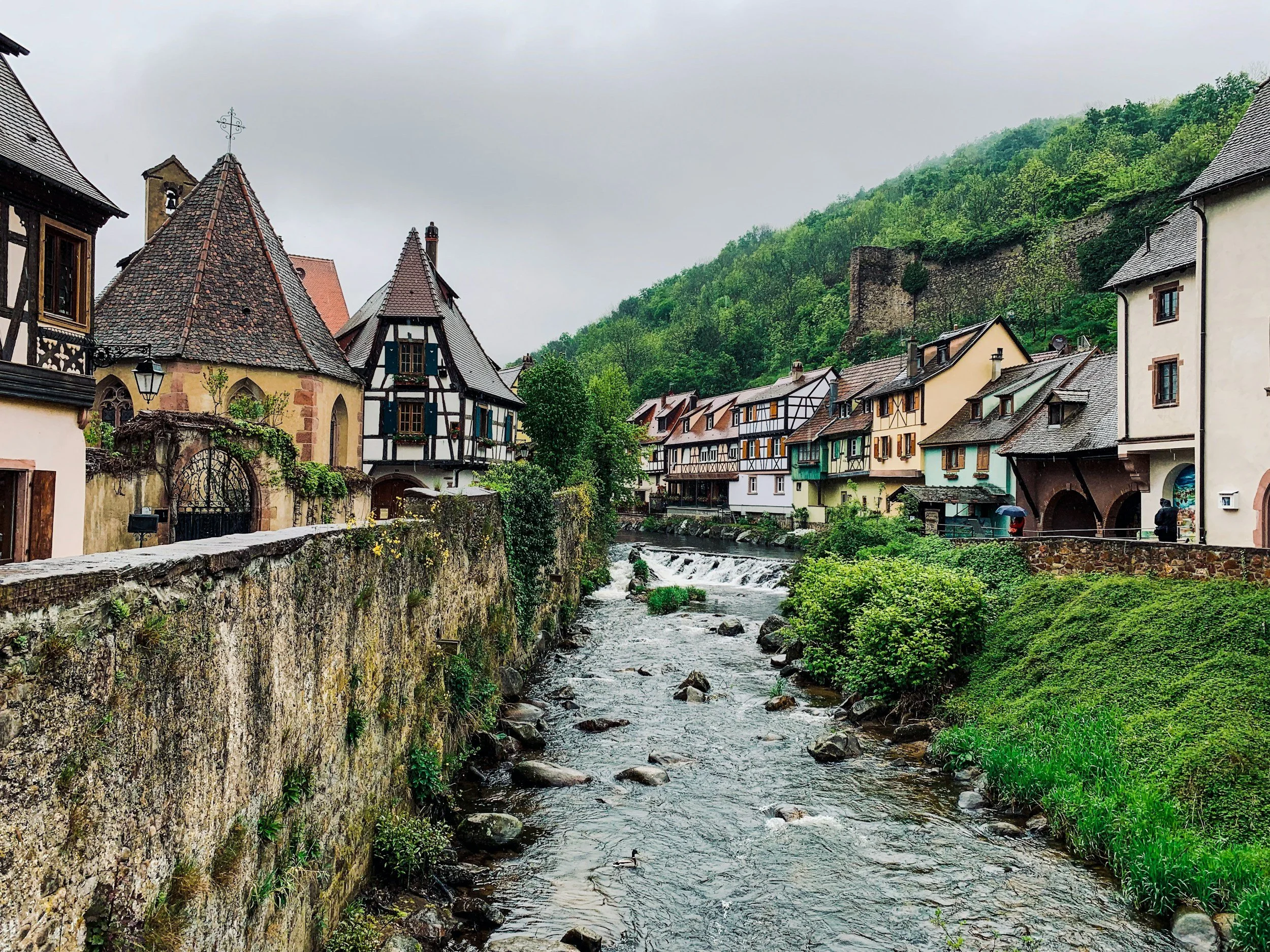
I couldn't leave out Riquewihr and Kaysersberg entirely, because they're two of the places people often dream of visiting at Christmas in Alsace. And I can understand why, with their beautiful half-timbered houses and Christmas markets tucked into the old streets.
You can visit them without a car, but the journey takes a little more organising. You'll need to take the train to Colmar and continue by bus or one of the special Christmas shuttles, which run on selected dates from 27 November to 20 December 2026. The same goes for Ribeauvillé and Eguisheim. Rosheim is a little closer to Strasbourg and has its own local shuttle from the station.
I've covered these options in more detail in my guide to Christmas in Alsace without a car, including how to plan around the different connections.
I'd happily make the extra effort for a village I really wanted to see. But for a spontaneous afternoon away from Strasbourg, I'd choose somewhere I could reach by train and spend the extra time enjoying the town itself.